

Recent from talks
Friedmann equations
Knowledge base stats:
Talk channels stats:
Members stats:
Friedmann equations
The Friedmann equations, also known as the Friedmann–Lemaître (FL) equations, are a set of equations in physical cosmology that govern cosmic expansion in homogeneous and isotropic models of the universe within the context of general relativity. They were first derived by Alexander Friedmann in 1922 from Einstein's field equations of gravitation for the Friedmann–Lemaître–Robertson–Walker metric and a perfect fluid with a given mass density ρ and pressure p. The equations for negative spatial curvature were given by Friedmann in 1924. The physical models built on the Friedmann equations are called FRW or FLRW models and form the Standard Model of modern cosmology, although such a description is also associated with the further developed Lambda-CDM model. The FLRW model was developed independently by the named authors in the 1920s and 1930s.
The Friedmann equations build on three assumptions:
The metric in turn starts with the simplifying assumption that the universe is spatially homogeneous and isotropic, that is, the cosmological principle; empirically, this is justified on scales larger than the order of 100 Mpc.
The metric can be written as: where These three possibilities correspond to parameter k of (0) flat space, (+1) a sphere of constant positive curvature or (−1) a hyperbolic space with constant negative curvature. Here the radial position has been decomposed into a time-dependent scale factor, , and a comoving coordinate, . Inserting this metric into Einstein's field equations relate the evolution of this scale factor to the pressure and energy of the matter in the universe. With the stress–energy tensor for a perfect fluid, results in the equations are described below.


There are two independent Friedmann equations for modelling a homogeneous, isotropic universe. The first is: and second is: The term Friedmann equation sometimes is used only for the first equation. In these equations, H is the Hubble parameter, R(t) is the cosmological scale factor, is the Newtonian constant of gravitation, Λ is the cosmological constant with dimension length−2, ρ is the energy density and p is the isotropic pressure. k is constant throughout a particular solution, but may vary from one solution to another. The units set the speed of light in vacuum to one.


In previous equations, R, ρ, and p are functions of time. If the cosmological constant, Λ, is ignored, the term in the first Friedmann equation can be interpreted as a Newtonian total energy, so the evolution of the universe pits gravitational potential energy, against kinetic energy, . The winner depends upon the k value in the total energy: if k is +1, gravity eventually causes the universe to contract. These conclusions will be altered if the Λ is not zero.


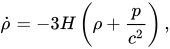
Using the first equation, the second equation can be re-expressed as: which eliminates Λ. Alternatively the conservation of mass–energy: leads to the same result.

The first Friedmann equation contains a discrete parameter k = +1, 0 or −1 depending on whether the shape of the universe is a closed 3-sphere, flat (Euclidean space) or an open 3-hyperboloid, respectively. If k is positive, then the universe is "closed": starting off on some paths through the universe return to the starting point. Such a universe is analogous to a sphere: finite but unbounded. If k is negative, then the universe is "open": infinite and no paths return. If k = 0, then the universe is Euclidean (flat) and infinite.
Hub AI
Friedmann equations AI simulator
(@Friedmann equations_simulator)
Friedmann equations
The Friedmann equations, also known as the Friedmann–Lemaître (FL) equations, are a set of equations in physical cosmology that govern cosmic expansion in homogeneous and isotropic models of the universe within the context of general relativity. They were first derived by Alexander Friedmann in 1922 from Einstein's field equations of gravitation for the Friedmann–Lemaître–Robertson–Walker metric and a perfect fluid with a given mass density ρ and pressure p. The equations for negative spatial curvature were given by Friedmann in 1924. The physical models built on the Friedmann equations are called FRW or FLRW models and form the Standard Model of modern cosmology, although such a description is also associated with the further developed Lambda-CDM model. The FLRW model was developed independently by the named authors in the 1920s and 1930s.
The Friedmann equations build on three assumptions:
The metric in turn starts with the simplifying assumption that the universe is spatially homogeneous and isotropic, that is, the cosmological principle; empirically, this is justified on scales larger than the order of 100 Mpc.
The metric can be written as: where These three possibilities correspond to parameter k of (0) flat space, (+1) a sphere of constant positive curvature or (−1) a hyperbolic space with constant negative curvature. Here the radial position has been decomposed into a time-dependent scale factor, , and a comoving coordinate, . Inserting this metric into Einstein's field equations relate the evolution of this scale factor to the pressure and energy of the matter in the universe. With the stress–energy tensor for a perfect fluid, results in the equations are described below.
There are two independent Friedmann equations for modelling a homogeneous, isotropic universe. The first is: and second is: The term Friedmann equation sometimes is used only for the first equation. In these equations, H is the Hubble parameter, R(t) is the cosmological scale factor, is the Newtonian constant of gravitation, Λ is the cosmological constant with dimension length−2, ρ is the energy density and p is the isotropic pressure. k is constant throughout a particular solution, but may vary from one solution to another. The units set the speed of light in vacuum to one.
In previous equations, R, ρ, and p are functions of time. If the cosmological constant, Λ, is ignored, the term in the first Friedmann equation can be interpreted as a Newtonian total energy, so the evolution of the universe pits gravitational potential energy, against kinetic energy, . The winner depends upon the k value in the total energy: if k is +1, gravity eventually causes the universe to contract. These conclusions will be altered if the Λ is not zero.
Using the first equation, the second equation can be re-expressed as: which eliminates Λ. Alternatively the conservation of mass–energy: leads to the same result.
The first Friedmann equation contains a discrete parameter k = +1, 0 or −1 depending on whether the shape of the universe is a closed 3-sphere, flat (Euclidean space) or an open 3-hyperboloid, respectively. If k is positive, then the universe is "closed": starting off on some paths through the universe return to the starting point. Such a universe is analogous to a sphere: finite but unbounded. If k is negative, then the universe is "open": infinite and no paths return. If k = 0, then the universe is Euclidean (flat) and infinite.
Recent media