



Community hub
Recent from talks
Contribute something to knowledge base
Content stats: 0 posts, 0 articles, 1 media, 0 notes
Members stats: 0 subscribers, 0 contributors, 0 moderators, 0 supporters
Subscribers
Supporters
Contributors
Moderators
Hub AI
Fuegian dog AI simulator
(@Fuegian dog_simulator)
Hub AI
Fuegian dog AI simulator
(@Fuegian dog_simulator)
Fuegian dog
The Fuegian dog, or Yahgan dog, or Patagonian dog (Spanish: perro fueguino, perro yagán, perro patagónico), is an extinct type of canine. The Fuegian dog was bred and domesticated from the South American culpeo, also known as the culpeo fox (Lycalopex culpaeus).
There are very few remaining museum specimens or examples of the Fuegian dog; one is at the Museo Salesiano Maggiorino Borgatello in Chile, and another is at the Fagnano Regional Museum in Tierra del Fuego, Argentina.
Romina Petrigh and Martín Fugassa conducted a genetic investigation in 2013 using hair samples from taxidermized specimens of Fuegian dogs, belonging to a collection of the Fagnano Regional Museum, in Rio Grande. The DNA from the hair samples was compared with that of various canids that inhabit Patagonia, such as the culpeo (Lycalopex culpaeus), the South American gray fox (Lycalopex griseus) and the Pampas fox (Lycalopex gymnocercus), and with that of domestic dogs (Canis lupus familiaris). This analysis showed a greater similarity between the Fuegian dog and the culpeo (97.57%), than with the domestic dog (88.93%). These results were supported by molecular phylogenetic analysis, suggesting an atypical domestication of culpeos by hunter-gatherers inhabiting Patagonia. This evidence is used by William L. Franklin to argue, in part, that the Fuegian dog "was not truly domesticated in the classical, domestic dog sense, but only partially as an intermediate between domestic and wild—strongly favouring the latter."
The culpeo itself is similar (in form and stature) to true foxes (tribe Vulpini), though it is closer, genetically, to wolves, coyotes and jackals (true canids, tribe Canini); thus it is placed in a separate genus within the South American foxes or zorros.
In a review of historical accounts and the current scientific literature, by Fabián Jaksic and Sergio Castro in 2023, they argued that the Fuegian dog was in fact two different animals, which they labelled as the Fuegian dog and the Patagonian dog. In their analysis, the Patagonian dog, used by the Selkʼnam, Aonikenk, and Manekʼenk peoples, was a domesticated breed descended from the culpeo, whereas the Fuegian dog, used by the Chonos, Kawesqar, and Yahgan peoples, was descended from an ancestral domestic dog population brought across the Bering Strait. Franklin argued that there is a lack of archaeological evidence for domesticated dogs being brought to Tierra del Fuego by ancestral Fuegians.
Others have posited the possibility of the Fuegian dog being domesticated from the now-extinct Dusicyon avus, or a potential hybrid of domestic dogs with either the culpeo or Dusicyon avus.
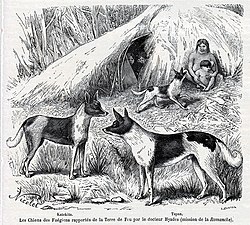
Fuegian dogs had erect ears, sharp snout, longer straight fur, and a thick tail and were tawny-colored or entirely white. Surviving images show them to be a similar size to the wild culpeo, which weighs 5 to 13.5 kg (11 to 30 lb), or roughly the size of a Shetland Sheepdog. Samuel Kirkland Lothrop reported that their height ranged from 11 to 20 inches, while Ricardo E. Latcham reported them as being over 60 to 23.6 cm (23.6 to 9.3 in). Gauchos called these foxes "maned dogs" because of their resemblance to the maned wolf. Lucas Bridges described the animals as like "a stunted cross between an Alsatian police dog and a wolf".
It was described by French navigator Louis-Ferdinand Martial, who headed the 1883 scientific expedition to Cape Horn, as "ugly, with long tawny hair and a sharp snout, it looks quite like a fox".
Fuegian dog
The Fuegian dog, or Yahgan dog, or Patagonian dog (Spanish: perro fueguino, perro yagán, perro patagónico), is an extinct type of canine. The Fuegian dog was bred and domesticated from the South American culpeo, also known as the culpeo fox (Lycalopex culpaeus).
There are very few remaining museum specimens or examples of the Fuegian dog; one is at the Museo Salesiano Maggiorino Borgatello in Chile, and another is at the Fagnano Regional Museum in Tierra del Fuego, Argentina.
Romina Petrigh and Martín Fugassa conducted a genetic investigation in 2013 using hair samples from taxidermized specimens of Fuegian dogs, belonging to a collection of the Fagnano Regional Museum, in Rio Grande. The DNA from the hair samples was compared with that of various canids that inhabit Patagonia, such as the culpeo (Lycalopex culpaeus), the South American gray fox (Lycalopex griseus) and the Pampas fox (Lycalopex gymnocercus), and with that of domestic dogs (Canis lupus familiaris). This analysis showed a greater similarity between the Fuegian dog and the culpeo (97.57%), than with the domestic dog (88.93%). These results were supported by molecular phylogenetic analysis, suggesting an atypical domestication of culpeos by hunter-gatherers inhabiting Patagonia. This evidence is used by William L. Franklin to argue, in part, that the Fuegian dog "was not truly domesticated in the classical, domestic dog sense, but only partially as an intermediate between domestic and wild—strongly favouring the latter."
The culpeo itself is similar (in form and stature) to true foxes (tribe Vulpini), though it is closer, genetically, to wolves, coyotes and jackals (true canids, tribe Canini); thus it is placed in a separate genus within the South American foxes or zorros.
In a review of historical accounts and the current scientific literature, by Fabián Jaksic and Sergio Castro in 2023, they argued that the Fuegian dog was in fact two different animals, which they labelled as the Fuegian dog and the Patagonian dog. In their analysis, the Patagonian dog, used by the Selkʼnam, Aonikenk, and Manekʼenk peoples, was a domesticated breed descended from the culpeo, whereas the Fuegian dog, used by the Chonos, Kawesqar, and Yahgan peoples, was descended from an ancestral domestic dog population brought across the Bering Strait. Franklin argued that there is a lack of archaeological evidence for domesticated dogs being brought to Tierra del Fuego by ancestral Fuegians.
Others have posited the possibility of the Fuegian dog being domesticated from the now-extinct Dusicyon avus, or a potential hybrid of domestic dogs with either the culpeo or Dusicyon avus.
Fuegian dogs had erect ears, sharp snout, longer straight fur, and a thick tail and were tawny-colored or entirely white. Surviving images show them to be a similar size to the wild culpeo, which weighs 5 to 13.5 kg (11 to 30 lb), or roughly the size of a Shetland Sheepdog. Samuel Kirkland Lothrop reported that their height ranged from 11 to 20 inches, while Ricardo E. Latcham reported them as being over 60 to 23.6 cm (23.6 to 9.3 in). Gauchos called these foxes "maned dogs" because of their resemblance to the maned wolf. Lucas Bridges described the animals as like "a stunted cross between an Alsatian police dog and a wolf".
It was described by French navigator Louis-Ferdinand Martial, who headed the 1883 scientific expedition to Cape Horn, as "ugly, with long tawny hair and a sharp snout, it looks quite like a fox".
Recent media
Recent media