



Community hub
Recent from talks
Contribute something to knowledge base
Content stats: 0 posts, 0 articles, 1 media, 0 notes
Members stats: 0 subscribers, 0 contributors, 0 moderators, 0 supporters
Subscribers
Supporters
Contributors
Moderators
Hub AI
Functional magnetic resonance imaging AI simulator
(@Functional magnetic resonance imaging_simulator)
Hub AI
Functional magnetic resonance imaging AI simulator
(@Functional magnetic resonance imaging_simulator)
Functional magnetic resonance imaging
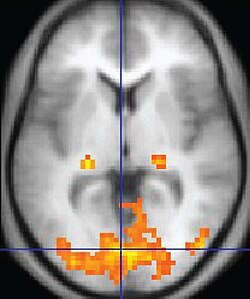
Functional magnetic resonance imaging or functional MRI (fMRI) measures brain activity by detecting changes associated with blood flow. This technique relies on the fact that cerebral blood flow and neuronal activation are coupled: When an area of the brain is in use, blood flow to that region increases.
The primary form of fMRI uses the blood-oxygen-level dependent (BOLD) contrast, discovered by Seiji Ogawa and his colleagues in 1990. This is a type of specialized brain and body scan used to map neural activity in the brain or spinal cord of humans or other animals by imaging the change in blood flow (hemodynamic response) related to energy use by nerve cells. Since the early 1990s, fMRI has come to dominate brain mapping research because it is noninvasive, typically requiring no injections, surgery, or the ingestion of substances such as radioactive tracers as in positron emission tomography. Data acquired using fMRI, however, is frequently corrupted by noise from various sources; hence, statistical procedures are used to extract the underlying signal. The resulting brain activation can be graphically represented by color-coding the strength of activation across the brain or the specific region studied. The technique can localize activity to within millimeters but, using standard techniques, no better than within a window of a few seconds. Other methods of obtaining contrast are arterial spin labeling and diffusion MRI. Diffusion MRI is similar to BOLD fMRI but provides contrast based on the magnitude of diffusion of water molecules in the brain.
In addition to detecting BOLD responses from activity due to tasks or stimuli, fMRI can measure resting state, or negative-task state, which shows the subjects' baseline BOLD variance. Since about 1998 studies have shown the existence and properties of the default mode network, a functionally connected neural network of apparent resting brain states.
fMRI is used in research, and to a lesser extent, in clinical work. It can complement other measures of brain physiology such as electroencephalography (EEG), and near-infrared spectroscopy (NIRS). Newer methods which improve both spatial and time resolution are being researched, and these largely use biomarkers other than the BOLD signal. Some companies have developed commercial products such as lie detectors based on fMRI techniques, but the research is not believed to be developed enough for widespread commercial use.
The fMRI concept builds on the earlier MRI scanning technology and the discovery of properties of oxygen-rich blood. MRI brain scans use a strong, uniform, static magnetic field to align the spins of nuclei in the brain region being studied. Another magnetic field, with a gradient strength rather than a uniform one, is then applied to spatially distinguish different nuclei. Finally, a radiofrequency (RF) pulse is applied to flip the nuclear spins, with the effect depending on where they are located, due to the gradient field. After the RF pulse, the nuclei return to their original (equilibrium) spin populations, and the energy they emit is measured with a coil. The use of the gradient field allows the positions of the nuclei to be determined. MRI thus provides a static structural view of brain matter. The central thrust behind fMRI was to extend MRI to capture functional changes in the brain caused by neuronal activity. Differences in magnetic properties between arterial (oxygen-rich) and venous (oxygen-poor) blood provided this link.
Since the 1890s, it has been known that changes in blood flow and blood oxygenation in the brain (collectively known as brain hemodynamics) are closely linked to neural activity. When neurons become active, local blood flow to those brain regions increases, and oxygen-rich (oxygenated) blood displaces oxygen-depleted (deoxygenated) blood around 2 seconds later. This rises to a peak over 4–6 seconds, before falling back to the original level (and typically undershooting slightly). Oxygen is carried by the hemoglobin molecule in red blood cells. Deoxygenated hemoglobin (dHb) is more magnetic (paramagnetic) than oxygenated hemoglobin (Hb), which is virtually resistant to magnetism (diamagnetic). This difference leads to an improved MR signal since the diamagnetic blood interferes with the magnetic MR signal less. This improvement can be mapped to show which neurons are active at a time.
During the late 19th century, Angelo Mosso invented the 'human circulation balance', which could non-invasively measure the redistribution of blood during emotional and intellectual activity. However, although briefly mentioned by William James in 1890, the details and precise workings of this balance and the experiments Mosso performed with it remained largely unknown until the recent discovery of the original instrument as well as Mosso's reports by Stefano Sandrone and colleagues. Angelo Mosso investigated several critical variables that are still relevant in modern neuroimaging such as the 'signal-to-noise ratio', the appropriate choice of the experimental paradigm and the need for the simultaneous recording of differing physiological parameters. Mosso's manuscripts do not provide direct evidence that the balance was really able to measure changes in cerebral blood flow due to cognition, however a modern replication performed by David T Field has now demonstrated—using modern signal processing techniques unavailable to Mosso—that a balance apparatus of this type is able to detect changes in cerebral blood volume related to cognition.[citation needed]
In 1890, Charles Roy and Charles Sherrington first experimentally linked brain function to its blood flow, at Cambridge University. The next step to resolving how to measure blood flow to the brain was Linus Pauling's and Charles Coryell's discovery in 1936 that oxygen-rich blood with Hb was weakly repelled by magnetic fields, while oxygen-depleted blood with dHb was attracted to a magnetic field, though less so than ferromagnetic elements such as iron. Seiji Ogawa at AT&T Bell labs recognized that this could be used to augment MRI, which could study just the static structure of the brain, since the differing magnetic properties of dHb and Hb caused by blood flow to activated brain regions would cause measurable changes in the MRI signal. BOLD is the MRI contrast of dHb, discovered in 1990 by Ogawa. In a seminal 1990 study based on earlier work by Thulborn et al., Ogawa and colleagues scanned rodents in a strong magnetic field (7.0 T) MRI. To manipulate blood oxygen level, they changed the proportion of oxygen the animals breathed. As this proportion fell, a map of blood flow in the brain was seen in the MRI. They verified this by placing test tubes with oxygenated or deoxygenated blood and creating separate images. They also showed that gradient-echo images, which depend on a form of loss of magnetization called T2* decay, produced the best images. To show these blood flow changes were related to functional brain activity, they changed the composition of the air breathed by rats, and scanned them while monitoring brain activity with EEG. The first attempt to detect the regional brain activity using MRI was performed by Belliveau and colleagues at Harvard University using the contrast agent Magnevist, a paramagnetic substance remaining in the bloodstream after intravenous injection. However, this method is not popular in human fMRI, because of the inconvenience of the contrast agent injection, and because the agent stays in the blood only for a short time.
Functional magnetic resonance imaging
Functional magnetic resonance imaging or functional MRI (fMRI) measures brain activity by detecting changes associated with blood flow. This technique relies on the fact that cerebral blood flow and neuronal activation are coupled: When an area of the brain is in use, blood flow to that region increases.
The primary form of fMRI uses the blood-oxygen-level dependent (BOLD) contrast, discovered by Seiji Ogawa and his colleagues in 1990. This is a type of specialized brain and body scan used to map neural activity in the brain or spinal cord of humans or other animals by imaging the change in blood flow (hemodynamic response) related to energy use by nerve cells. Since the early 1990s, fMRI has come to dominate brain mapping research because it is noninvasive, typically requiring no injections, surgery, or the ingestion of substances such as radioactive tracers as in positron emission tomography. Data acquired using fMRI, however, is frequently corrupted by noise from various sources; hence, statistical procedures are used to extract the underlying signal. The resulting brain activation can be graphically represented by color-coding the strength of activation across the brain or the specific region studied. The technique can localize activity to within millimeters but, using standard techniques, no better than within a window of a few seconds. Other methods of obtaining contrast are arterial spin labeling and diffusion MRI. Diffusion MRI is similar to BOLD fMRI but provides contrast based on the magnitude of diffusion of water molecules in the brain.
In addition to detecting BOLD responses from activity due to tasks or stimuli, fMRI can measure resting state, or negative-task state, which shows the subjects' baseline BOLD variance. Since about 1998 studies have shown the existence and properties of the default mode network, a functionally connected neural network of apparent resting brain states.
fMRI is used in research, and to a lesser extent, in clinical work. It can complement other measures of brain physiology such as electroencephalography (EEG), and near-infrared spectroscopy (NIRS). Newer methods which improve both spatial and time resolution are being researched, and these largely use biomarkers other than the BOLD signal. Some companies have developed commercial products such as lie detectors based on fMRI techniques, but the research is not believed to be developed enough for widespread commercial use.
The fMRI concept builds on the earlier MRI scanning technology and the discovery of properties of oxygen-rich blood. MRI brain scans use a strong, uniform, static magnetic field to align the spins of nuclei in the brain region being studied. Another magnetic field, with a gradient strength rather than a uniform one, is then applied to spatially distinguish different nuclei. Finally, a radiofrequency (RF) pulse is applied to flip the nuclear spins, with the effect depending on where they are located, due to the gradient field. After the RF pulse, the nuclei return to their original (equilibrium) spin populations, and the energy they emit is measured with a coil. The use of the gradient field allows the positions of the nuclei to be determined. MRI thus provides a static structural view of brain matter. The central thrust behind fMRI was to extend MRI to capture functional changes in the brain caused by neuronal activity. Differences in magnetic properties between arterial (oxygen-rich) and venous (oxygen-poor) blood provided this link.
Since the 1890s, it has been known that changes in blood flow and blood oxygenation in the brain (collectively known as brain hemodynamics) are closely linked to neural activity. When neurons become active, local blood flow to those brain regions increases, and oxygen-rich (oxygenated) blood displaces oxygen-depleted (deoxygenated) blood around 2 seconds later. This rises to a peak over 4–6 seconds, before falling back to the original level (and typically undershooting slightly). Oxygen is carried by the hemoglobin molecule in red blood cells. Deoxygenated hemoglobin (dHb) is more magnetic (paramagnetic) than oxygenated hemoglobin (Hb), which is virtually resistant to magnetism (diamagnetic). This difference leads to an improved MR signal since the diamagnetic blood interferes with the magnetic MR signal less. This improvement can be mapped to show which neurons are active at a time.
During the late 19th century, Angelo Mosso invented the 'human circulation balance', which could non-invasively measure the redistribution of blood during emotional and intellectual activity. However, although briefly mentioned by William James in 1890, the details and precise workings of this balance and the experiments Mosso performed with it remained largely unknown until the recent discovery of the original instrument as well as Mosso's reports by Stefano Sandrone and colleagues. Angelo Mosso investigated several critical variables that are still relevant in modern neuroimaging such as the 'signal-to-noise ratio', the appropriate choice of the experimental paradigm and the need for the simultaneous recording of differing physiological parameters. Mosso's manuscripts do not provide direct evidence that the balance was really able to measure changes in cerebral blood flow due to cognition, however a modern replication performed by David T Field has now demonstrated—using modern signal processing techniques unavailable to Mosso—that a balance apparatus of this type is able to detect changes in cerebral blood volume related to cognition.[citation needed]
In 1890, Charles Roy and Charles Sherrington first experimentally linked brain function to its blood flow, at Cambridge University. The next step to resolving how to measure blood flow to the brain was Linus Pauling's and Charles Coryell's discovery in 1936 that oxygen-rich blood with Hb was weakly repelled by magnetic fields, while oxygen-depleted blood with dHb was attracted to a magnetic field, though less so than ferromagnetic elements such as iron. Seiji Ogawa at AT&T Bell labs recognized that this could be used to augment MRI, which could study just the static structure of the brain, since the differing magnetic properties of dHb and Hb caused by blood flow to activated brain regions would cause measurable changes in the MRI signal. BOLD is the MRI contrast of dHb, discovered in 1990 by Ogawa. In a seminal 1990 study based on earlier work by Thulborn et al., Ogawa and colleagues scanned rodents in a strong magnetic field (7.0 T) MRI. To manipulate blood oxygen level, they changed the proportion of oxygen the animals breathed. As this proportion fell, a map of blood flow in the brain was seen in the MRI. They verified this by placing test tubes with oxygenated or deoxygenated blood and creating separate images. They also showed that gradient-echo images, which depend on a form of loss of magnetization called T2* decay, produced the best images. To show these blood flow changes were related to functional brain activity, they changed the composition of the air breathed by rats, and scanned them while monitoring brain activity with EEG. The first attempt to detect the regional brain activity using MRI was performed by Belliveau and colleagues at Harvard University using the contrast agent Magnevist, a paramagnetic substance remaining in the bloodstream after intravenous injection. However, this method is not popular in human fMRI, because of the inconvenience of the contrast agent injection, and because the agent stays in the blood only for a short time.
Recent media
Recent media