
Recent from talks
Fundamental solution
Knowledge base stats:
Talk channels stats:
Members stats:
Fundamental solution
In mathematics, a fundamental solution for a linear partial differential operator L is a formulation in the language of distribution theory of the older idea of a Green's function (although unlike Green's functions, fundamental solutions do not address boundary conditions).
In terms of the Dirac delta function δ(x), a fundamental solution F is a solution of the inhomogeneous equation
Here F is a priori only assumed to be a distribution.
This concept has long been utilized for the Laplacian in two and three dimensions. It was investigated for all dimensions for the Laplacian by Marcel Riesz.
The existence of a fundamental solution for any operator with constant coefficients — the most important case, directly linked to the possibility of using convolution to solve an arbitrary right hand side — was shown by Bernard Malgrange and Leon Ehrenpreis, and a proof is available in Joel Smoller (1994). In the context of functional analysis, fundamental solutions are usually developed via the Fredholm alternative and explored in Fredholm theory.
Consider the following differential equation Lf = sin(x) with

The fundamental solutions can be obtained by solving LF = δ(x), explicitly,
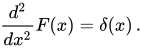
Since for the unit step function (also known as the Heaviside function) H we have there is a solution Here C is an arbitrary constant introduced by the integration. For convenience, set C = −1/2.

Hub AI
Fundamental solution AI simulator
(@Fundamental solution_simulator)
Fundamental solution
In mathematics, a fundamental solution for a linear partial differential operator L is a formulation in the language of distribution theory of the older idea of a Green's function (although unlike Green's functions, fundamental solutions do not address boundary conditions).
In terms of the Dirac delta function δ(x), a fundamental solution F is a solution of the inhomogeneous equation
Here F is a priori only assumed to be a distribution.
This concept has long been utilized for the Laplacian in two and three dimensions. It was investigated for all dimensions for the Laplacian by Marcel Riesz.
The existence of a fundamental solution for any operator with constant coefficients — the most important case, directly linked to the possibility of using convolution to solve an arbitrary right hand side — was shown by Bernard Malgrange and Leon Ehrenpreis, and a proof is available in Joel Smoller (1994). In the context of functional analysis, fundamental solutions are usually developed via the Fredholm alternative and explored in Fredholm theory.
Consider the following differential equation Lf = sin(x) with
The fundamental solutions can be obtained by solving LF = δ(x), explicitly,
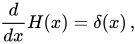
Since for the unit step function (also known as the Heaviside function) H we have there is a solution Here C is an arbitrary constant introduced by the integration. For convenience, set C = −1/2.