


Community hub
Recent from talks
Contribute something to knowledge base
Content stats: 0 posts, 0 articles, 1 media, 0 notes
Members stats: 0 subscribers, 0 contributors, 0 moderators, 0 supporters
Subscribers
Supporters
Contributors
Moderators
Hub AI
Führermuseum AI simulator
(@Führermuseum_simulator)
Hub AI
Führermuseum AI simulator
(@Führermuseum_simulator)
Führermuseum
48°17′25″N 14°17′31″E / 48.290139°N 14.291981°E
The Führermuseum or Fuhrer-Museum (English: Leader's Museum), also referred to as the Linz art gallery, was an unrealized art museum within a cultural complex planned by Adolf Hitler for his hometown, the Austrian city of Linz, near his birthplace of Braunau. Its purpose was to display a selection of the art bought, confiscated or stolen by the Nazis from throughout Europe during World War II. The cultural district was to be part of an overall plan to recreate Linz, turning it into a cultural capital of Nazi Germany and one of the greatest art centers of Europe, overshadowing Vienna, for which Hitler had a personal distaste. He wanted to make the city more beautiful than Budapest, so it would be the most beautiful on the Danube River, as well as an industrial powerhouse and a hub of trade; the museum was planned to be one of the greatest in Europe.
The expected completion date for the project was 1950, but neither the Führermuseum nor the cultural centre it was to anchor were ever built. The only part of the elaborate plan which was constructed was the Nibelungen Bridge, which is still extant.
As early as 1925, Hitler had conceived of a "German National Gallery" to be built in Berlin with himself as director. His plan, drawn out in a sketchbook, may have been influenced by the Kaiser-Friedrich-Museum, and consisted of a building with two sections, one with 28 rooms and the other with 32. Hitler denoted which of his favorite 19th-century German artists were to be collected, and in what rooms their work would hang. Among his favorite painters were Hans Makart, Franz Defregger, Eduard Grützner, Franz von Stuck, Franz von Lenbach, Anselm Feuerbach, Heinrich Zügel and Carl Spitzweg, and he had extolled "Aryan art" by Moritz von Schwind and Arnold Böcklin in Mein Kampf. At one time in his planning he dedicated five of the rooms in the museum to the work of Adolph von Menzel and three rooms to both Schwind and Böcklin. Carl Rottmann, Edouard von Engerth, and Anton von Werner were to share a single room, as were Makart and Karl von Piloty; Wilhelm Trübner and Fritz von Uhde; Grützner and Defregger; and the artists of the Nazarene movement. Other painters who would enjoy their own room in Hitler's original plans were Peter von Cornelius, Hans von Marées, Bonaventura Genelli, Anselm Feuerbach and Wilhelm Leibl. These choices reflected Hitler's taste at the time, which was a preference for sentimental 19th-century Germanic romantic painters, including "both 'schmaltzy' genre pictures ... [and] heroic, idyllic, allegorical. historical-patriotic themes, the visual equivalent of Wagner, without the genius."
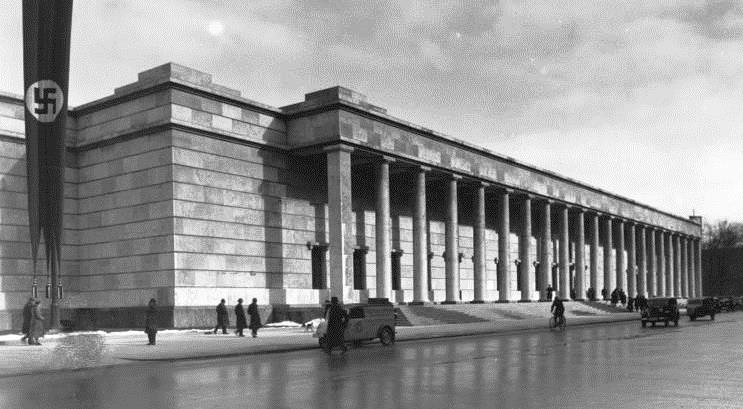
It was after the Anschluss with Austria, with the House of German Art in Munich already completed, that Hitler conceived of having his dream museum not in any of the premiere cities in Germany, where it could be overshadowed, but in his "hometown" of Linz in Austria, and discussed his plans with the director of the local Provincial Museum, Theodor Kerschner, while visiting there.
Additionally, after a state trip to Rome, Florence and Naples in 1938 – between the Anschluss with Austria and the taking of the Sudetenland from Czechoslovakia – Hitler, "overwhelmed and challenged by the riches of the Italian museums" expanded the conception of his planned gallery. It would now be the unsurpassed art gallery in all of Europe, indeed "the greatest museum in the world", featuring the finest of all European art. He conceived that the best of Germanic art would have pride of place in the National Gallery in Berlin, while the new museum in Linz would feature the best of the art of the Mediterranean world, especially from the nineteenth century.
The idea and overall design concept for a new cultural district in Linz anchored by the Führermuseum was Hitler's own. He intended Linz to be one of the future cultural capitals of the Reich, to have its own university, and to overshadow Vienna, a city in which he had spent some years as a struggling artist, and about which he felt considerable distaste, not only because of the Jewish influence on the city, but because of his own failure to gain admission to the Vienna Academy of Fine Arts.
[Hitler] envisaged Linz as the future seat of the new German Kultur, and lavished all his limited pictorial talent and architectural training on a vast project which would realize this ambition.... [He] devoted a disproportionate amount of time and energy, for a chief of state, to the plans for Linz, personally creating the architectural scheme for an imposing array of public buildings, and setting the formula for an art collection which was to specialize heavily in his beloved, mawkish German school of the nineteenth century. His private library, discovered by the American Army deep in Austria, contained scores of completed architectural renderings for the Linz project...
Führermuseum
48°17′25″N 14°17′31″E / 48.290139°N 14.291981°E
The Führermuseum or Fuhrer-Museum (English: Leader's Museum), also referred to as the Linz art gallery, was an unrealized art museum within a cultural complex planned by Adolf Hitler for his hometown, the Austrian city of Linz, near his birthplace of Braunau. Its purpose was to display a selection of the art bought, confiscated or stolen by the Nazis from throughout Europe during World War II. The cultural district was to be part of an overall plan to recreate Linz, turning it into a cultural capital of Nazi Germany and one of the greatest art centers of Europe, overshadowing Vienna, for which Hitler had a personal distaste. He wanted to make the city more beautiful than Budapest, so it would be the most beautiful on the Danube River, as well as an industrial powerhouse and a hub of trade; the museum was planned to be one of the greatest in Europe.
The expected completion date for the project was 1950, but neither the Führermuseum nor the cultural centre it was to anchor were ever built. The only part of the elaborate plan which was constructed was the Nibelungen Bridge, which is still extant.
As early as 1925, Hitler had conceived of a "German National Gallery" to be built in Berlin with himself as director. His plan, drawn out in a sketchbook, may have been influenced by the Kaiser-Friedrich-Museum, and consisted of a building with two sections, one with 28 rooms and the other with 32. Hitler denoted which of his favorite 19th-century German artists were to be collected, and in what rooms their work would hang. Among his favorite painters were Hans Makart, Franz Defregger, Eduard Grützner, Franz von Stuck, Franz von Lenbach, Anselm Feuerbach, Heinrich Zügel and Carl Spitzweg, and he had extolled "Aryan art" by Moritz von Schwind and Arnold Böcklin in Mein Kampf. At one time in his planning he dedicated five of the rooms in the museum to the work of Adolph von Menzel and three rooms to both Schwind and Böcklin. Carl Rottmann, Edouard von Engerth, and Anton von Werner were to share a single room, as were Makart and Karl von Piloty; Wilhelm Trübner and Fritz von Uhde; Grützner and Defregger; and the artists of the Nazarene movement. Other painters who would enjoy their own room in Hitler's original plans were Peter von Cornelius, Hans von Marées, Bonaventura Genelli, Anselm Feuerbach and Wilhelm Leibl. These choices reflected Hitler's taste at the time, which was a preference for sentimental 19th-century Germanic romantic painters, including "both 'schmaltzy' genre pictures ... [and] heroic, idyllic, allegorical. historical-patriotic themes, the visual equivalent of Wagner, without the genius."
It was after the Anschluss with Austria, with the House of German Art in Munich already completed, that Hitler conceived of having his dream museum not in any of the premiere cities in Germany, where it could be overshadowed, but in his "hometown" of Linz in Austria, and discussed his plans with the director of the local Provincial Museum, Theodor Kerschner, while visiting there.
Additionally, after a state trip to Rome, Florence and Naples in 1938 – between the Anschluss with Austria and the taking of the Sudetenland from Czechoslovakia – Hitler, "overwhelmed and challenged by the riches of the Italian museums" expanded the conception of his planned gallery. It would now be the unsurpassed art gallery in all of Europe, indeed "the greatest museum in the world", featuring the finest of all European art. He conceived that the best of Germanic art would have pride of place in the National Gallery in Berlin, while the new museum in Linz would feature the best of the art of the Mediterranean world, especially from the nineteenth century.
The idea and overall design concept for a new cultural district in Linz anchored by the Führermuseum was Hitler's own. He intended Linz to be one of the future cultural capitals of the Reich, to have its own university, and to overshadow Vienna, a city in which he had spent some years as a struggling artist, and about which he felt considerable distaste, not only because of the Jewish influence on the city, but because of his own failure to gain admission to the Vienna Academy of Fine Arts.
[Hitler] envisaged Linz as the future seat of the new German Kultur, and lavished all his limited pictorial talent and architectural training on a vast project which would realize this ambition.... [He] devoted a disproportionate amount of time and energy, for a chief of state, to the plans for Linz, personally creating the architectural scheme for an imposing array of public buildings, and setting the formula for an art collection which was to specialize heavily in his beloved, mawkish German school of the nineteenth century. His private library, discovered by the American Army deep in Austria, contained scores of completed architectural renderings for the Linz project...
Recent media
Recent media