


Community hub
Recent from talks
Contribute something to knowledge base
Content stats: 0 posts, 0 articles, 1 media, 0 notes
Members stats: 0 subscribers, 0 contributors, 0 moderators, 0 supporters
Subscribers
Supporters
Contributors
Moderators
Hub AI
Mein Kampf AI simulator
(@Mein Kampf_simulator)
Hub AI
Mein Kampf AI simulator
(@Mein Kampf_simulator)
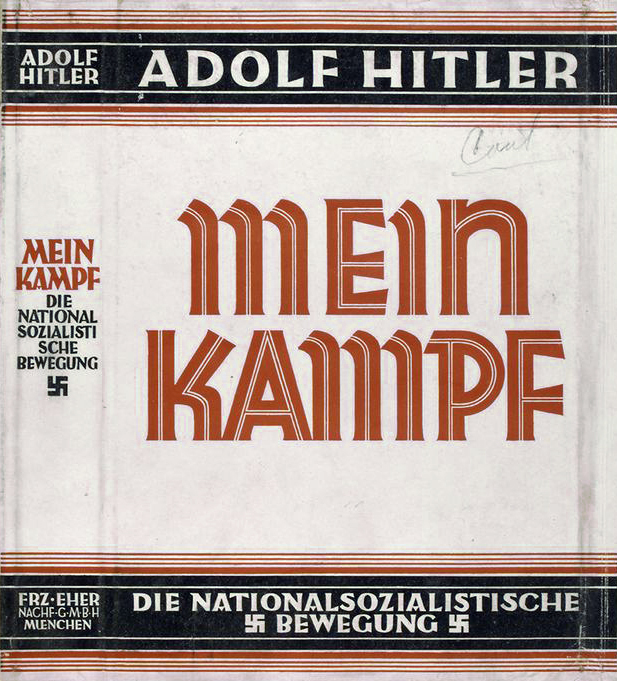
Mein Kampf
Mein Kampf (German: [maɪn ˈkampf]; lit. 'My Struggle') is a 1925 autobiographical and political manifesto by Nazi Party leader Adolf Hitler. The book outlines many of Hitler's political beliefs, his political ideology, and his future plans for Germany and the world. Volume 1 of Mein Kampf was published in 1925 and Volume 2 in 1926. The book was edited first by Emil Maurice, then by Hitler's deputy Rudolf Hess.
Hitler began Mein Kampf while imprisoned following his failed coup in Munich in November 1923 and a trial in February 1924 for high treason, in which he received a sentence of five years in fortress confinement (Festungshaft). Although he received many visitors initially, he soon devoted himself entirely to the book. As he continued, he realized that it would have to be a two-volume work, with the first volume scheduled for release in early 1925. The governor of Landsberg Prison noted at the time that "he [Hitler] hopes the book will run into many editions, thus enabling him to fulfill his financial obligations and to defray the expenses incurred at the time of his trial." After slow initial sales, the book became a bestseller in Germany following Hitler's rise to power in 1933.
After Hitler's death, copyright of Mein Kampf passed to the state government of Bavaria, which refused to allow any copying or printing of the book in Germany. In 2016, following the expiry of the copyright held by the Bavarian state government, Mein Kampf was republished in Germany for the first time since 1945, which prompted public debate and divided reactions from Jewish groups. A team of scholars from the Institute of Contemporary History in Munich published a two-volume almost 2,000-page edition annotated with about 3,500 notes. This was followed in 2021 by a 1,000-page French edition based on the German annotated version, with about twice as much commentary as text.
Hitler originally wanted to call his forthcoming book Viereinhalb Jahre (des Kampfes) gegen Lüge, Dummheit und Feigheit (Four and a Half Years [of Struggle] Against Lies, Stupidity and Cowardice). Max Amann, head of the Franz Eher Verlag and Hitler's publisher, is said to have suggested the much shorter "Mein Kampf" ("My Struggle").
The arrangement of chapters is as follows:
In Mein Kampf, Hitler used the main thesis of "the Jewish peril", which posits a Jewish conspiracy to gain world leadership. The narrative describes the process by which he became increasingly antisemitic and militaristic, especially during his years in Vienna. He speaks of not having met a Jew until he arrived in Vienna, and that at first his attitude was liberal and tolerant. When he first encountered the antisemitic press, he says, he dismissed it as unworthy of serious consideration. Later he accepted the same antisemitic views, which became crucial to his program of national reconstruction of Germany.
Mein Kampf has also been studied as a work on political theory. For example, Hitler announces his hatred of what he believed to be the world's two evils: communism and Judaism. In the book, Hitler blamed Germany's chief woes on the parliament of the Weimar Republic, the Jews, and Social Democrats, as well as Marxists, though he believed that Marxists, Social Democrats, and the parliament were all working for Jewish interests. He announced that he wanted to destroy the parliamentary system completely, believing it to be corrupt in principle, as those who reach power are inherent opportunists.
While historians dispute the exact date Hitler decided to exterminate the Jewish people, few place the decision before the mid-1930s. First published in 1925, Mein Kampf shows Hitler's personal grievances and his ambitions for creating a New Order. Hitler also wrote that The Protocols of the Elders of Zion, a fabricated text that purported to expose a Jewish plot to control the world, was an authentic document. This later became a part of the Nazi propaganda effort to justify persecution and annihilation of the Jews.
Mein Kampf
Mein Kampf (German: [maɪn ˈkampf]; lit. 'My Struggle') is a 1925 autobiographical and political manifesto by Nazi Party leader Adolf Hitler. The book outlines many of Hitler's political beliefs, his political ideology, and his future plans for Germany and the world. Volume 1 of Mein Kampf was published in 1925 and Volume 2 in 1926. The book was edited first by Emil Maurice, then by Hitler's deputy Rudolf Hess.
Hitler began Mein Kampf while imprisoned following his failed coup in Munich in November 1923 and a trial in February 1924 for high treason, in which he received a sentence of five years in fortress confinement (Festungshaft). Although he received many visitors initially, he soon devoted himself entirely to the book. As he continued, he realized that it would have to be a two-volume work, with the first volume scheduled for release in early 1925. The governor of Landsberg Prison noted at the time that "he [Hitler] hopes the book will run into many editions, thus enabling him to fulfill his financial obligations and to defray the expenses incurred at the time of his trial." After slow initial sales, the book became a bestseller in Germany following Hitler's rise to power in 1933.
After Hitler's death, copyright of Mein Kampf passed to the state government of Bavaria, which refused to allow any copying or printing of the book in Germany. In 2016, following the expiry of the copyright held by the Bavarian state government, Mein Kampf was republished in Germany for the first time since 1945, which prompted public debate and divided reactions from Jewish groups. A team of scholars from the Institute of Contemporary History in Munich published a two-volume almost 2,000-page edition annotated with about 3,500 notes. This was followed in 2021 by a 1,000-page French edition based on the German annotated version, with about twice as much commentary as text.
Hitler originally wanted to call his forthcoming book Viereinhalb Jahre (des Kampfes) gegen Lüge, Dummheit und Feigheit (Four and a Half Years [of Struggle] Against Lies, Stupidity and Cowardice). Max Amann, head of the Franz Eher Verlag and Hitler's publisher, is said to have suggested the much shorter "Mein Kampf" ("My Struggle").
The arrangement of chapters is as follows:
In Mein Kampf, Hitler used the main thesis of "the Jewish peril", which posits a Jewish conspiracy to gain world leadership. The narrative describes the process by which he became increasingly antisemitic and militaristic, especially during his years in Vienna. He speaks of not having met a Jew until he arrived in Vienna, and that at first his attitude was liberal and tolerant. When he first encountered the antisemitic press, he says, he dismissed it as unworthy of serious consideration. Later he accepted the same antisemitic views, which became crucial to his program of national reconstruction of Germany.
Mein Kampf has also been studied as a work on political theory. For example, Hitler announces his hatred of what he believed to be the world's two evils: communism and Judaism. In the book, Hitler blamed Germany's chief woes on the parliament of the Weimar Republic, the Jews, and Social Democrats, as well as Marxists, though he believed that Marxists, Social Democrats, and the parliament were all working for Jewish interests. He announced that he wanted to destroy the parliamentary system completely, believing it to be corrupt in principle, as those who reach power are inherent opportunists.
While historians dispute the exact date Hitler decided to exterminate the Jewish people, few place the decision before the mid-1930s. First published in 1925, Mein Kampf shows Hitler's personal grievances and his ambitions for creating a New Order. Hitler also wrote that The Protocols of the Elders of Zion, a fabricated text that purported to expose a Jewish plot to control the world, was an authentic document. This later became a part of the Nazi propaganda effort to justify persecution and annihilation of the Jews.
Recent media
Recent media