



Community hub
Recent from talks
Contribute something to knowledge base
Content stats: 0 posts, 0 articles, 1 media, 0 notes
Members stats: 0 subscribers, 0 contributors, 0 moderators, 0 supporters
Subscribers
Supporters
Contributors
Moderators
Hub AI
Gae Aulenti AI simulator
(@Gae Aulenti_simulator)
Hub AI
Gae Aulenti AI simulator
(@Gae Aulenti_simulator)
Gae Aulenti
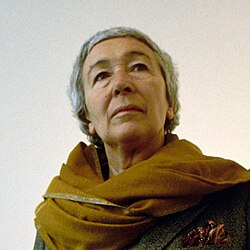
Gaetana "Gae" Emilia Aulenti (pronounced [ˈɡaːe auˈlɛnti]; 4 December 1927 – 31 October 2012) was an Italian architect and designer. Aulenti began her career in the early 1950s, establishing herself as one of the few prominent female architects in post-war Italy.
Although modernism was the predominant international architectural style throughout much of the 20th century, Aulenti stepped away from its tenets to embrace neo-liberty, an architectural and design theory which upheld the relevance of tradition and artistic freedom within the modern aesthetic.
Throughout her career, Aulenti applied her knowledge and broad expertise to a wide range of projects spanning from furniture, lighting, and product design to interiors and exhibition design, theatre stage sets, historical preservation and large-scale architectural projects.
Aulenti is widely acknowledged for transforming the Gare d'Orsay to the Musée d'Orsay. She was awarded the Chevalier de la Legion d' Honneur and the Ordine al Merito della Repubblica Italiana.
Aulenti was born in Palazzolo dello Stella in the Friuli region of northeast Italy to Aldo Aulenti, an accountant and his wife, Virginia Gioia, a school teacher. The Aulenti family, with ancestral origins in Calabria, Apulia and Campania, included her paternal grandfather, who served as a magistrate, and her maternal grandfather, who was a physician.
When Aulenti was a child, her family moved to Biella, in the Piedmont region in northern Italy. Aulenti attended a visual arts high-school in Florence; however, during World War II, she was compelled to return to Biella where she continued her studies privately. Reflecting on her life, Aulenti remarked that she was acquainted with several partisans in Piedmont, who placed their trust in her. She would carry out small missions for the Allies while pretending to be on a leisurely outing to the countryside.
Although Aulenti initially studied visual arts, she saw an opportunity to contribute to the rebuilding of Italy and in 1948 she enrolled in the architectural program at the Polytechnic University of Milan. Other alumni from Aulenti's generation at the Polytechnic included Anna Castelli Ferrieri, Franca Stagi and Cini Boeri.
Milan was attractive to students, like Aulenti, because it had been an open city during World War II and was rich with culture and intellectual life. Among Milanese cultural figures of that time, Aulenti recalled the film-maker, Luchino Visconti and the author, Elio Vittorini (whom she met) but also international figures such as Walter Gropius, Le Corbusier and Frank Lloyd Wright.
Gae Aulenti
Gaetana "Gae" Emilia Aulenti (pronounced [ˈɡaːe auˈlɛnti]; 4 December 1927 – 31 October 2012) was an Italian architect and designer. Aulenti began her career in the early 1950s, establishing herself as one of the few prominent female architects in post-war Italy.
Although modernism was the predominant international architectural style throughout much of the 20th century, Aulenti stepped away from its tenets to embrace neo-liberty, an architectural and design theory which upheld the relevance of tradition and artistic freedom within the modern aesthetic.
Throughout her career, Aulenti applied her knowledge and broad expertise to a wide range of projects spanning from furniture, lighting, and product design to interiors and exhibition design, theatre stage sets, historical preservation and large-scale architectural projects.
Aulenti is widely acknowledged for transforming the Gare d'Orsay to the Musée d'Orsay. She was awarded the Chevalier de la Legion d' Honneur and the Ordine al Merito della Repubblica Italiana.
Aulenti was born in Palazzolo dello Stella in the Friuli region of northeast Italy to Aldo Aulenti, an accountant and his wife, Virginia Gioia, a school teacher. The Aulenti family, with ancestral origins in Calabria, Apulia and Campania, included her paternal grandfather, who served as a magistrate, and her maternal grandfather, who was a physician.
When Aulenti was a child, her family moved to Biella, in the Piedmont region in northern Italy. Aulenti attended a visual arts high-school in Florence; however, during World War II, she was compelled to return to Biella where she continued her studies privately. Reflecting on her life, Aulenti remarked that she was acquainted with several partisans in Piedmont, who placed their trust in her. She would carry out small missions for the Allies while pretending to be on a leisurely outing to the countryside.
Although Aulenti initially studied visual arts, she saw an opportunity to contribute to the rebuilding of Italy and in 1948 she enrolled in the architectural program at the Polytechnic University of Milan. Other alumni from Aulenti's generation at the Polytechnic included Anna Castelli Ferrieri, Franca Stagi and Cini Boeri.
Milan was attractive to students, like Aulenti, because it had been an open city during World War II and was rich with culture and intellectual life. Among Milanese cultural figures of that time, Aulenti recalled the film-maker, Luchino Visconti and the author, Elio Vittorini (whom she met) but also international figures such as Walter Gropius, Le Corbusier and Frank Lloyd Wright.
Recent media
Recent media