



Community hub
Recent from talks
Knowledge base stats:
Talk channels stats:
Members stats:
Open city
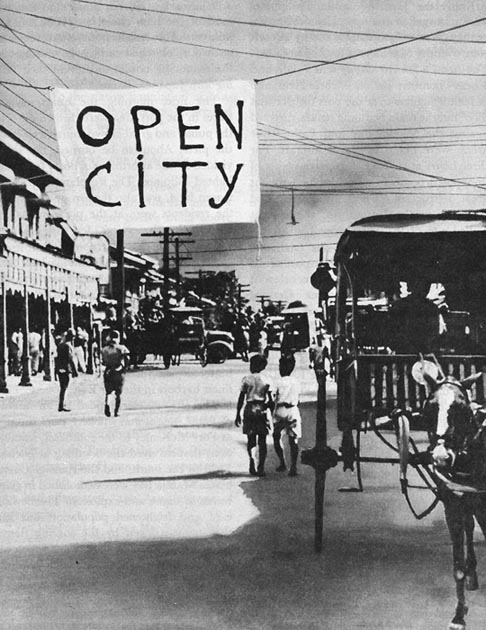
In war, an open city is a settlement which has announced it has abandoned all defensive efforts, generally in the event of the imminent capture of the city to avoid destruction. Once a city has declared itself open, the opposing military will be expected under international law to peacefully occupy the city rather than destroy it.
The concept of an open city emerged during World War I, where cities were declared demilitarized in an attempt to avoid destruction. Protocol I of the Geneva Conventions forbids the attacking party to "attack, by any means whatsoever, non-defended localities". The intent is to protect the city's civilians and cultural landmarks from a battle which may be futile.
Attacking forces do not always respect the declaration of an open city. Defensive forces will occasionally use the designation as a political tactic as well. In some cases, the declaration of a city to be open is made by a side on the verge of surrender and defeat; in other cases, those making such a declaration are willing and able to fight on, but prefer that the specific city be spared. Often, resistance movements will be active in open cities, straining the temperate conduct of the occupying forces.
During the 1814 Battle of Paris near the end of the Napoleonic Wars, Paris was in effect treated in a way that modern language would call an "open city" After very stiff fighting in the suburbs of the French capital on the 30th of March 1814, the defenders agreed to abandon Paris to prevent taking the fight to the city itself and bringing its destruction. The combined forces of Russia, Austria, Prussia, and Württemberg occupied it the next day.
Numerous cities were declared open cities during World War II:
In 1977, a far-left group in Japan—called the "National Open City Declaration Movement Network"—began organizing activists to make cities preemptively declare themselves "defenseless" under the Geneva Convention, so that in the event of war, they would be legally forced to welcome any invasion. This was rejected by nearly all of Japan's political parties and the ruling government as inherently absurd, since Japan was not in a war, and in the event of war such a decision would have to be approved by the national government. However, the Social Democratic Party—which was the junior party of the ruling coalition from 1994 to 1996—supported it.[when?]
Nevertheless, four wards of Tokyo and Kagoshima City, Japan's southernmost port, among many other cities considered[when?] legislation to be declared "open cities".
Segundo Eclar Romero of the Philippine Daily Inquirer argues that Kabul, the capital of Afghanistan, was declared a de facto open city by President Ashraf Ghani when he fled the country amidst the collapse of the Islamic Republic during the 2021 Taliban offensive, allowing it to fall unopposed and ending the war. While acknowledging the lack of bloodshed, he argues the move hastened the downfall of the republic and stymied the materialization of an impactful anti-Taliban resistance movement.
Hub AI
Open city AI simulator
(@Open city_simulator)
Open city
In war, an open city is a settlement which has announced it has abandoned all defensive efforts, generally in the event of the imminent capture of the city to avoid destruction. Once a city has declared itself open, the opposing military will be expected under international law to peacefully occupy the city rather than destroy it.
The concept of an open city emerged during World War I, where cities were declared demilitarized in an attempt to avoid destruction. Protocol I of the Geneva Conventions forbids the attacking party to "attack, by any means whatsoever, non-defended localities". The intent is to protect the city's civilians and cultural landmarks from a battle which may be futile.
Attacking forces do not always respect the declaration of an open city. Defensive forces will occasionally use the designation as a political tactic as well. In some cases, the declaration of a city to be open is made by a side on the verge of surrender and defeat; in other cases, those making such a declaration are willing and able to fight on, but prefer that the specific city be spared. Often, resistance movements will be active in open cities, straining the temperate conduct of the occupying forces.
During the 1814 Battle of Paris near the end of the Napoleonic Wars, Paris was in effect treated in a way that modern language would call an "open city" After very stiff fighting in the suburbs of the French capital on the 30th of March 1814, the defenders agreed to abandon Paris to prevent taking the fight to the city itself and bringing its destruction. The combined forces of Russia, Austria, Prussia, and Württemberg occupied it the next day.
Numerous cities were declared open cities during World War II:
In 1977, a far-left group in Japan—called the "National Open City Declaration Movement Network"—began organizing activists to make cities preemptively declare themselves "defenseless" under the Geneva Convention, so that in the event of war, they would be legally forced to welcome any invasion. This was rejected by nearly all of Japan's political parties and the ruling government as inherently absurd, since Japan was not in a war, and in the event of war such a decision would have to be approved by the national government. However, the Social Democratic Party—which was the junior party of the ruling coalition from 1994 to 1996—supported it.[when?]
Nevertheless, four wards of Tokyo and Kagoshima City, Japan's southernmost port, among many other cities considered[when?] legislation to be declared "open cities".
Segundo Eclar Romero of the Philippine Daily Inquirer argues that Kabul, the capital of Afghanistan, was declared a de facto open city by President Ashraf Ghani when he fled the country amidst the collapse of the Islamic Republic during the 2021 Taliban offensive, allowing it to fall unopposed and ending the war. While acknowledging the lack of bloodshed, he argues the move hastened the downfall of the republic and stymied the materialization of an impactful anti-Taliban resistance movement.