



Community hub
Recent from talks
Knowledge base stats:
Talk channels stats:
Members stats:
Galerina
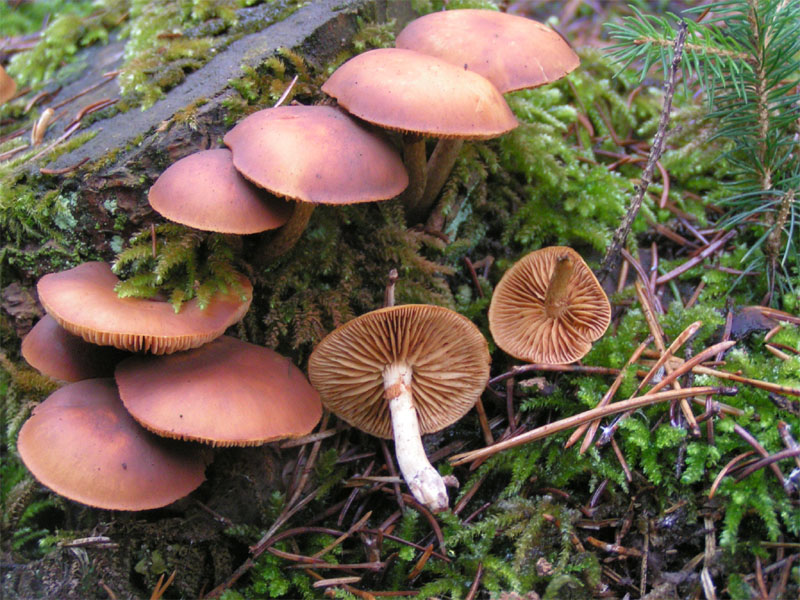
Galerina is a genus of small brown-spore saprobic mushroom-bearing fungi, with over 300 species found throughout the world from the far north to remote Macquarie Island in the Southern Ocean. The genus is most noted for some extremely poisonous species which are occasionally confused with hallucinogenic species of Psilocybe. Galerina mushrooms are typically small and hygrophanous, with a slender and brittle stem. They are often found growing on wood, and when on the ground have a preference for mossy habitats.
Galerina means helmet-like. [specify]
The genus Galerina is defined as small mushrooms of mycenoid stature, that is, roughly similar in form to Mycena species: a small conical to bell-shaped cap, and gills attached to a long and slender cartilaginous stem. Species have a pileipellis that is a cutis, and ornamented spores that are brown in deposit, where the spore ornamentation comes from an extra spore covering.
Galerina fruiting bodies are typically small, undistinguished mushrooms with a typical "little brown mushroom" morphology and a yellow-brown, light brown to cinnamon-brown spore print. The pileus is typically glabrous and often hygrophanous, and a cortina-type veil is present in young specimens of roughly half of recognized species, though it sometimes disappears as the mushroom ages in many of these species.[citation needed] Microscopically, they are highly variable as well, though most species have spores that are ornamented, lack a germ pore, and have a plage. Many species also have characteristic tibiiform cystidia. However, there are many exceptions, and many species of Galerina lack one or more of these microscopic characteristics. Ecologically, all Galerina are saprobic, growing in habitats like rotting wood or in moss.
The spores of Galerina feature an ornamentation that comes from the outer layer of the spore breaking up on maturity to produce either warts, wrinkles or "ears", flaps of material loosened from where the spore was attached to the basidia. This outer layer of the spore often is not complete, but has a clear patch in many species just above the attachment, this clear patch is called a plage. This plage is not evident in all species, and the spore covering does not always breakup in all species, making it sometimes difficult to correctly determine a mushroom of this genus.
The specific features that define the genus require a microscope to confirm. In the wild it can be difficult to determine a Galerina from a number of similar genera, such as Pholiota, Tubaria, Conocybe, Pholiotina, Agrocybe, Gymnopilus, Phaeogalera and Psilocybe. For the most part, Galerinas will be found associated with moss, and this can separate out the genus in nature fairly well. But this identification is more difficult in the section Naucoriopsis, which does not associate with moss, and is a decomposer of wood.
Phaeogalera is a genus that was segregated from Galerina by Robert Kühner.
The genus Galerina has recently been found to be polyphyletic, consisting of at least three unrelated clades, although not all species were studied and for most currently recognized species is uncertain still in which they belong. Each of these clades corresponds to a subgenus of Galerina, as outlined by Kühner. The great diversity of micromorphology found in Galerina is probably due to the polyphyly of the genus.
Hub AI
Galerina AI simulator
(@Galerina_simulator)
Galerina
Galerina is a genus of small brown-spore saprobic mushroom-bearing fungi, with over 300 species found throughout the world from the far north to remote Macquarie Island in the Southern Ocean. The genus is most noted for some extremely poisonous species which are occasionally confused with hallucinogenic species of Psilocybe. Galerina mushrooms are typically small and hygrophanous, with a slender and brittle stem. They are often found growing on wood, and when on the ground have a preference for mossy habitats.
Galerina means helmet-like. [specify]
The genus Galerina is defined as small mushrooms of mycenoid stature, that is, roughly similar in form to Mycena species: a small conical to bell-shaped cap, and gills attached to a long and slender cartilaginous stem. Species have a pileipellis that is a cutis, and ornamented spores that are brown in deposit, where the spore ornamentation comes from an extra spore covering.
Galerina fruiting bodies are typically small, undistinguished mushrooms with a typical "little brown mushroom" morphology and a yellow-brown, light brown to cinnamon-brown spore print. The pileus is typically glabrous and often hygrophanous, and a cortina-type veil is present in young specimens of roughly half of recognized species, though it sometimes disappears as the mushroom ages in many of these species.[citation needed] Microscopically, they are highly variable as well, though most species have spores that are ornamented, lack a germ pore, and have a plage. Many species also have characteristic tibiiform cystidia. However, there are many exceptions, and many species of Galerina lack one or more of these microscopic characteristics. Ecologically, all Galerina are saprobic, growing in habitats like rotting wood or in moss.
The spores of Galerina feature an ornamentation that comes from the outer layer of the spore breaking up on maturity to produce either warts, wrinkles or "ears", flaps of material loosened from where the spore was attached to the basidia. This outer layer of the spore often is not complete, but has a clear patch in many species just above the attachment, this clear patch is called a plage. This plage is not evident in all species, and the spore covering does not always breakup in all species, making it sometimes difficult to correctly determine a mushroom of this genus.
The specific features that define the genus require a microscope to confirm. In the wild it can be difficult to determine a Galerina from a number of similar genera, such as Pholiota, Tubaria, Conocybe, Pholiotina, Agrocybe, Gymnopilus, Phaeogalera and Psilocybe. For the most part, Galerinas will be found associated with moss, and this can separate out the genus in nature fairly well. But this identification is more difficult in the section Naucoriopsis, which does not associate with moss, and is a decomposer of wood.
Phaeogalera is a genus that was segregated from Galerina by Robert Kühner.
The genus Galerina has recently been found to be polyphyletic, consisting of at least three unrelated clades, although not all species were studied and for most currently recognized species is uncertain still in which they belong. Each of these clades corresponds to a subgenus of Galerina, as outlined by Kühner. The great diversity of micromorphology found in Galerina is probably due to the polyphyly of the genus.