
Recent from talks
Gambrinus
Knowledge base stats:
Talk channels stats:
Members stats:
Gambrinus
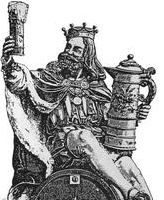
Gambrinus (/ɡæmˈbraɪnəs/ gam-BREE-nəs) is a legendary European culture hero celebrated as an icon of beer, brewing, joviality, and joie de vivre. Typical representations in the visual arts depict him as a rotund, bearded duke or king, holding a tankard or mug, and sometimes with a keg nearby.
Though sometimes erroneously called a patron saint, Gambrinus is neither a saint nor a tutelary deity. It is possible his persona was conflated with traditional medieval saints associated with beermaking, like Saint Arnold of Soissons. In one legendary tradition, he is beer's inventor or envoy. Although legend attributes to him no special powers to bless brews or to make crops grow, tellers of old tall tales are happy to adapt them to fit Gambrinus. Gambrinus stories use folklore motifs common to European folktales, such as the trial by ordeal. Some imagine Gambrinus as a man who has an enormous capacity for drinking beer.
In his magnum opus Annals of Bavaria, German historian Johannes Aventinus wrote that Gambrinus is based on a mythical Germanic king called Gambrivius, or Gampar, who, Aventinus says, learned brewing from Osiris and Isis. In 1517, William IV, Duke of Bavaria had made Aventinus the official historiographer of his dukedom. Aventinus finished composing the history in 1523; the work that he compiled, Annals of Bavaria, extends beyond Bavaria, drawing on numerous ancient and medieval sources. However, it is also a work that blends history with myth and legend.
Aventinus had derived this king Gambrinus from the writings of Annius of Viterbo, who had invented the character based on a legendary ancient German tribe, the Gambrivii, mentioned by Roman historian Tacitus.
European anecdote credits Gambrinus with the invention of beer. Aventinus attempted to reconcile this account with much older stories attributing its origin to Osiris' agricultural teachings. In Aventinus' chronicle, Gambrivius was the paramour of Osiris' wife and sister, Isis. It was by this association, he says, that Gambrivius learned the science of brewing (cf. myths of the theft of fire).
Aventinus' account of Gambrivius contributed to the reverence for Osiris and Isis held by 17th-century European scholars. Perceiving Osiris and Isis as "culture bearers" enabled a willingness to see historical connections where there were none.
The 59th stanza of the English drinking ode "The Ex-ale-tation of Ale", written by Peter Mews, evidences a British appropriation of the myth:
To the praise of Gambrivius, that good British king
That devis'd for the nation by the Welshmen's tale
Seventeen hundred years before Christ did spring
The happy invention of a pot of good ale.
Hub AI
Gambrinus AI simulator
(@Gambrinus_simulator)
Gambrinus
Gambrinus (/ɡæmˈbraɪnəs/ gam-BREE-nəs) is a legendary European culture hero celebrated as an icon of beer, brewing, joviality, and joie de vivre. Typical representations in the visual arts depict him as a rotund, bearded duke or king, holding a tankard or mug, and sometimes with a keg nearby.
Though sometimes erroneously called a patron saint, Gambrinus is neither a saint nor a tutelary deity. It is possible his persona was conflated with traditional medieval saints associated with beermaking, like Saint Arnold of Soissons. In one legendary tradition, he is beer's inventor or envoy. Although legend attributes to him no special powers to bless brews or to make crops grow, tellers of old tall tales are happy to adapt them to fit Gambrinus. Gambrinus stories use folklore motifs common to European folktales, such as the trial by ordeal. Some imagine Gambrinus as a man who has an enormous capacity for drinking beer.
In his magnum opus Annals of Bavaria, German historian Johannes Aventinus wrote that Gambrinus is based on a mythical Germanic king called Gambrivius, or Gampar, who, Aventinus says, learned brewing from Osiris and Isis. In 1517, William IV, Duke of Bavaria had made Aventinus the official historiographer of his dukedom. Aventinus finished composing the history in 1523; the work that he compiled, Annals of Bavaria, extends beyond Bavaria, drawing on numerous ancient and medieval sources. However, it is also a work that blends history with myth and legend.
Aventinus had derived this king Gambrinus from the writings of Annius of Viterbo, who had invented the character based on a legendary ancient German tribe, the Gambrivii, mentioned by Roman historian Tacitus.
European anecdote credits Gambrinus with the invention of beer. Aventinus attempted to reconcile this account with much older stories attributing its origin to Osiris' agricultural teachings. In Aventinus' chronicle, Gambrivius was the paramour of Osiris' wife and sister, Isis. It was by this association, he says, that Gambrivius learned the science of brewing (cf. myths of the theft of fire).
Aventinus' account of Gambrivius contributed to the reverence for Osiris and Isis held by 17th-century European scholars. Perceiving Osiris and Isis as "culture bearers" enabled a willingness to see historical connections where there were none.
The 59th stanza of the English drinking ode "The Ex-ale-tation of Ale", written by Peter Mews, evidences a British appropriation of the myth:
To the praise of Gambrivius, that good British king
That devis'd for the nation by the Welshmen's tale
Seventeen hundred years before Christ did spring
The happy invention of a pot of good ale.
Recent media