
Recent from talks
Keg
Knowledge base stats:
Talk channels stats:
Members stats:
Keg
A keg is a small cask used for storing liquids. Wooden kegs made by a cooper were used to transport nails, gunpowder, and a variety of liquids. Nowadays a keg is normally constructed of stainless steel, although aluminium can be used if it is coated with plastic on the inside. It is commonly used to store, transport, and serve beer. Other alcoholic or non-alcoholic drinks, carbonated or non-carbonated, may be housed in a keg as well. Carbonated drinks are generally kept under pressure in order to maintain carbon dioxide in solution, preventing the beverage from becoming flat.
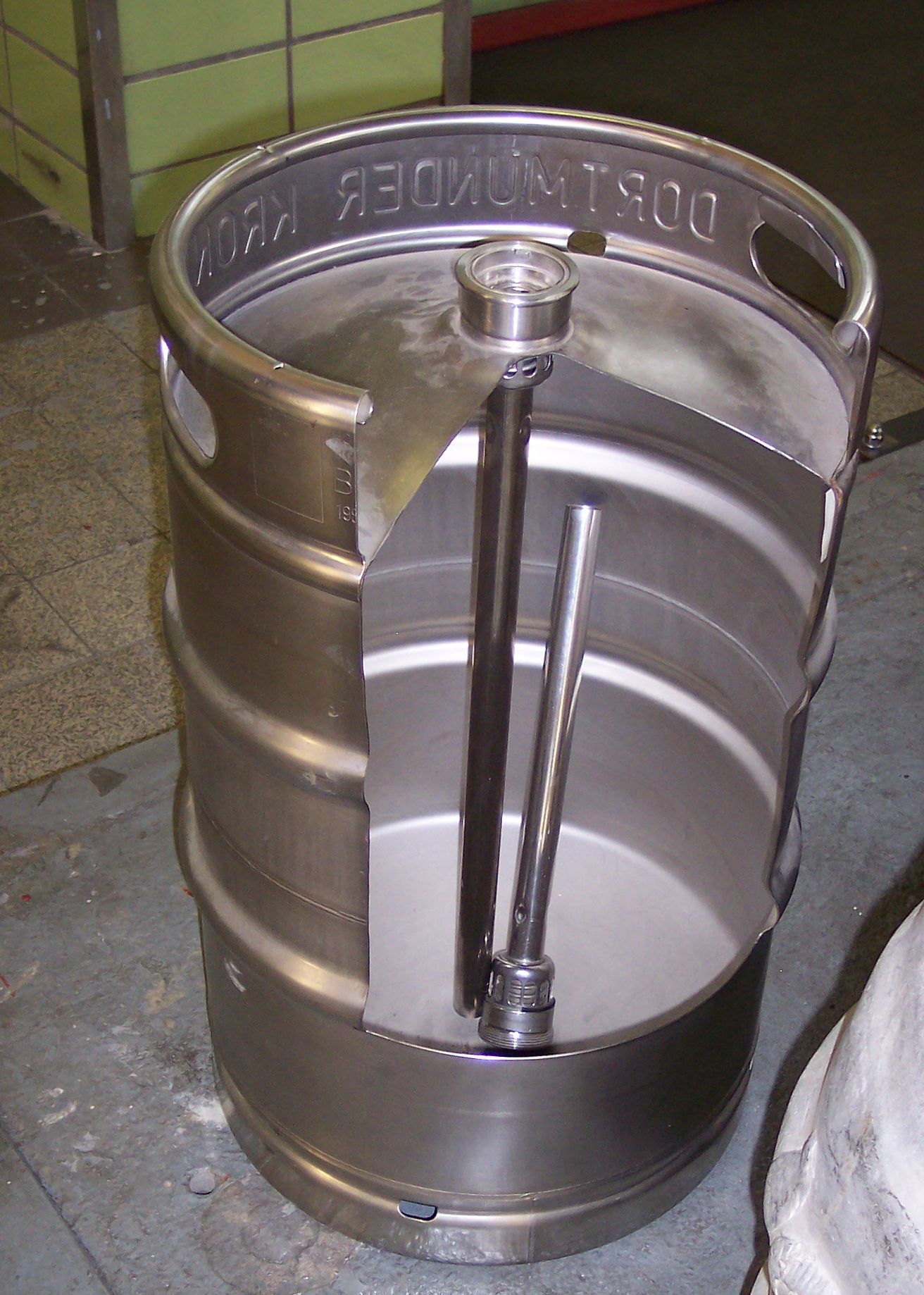
Beer kegs are made of stainless steel, or less commonly, of aluminium. A keg has a single opening on one end, called a "bung". A tube called a "spear" extends from the opening to the other end. There is a self-closing valve that is opened by the coupling fitting which is attached when the keg is tapped. There is also an opening at the top of the spear that allows gas (usually carbon dioxide) to drive the beer out of the keg. The coupling fitting has one or two valves that control the flow of beer out of and gas into the keg. The keg must be in the upright position, that is, with the opening on top, for the beer to be dispensed. Kegs can be contrasted to casks, which have two or more openings and no spear. Most major breweries now use internally speared kegs. Beer that is sold in kegs is fully conditioned. Beer intended for local use may be kegged without sterilization, however, the beer must stay cold.
Historically a beer barrel was a standard size of 36 US gallons (140 L; 30 imp gal), as opposed to a wine barrel of 32 US gallons (120 L; 27 imp gal), or an oil barrel of 42 US gallons (160 L; 35 imp gal). Over the years barrel sizes have evolved, and breweries throughout the world use different sized containers. Even when the content capacity of two kegs are equal, e.g. metricized to 50 liters, the keg shape and tap system may differ greatly.
Most U.S. brewers sell beer in 1/2 barrels of 15.5 gallons, 1/4 barrels of 7.75 gallons, and 1/6 barrels of 5.17 gallons.
Since keg sizes are not standardized, the keg cannot be used as a standard unit of measure for liquid volumes: despite this, a number of people still refer to kegs as if they were a unit of measure. This size standard varies from country to country and brewery to brewery, with most countries using the metric system rather than U.S. gallons.
In common parlance, the term keg refers to a half-barrel (15.5 U.S. gallon) vessel as this is the most common size used in restaurants, bars and limited home use. A quarter-barrel has a volume of 7.75 U.S. gallons. Generally, a keg is a vessel smaller than a barrel; thus, it is 30 gallons or smaller.
In the U.S. the terms half-barrel and quarter-barrel are derived from the U.S. beer barrel, legally defined as being equal to 31 U.S. gallons (this is not the same volume as some other units also known as barrels).
A 15.5 U.S. gallon keg is also equal to:
Hub AI
Keg AI simulator
(@Keg_simulator)
Keg
A keg is a small cask used for storing liquids. Wooden kegs made by a cooper were used to transport nails, gunpowder, and a variety of liquids. Nowadays a keg is normally constructed of stainless steel, although aluminium can be used if it is coated with plastic on the inside. It is commonly used to store, transport, and serve beer. Other alcoholic or non-alcoholic drinks, carbonated or non-carbonated, may be housed in a keg as well. Carbonated drinks are generally kept under pressure in order to maintain carbon dioxide in solution, preventing the beverage from becoming flat.
Beer kegs are made of stainless steel, or less commonly, of aluminium. A keg has a single opening on one end, called a "bung". A tube called a "spear" extends from the opening to the other end. There is a self-closing valve that is opened by the coupling fitting which is attached when the keg is tapped. There is also an opening at the top of the spear that allows gas (usually carbon dioxide) to drive the beer out of the keg. The coupling fitting has one or two valves that control the flow of beer out of and gas into the keg. The keg must be in the upright position, that is, with the opening on top, for the beer to be dispensed. Kegs can be contrasted to casks, which have two or more openings and no spear. Most major breweries now use internally speared kegs. Beer that is sold in kegs is fully conditioned. Beer intended for local use may be kegged without sterilization, however, the beer must stay cold.
Historically a beer barrel was a standard size of 36 US gallons (140 L; 30 imp gal), as opposed to a wine barrel of 32 US gallons (120 L; 27 imp gal), or an oil barrel of 42 US gallons (160 L; 35 imp gal). Over the years barrel sizes have evolved, and breweries throughout the world use different sized containers. Even when the content capacity of two kegs are equal, e.g. metricized to 50 liters, the keg shape and tap system may differ greatly.
Most U.S. brewers sell beer in 1/2 barrels of 15.5 gallons, 1/4 barrels of 7.75 gallons, and 1/6 barrels of 5.17 gallons.
Since keg sizes are not standardized, the keg cannot be used as a standard unit of measure for liquid volumes: despite this, a number of people still refer to kegs as if they were a unit of measure. This size standard varies from country to country and brewery to brewery, with most countries using the metric system rather than U.S. gallons.
In common parlance, the term keg refers to a half-barrel (15.5 U.S. gallon) vessel as this is the most common size used in restaurants, bars and limited home use. A quarter-barrel has a volume of 7.75 U.S. gallons. Generally, a keg is a vessel smaller than a barrel; thus, it is 30 gallons or smaller.
In the U.S. the terms half-barrel and quarter-barrel are derived from the U.S. beer barrel, legally defined as being equal to 31 U.S. gallons (this is not the same volume as some other units also known as barrels).
A 15.5 U.S. gallon keg is also equal to:
Recent media