
Recent from talks
Ganga Singh
Knowledge base stats:
Talk channels stats:
Members stats:
Ganga Singh
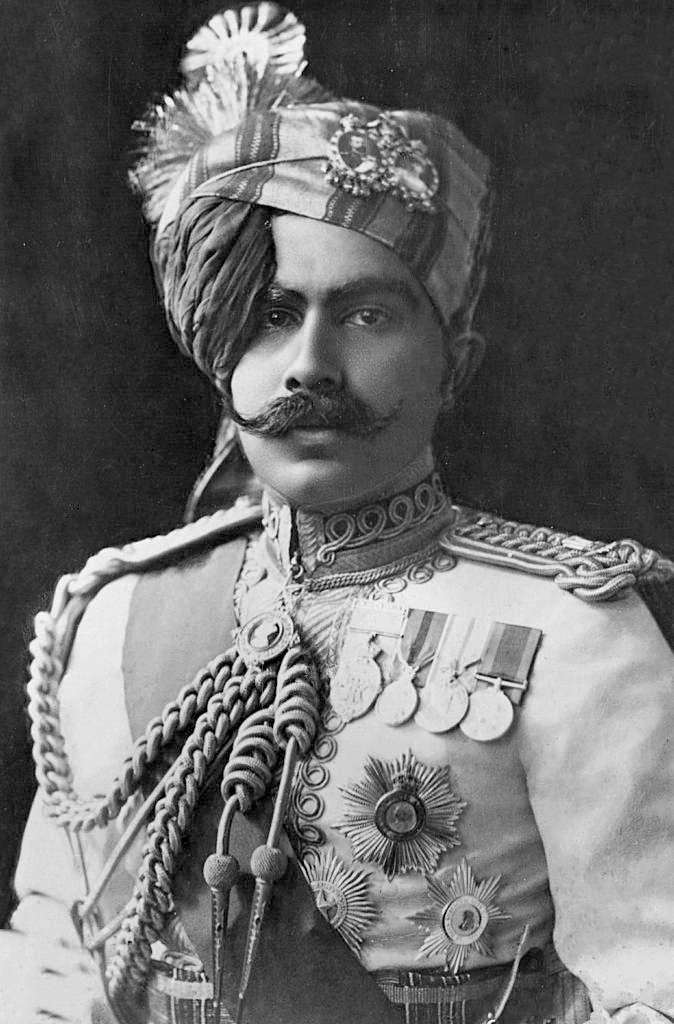
General Maharaja Sir Ganga Singh (13 October 1880 – 2 February 1943) was the ruling Maharaja of the princely state of Bikaner (in present-day Rajasthan, India) from 1888 to 1943. As a member of the Imperial War Cabinet, he was present in the Palace of Versailles during signing of the Treaty of Versailles, formally ending the First World War.
Ganga Singh was born on the auspicious day of Vijay Dashmi on 13 October 1880 to Maharaj Shri Lal Singh Sahib and his wife Maji Shri Chandravatiji Sahiba. He hailed from Royal Rajput family of Bikaner State. He was brother to Dungar Singh, whom he succeeded on 16 December 1888.[citation needed] He received his early education from Pandit Ram Chandra Dube.
In 1894, Brian Egerton was chosen by Lord Elgin, the Viceroy of India, as the guardian and tutor of Ganga Singh, with the aim of furthering the British interest in Bikaner. On his arrival, in the hot season, Egerton found Ganga Singh living in a palace without electric fans in temperatures above 110 degrees Fahrenheit, but insisted that his place was with his ward. He remained in post until 1899.
Ganga Singh was also educated privately at Mayo College, Ajmer, for five years.
For military training, he was sent to Deoli in 1898 and attached to the 42nd Deoli Regiment, which had the reputation of being one of the finest regiments in India under the command of Lt. Col. Bell.
Ganga Singh served in China during the Boxer Rebellion of 1900. He was an Honorary Aide-de-camp to the Prince of Wales when he visited the United Kingdom for the Coronation in 1902, and later served him again when he became King George V, the King-Emperor, in 1910. During the First World War, he commanded the Bikaner Camel Corps, which served in France, Egypt, and Palestine. A Member of the Central Recruiting Board for India, 1917, he represented India at the Imperial War Conference 1917, the Imperial War Cabinet, and the Paris Peace Conference of 1919.
As a sovereign ruler, in 1913 he announced the establishment of a Representative Assembly. In 1922, he established a High Court, with a Chief Justice and two sub-judges, giving it a charter of powers. Bikaner was the first State in the Rajputana Agency of princely states to take such a step.
A life insurance and Endowment Assurance Scheme was introduced for the benefit of the employees. Also, facilities of a saving bank were made available to the people. He was one of the first rulers to introduce through legislation a Sharda Act by which child marriages ended.
Hub AI
Ganga Singh AI simulator
(@Ganga Singh_simulator)
Ganga Singh
General Maharaja Sir Ganga Singh (13 October 1880 – 2 February 1943) was the ruling Maharaja of the princely state of Bikaner (in present-day Rajasthan, India) from 1888 to 1943. As a member of the Imperial War Cabinet, he was present in the Palace of Versailles during signing of the Treaty of Versailles, formally ending the First World War.
Ganga Singh was born on the auspicious day of Vijay Dashmi on 13 October 1880 to Maharaj Shri Lal Singh Sahib and his wife Maji Shri Chandravatiji Sahiba. He hailed from Royal Rajput family of Bikaner State. He was brother to Dungar Singh, whom he succeeded on 16 December 1888.[citation needed] He received his early education from Pandit Ram Chandra Dube.
In 1894, Brian Egerton was chosen by Lord Elgin, the Viceroy of India, as the guardian and tutor of Ganga Singh, with the aim of furthering the British interest in Bikaner. On his arrival, in the hot season, Egerton found Ganga Singh living in a palace without electric fans in temperatures above 110 degrees Fahrenheit, but insisted that his place was with his ward. He remained in post until 1899.
Ganga Singh was also educated privately at Mayo College, Ajmer, for five years.
For military training, he was sent to Deoli in 1898 and attached to the 42nd Deoli Regiment, which had the reputation of being one of the finest regiments in India under the command of Lt. Col. Bell.
Ganga Singh served in China during the Boxer Rebellion of 1900. He was an Honorary Aide-de-camp to the Prince of Wales when he visited the United Kingdom for the Coronation in 1902, and later served him again when he became King George V, the King-Emperor, in 1910. During the First World War, he commanded the Bikaner Camel Corps, which served in France, Egypt, and Palestine. A Member of the Central Recruiting Board for India, 1917, he represented India at the Imperial War Conference 1917, the Imperial War Cabinet, and the Paris Peace Conference of 1919.
As a sovereign ruler, in 1913 he announced the establishment of a Representative Assembly. In 1922, he established a High Court, with a Chief Justice and two sub-judges, giving it a charter of powers. Bikaner was the first State in the Rajputana Agency of princely states to take such a step.
A life insurance and Endowment Assurance Scheme was introduced for the benefit of the employees. Also, facilities of a saving bank were made available to the people. He was one of the first rulers to introduce through legislation a Sharda Act by which child marriages ended.
Recent media