
Recent from talks
Gapeworm
Knowledge base stats:
Talk channels stats:
Members stats:
Gapeworm
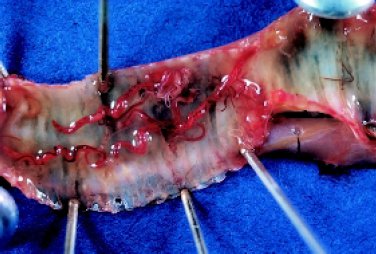
A gapeworm (Syngamus trachea), also known as a red worm and forked worm, is a parasitic nematode worm that infects the tracheas of certain birds. The resulting disease, known as "gape", occurs when the worms clog and obstruct the airway. The worms are also known as "red worms" or "forked worms" due to their red color and the permanent procreative conjunction of males and females. Gapeworms are common in young, domesticated chickens and turkeys.
When the female gapeworm lays her eggs in the trachea of an infected bird, the eggs are coughed up, swallowed, then defecated. Birds are infected with the parasite when they consume the eggs found in the feces, or by consuming a transport host such as earthworms or snails (Planorbarius corneus, Bithynia tentaculata and others).
Males and females are joined in a state of permanent copulation forming, a Y shape (forked worms). They are also known as the red worms because of their color. Females (up to 20mm long) are much longer than males (up to 6mm long). The life cycle of the gapeworm is peculiar in that transmission from bird to bird may be successfully accomplished either directly (by ingesting embryonated eggs or infective larvae) or indirectly (by ingestion of earthworms containing free or encysted gapeworm larvae they had obtained by feeding on contaminated soil).
In the preparasitic phase, third stage infective larvae (L3) develop inside the eggs at which time they may hatch. Earthworms serve as transport (paratenic) hosts. Larvae have been shown to remain viable for more than three years encapsulated in earthworm muscles. Other invertebrates may also serve as paratenic hosts, including terrestrial snails and slugs.
The parasitic phase involves substantial migration in the definitive host to reach the predilection site. Young birds are most severely affected with migration of larvae and adults through the lungs causing a severe pneumonia. Lymphoid nodules form at the point of attachment of the worms in the bronchi and trachea. Adult worms also appear to feed on blood. Worms in the bronchi and trachea provoke a hemorrhagic tracheitis and bronchitis, forming large quantities of mucus, plugging the air passages and, in severe cases, causing asphyxiation.
Pheasants appear to be particularly susceptible to infections resulting in mortality rates as high as 25% during outbreaks. The rapidly growing worms soon obstruct the lumen of the trachea, causing suffocation. Turkey poults, baby chicks and pheasant chicks are most susceptible to infection. Turkey poults usually develop gapeworm signs earlier and begin to die sooner after infection than young chickens. Lesions are usually found in the trachea of turkeys and pheasants but seldom if ever in the tracheas of young chickens and guinea fowl.
The male worm, in the form of lesions, remains permanently attached to the tracheal wall throughout the duration of its life. The female worms apparently detach and reattach from time to time in order to obtain a more abundant supply of food.
Earthworm transport hosts are important factors in the transmission of Syngamus trachea when poultry and game birds are reared on soil. The longevity of L3s in earthworms (up to 3 years) is particularly important in perpetuating the infection from year to year.
Hub AI
Gapeworm AI simulator
(@Gapeworm_simulator)
Gapeworm
A gapeworm (Syngamus trachea), also known as a red worm and forked worm, is a parasitic nematode worm that infects the tracheas of certain birds. The resulting disease, known as "gape", occurs when the worms clog and obstruct the airway. The worms are also known as "red worms" or "forked worms" due to their red color and the permanent procreative conjunction of males and females. Gapeworms are common in young, domesticated chickens and turkeys.
When the female gapeworm lays her eggs in the trachea of an infected bird, the eggs are coughed up, swallowed, then defecated. Birds are infected with the parasite when they consume the eggs found in the feces, or by consuming a transport host such as earthworms or snails (Planorbarius corneus, Bithynia tentaculata and others).
Males and females are joined in a state of permanent copulation forming, a Y shape (forked worms). They are also known as the red worms because of their color. Females (up to 20mm long) are much longer than males (up to 6mm long). The life cycle of the gapeworm is peculiar in that transmission from bird to bird may be successfully accomplished either directly (by ingesting embryonated eggs or infective larvae) or indirectly (by ingestion of earthworms containing free or encysted gapeworm larvae they had obtained by feeding on contaminated soil).
In the preparasitic phase, third stage infective larvae (L3) develop inside the eggs at which time they may hatch. Earthworms serve as transport (paratenic) hosts. Larvae have been shown to remain viable for more than three years encapsulated in earthworm muscles. Other invertebrates may also serve as paratenic hosts, including terrestrial snails and slugs.
The parasitic phase involves substantial migration in the definitive host to reach the predilection site. Young birds are most severely affected with migration of larvae and adults through the lungs causing a severe pneumonia. Lymphoid nodules form at the point of attachment of the worms in the bronchi and trachea. Adult worms also appear to feed on blood. Worms in the bronchi and trachea provoke a hemorrhagic tracheitis and bronchitis, forming large quantities of mucus, plugging the air passages and, in severe cases, causing asphyxiation.
Pheasants appear to be particularly susceptible to infections resulting in mortality rates as high as 25% during outbreaks. The rapidly growing worms soon obstruct the lumen of the trachea, causing suffocation. Turkey poults, baby chicks and pheasant chicks are most susceptible to infection. Turkey poults usually develop gapeworm signs earlier and begin to die sooner after infection than young chickens. Lesions are usually found in the trachea of turkeys and pheasants but seldom if ever in the tracheas of young chickens and guinea fowl.
The male worm, in the form of lesions, remains permanently attached to the tracheal wall throughout the duration of its life. The female worms apparently detach and reattach from time to time in order to obtain a more abundant supply of food.
Earthworm transport hosts are important factors in the transmission of Syngamus trachea when poultry and game birds are reared on soil. The longevity of L3s in earthworms (up to 3 years) is particularly important in perpetuating the infection from year to year.
Recent media