
Recent from talks
Gask Ridge
Knowledge base stats:
Talk channels stats:
Members stats:
Gask Ridge
The Gask Ridge is the modern name given to an early series of fortifications, built by the Romans in Scotland, close to the Highland Line. Modern excavation and interpretation has been pioneered by the Roman Gask Project, with Birgitta Hoffmann and David Woolliscroft. The ridge fortifications: forts, fortlets and watchtowers were only in operation for a few years, probably fewer than ten.
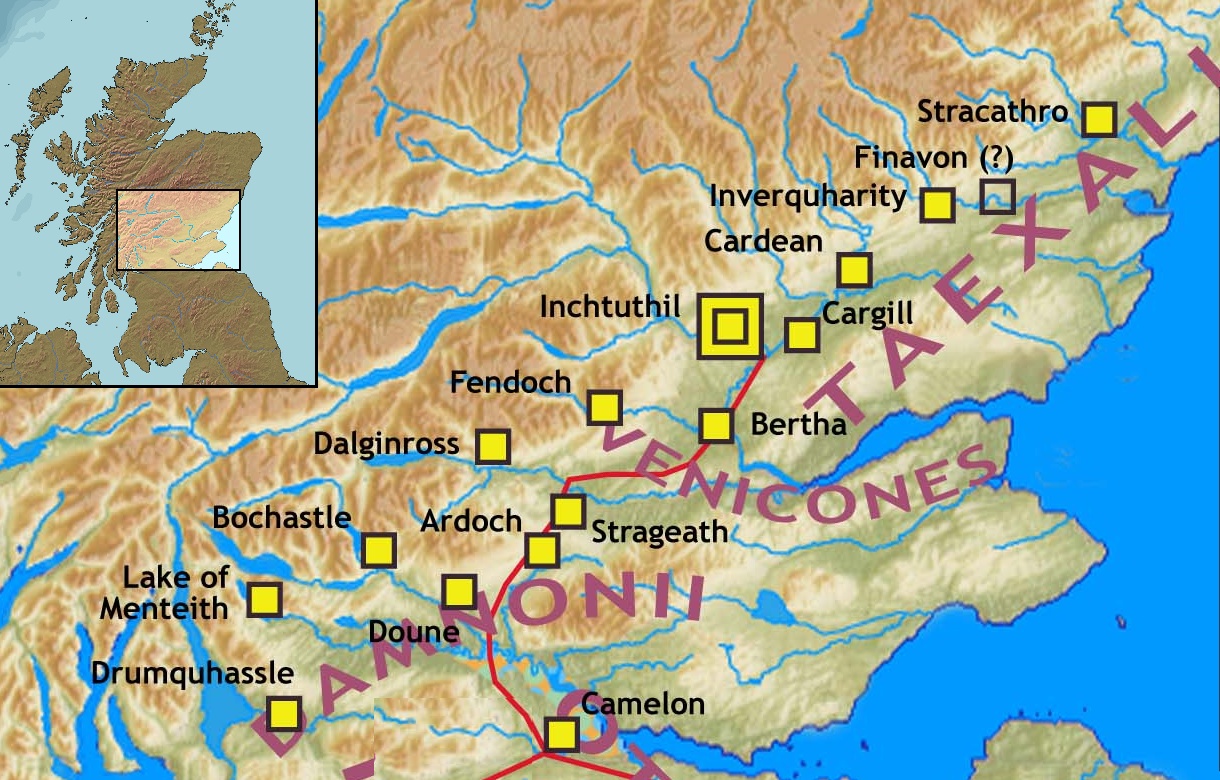
The name "Gask Ridge" refers to the 10-mile (16 km) ridge of land to the north of the River Earn in Perthshire. In Scottish Gaelic, a gasg is a projecting tail or strip of land. In the early 20th century, a line of Roman signal-towers (or watch-towers) was discovered along this ridge between the Roman forts of Strageath and Bertha.
The Gask Ridge system was constructed sometime between 70 and 80 AD. Construction on Hadrian's Wall was started 42 years after completion of the Gask Ridge (from 122 to 130 AD), and the Antonine Wall was started 12 years after completion of Hadrian's Wall (from 142 to 144 AD). Although the Gask Ridge was not a wall, it may be Rome's earliest fortified land frontier. The fortifications approximately follow the boundary between Scotland's fertile Lowlands and mountainous Highlands, in Perth and Kinross and Angus. The later Hadrian's Wall and Antonine Wall were further south and considerably shorter.
The principal forts of the Gask Ridge frontier system were (from south to north): Camelon, Drumquhassle, Malling, Doune, Glenbank (fortlet), Bochastle, Ardoch, Kaims Castle (fortlet), Strageath, Dalginross, Bertha, Fendoch, Cargill (fort and fortlet), Inchtuthil (Legionary fortress), Cardean, Inverquharity (fortlet) and Stracathro.
The forts of Drumquhassle, Menteith/Malling, Bochastle, Doune, Dalginross and Fendoch in the south-west were collectively referred to as glenblocker forts in the older literature; they are also called the Highland line forts. Glenblocker describes their location at the exit of some of the glens.
All of the forts were originally built during the Flavian occupation in Scotland. A broader group consists of
Cardean, Stracathro and Doune are sited further away from their respective traffic corridors, although fulfilling the same function.
A line of watchtowers sit on the Roman Road which you can drive along and then walk when the road turns off.
Hub AI
Gask Ridge AI simulator
(@Gask Ridge_simulator)
Gask Ridge
The Gask Ridge is the modern name given to an early series of fortifications, built by the Romans in Scotland, close to the Highland Line. Modern excavation and interpretation has been pioneered by the Roman Gask Project, with Birgitta Hoffmann and David Woolliscroft. The ridge fortifications: forts, fortlets and watchtowers were only in operation for a few years, probably fewer than ten.
The name "Gask Ridge" refers to the 10-mile (16 km) ridge of land to the north of the River Earn in Perthshire. In Scottish Gaelic, a gasg is a projecting tail or strip of land. In the early 20th century, a line of Roman signal-towers (or watch-towers) was discovered along this ridge between the Roman forts of Strageath and Bertha.
The Gask Ridge system was constructed sometime between 70 and 80 AD. Construction on Hadrian's Wall was started 42 years after completion of the Gask Ridge (from 122 to 130 AD), and the Antonine Wall was started 12 years after completion of Hadrian's Wall (from 142 to 144 AD). Although the Gask Ridge was not a wall, it may be Rome's earliest fortified land frontier. The fortifications approximately follow the boundary between Scotland's fertile Lowlands and mountainous Highlands, in Perth and Kinross and Angus. The later Hadrian's Wall and Antonine Wall were further south and considerably shorter.
The principal forts of the Gask Ridge frontier system were (from south to north): Camelon, Drumquhassle, Malling, Doune, Glenbank (fortlet), Bochastle, Ardoch, Kaims Castle (fortlet), Strageath, Dalginross, Bertha, Fendoch, Cargill (fort and fortlet), Inchtuthil (Legionary fortress), Cardean, Inverquharity (fortlet) and Stracathro.
The forts of Drumquhassle, Menteith/Malling, Bochastle, Doune, Dalginross and Fendoch in the south-west were collectively referred to as glenblocker forts in the older literature; they are also called the Highland line forts. Glenblocker describes their location at the exit of some of the glens.
All of the forts were originally built during the Flavian occupation in Scotland. A broader group consists of
Cardean, Stracathro and Doune are sited further away from their respective traffic corridors, although fulfilling the same function.
A line of watchtowers sit on the Roman Road which you can drive along and then walk when the road turns off.
Recent media