



Community hub
Recent from talks
Contribute something to knowledge base
Content stats: 0 posts, 0 articles, 0 media, 0 notes
Members stats: 0 subscribers, 0 contributors, 0 moderators, 0 supporters
Subscribers
Supporters
Contributors
Moderators
Hub AI
Gaussian function AI simulator
(@Gaussian function_simulator)
Hub AI
Gaussian function AI simulator
(@Gaussian function_simulator)
Gaussian function
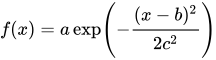
In mathematics, a Gaussian function, often simply referred to as a Gaussian, is a function of the base form and with parametric extension for arbitrary real constants a, b and non-zero c. It is named after the mathematician Carl Friedrich Gauss. The graph of a Gaussian is a characteristic symmetric "bell curve" shape. The parameter a is the height of the curve's peak, b is the position of the center of the peak, and c (the standard deviation, sometimes called the Gaussian RMS width) controls the width of the "bell".

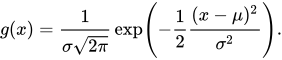
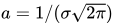
Gaussian functions are often used to represent the probability density function of a normally distributed random variable with expected value μ = b and variance σ2 = c2. In this case, the Gaussian is of the form
Gaussian functions are widely used in statistics to describe the normal distributions, in signal processing to define Gaussian filters, in image processing where two-dimensional Gaussians are used for Gaussian blurs, and in mathematics to solve heat equations and diffusion equations and to define the Weierstrass transform. They are also abundantly used in quantum chemistry to form basis sets.
Gaussian functions arise by composing the exponential function with a concave quadratic function:where

(Note: in , not to be confused with )


The Gaussian functions are thus those functions whose logarithm is a concave quadratic function.
The parameter c is related to the full width at half maximum (FWHM) of the peak according to
Gaussian function
In mathematics, a Gaussian function, often simply referred to as a Gaussian, is a function of the base form and with parametric extension for arbitrary real constants a, b and non-zero c. It is named after the mathematician Carl Friedrich Gauss. The graph of a Gaussian is a characteristic symmetric "bell curve" shape. The parameter a is the height of the curve's peak, b is the position of the center of the peak, and c (the standard deviation, sometimes called the Gaussian RMS width) controls the width of the "bell".
Gaussian functions are often used to represent the probability density function of a normally distributed random variable with expected value μ = b and variance σ2 = c2. In this case, the Gaussian is of the form
Gaussian functions are widely used in statistics to describe the normal distributions, in signal processing to define Gaussian filters, in image processing where two-dimensional Gaussians are used for Gaussian blurs, and in mathematics to solve heat equations and diffusion equations and to define the Weierstrass transform. They are also abundantly used in quantum chemistry to form basis sets.
Gaussian functions arise by composing the exponential function with a concave quadratic function:where
(Note: in , not to be confused with )
The Gaussian functions are thus those functions whose logarithm is a concave quadratic function.
The parameter c is related to the full width at half maximum (FWHM) of the peak according to