
Hubbry Logo
Diffusion equationDiffusion equationMain
Open search
Diffusion equation
Community hub
Diffusion equation
logo
7 pages, 0 posts
0 subscribers
Be the first to start a discussion here.
Diffusion equation
Diffusion equation
from Wikipedia

The diffusion equation is a parabolic partial differential equation. In physics, it describes the macroscopic behavior of many micro-particles in Brownian motion, resulting from the random movements and collisions of the particles (see Fick's laws of diffusion). In mathematics, it is related to Markov processes, such as random walks, and applied in many other fields, such as materials science, information theory, and biophysics. The diffusion equation is a special case of the convection–diffusion equation when bulk velocity is zero. It is equivalent to the heat equation under some circumstances.

Statement

[edit]

The equation is usually written as: where ϕ(r, t) is the density of the diffusing material at location r and time t and D(ϕ, r) is the collective diffusion coefficient for density ϕ at location r; and represents the vector differential operator del. If the diffusion coefficient depends on the density then the equation is nonlinear, otherwise it is linear.

The equation above applies when the diffusion coefficient is isotropic; in the case of anisotropic diffusion, D is a symmetric positive definite matrix, and the equation is written (for three dimensional diffusion) as: The diffusion equation has numerous analytic solutions.[1]

If D is constant, then the equation reduces to the following linear differential equation:

which is identical to the heat equation.

Historical origin

[edit]

The particle diffusion equation was originally derived by Adolf Fick in 1855.[2]

Derivation

[edit]

The diffusion equation can be trivially derived from the continuity equation, which states that a change in density in any part of the system is due to inflow and outflow of material into and out of that part of the system. Effectively, no material is created or destroyed: where j is the flux of the diffusing material. The diffusion equation can be obtained easily from this when combined with the phenomenological Fick's first law, which states that the flux of the diffusing material in any part of the system is proportional to the local density gradient:
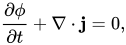

If drift must be taken into account, the Fokker–Planck equation provides an appropriate generalization.

Discretization

[edit]

The diffusion equation is continuous in both space and time. One may discretize space, time, or both space and time, which arise in application. Discretizing time alone just corresponds to taking time slices of the continuous system, and no new phenomena arise. In discretizing space alone, the Green's function becomes the discrete Gaussian kernel, rather than the continuous Gaussian kernel. In discretizing both time and space, one obtains the random walk.

Discretization in image processing

[edit]

The product rule is used to rewrite the anisotropic tensor diffusion equation, in standard discretization schemes, because direct discretization of the diffusion equation with only first order spatial central differences leads to checkerboard artifacts. The rewritten diffusion equation used in image filtering: where "tr" denotes the trace of the 2nd rank tensor, and superscript "T" denotes transpose, in which in image filtering D(ϕ, r) are symmetric matrices constructed from the eigenvectors of the image structure tensors. The spatial derivatives can then be approximated by two first order and a second order central finite differences. The resulting diffusion algorithm can be written as an image convolution with a varying kernel (stencil) of size 3 × 3 in 2D and 3 × 3 × 3 in 3D.

See also

[edit]

References

[edit]

Further reading

[edit]
[edit]
Revisions and contributorsEdit on WikipediaRead on Wikipedia
from Grokipedia
The diffusion equation is a fundamental (PDE) in and physics that models the of a quantity, such as concentration of a substance or , as it spreads through a medium due to random molecular motion. In its standard form in one spatial dimension, it is expressed as ut=D2ux2\frac{\partial u}{\partial t} = D \frac{\partial^2 u}{\partial x^2}, where u(x,t)u(x,t) represents the quantity of interest, tt is time, xx is position, and D>0D > 0 is the diffusion coefficient characterizing the medium's . In higher dimensions, the equation generalizes to ut=D2u\frac{\partial u}{\partial t} = D \nabla^2 u, where 2\nabla^2 is the Laplacian operator. The equation arises from the principle of or energy combined with Fick's first law of diffusion, which states that the diffusive flux JJ is proportional to the negative gradient of concentration: J=DuJ = -D \nabla u. This law, proposed by Adolf Fick in 1855, posits that particles move from regions of higher concentration to lower concentration to equalize differences. Applying the ut+J=0\frac{\partial u}{\partial t} + \nabla \cdot J = 0 yields the diffusion equation, assuming DD is constant. Historically, the diffusion equation first emerged in the context of heat conduction through Joseph Fourier's work in his 1822 treatise Théorie analytique de la chaleur, where it describes heat flow as Tt=κ2T\frac{\partial T}{\partial t} = \kappa \nabla^2 T with thermal diffusivity κ\kappa. Fourier's formulation provided the mathematical foundation, later adapted by Fick for mass diffusion and by in 1905 to explain , linking microscopic random walks to macroscopic diffusion. This PDE is parabolic, exhibiting smoothing behavior that leads to solutions approaching uniform equilibrium over time, distinguishing it from hyperbolic wave equations or elliptic steady-state equations. The diffusion equation has broad applications across disciplines, including modeling solute transport in porous media, in ecology, movement in semiconductors, and even financial option pricing via the Black-Scholes equation, a variant incorporating drift. Numerical solutions often employ or finite element methods due to the equation's linearity and well-posedness under appropriate initial and boundary conditions, such as Dirichlet or Neumann types. Extensions include nonlinear, fractional, or reaction-diffusion variants to capture more complex phenomena like in biology.

Introduction

General statement

The diffusion equation is a that models the spread of a substance through a medium over time. In its standard linear form for isotropic with constant diffusivity, it is given by ut=D2u,\frac{\partial u}{\partial t} = D \nabla^2 u, where u(x,t)u(\mathbf{x}, t) represents the concentration or of the diffusing substance as a function of position x\mathbf{x} and time tt, D>0D > 0 is the , and 2\nabla^2 denotes the Laplacian operator. Here, uu quantifies the amount of the substance per unit volume at a given point, evolving temporally due to random particle motion, while x\mathbf{x} typically spans one, two, or three spatial dimensions depending on the context. The coefficient DD characterizes the material's , determining the rate of spreading; it is a positive scalar in isotropic media where occurs equally in all directions. For more general cases, including variable or direction-dependent diffusivity, the equation takes the form ut=(Du),\frac{\partial u}{\partial t} = \nabla \cdot (D \nabla u), where DD may be a position- or concentration-dependent scalar (for isotropic but inhomogeneous media) or a tensor (for , allowing different rates along principal directions). The diffusion coefficient DD has dimensions of length squared per time, such as m²/s in SI units, reflecting the probabilistic nature of . This formulation bears a close mathematical resemblance to the , which describes temperature evolution in a conducting medium under analogous assumptions.

Physical and mathematical context

The provides a for where particles or substances spread through random motion, leading to a net flux from regions of higher concentration to lower concentration, as conceptualized in . This physical interpretation captures processes like the mixing of solutes in fluids or in solids, where the driving force is the concentration gradient rather than external forces. Mathematically, the diffusion equation belongs to the class of parabolic partial differential (PDEs), which are second-order in spatial variables and first-order in time. This classification arises from the general theory of linear second-order PDEs, where the of the principal symbol determines the type: parabolic equations feature a repeated real root, distinguishing them from hyperbolic PDEs (like the wave equation, which propagate disturbances at finite speeds along characteristics) and elliptic PDEs (like , which describe equilibrium states without and exhibit smoothing). Parabolic equations, in contrast, demonstrate infinite propagation speed but with an inherent smoothing effect, where irregularities in the initial data are rapidly damped over time. To solve the diffusion equation in a bounded domain, appropriate boundary conditions are specified, such as Dirichlet conditions (prescribing the value of the solution on the boundary), Neumann conditions (prescribing the normal derivative or ), or periodic conditions (for repeating domains). Additionally, an is required, typically of the form u(x,0)=u0(x)u(\mathbf{x}, 0) = u_0(\mathbf{x}), which sets the distribution at the starting time. The standard formulation of the diffusion equation relies on several key assumptions: the medium is homogeneous, the diffusion coefficient [D](/page/D)[D](/page/D*) is constant and positive, and the process is linear, meaning superposition holds for solutions. These simplifications enable analytical tractability but may require extensions for heterogeneous or nonlinear scenarios.

Historical development

Origins in diffusion processes

The phenomenon of diffusion has been observed empirically for centuries, with informal descriptions of substances spreading through media, such as the gradual dissemination of vapors in air or dispersing in , predating any formal mathematical treatment. These pre-mathematical models highlighted the spontaneous mixing of matter without mechanical agitation, as noted in early qualitative accounts of natural processes. In the 19th century, systematic experiments began to quantify diffusion in gases and liquids, laying the groundwork for later theoretical developments. Scottish chemist Thomas Graham conducted pioneering studies in the 1820s and 1830s, observing the rates at which gases effuse through small openings or diffuse into other gases, such as the classic demonstration of ammonia and hydrogen chloride vapors meeting to form a white ring. His work culminated in Graham's law of effusion, formulated around 1833, which states that the rate of diffusion of a gas is inversely proportional to the square root of its density, thereby linking macroscopic transport to the underlying molecular motion. Building on these observations, Adolf Fick introduced a quantitative framework in 1855 through his seminal paper "On Liquid Diffusion," where he drew an analogy to Joseph Fourier's earlier work on heat conduction. Fick's first law posits that the diffusive flux J\mathbf{J} is proportional to the negative gradient of the concentration uu, expressed as J=Du\mathbf{J} = -D \nabla u, with DD as the diffusion coefficient; this empirical relation was derived from experiments measuring salt diffusion in aqueous solutions. A microscopic justification for diffusion emerged in 1905 with Albert Einstein's theoretical analysis of , which modeled the erratic movement of suspended particles as a driven by molecular collisions. Einstein demonstrated that this leads to a proportional to time, directly connecting it to the macroscopic diffusion equation and providing empirical validation through predictable particle trajectories in fluids.

Key contributors and milestones

Joseph Fourier's seminal work in 1822 laid the groundwork for the diffusion equation through his development of the heat equation in Théorie analytique de la chaleur, which mathematically described heat conduction as a parabolic partial differential equation and directly inspired subsequent models for mass and particle diffusion processes. Fourier's formulation demonstrated how diffusive phenomena could be captured by equations of the form ut=α2u\frac{\partial u}{\partial t} = \alpha \nabla^2 u, where uu represents temperature or concentration, providing a template for analogous diffusion problems. In the late 19th century, Lord Rayleigh and advanced the theoretical foundations by integrating kinetic theory with , linking macroscopic to microscopic of particle collisions in gases. Rayleigh's work in the 1880s on stochastic processes rediscovered the unity between physical and probabilistic descriptions, while Boltzmann's transport equation (1872, refined through the 1890s) derived coefficients from , establishing as a consequence of random walks in equilibrium systems. Adolf Fick's publication of his laws in 1855 marked a pivotal milestone, formalizing the flux of diffusing substances proportional to the concentration gradient (J=DcJ = -D \nabla c) and leading to the second law that yields the diffusion equation ct=D2c\frac{\partial c}{\partial t} = D \nabla^2 c. In 1905, Albert Einstein provided a rigorous probabilistic interpretation by deriving the diffusion coefficient for spherical particles as D=kT6πηrD = \frac{kT}{6\pi \eta r}, connecting Brownian motion to Fickian diffusion and enabling experimental verification of atomic theory. Early 20th-century extensions by and contemporaries applied the diffusion equation to colloidal systems, introducing boundary conditions for and while emphasizing probabilistic interpretations through Smoluchowski's 1906 theory of under external forces. John Crank's 1956 book The Mathematics of Diffusion synthesized these developments into a comprehensive reference, cataloging analytical solutions and boundary value problems for the equation across diverse geometries and conditions. From the onward, the diffusion equation was recognized as a limiting case of the Fokker-Planck equation, which generalizes it to include drift terms in processes, as formulated by Adriaan Fokker (1914) and (1917) but widely adopted in diffusion contexts during that decade for modeling inhomogeneous random walks.

Mathematical formulation

Derivation from conservation laws

The diffusion equation can be derived from the fundamental principle of mass conservation, expressed through the , combined with a constitutive relation describing the diffusive flux. This approach assumes a continuum description of the diffusing substance, where the local concentration u(x,t)u(\mathbf{x}, t) represents the per unit volume at position x\mathbf{x} and time tt. The continuity equation for mass conservation, in the absence of sources or sinks, states that the rate of change of concentration within a volume equals the negative divergence of the flux J\mathbf{J} through its surface: \frac{\partial u}{\partial t} + \nabla \cdot \mathbf{J} = 0. $$/03%3A_Diffusion/10%3A_Diffusion/10.01%3A_Continuum_Diffusion) Fick's first law provides the relation between the flux and the concentration gradient, stating that the diffusive flux is proportional to the negative gradient of the concentration, reflecting the tendency of particles to move from regions of high to low concentration: \mathbf{J} = -D \nabla u, [](https://www.researchgate.net/publication/7926018_On_the_sesquicentennial_of_Fick%27s_laws_of_diffusion) where $D > 0$ is the [diffusion](/page/Diffusion) coefficient, a material-specific constant characterizing the ease of diffusion. This law was originally proposed by Adolf Fick in 1855 as an analogy to Fourier's law of heat conduction.[](https://www.researchgate.net/publication/7926018_On_the_sesquicentennial_of_Fick%27s_laws_of_diffusion) Substituting Fick's first law into the [continuity equation](/page/Continuity_equation) yields the diffusion equation: \frac{\partial u}{\partial t} = \nabla \cdot (D \nabla u). [](https://www.comsol.com/multiphysics/diffusion-equation) For constant $D$ and in Cartesian coordinates, this simplifies to the standard form: \frac{\partial u}{\partial t} = D \nabla^2 u. To illustrate the derivation in one dimension, consider a thin slab of material between positions $x$ and $x + \Delta x$ with cross-sectional area $A = 1$ for simplicity. The mass in this [control volume](/page/Control_volume) is $u(x, t) \Delta x$, and its time rate of change is $\frac{\partial u}{\partial t} \Delta x$. The net mass flux out of the slab is the difference in one-dimensional flux: $J(x + \Delta x, t) - J(x, t)$. By [conservation of mass](/page/Conservation_of_mass), \frac{\partial u}{\partial t} \Delta x = - [J(x + \Delta x, t) - J(x, t)]. Dividing by $\Delta x$ and taking the limit as $\Delta x \to 0$ gives \frac{\partial u}{\partial t} = -\frac{\partial J}{\partial x}. Applying Fick's first law in one dimension, $J = -D \frac{\partial u}{\partial x}$, and assuming constant $D$, substitution results in \frac{\partial u}{\partial t} = D \frac{\partial^2 u}{\partial x^2}. This derivation relies on several key assumptions: the absence of sources or sinks (no production or consumption terms in the continuity equation), isotropic diffusion (where $D$ is a scalar rather than a tensor, implying uniform diffusion in all directions), and local thermodynamic equilibrium (justifying the linear relation in Fick's law).[](https://scholar.harvard.edu/files/schwartz/files/2-diffusion_0.pdf) ### General forms in different dimensions The diffusion equation generalizes naturally to higher spatial dimensions by replacing the second derivative in one dimension with the Laplacian operator, which accounts for diffusion in all directions. In two dimensions, the isotropic form is given by \frac{\partial u}{\partial t} = D \left( \frac{\partial^2 u}{\partial x^2} + \frac{\partial^2 u}{\partial y^2} \right), where $u(x,y,t)$ represents the concentration or temperature, and $D$ is the diffusion coefficient. This equation describes the evolution of diffusive processes on a plane, such as heat spread in a thin sheet. In polar coordinates $(r, \theta)$, the Laplacian takes the form $\nabla^2 u = \frac{1}{r} \frac{\partial}{\partial r} \left( r \frac{\partial u}{\partial r} \right) + \frac{1}{r^2} \frac{\partial^2 u}{\partial \theta^2}$, yielding \frac{\partial u}{\partial t} = D \left[ \frac{1}{r} \frac{\partial}{\partial r} \left( r \frac{\partial u}{\partial r} \right) + \frac{1}{r^2} \frac{\partial^2 u}{\partial \theta^2} \right]. Thiscoordinatesystemisparticularlyusefulforproblemswithradialorangularsymmetry,likediffusionfromacircularsource.[](https://www.unimuenster.de/imperia/md/content/physiktp/lectures/ws20162017/nummethodsi/heat.pdf)[](https://lkn.math.ncsu.edu/MA401/OnLine/LaplacianInPolarCoordinates.pdf)Inthreedimensions,theequationbecomes This coordinate system is particularly useful for problems with radial or angular symmetry, like diffusion from a circular source.[](https://www.uni-muenster.de/imperia/md/content/physik_tp/lectures/ws2016-2017/num_methods_i/heat.pdf)[](https://lkn.math.ncsu.edu/MA401/OnLine/LaplacianInPolarCoordinates.pdf) In three dimensions, the equation becomes \frac{\partial u}{\partial t} = D \nabla^2 u, where $\nabla^2 u = \frac{\partial^2 u}{\partial x^2} + \frac{\partial^2 u}{\partial y^2} + \frac{\partial^2 u}{\partial z^2}$ is the scalar Laplacian in Cartesian coordinates. For spherical symmetry in coordinates $(r, \theta, \phi)$, the Laplacian expands to $\nabla^2 u = \frac{1}{r^2} \frac{\partial}{\partial r} \left( r^2 \frac{\partial u}{\partial r} \right) + \frac{1}{r^2 \sin \theta} \frac{\partial}{\partial \theta} \left( \sin \theta \frac{\partial u}{\partial \theta} \right) + \frac{1}{r^2 \sin^2 \theta} \frac{\partial^2 u}{\partial \phi^2}$, simplifying to the radial form $\frac{\partial u}{\partial t} = D \frac{1}{r^2} \frac{\partial}{\partial r} \left( r^2 \frac{\partial u}{\partial r} \right)$ when angular dependence is absent. This is applicable to scenarios like solute diffusion in a spherical particle.[](https://people.maths.bris.ac.uk/~macpd/apde2/chap7.pdf)[](http://web.mit.edu/8.Math/www/lectures/lec13/3.5.3.pdf) For anisotropic diffusion, where diffusivity varies by direction, $D$ becomes a symmetric positive-definite tensor $\mathbf{D}$, and the equation is \frac{\partial u}{\partial t} = \nabla \cdot (\mathbf{D} \nabla u). In matrix form for Cartesian coordinates, this expands to $\frac{\partial u}{\partial t} = \sum_{i,j=1}^n \frac{\partial}{\partial x_i} \left( D_{ij} \frac{\partial u}{\partial x_j} \right)$, capturing directional preferences in materials like composites.[](https://link.aps.org/doi/10.1103/PhysRevE.74.061103)[](https://homepage.tudelft.nl/d2b4e/numanal/marlen_afst.pdf) The standard forms assume infinite domains, but for finite or bounded regions, boundary conditions are essential to specify [flux](/page/Flux) at interfaces. No-[flux](/page/Flux) (Neumann) boundaries enforce $\mathbf{n} \cdot (\mathbf{D} \nabla u) = 0$, where $\mathbf{n}$ is the outward normal, preventing diffusive transport across impermeable walls and conserving total quantity.[](http://web.mit.edu/1.061/www/dream/FOUR/FOURTHEORY.PDF) When the diffusion coefficient varies with time, the equation adjusts to $\frac{\partial u}{\partial t} = \nabla \cdot (D(t) \nabla u)$, though this introduces challenges like non-self-adjoint operators that may complicate analytical solutions and require case-specific analysis for well-posedness.[](https://link.aps.org/doi/10.1103/PhysRevE.72.011107) ## Properties and theory ### Fundamental solutions and Green's functions The fundamental solution to the diffusion equation $\partial_t u = D \partial_{xx} u$ on the infinite domain $-\infty < x < \infty$ with a Dirac delta initial condition at $x=0$ is given by the Gaussian kernel G(x, t) = \frac{1}{\sqrt{4\pi D t}} \exp\left( -\frac{x^2}{4 D t} \right) for $t > 0$.[](https://www.math.ucsd.edu/~jmckerna/Teaching/18-19/Autumn/110A/l_11.pdf) This explicit form arises from solving the equation via self-similar [ansatz](/page/Ansatz) or [Fourier transform](/page/Fourier_transform) methods and satisfies the initial condition in the sense of distributions, as $\int_{-\infty}^{\infty} G(x, t) \, dx = 1$ for all $t > 0$.[](https://www.math.ucsd.edu/~jmckerna/Teaching/18-19/Autumn/110A/l_11.pdf) Physically, $G(x, t)$ describes the evolution of a point-source initial concentration of total mass 1 at the origin, with the [diffusion process](/page/Diffusion_process) spreading the mass symmetrically. The distribution has zero [mean](/page/Mean) and variance $2 D t$, reflecting the linear growth of spatial spread with time.[](https://neherlab.org/PoL_notebooks/2023/lecture04b_DiffusionEquation.pdf) In higher dimensions, the fundamental solution generalizes to G(\mathbf{x}, t) = \frac{1}{(4\pi D t)^{n/2}} \exp\left( -\frac{|\mathbf{x}|^2}{4 D t} \right) for $\mathbf{x} \in \mathbb{R}^n$, preserving the total [integral](/page/Integral) of 1 and exhibiting variance $2 D t$ per [dimension](/page/Dimension).[](https://www.damtp.cam.ac.uk/user/dbs26/1BMethods/Heat.pdf) The Green's function approach leverages this kernel to represent general solutions to the initial-value problem. For initial data $u(\mathbf{x}, 0) = u_0(\mathbf{x})$, the solution is the convolution u(\mathbf{x}, t) = \int_{\mathbb{R}^n} G(\mathbf{x} - \mathbf{y}, t) u_0(\mathbf{y}) , d\mathbf{y}, which linearly superposes point-source responses and ensures mass conservation if $u_0$ integrates to a finite total.[](https://www.math.ucsd.edu/~jmckerna/Teaching/18-19/Autumn/110A/l_11.pdf) This integral form highlights the smoothing effect of diffusion, transforming arbitrary initial profiles into progressively Gaussian-like distributions over time. A key property of the fundamental solution is its [self-similarity](/page/Self-similarity), stemming from the scaling invariance of the diffusion equation under transformations $x \mapsto \lambda x$, $t \mapsto \lambda^2 t$, and $u \mapsto \lambda^{-n} u$ in $[n](/page/N+)$ dimensions. The solution depends only on the similarity variable $\eta = \mathbf{x} / \sqrt{4 D t}$, yielding $G(\mathbf{x}, t) = (4 D t)^{-n/2} g(\eta)$ where $g$ is a fixed radial Gaussian profile.[](https://www.damtp.cam.ac.uk/user/dbs26/1BMethods/Heat.pdf) This reduces the PDE to [an ODE](/page/An_Ode) in $\eta$, facilitating analytical insight into the spreading dynamics. Asymptotically, as $t \to 0^+$, the kernel sharpens to a Dirac delta distribution $\delta(\mathbf{x})$, preserving the initial point-source localization. Conversely, as $t \to \infty$, the solution flattens with peak height decaying as $(4\pi D t)^{-n/2}$ and width expanding proportionally to $\sqrt{t}$, illustrating the irreversible homogenization inherent to diffusion.[](https://www.damtp.cam.ac.uk/user/dbs26/1BMethods/Heat.pdf) ### Uniqueness and maximum principles The maximum principle for solutions of the [diffusion equation](/page/Diffusion_equation), a prototypical [parabolic partial differential equation](/page/Parabolic_partial_differential_equation), asserts that the maximum value of the solution $u(x,t)$ over a bounded domain $\Omega \subset \mathbb{R}^n$ and time interval $[0,T]$ occurs either on the initial time $t=0$ or on the parabolic boundary $\partial \Omega \times [0,T]$.[](https://www.math.ubc.ca/~gustaf/M516/L17.pdf) This principle holds for the classical [heat equation](/page/Heat_equation) $\partial_t u = \Delta u$ under suitable boundary conditions, such as Dirichlet or [Neumann](/page/Neumann), and extends to more general linear parabolic equations with bounded coefficients.[](https://projecteuclid.org/journals/pacific-journal-of-mathematics/volume-8/issue-2/Remarks-on-the-maximum-principle-for-parabolic-equations-and-its/pjm/1103040096.pdf) A proof sketch relies on the comparison [principle](/page/Principle): suppose $u$ achieves an interior maximum at $(x_0, t_0)$ with $t_0 > 0$; then at that point, $\partial_t u(x_0, t_0) \leq 0$ and $\Delta u(x_0, t_0) \leq 0$, contradicting the equation unless the maximum is constant, which propagates backward to the boundary via energy methods or the strong [maximum principle](/page/Maximum_principle).[](https://www.math.ucdavis.edu/~hunter/pdes/ch6.pdf) Uniqueness of solutions to the diffusion equation follows from energy estimates in appropriate function spaces. For the initial-boundary value problem on a bounded domain with $u_0 \in L^2(\Omega)$, if two solutions $u$ and $v$ satisfy the equation, their difference $w = u - v$ solves the homogeneous equation with zero initial and boundary data; multiplying by $w$ and integrating yields $\frac{d}{dt} \int_\Omega |w|^2 \, dx + 2 \int_\Omega |\nabla w|^2 \, dx = 0$, implying $\int_\Omega |\nabla w|^2 \, dx$ is nonincreasing and $w \equiv 0$ by Gronwall's inequality or Poincaré estimates.[](https://math.uchicago.edu/~may/REU2014/REUPapers/Ji.pdf) This holds under conditions like $L^2$ integrability of initial data and compatibility with boundary conditions, ensuring well-posedness in Hilbert spaces.[](https://www.math.cmu.edu/~rcristof/pdf/Teaching/Spring2017/Energy-uniqueness%281%29.pdf) Existence of solutions can be established via the Galerkin method for weak solutions in Sobolev spaces or through semigroup theory in Banach spaces. In the Galerkin approach, approximate solutions are projected onto finite-dimensional subspaces of $H^1_0(\Omega)$, yielding a system of ODEs whose solutions converge weakly to a solution of the variational formulation as the dimension increases, with uniform energy bounds ensuring compactness.[](https://www.math.ucdavis.edu/~hunter/notes/nonlinev.pdf) Semigroup methods generate a contraction semigroup on $L^2(\Omega)$ via the Laplacian's self-adjointness, providing mild solutions that coincide with classical ones under higher regularity.[](https://web.stanford.edu/class/math220b/handouts/heateqn.pdf) Solutions to the diffusion equation exhibit strong regularity properties for $t > 0$, even with rough initial data. Specifically, if the initial condition $u_0$ is merely bounded or in $L^p(\Omega)$, the solution $u(\cdot, t)$ becomes infinitely differentiable in space and Hölder continuous in time, with estimates like $\|u(\cdot, t)\|_{C^{k,\alpha}(\overline{\Omega})} \leq C t^{-\beta}$ for suitable $\beta > 0$, reflecting the parabolic smoothing effect.[](https://people.math.harvard.edu/~spicard/notes-parabolicpde.pdf) This Hölder continuity, often in the Schauder sense, follows from potential theory or parametrix constructions, ensuring classical solutions interior to the domain for positive times.[](https://www.math.ucdavis.edu/~hunter/pdes/ch6.pdf) These principles have limitations in nonlinear variants of the diffusion equation, such as those with reaction terms or degenerate diffusion coefficients, where the strong [maximum principle](/page/Maximum_principle) may fail due to interior maxima or "[needles](/page/The_Needles)" in the solution profile.[](https://www.researchgate.net/publication/278099699_Failure_of_the_strong_maximum_principle_in_nonlinear_diffusion_Existence_of_needles) ## Solution methods ### Analytical approaches Analytical approaches to solving the diffusion equation, ∂u/∂t = D ∇²u, yield exact closed-form solutions for well-posed initial-boundary value problems, particularly in one or higher dimensions with specific geometries. These methods, rooted in transform techniques and series expansions, transform the [partial differential equation](/page/Partial_differential_equation) (PDE) into solvable ordinary differential equations (ODEs) or [integral](/page/Integral) equations, often leveraging [symmetry](/page/Symmetry) or superposition principles. Pioneered in the context of [heat](/page/Heat) conduction, such techniques remain foundational for theoretical [analysis](/page/Analysis) in diffusion processes.[](https://www3.nd.edu/~powers/ame.20231/fourier1822.pdf) The [separation of variables](/page/Separation_of_variables) method is applicable to bounded domains with homogeneous boundary conditions, assuming a product form u(x,t) = X(x)T(t) that decouples the PDE into spatial and temporal ODEs. For the one-dimensional case on [0, L] with Dirichlet conditions u(0,t) = u(L,t) = 0, substitution yields X''/X = (1/D) T'/T = -λ, leading to the eigenvalue problem X'' + λX = 0 with eigenvalues λ_n = (nπ/L)^2 and eigenfunctions X_n(x) = [sin](/page/Sin)(nπx/L) for n = 1,2,... The temporal equation T' + D λ T = 0 gives T_n(t) = exp(-D λ_n t), so the general solution is the superposition u(x,t) = \sum_{n=1}^\infty b_n \sin\left(\frac{n\pi x}{L}\right) \exp\left(-D \left(\frac{n\pi}{L}\right)^2 t\right), where coefficients b_n are Fourier sine series coefficients of the initial condition u(x,0). This approach extends to higher dimensions and other boundary types, such as Neumann conditions, by adjusting the eigenfunctions accordingly. Originally developed by Fourier for heat flow in solids, it provides explicit series solutions for transient diffusion in finite geometries.[](https://www3.nd.edu/~powers/ame.20231/fourier1822.pdf)[](https://www-eng.lbl.gov/~shuman/NEXT/MATERIALS&COMPONENTS/Xe_damage/Crank-The-Mathematics-of-Diffusion.pdf) For unbounded or semi-infinite domains, the Fourier transform method exploits translational invariance. The one-dimensional Fourier transform of u(x,t) is û(ω,t) = ∫_{-∞}^∞ u(x,t) e^{-i ω x} dx, transforming the diffusion equation to ∂û/∂t = -D ω² û(ω,t). With initial condition û(ω,0), the solution is û(ω,t) = û(ω,0) exp(-D ω² t), and u(x,t) is recovered via inverse transform u(x,t) = \frac{1}{2\pi} \int_{-\infty}^\infty \hat{u}(\omega,0) \exp(i \omega x - D \omega^2 t) , d\omega. This yields the fundamental Gaussian solution for an initial delta function, u(x,0) = δ(x), as u(x,t) = (4π D t)^{-1/2} exp(-x²/(4 D t)), which convolves with arbitrary initials via superposition. The method is particularly effective for infinite domains without boundaries.[](https://www-eng.lbl.gov/~shuman/NEXT/MATERIALS&COMPONENTS/Xe_damage/Crank-The-Mathematics-of-Diffusion.pdf) The [Laplace transform](/page/Laplace_transform), applied with respect to time, suits initial-boundary value problems by converting the time derivative to an algebraic term. For one dimension, the transform ũ(x,s) = ∫_0^∞ u(x,t) e^{-s t} dt satisfies s ũ(x,s) - u(x,0) = D ∂²ũ/∂x², a second-order [ODE](/page/Ode) solvable subject to transformed boundary conditions. Inversion via [contour integration](/page/Contour_integration) or tables then yields u(x,t). This technique handles non-homogeneous or time-dependent boundaries efficiently, often complementing [separation of variables](/page/Separation_of_variables) for finite times.[](https://www-eng.lbl.gov/~shuman/NEXT/MATERIALS&COMPONENTS/Xe_damage/Crank-The-Mathematics-of-Diffusion.pdf) The [method of images](/page/Method_of_images) addresses boundary effects in semi-infinite or finite domains by extending the infinite-domain solution with fictitious "[image](/page/Image)" sources to enforce conditions. For a reflecting (no-flux) boundary at x=0, an [image](/page/Image) source at -x_0 mirrors a real source at x_0, yielding u(x,t) = (4π D t)^{-1/2} [exp(-(x - x_0)^2/(4 D t)) + exp(-(x + x_0)^2/(4 D t))], satisfying ∂u/∂x|_{x=0} = 0. For absorbing boundaries (u=0), a negative [image](/page/Image) is used. Multiple images handle slabs or cylinders via infinite series or periodic extensions. This approach simplifies problems reducible to fundamental solutions.[](https://www-eng.lbl.gov/~shuman/NEXT/MATERIALS&COMPONENTS/Xe_damage/Crank-The-Mathematics-of-Diffusion.pdf) In the long-time limit t → ∞, transient terms decay, and the diffusion equation reduces to the steady-state form ∇²u = 0, known as [Laplace's equation](/page/Laplace's_equation). Solutions are harmonic functions, analytic and satisfying the mean-value property, determined solely by boundary values without sources. For example, in one dimension, u(x) = a + b x for constant flux boundaries. These limits provide equilibrium profiles essential for interpreting asymptotic behavior in confined systems.[](https://www-eng.lbl.gov/~shuman/NEXT/MATERIALS&COMPONENTS/Xe_damage/Crank-The-Mathematics-of-Diffusion.pdf) ### Numerical discretization techniques Numerical discretization techniques approximate solutions to the diffusion equation by replacing continuous [derivatives](/page/Hartshorn) with discrete differences or integrals on a computational grid, enabling solutions for complex geometries, nonlinear variants, or irregular boundaries where analytical methods are impractical. These methods convert the PDE into a system of ordinary differential or algebraic equations, solved iteratively, with considerations for stability, accuracy, and computational efficiency.[](https://www-eng.lbl.gov/~shuman/NEXT/MATERIALS&COMPONENTS/Xe_damage/Crank-The-Mathematics-of-Diffusion.pdf) Finite difference methods are among the most common, approximating spatial and temporal derivatives on a uniform grid. The explicit forward-time centered-space ([FTCS](/page/FTCS_scheme)) scheme discretizes the one-dimensional equation as (u_i^{n+1} - u_i^n)/Δt = D (u_{i+1}^n - 2u_i^n + u_{i-1}^n)/(Δx)^2, yielding u_i^{n+1} = u_i^n + r (u_{i+1}^n - 2u_i^n + u_{i-1}^n), where r = D Δt / (Δx)^2 ≤ 1/2 for stability. This method is straightforward but restricted by the stability condition, limiting time step size.[](https://www-eng.lbl.gov/~shuman/NEXT/MATERIALS&COMPONENTS/Xe_damage/Crank-The-Mathematics-of-Diffusion.pdf)[](https://sites.engineering.ucsb.edu/~moehlis/APC591/tutorials/tutorial5/) Implicit schemes, such as backward Euler, use future time levels for spatial differences, resulting in a [linear system](/page/Linear_system) Au^{n+1} = u^n that must be solved at each step; they are unconditionally stable but require matrix inversion. The Crank-Nicolson method combines explicit and implicit approximations, achieving second-order accuracy in time and unconditional stability, and is widely used for its balance of efficiency and reliability in multi-dimensional problems. Extensions to higher dimensions and variable coefficients involve analogous grids, with boundary conditions incorporated via ghost points or modified stencils.[](https://www-eng.lbl.gov/~shuman/NEXT/MATERIALS&COMPONENTS/Xe_damage/Crank-The-Mathematics-of-Diffusion.pdf) Other techniques include finite element methods, which use variational formulations and basis functions for irregular domains, and finite volume methods, which conserve quantities locally by integrating over control volumes. These are particularly suited for engineering applications like [heat transfer](/page/Heat_transfer) or porous media flow, often implemented in software libraries.[](https://www-eng.lbl.gov/~shuman/NEXT/MATERIALS&COMPONENTS/Xe_damage/Crank-The-Mathematics-of-Diffusion.pdf) ## Applications ### In physical sciences The diffusion equation finds one of its primary applications in modeling heat conduction in physical systems, where it manifests as the [heat equation](/page/Heat_equation). This [parabolic partial differential equation](/page/Parabolic_partial_differential_equation) describes how thermal energy propagates through materials due to [temperature](/page/Temperature) gradients, governed by Fourier's law of heat conduction, which posits that [heat flux](/page/Heat_flux) is proportional to the negative [gradient](/page/Gradient) of [temperature](/page/Temperature). The standard one-dimensional form is \frac{\partial T}{\partial t} = \alpha \frac{\partial^2 T}{\partial x^2}, where $T$ is temperature, $t$ is time, $x$ is position, and $\alpha = k / (\rho c_p)$ is the [thermal diffusivity](/page/Thermal_diffusivity), with $k$ denoting thermal conductivity, $\rho$ the [density](/page/Density), and $c_p$ the [specific heat capacity](/page/Specific_heat_capacity). This formulation was first systematically derived by [Joseph Fourier](/page/Joseph_Fourier) in his seminal 1822 treatise *Théorie analytique de la chaleur*, revolutionizing the understanding of [heat transfer](/page/Heat_transfer) as a diffusive process rather than relying on caloric [fluid](/page/Fluid) theories.[](https://www3.nd.edu/~powers/ame.20231/fourier1878.pdf) A classic example is the cooling of a hot metal object in a cooler environment, where initial high temperatures at the surface diffuse inward, leading to uniform cooling over time; solutions to the [heat equation](/page/Heat_equation) predict [exponential decay](/page/Exponential_decay) of temperature differences, essential for analyzing transient [thermal](/page/Thermal) behaviors in [solids](/page/The_Solids) like metals or ceramics. In chemistry and physics, the diffusion equation underpins the description of [molecular diffusion](/page/Molecular_diffusion), particularly through Fick's laws, which quantify the [transport](/page/Transport) of particles from regions of high to low concentration. Fick's first law states that the diffusive [flux](/page/Flux) $J$ is $J = -D \nabla c$, where $D$ is the diffusion coefficient and $c$ is concentration; combining this with [conservation of mass](/page/Conservation_of_mass) yields the second law, the diffusion equation $\partial c / \partial t = D \nabla^2 c$, originally proposed by Adolf Fick in 1855 by analogy to heat conduction.[](https://pubs.acs.org/doi/10.1021/ed041p397) This model applies to Fickian [diffusion](/page/Diffusion) in gases, liquids, and solutions, capturing phenomena such as the spread of oxygen molecules through biological tissues, where $D$ for O₂ in [water](/page/Water) is approximately $2 \times 10^{-9}$ m²/s at 25°C, facilitating respiration at cellular levels./Kinetics/09%3A_Diffusion) Similarly, in environmental physics, it models [pollutant](/page/Pollutant) dispersion in [water](/page/Water) bodies, like the diffusion of contaminants from a spill, where low $D$ values (e.g., $10^{-10}$ to $10^{-9}$ m²/s for organic solutes) lead to gradual spreading influenced by hydrodynamic conditions.[](https://www.sciencedirect.com/topics/engineering/ficks-law) A representative example is the diffusion of [sucrose](/page/Sucrose) (table sugar) in [water](/page/Water), with $D \approx 5 \times 10^{-10}$ m²/s at 25°C, illustrating how molecular size and [solvent](/page/Solvent) interactions determine [transport](/page/Transport) rates in dilute solutions.[](https://ift.onlinelibrary.wiley.com/doi/pdf/10.1111/j.1365-2621.1987.tb06655.x) In nuclear physics, the diffusion equation approximates neutron transport in reactors, simplifying the more complex Boltzmann transport equation under assumptions of isotropic scattering and low absorption. The steady-state neutron diffusion equation takes the form $D \nabla^2 \phi + (k - 1) \Sigma_a \phi = 0$, where $\phi$ is the neutron flux, $D$ is the diffusion coefficient (related to mean free path and speed), $\Sigma_a$ is the macroscopic absorption cross-section, and $k$ is the effective multiplication factor determining reactor criticality ($k = 1$ for steady operation).[](https://www.sciencedirect.com/topics/engineering/neutron-diffusion-equation) This approximation, developed in the mid-20th century as part of reactor theory, enables efficient calculation of flux distributions in fissile materials like uranium-235, crucial for designing thermal reactors where neutrons diffuse through moderators like water or graphite to sustain controlled chain reactions.[](https://www.nrc.gov/docs/ml1214/ml12142a086.pdf) Electrochemical processes in physical sciences also rely on the diffusion equation, often extended via the Nernst-Planck framework to account for ion migration under [electric fields](/page/Electric_Fields) alongside [diffusion](/page/Diffusion). The Nernst-Planck equation for species flux is $J_i = -D_i \nabla c_i - \frac{z_i F D_i c_i}{RT} \nabla \phi$, where subscripts denote species, $z_i$ is charge number, $F$ is Faraday's constant, $R$ is the [gas constant](/page/Gas_constant), $T$ is [temperature](/page/Temperature), and $\phi$ is [electric potential](/page/Electric_potential); continuity yields a diffusion-like equation coupled with [Poisson's equation](/page/Poisson's_equation) for charge balance.[](https://www.sciencedirect.com/topics/engineering/nernst-planck-equation) This describes ion [diffusion](/page/Diffusion) in batteries, such as lithium-ion transport in electrolytes, limiting charge-discharge rates and capacity.[](https://www.mdpi.com/2313-0105/10/7/238) In [corrosion](/page/Corrosion) modeling, it simulates the [diffusion](/page/Diffusion) of corrosive ions (e.g., Cl⁻) through protective [oxide](/page/Oxide) layers on metals, where slow diffusion coefficients predict pitting [initiation](/page/Initiation) and [propagation](/page/Propagation) rates in aqueous environments.[](https://pubs.acs.org/doi/10.1021/acsmeasuresciau.2c00070) ### In engineering and computation In engineering, the diffusion equation finds extensive application in image processing through anisotropic variants that enable [noise reduction](/page/Noise_reduction) while preserving edges. The Perona-Malik model introduces a nonlinear diffusion process defined by the partial differential equation \frac{\partial I}{\partial t} = \div \left( g(|\nabla I|) \nabla I \right), where $I$ represents the image intensity, $\nabla I$ is the [image gradient](/page/Image_gradient), and $g$ is an edge-stopping function that decreases with increasing gradient magnitude to halt diffusion across strong edges.[](https://www.sci.utah.edu/~gerig/CS7960-S2010/materials/Perona-Malik/PeronaMalik-PAMI-1990.pdf) This approach, originally proposed for [scale-space](/page/Scale_space) analysis and [edge detection](/page/Edge_detection), has become a cornerstone for denoising in [computer vision](/page/Computer_vision) tasks, balancing smoothness in homogeneous regions with fidelity at boundaries.[](https://www.sci.utah.edu/~gerig/CS7960-S2010/materials/Perona-Malik/PeronaMalik-PAMI-1990.pdf) In [fluid dynamics](/page/Fluid_dynamics), the diffusion equation underpins the modeling of viscous effects within the Navier-Stokes equations, where the term $\nu \nabla^2 \mathbf{u}$ captures [momentum diffusion](/page/Momentum_diffusion) due to [viscosity](/page/Viscosity), with $\nu$ as the kinematic [viscosity](/page/Viscosity) and $\mathbf{u}$ the velocity field.[](https://www.grc.nasa.gov/www/BGH/nseqs.html) This viscous diffusion term is essential for simulating laminar flows, [boundary layer](/page/Boundary_layer) development, and [turbulence](/page/Turbulence) in [engineering](/page/Engineering) designs such as pipelines, [aircraft](/page/Aircraft) wings, and [heat](/page/Heat) exchangers.[](https://www.grc.nasa.gov/www/BGH/nseqs.html) Similarly, in [materials science](/page/Materials_science), [dopant](/page/Dopant) [diffusion](/page/Diffusion) during [semiconductor](/page/Semiconductor) fabrication relies on the diffusion equation to predict impurity profiles, enabling precise control of electrical properties in devices like transistors and solar cells through thermal annealing processes.[](https://www.cityu.edu.hk/phy/appkchu/AP6120/8.PDF) The diffusion equation also manifests in finance via the Black-Scholes partial differential equation for option pricing, given by \frac{\partial V}{\partial t} + \frac{1}{2} \sigma^2 S^2 \frac{\partial^2 V}{\partial S^2} + r S \frac{\partial V}{\partial S} - r V = 0, where $V$ is the option value, $S$ the underlying asset price, $\sigma$ the volatility, and $r$ the risk-free rate; this heat-like equation models the probabilistic diffusion of asset prices under [geometric Brownian motion](/page/Geometric_Brownian_motion).[](https://www.cs.princeton.edu/courses/archive/fall09/cos323/papers/black_scholes73.pdf) In computational engineering, solving large-scale diffusion problems benefits from GPU acceleration, which parallelizes [finite difference](/page/Finite_difference) or finite element discretizations to achieve real-time simulations in scenarios like reacting flows or [heat transfer](/page/Heat_transfer), often yielding speedups of 10-100x over CPU implementations.[](https://developer.nvidia.com/gpugems/gpugems/part-vi-beyond-triangles/chapter-38-fast-fluid-dynamics-simulation-gpu) Recent advancements integrate diffusion principles into [machine learning](/page/Machine_learning) for generative AI, where score-based models approximate the reverse [diffusion process](/page/Diffusion_process) to generate data by iteratively denoising from noise distributions, as in denoising diffusion probabilistic models that have revolutionized [image](/page/Image) and video synthesis.[](https://proceedings.neurips.cc/paper/2020/file/4c5bcfec8584af0d967f1ab10179ca4b-Paper.pdf) These models, rooted in [stochastic](/page/Stochastic) differential equations akin to the [diffusion equation](/page/Diffusion), enable high-fidelity sampling in applications from art generation to [drug discovery](/page/Drug_discovery).[](https://arxiv.org/abs/2011.13456)
Add your contribution
Related Hubs
User Avatar
No comments yet.