



Community hub
Recent from talks
Knowledge base stats:
Talk channels stats:
Members stats:
Geats
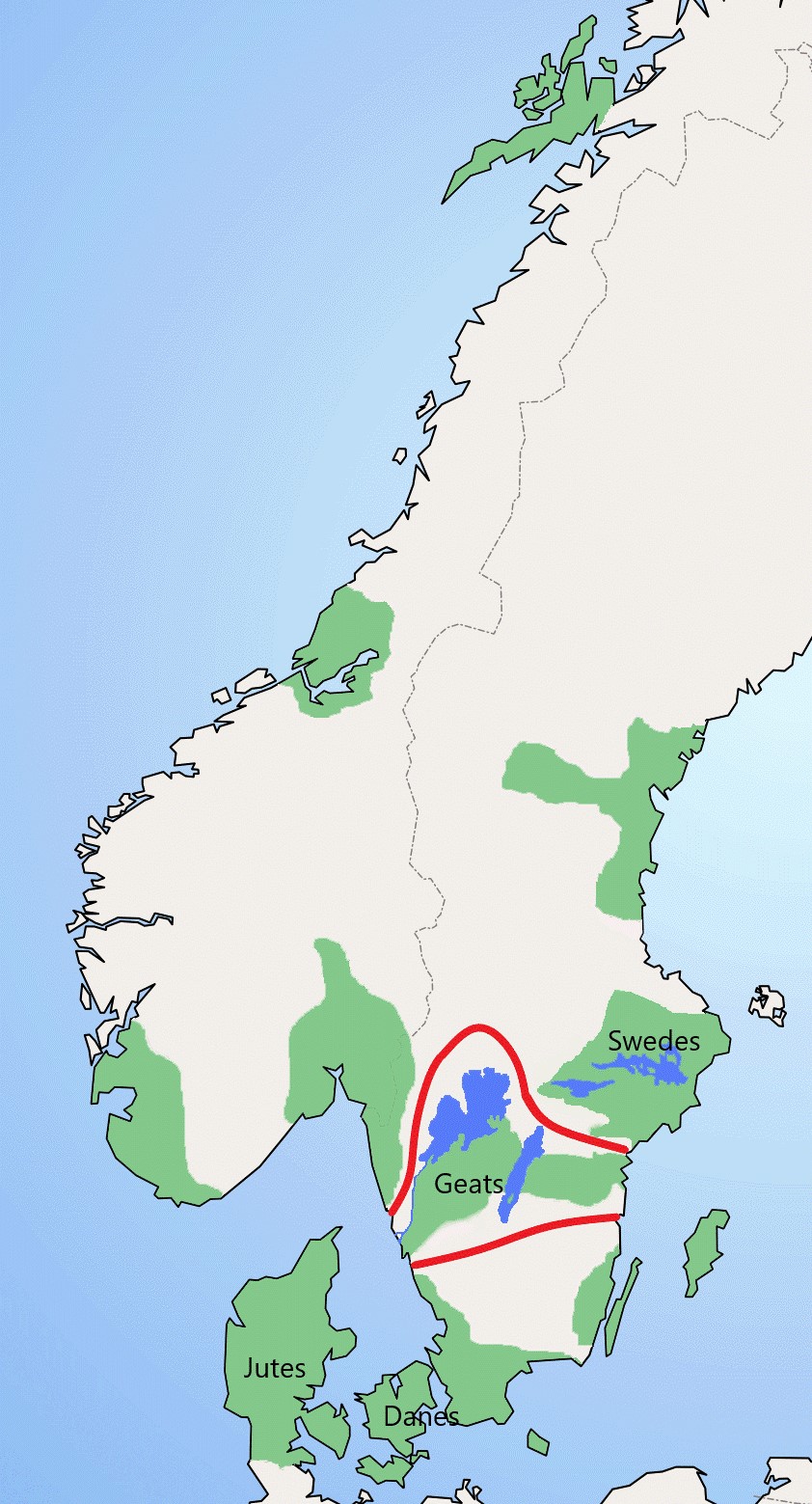
The Geats (/ɡiːts, ˈɡeɪəts, jæts/ GHEETS, GAY-əts, YATS; Old English: gēatas [ˈjæɑtɑs]; Old Norse: gautar [ˈɡɑu̯tɑr]; Swedish: götar [ˈjø̂ːtar]), sometimes called Goths, were a large North Germanic tribe who inhabited Götaland ("land of the Geats") in modern southern Sweden from antiquity until the Late Middle Ages. They are one of the progenitor groups of modern Swedes, along with the tribes of Swedes and Gutes. The name of the Geats also lives on in the Swedish provinces of Västergötland and Östergötland, the western and eastern lands of the Geats, and in many other toponyms.
The Swedish dialects spoken in the areas that used to be inhabited by Geats form a distinct group, Götamål.
The etymology of the name Geat (Old English Geatas, from a Proto-Germanic *Gautaz, plural *Gautōz) is similar to that of Goths and Gutes (*Gutô, plural *Gutaniz). The names derive from ablaut grades of the Proto-Germanic word *geutaną, meaning "to pour". They have the literal meaning "they who pour their seed". (For more information see Goths § Etymology.) The names could also allude to watercourses in the land where they were living, but this is not generally accepted to be the case, partly because that would mean that the names' similarity would be coincidental.
A more specific theory about the word Gautigoths is that it means the Goths who live near the river Gaut, today's Göta älv (Old Norse: Gautelfr). It might also have been a conflation of the word Gauti with a gloss of Goths. In the 17th century the name Göta älv, 'River of the Geats', replaced the earlier names Götälven and Gautelfr. The etymology of the word Gaut (as mentioned above) derives from the Proto-Germanic word *geutan, and the extended meaning of "to pour" is "flow, stream, waterfall", which could refer to Trollhättan Falls or to the river itself.
The short form of Gautigoths was the Old Norse Gautar, which originally referred to just the inhabitants of Västergötland, or the western parts of today's Götaland, a meaning which is retained in some Icelandic sagas.
The earliest known surviving mention of the Geats appears in Ptolemy (2nd century AD), who refers to them as Goutai. In the 6th century, Jordanes writes of the Gautigoths and Ostrogoths (the Ostrogoths of Scandza); and Procopius refers to Gautoi. The Norse Sagas know them as Gautar; Beowulf and Widsith as Gēatas. Beowulf and the Norse sagas name several Geatish kings, but only Hygelac finds confirmation in Liber Monstrorum where he is referred to as "Rex Getarum" and in a copy of Historiae Francorum where he is called "Rege Gotorum". These sources concern a raid into Frisia, ca 516, which is also described in Beowulf. C. 551, some decades after Hygelac's raid, Jordanes described the Geats as a nation which was "bold, and quick to engage in war".
The Anglo-Saxon settlement of Britain included many North Germanic people who were losers in the brutal tribal warfare of Scandinavia. The place-name -gate marks the site of Geatish settlement, often alongside strategically important Roman roads and nearby Visigothic and/or Jutish settlements. Defeated Jutes like Hengest and his brother Horsa fled to Kent, while Geats defeated by encroaching Swedes moved to Yorkshire where they founded Gillingshire by the Tees, originally the settlement of the Geatlings. It has also been suggested that East Anglia was settled by Geats at this time, or by Wulfings who also came from Götaland, bringing the traditions of Beowulf with them.
Any peace that eventually settled in southern Scandinavia was most likely due to exhaustion, and a Danish archaeologist has summarized that in the mid-6th century, and after, Scandinavia "went down to hell". Scandinavian wares appear to have stopped arriving in England, c. 550, suggesting that contact was broken.
Hub AI
Geats AI simulator
(@Geats_simulator)
Geats
The Geats (/ɡiːts, ˈɡeɪəts, jæts/ GHEETS, GAY-əts, YATS; Old English: gēatas [ˈjæɑtɑs]; Old Norse: gautar [ˈɡɑu̯tɑr]; Swedish: götar [ˈjø̂ːtar]), sometimes called Goths, were a large North Germanic tribe who inhabited Götaland ("land of the Geats") in modern southern Sweden from antiquity until the Late Middle Ages. They are one of the progenitor groups of modern Swedes, along with the tribes of Swedes and Gutes. The name of the Geats also lives on in the Swedish provinces of Västergötland and Östergötland, the western and eastern lands of the Geats, and in many other toponyms.
The Swedish dialects spoken in the areas that used to be inhabited by Geats form a distinct group, Götamål.
The etymology of the name Geat (Old English Geatas, from a Proto-Germanic *Gautaz, plural *Gautōz) is similar to that of Goths and Gutes (*Gutô, plural *Gutaniz). The names derive from ablaut grades of the Proto-Germanic word *geutaną, meaning "to pour". They have the literal meaning "they who pour their seed". (For more information see Goths § Etymology.) The names could also allude to watercourses in the land where they were living, but this is not generally accepted to be the case, partly because that would mean that the names' similarity would be coincidental.
A more specific theory about the word Gautigoths is that it means the Goths who live near the river Gaut, today's Göta älv (Old Norse: Gautelfr). It might also have been a conflation of the word Gauti with a gloss of Goths. In the 17th century the name Göta älv, 'River of the Geats', replaced the earlier names Götälven and Gautelfr. The etymology of the word Gaut (as mentioned above) derives from the Proto-Germanic word *geutan, and the extended meaning of "to pour" is "flow, stream, waterfall", which could refer to Trollhättan Falls or to the river itself.
The short form of Gautigoths was the Old Norse Gautar, which originally referred to just the inhabitants of Västergötland, or the western parts of today's Götaland, a meaning which is retained in some Icelandic sagas.
The earliest known surviving mention of the Geats appears in Ptolemy (2nd century AD), who refers to them as Goutai. In the 6th century, Jordanes writes of the Gautigoths and Ostrogoths (the Ostrogoths of Scandza); and Procopius refers to Gautoi. The Norse Sagas know them as Gautar; Beowulf and Widsith as Gēatas. Beowulf and the Norse sagas name several Geatish kings, but only Hygelac finds confirmation in Liber Monstrorum where he is referred to as "Rex Getarum" and in a copy of Historiae Francorum where he is called "Rege Gotorum". These sources concern a raid into Frisia, ca 516, which is also described in Beowulf. C. 551, some decades after Hygelac's raid, Jordanes described the Geats as a nation which was "bold, and quick to engage in war".
The Anglo-Saxon settlement of Britain included many North Germanic people who were losers in the brutal tribal warfare of Scandinavia. The place-name -gate marks the site of Geatish settlement, often alongside strategically important Roman roads and nearby Visigothic and/or Jutish settlements. Defeated Jutes like Hengest and his brother Horsa fled to Kent, while Geats defeated by encroaching Swedes moved to Yorkshire where they founded Gillingshire by the Tees, originally the settlement of the Geatlings. It has also been suggested that East Anglia was settled by Geats at this time, or by Wulfings who also came from Götaland, bringing the traditions of Beowulf with them.
Any peace that eventually settled in southern Scandinavia was most likely due to exhaustion, and a Danish archaeologist has summarized that in the mid-6th century, and after, Scandinavia "went down to hell". Scandinavian wares appear to have stopped arriving in England, c. 550, suggesting that contact was broken.