Recent from talks
Nothing was collected or created yet.
Gene Snyder
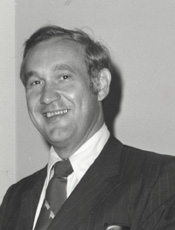
View on WikipediaMarion Eugene Snyder (January 26, 1928 – February 16, 2007[1]) was an American politician elected as a Republican to the United States House of Representatives from two different districts in his native Kentucky.
Key Information
Background
[edit]Snyder was born in Louisville and attended public schools there, having graduated from duPont Manual High School. He studied at the University of Louisville and graduated from the Jefferson School of Law. He began a career as a lawyer in Louisville in 1950. In 1954, he became the city attorney in Jeffersontown, a post that he held for some four years. Snyder was elected as the magistrate for the first district of Jefferson County in the fall of 1957 and was re-elected in 1961. He also had several business interests in farming, real estate, insurance, and construction.
Political life
[edit]Snyder was elected to the House of Representatives from Kentucky's 3rd congressional district, based in Louisville, in 1962. He was one of the few Republicans to vote against the Civil Rights Act of 1964,[2] although he later voted in favor of the Civil Rights Act of 1968.[3] A Barry M. Goldwater supporter, he was unseated in 1964 after only one term by former Louisville Mayor Charlie Farnsley, amid the gigantic Lyndon B. Johnson-Hubert H. Humphrey Democratic landslide that year.
Snyder then moved to nearby Oldham County, which was in the neighboring 4th District, and prepared for a run against 11-term incumbent Frank Chelf in 1966. The 4th by that time was rapidly trending Republican because of an influx of new residents from Cincinnati; it had absorbed most of the Kentucky side of the Cincinnati metro area in the 1960s round of redistricting. He took full advantage of this trend and defeated Chelf by almost eight points. He was re-elected eight times from this district with almost no difficulty. In 1984, however, Democrat Pat Mulloy ran a surprisingly strong campaign and almost unseated Snyder; only Ronald Reagan's landslide win in Kentucky (by almost twenty points) helped Snyder remain in office. Rather than face Mulloy again, Snyder chose not to seek an 11th term in 1986. The seat then went to the Republican Jim Bunning, who in 1983 had been the unsuccessful Republican gubernatorial nominee against Martha Layne Collins.
In 1982, Congressman Snyder secured federal funds to build a beltway around Louisville. For this reason, a portion of I-265 was named for him[4] in 1986.[5] The federal courthouse building in Louisville and a general aviation airport near Falmouth, Kentucky (K62) also bear his name.
References
[edit]- ^ Will Graves (2007-02-19). "Former Congressman Gene Snyder dies at 79". The Advocate-Messenger. Danville, Kentucky. p. A2.
- ^ "H.R. 7152. PASSAGE".
- ^ "TO PASS H.R. 2516, A BILL TO ESTABLISH PENALTIES FOR INTERFERENCE WITH CIVIL RIGHTS. INTERFERENCE WITH A PERSON ENGAGED IN ONE OF THE 8 ACTIVITIES PROTECTED UNDER THIS BILL MUST BE RACIALLY MOTIVATED TO INCUR THE BILL'S PENALTIES".
- ^ "Louisville Roadways - What's in a Name?". Louisville Life. KET. Archived from the original on 2014-04-13.
- ^ Daniel Rubin (August 18, 1986). "Few people are using correct designation for renamed freeway". The Courier-Journal. Louisville, Kentucky. p. B1.
- ^ "SNYDER, Marion Gene - Biographical Information". Biographical Directory of the United States Congress.
External links
[edit]- Gene Snyder at Find a Grave (as Marion G. "Gene" Snyder)
- Appearances on C-SPAN
Gene Snyder
View on GrokipediaEarly Life and Education
Childhood and Family Background
Marion Gene Snyder was born on January 26, 1928, in Louisville, Jefferson County, Kentucky, to parents Marion and Lois Snyder.[5][3] Raised in West Louisville amid modest economic conditions, Snyder later characterized his early years as those of a "poor boy."[3] He attended local public schools before graduating from duPont Manual High School in Louisville.[5]Academic and Formative Years
Snyder attended public schools in Louisville, Kentucky, graduating from duPont Manual High School.[6] He subsequently enrolled at the University of Louisville for undergraduate studies, though specific details of his coursework or duration there remain undocumented in primary congressional records.[7][8] Transitioning to legal training, Snyder pursued a degree at the Jefferson School of Law in Louisville, earning both an LL.B. and J.D. in 1950.[6][5] The institution, known for its evening program accommodating working students, later merged into the University of Louisville School of Law.[8] This education equipped him for immediate entry into legal practice, reflecting a formative emphasis on practical, locally oriented professional development amid post-World War II opportunities in Kentucky.[1] During these years, Snyder's academic path aligned with his emerging interest in public service, as evidenced by his prompt admission to the Kentucky bar upon graduation and subsequent local engagements, though explicit records of extracurricular or intellectual influences are limited to his Louisville roots.[6][7]Pre-Political Career
Legal Practice
Following his graduation with a J.D. from the University of Louisville School of Law in 1950, Snyder was admitted to the Kentucky bar the same year and commenced a private legal practice in Louisville.[5] His early professional work centered on general legal services in the Louisville area, establishing a foundation in local law before transitioning to public roles.[8] Specific casework or firm affiliations from this period remain undocumented in primary records, reflecting a typical entry-level trajectory for attorneys of the era in Jefferson County.[5] This phase of Snyder's career lasted until 1954, when he assumed municipal responsibilities that intersected with his legal expertise.Business Ventures and Local Public Service
Snyder pursued multiple business interests in Louisville, Kentucky, between 1951 and 1962, encompassing farming, real estate dealings, insurance operations, and residential construction projects.[5][6] These ventures supplemented his legal practice and reflected his engagement in local economic activities during the post-war expansion period in the region. Concurrently, Snyder contributed to local governance as city attorney for Jeffersontown, a suburb of Louisville, holding the position from 1954 to 1958.[1][7] In this role, he provided legal counsel to the municipal government, handling matters pertinent to a growing community amid Jefferson County's suburban development. He was also elected as a magistrate for the first district of Jefferson County, further embedding his involvement in grassroots public administration prior to higher elective pursuits.[9]Entry into Elective Politics
Local Offices and Initial Campaigns
Snyder commenced his public service as city attorney for Jeffersontown, Kentucky, holding the position from 1954 to 1958.[5] [9] This role marked the beginning of his political involvement shortly after his admission to the Kentucky bar in 1954.[5] He was subsequently elected as magistrate for the first district of Jefferson County, serving from 1958 to 1962.[5] [9] In this capacity, Snyder addressed local governance issues in the Louisville metropolitan area, building a foundation for his Republican political profile in a predominantly Democratic region.[3] Snyder's initial federal campaign occurred in 1960, when he ran unsuccessfully as a Republican candidate for Kentucky's 3rd congressional district seat in the U.S. House of Representatives.[5] This bid against incumbent Democrat Edward Whitener highlighted Snyder's emerging conservative stance but ended in defeat amid strong Democratic majorities in the state.[5] His local electoral successes as magistrate provided visibility and experience that informed subsequent campaigns.[10]1962 Congressional Election
In the Republican primary for Kentucky's 3rd congressional district on May 1, 1962, attorney Marion Gene "Gene" Snyder of Louisville, then 34 years old and without prior elective office, won nomination by defeating challenger Jesse Johnson, receiving 9,288 votes to Johnson's 2,095 for an 81.6% share.[11] The district, centered on Louisville and historically Democratic-leaning, featured an open contest against incumbent Democrat Frank W. Burke, who had held the seat since 1959. Snyder's campaign emphasized conservative fiscal restraint and opposition to U.S. foreign aid for India and communist-bloc countries, while rejecting John Birch Society claims that the United Nations constituted a subversive entity.[12] Snyder's general election victory on November 6, 1962, represented a narrow Republican gain amid national midterm trends favoring the GOP following President Kennedy's Cuban Missile Crisis resolution, which muted anti-administration attacks on foreign policy.[13] He defeated Burke with 94,579 votes (50.8%) to 91,544 (49.2%), a margin of 3,035 votes out of 186,123 cast.[14] [13] This upset flipped the district for the first time in over a decade, bucking Kentucky's Democratic dominance in congressional races, though Republicans held only one House seat statewide entering the cycle.[13] Snyder's win aligned with 13 net GOP House pickups nationwide, yet Democrats retained their majority at 258-177.[13]Congressional Service
First Term and 1964 Defeat (1963–1965)
Snyder assumed office in the Eighty-eighth United States Congress on January 3, 1963, representing Kentucky's 3rd congressional district centered on Louisville.[2] As one of 176 Republicans in a House controlled by Democrats following the 1962 midterm gains, he focused on conservative priorities amid President Kennedy's agenda, though specific sponsored legislation from his freshman term remains limited in records.[1] He aligned with Republican opposition to expansive federal programs, including reservations on civil rights expansions that risked alienating his district's urban voters. A defining action came in February 1964, when Snyder joined 91 other House Republicans—contrasting the party majority—in voting against the Civil Rights Act (H.R. 7152), citing concerns over private property rights and federal overreach in Titles II and VII.[15] This stance, shared by only about 20% of House Republicans despite broader GOP support for anti-discrimination measures, drew backlash in his district, home to approximately 78,000 Black residents who mobilized against him.[15] Snyder publicly defended the vote by criticizing civil rights leaders like Roy Wilkins, further polarizing his base amid national debates.[16] The 1964 election amplified these tensions, coinciding with President Lyndon B. Johnson's landslide victory over Barry Goldwater, which propelled Democratic coattails and net House gains of 36 seats nationwide. Snyder lost reelection to Democrat Charles P. Farnsley, former Louisville mayor, in a district shifting toward the national Democratic wave; his civil rights opposition alienated key urban demographics, contributing to the upset despite his 1962 narrow win.[17] He conceded the race, ending his initial congressional tenure on January 3, 1965.[9]Comeback and Long Tenure (1967–1987)
After his defeat in the 1964 election, Snyder mounted a successful comeback campaign for Kentucky's 4th congressional district in 1966, which had been redrawn to include more suburban and rural areas favorable to Republicans. He won the Republican primary on May 24, 1966, defeating a moderate challenger amid party divisions, positioning himself as the conservative standard-bearer.[18][19] In the general election on November 8, 1966, Snyder secured victory, returning to the House for the 90th Congress (1967–1969) and beginning a decade-long period of electoral dominance in the district.[2] Snyder's long tenure from 1967 to 1987 encompassed service across ten Congresses, marked by consistent reelections with substantial margins in a district that shifted toward Republican strength. He prevailed in the 1968, 1970, 1972, 1974, 1976, 1978, 1980, 1982, and 1984 general elections, often facing Democratic opponents who polled significantly behind, reflecting his appeal among constituents in Jefferson County and surrounding areas.[5][1] This stability allowed Snyder to build seniority on key committees, contributing to his influence on legislation affecting Kentucky, particularly in transportation and public works.[3] In 1986, at age 58, Snyder announced he would not seek a twelfth term, citing a desire to retire after two decades of service despite encouragement from Republican leaders to continue.[7] He endorsed former baseball player Jim Bunning as his successor, who won the seat and held it until 1998, ensuring a smooth transition for GOP control of the district.[7] Snyder's decision to step down voluntarily underscored his long-term commitment to the role without overstaying, leaving a legacy of reliable representation for Louisville-area interests.[8]Committee Roles and Legislative Priorities
Snyder served on the House Committee on Public Works and Transportation throughout much of his tenure, rising to the position of ranking Republican member by the 1980s, where he influenced legislation on highways, bridges, and flood control projects critical to Kentucky's infrastructure.[7][3] He advocated for funding allocations that prioritized regional needs, such as opposing cuts to a flood control initiative in his district during the 1984 water projects bill debate.[20] This role enabled him to secure federal support for expansions like the interstate corridor in Louisville, later designated the Gene Snyder Freeway in recognition of his efforts.[4] He also held assignments on the House Committee on Merchant Marine and Fisheries, focusing on policies affecting riverine commerce and environmental safeguards along the Ohio River bordering his district.[7] In this capacity, Snyder contributed to bills enhancing maritime safety and fisheries management, aligning with his broader emphasis on practical economic development over expansive regulatory measures.[3] Snyder's legislative priorities reflected a conservative commitment to fiscal restraint alongside targeted infrastructure investments, sponsoring or cosponsoring measures like transportation reauthorizations that balanced highway funding with deficit concerns.[2] He opposed unchecked spending increases, as evidenced by his criticism of bloated appropriations in transportation debates, while prioritizing bills that delivered verifiable benefits to constituents, such as improved road networks and water resource management.[21] This approach underscored his skepticism of federal overreach, favoring legislation grounded in local economic imperatives rather than broad ideological mandates.[3]Key Positions and Voting Record
Conservative Ideology
Snyder's conservative ideology emphasized fiscal restraint, limited federal intervention in state affairs, and skepticism toward expansive government programs. As a member of the House Appropriations Committee, he consistently opposed bills he viewed as wasteful, prioritizing targeted district investments over broad spending increases, which aligned with traditional Republican fiscal hawkishness during the post-Great Society era.[3][22] His support for the 1986 budget reconciliation measure (HR 5300), which aimed to reduce deficits through spending cuts and revenue adjustments, exemplified this approach, earning a "yea" vote in a 305-70 tally on October 17, 1986.[6] In ideological metrics derived from roll-call voting data, Snyder ranked more conservative than 71% of House members in the 99th Congress (1985-1987), though he demonstrated moderate tendencies within his party, scoring more liberal than 69% of fellow Republicans and maintaining 77% party unity.[6] This positioning reflected a pragmatic conservatism, blending opposition to federal overreach—such as his "nay" vote against the Columbia River Gorge National Scenic Area Act (HR 5705) on October 16, 1986, which expanded federal land controls—with selective advocacy for infrastructure funding benefiting Kentucky.[6] Snyder's stance on civil rights legislation underscored a commitment to states' rights, a core conservative tenet in the mid-20th century. He was among the minority of Republicans voting against the Civil Rights Act of 1964 (H.R. 7152), passed July 2, 1964, citing concerns over federal mandates infringing on local authority, a position that contributed to his 1964 reelection loss amid national Democratic mobilization.[17] Later, he supported the Civil Rights Act of 1968, indicating evolution toward broader consensus on enforcement while retaining wariness of unchecked centralization. His opposition to the Immigration Reform and Control Act of 1986 (S. 1200), rejected in a 274-132 vote on October 15, 1986, further highlighted immigration skepticism typical of era conservatives favoring border security over amnesty provisions.[6]Civil Rights Legislation
Snyder, a conservative Republican representing Kentucky's suburban Louisville district, voted against the Civil Rights Act of 1964 (H.R. 7152) when it passed the House 290–130 on February 10, 1964.[17][23] His opposition aligned with many Southern and conservative members who argued the bill represented excessive federal overreach into states' rights, private property, and business operations, despite prohibiting discrimination in public accommodations, employment, and federally funded programs.[17][24] This stance contributed to his narrow 1964 reelection defeat against Democrat Charles Farnsley, as the district included growing urban areas sensitive to civil rights issues amid national debates following events like the March on Washington.[24] Snyder did not serve during passage of the Voting Rights Act of 1965, having left office in January 1965.[2] Upon regaining his seat in 1967, Snyder's approach to civil rights evolved in line with shifting conservative priorities emphasizing law and order over expansive federal mandates. He supported the Civil Rights Act of 1968 (H.R. 2516), which included Title VIII's fair housing provisions banning discrimination in housing sales, rentals, and financing, passing the House 250–171 on April 10, 1968. This vote reflected a pragmatic adjustment, as the bill responded to urban riots and focused on enforcement mechanisms rather than broad economic interventions.[25]Transportation and Infrastructure Advocacy
During his congressional tenure from 1967 to 1987, Snyder served on the House Committee on Public Works and Transportation, where he advanced to ranking Republican member and focused on securing federal appropriations for transportation projects in Kentucky's 4th district and beyond.[2] [3] His committee role enabled him to prioritize infrastructure investments aimed at economic development, flood mitigation, and regional connectivity, often channeling funds through highway trust allocations and public works authorizations.[3] Snyder advocated successfully for several key bridge projects across the Ohio River and its tributaries, including federal support for the Clay Wade Bailey Bridge connecting Covington, Kentucky, to Cincinnati, Ohio, which opened to traffic on November 25, 1974, after initial construction phases funded under earlier interstate programs.[3] He also secured resources for the "Big Mac Bridge" (Interstate 471), linking Newport, Kentucky, to Cincinnati, dedicated on November 25, 1976, and the Markland Dam bridge spanning Indiana and Kentucky, utilizing targeted statutory provisions to expedite approvals and funding.[3] These efforts addressed critical bottlenecks in cross-state commerce and commuter traffic, with Snyder leveraging his position to counterbalance urban-rural funding disparities in appropriations bills.[3] In flood control and watershed management, Snyder pushed for allocations benefiting northern Kentucky communities, obtaining federal dollars for the Jefferson County Floodwall system and Banklick Creek Watershed project to protect against Ohio River overflows, which had historically disrupted local economies.[3] Additionally, he contributed to new bridge constructions in Covington and Newport, enhancing urban infrastructure resilience.[3] His persistent advocacy for the partial outer beltway around Louisville culminated in the naming of Interstate 265 as the Gene Snyder Freeway in 1987, recognizing his role in obtaining construction funding that facilitated its expansion and integration into the regional highway network.[26] These initiatives, totaling millions in federal outlays, supported job creation in construction and bolstered long-term transportation capacity in a growing metropolitan area.[3]Elections and Political Challenges
Electoral History
Snyder secured his initial entry to Congress in the 1962 election for Kentucky's 3rd congressional district, narrowly defeating two-term Democratic incumbent Frank W. Burke with 94,579 votes (50.8%) to Burke's 91,544 (49.2%).[11] His 1964 bid for re-election faltered amid the national Democratic landslide and voter reaction to his opposition to the Civil Rights Act of 1964, resulting in defeat by Democrat Charles R. Farnsley, former mayor of Louisville, by a margin of approximately 20 percentage points.[17] Following redistricting, Snyder reclaimed the seat in 1966 for the newly configured 4th district as part of the Republican gains in the midterm elections, defeating Democrat Eugene C. Harter Jr. with 66,577 votes (53.9%) to Harter's 56,902 (46.1%).[27] He then won re-election ten consecutive times through 1984, often by substantial margins that demonstrated his entrenchment in the district, though challenges grew closer in later cycles amid shifting national trends.| Year | Opponent (Party) | Snyder Votes (%) | Opponent Votes (%) | Outcome |
|---|---|---|---|---|
| 1968 | Gus Sheehan Jr. (D) | 65.0 | 35.0 | Won |
| 1972 | James W. Rogers (D) | 73.8 | 26.2 | Won [28] |
| 1984 | William Patrick Mulloy II (D) | 53.65 | 46.35 | Won [10] |

