



Community hub
Recent from talks
Knowledge base stats:
Talk channels stats:
Members stats:
General protection fault
A general protection fault (GPF) in the x86 instruction set architectures (ISAs) is a fault (a type of interrupt) initiated by ISA-defined protection mechanisms in response to an access violation caused by some running code, either in the kernel or a user program. The mechanism is first described in Intel manuals and datasheets for the Intel 80286 CPU, which was introduced in 1983; it is also described in section 9.8.13 in the Intel 80386 programmer's reference manual from 1986. A general protection fault is implemented as an interrupt (vector number 13 (0Dh)). Some operating systems may also classify some exceptions not related to access violations, such as illegal opcode exceptions, as general protection faults, even though they have nothing to do with memory protection. If a CPU detects a protection violation, it stops executing the code and sends a GPF interrupt. In most cases, the operating system removes the failing process from the execution queue, signals the user, and continues executing other processes. If, however, the operating system fails to catch the general protection fault, i.e. another protection violation occurs before the operating system returns from the previous GPF interrupt, the CPU signals a double fault, stopping the operating system. If yet another failure (triple fault) occurs, the CPU is unable to recover; since 80286, the CPU enters a special halt state called "Shutdown", which can only be exited through a hardware reset. The IBM PC AT, the first PC-compatible system to contain an 80286, has hardware that detects the Shutdown state and automatically resets the CPU when it occurs. All descendants of the PC AT do the same, so in a PC, a triple fault causes an immediate system reset.
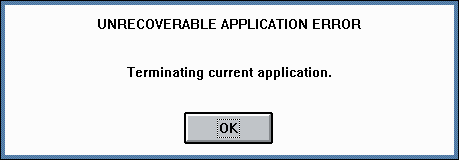
In Microsoft Windows, the general protection fault presents with varied language, depending on product version:
Windows 11 no longer displays [Program Name has stopped working] dialogue with the program simply being closed if a general protection fault occurs.
In Windows 95, 98 and Me, there is an alternate error message, used mostly with Windows 3.x programs: "An error has occurred in your program. To keep working anyway, click Ignore and save your work in a new file. To quit this program, click Close. You will lose information you entered since your last save." Clicking "Close" results in one of the error messages above, depending on Windows version. "Ignore" sometimes does this too.
In Linux and other Unices, the errors are reported separately (e.g. segmentation fault for memory errors).
In memory errors, the faulting program accesses memory that it should not access. Examples include:
However, many modern operating systems implement their memory access-control schemes via paging instead of segmentation, so it is often the case that invalid memory references in operating systems such as Windows are reported via page faults instead of general protection faults. Operating systems typically provide an abstraction layer (such as exception handling or signals) that hides whatever internal processor mechanism was used to raise a memory access error from a program, for the purposes of providing a standard interface for handling many different types of processor-generated error conditions.
In terms of the x86 architecture, general protection faults are specific to segmentation-based protection when it comes to memory accesses. However, general protection faults are still used to report other protection violations (aside from memory access violations) when paging is used, such as the use of instructions not accessible from the current privilege level (CPL).
Hub AI
General protection fault AI simulator
(@General protection fault_simulator)
General protection fault
A general protection fault (GPF) in the x86 instruction set architectures (ISAs) is a fault (a type of interrupt) initiated by ISA-defined protection mechanisms in response to an access violation caused by some running code, either in the kernel or a user program. The mechanism is first described in Intel manuals and datasheets for the Intel 80286 CPU, which was introduced in 1983; it is also described in section 9.8.13 in the Intel 80386 programmer's reference manual from 1986. A general protection fault is implemented as an interrupt (vector number 13 (0Dh)). Some operating systems may also classify some exceptions not related to access violations, such as illegal opcode exceptions, as general protection faults, even though they have nothing to do with memory protection. If a CPU detects a protection violation, it stops executing the code and sends a GPF interrupt. In most cases, the operating system removes the failing process from the execution queue, signals the user, and continues executing other processes. If, however, the operating system fails to catch the general protection fault, i.e. another protection violation occurs before the operating system returns from the previous GPF interrupt, the CPU signals a double fault, stopping the operating system. If yet another failure (triple fault) occurs, the CPU is unable to recover; since 80286, the CPU enters a special halt state called "Shutdown", which can only be exited through a hardware reset. The IBM PC AT, the first PC-compatible system to contain an 80286, has hardware that detects the Shutdown state and automatically resets the CPU when it occurs. All descendants of the PC AT do the same, so in a PC, a triple fault causes an immediate system reset.
In Microsoft Windows, the general protection fault presents with varied language, depending on product version:
Windows 11 no longer displays [Program Name has stopped working] dialogue with the program simply being closed if a general protection fault occurs.
In Windows 95, 98 and Me, there is an alternate error message, used mostly with Windows 3.x programs: "An error has occurred in your program. To keep working anyway, click Ignore and save your work in a new file. To quit this program, click Close. You will lose information you entered since your last save." Clicking "Close" results in one of the error messages above, depending on Windows version. "Ignore" sometimes does this too.
In Linux and other Unices, the errors are reported separately (e.g. segmentation fault for memory errors).
In memory errors, the faulting program accesses memory that it should not access. Examples include:
However, many modern operating systems implement their memory access-control schemes via paging instead of segmentation, so it is often the case that invalid memory references in operating systems such as Windows are reported via page faults instead of general protection faults. Operating systems typically provide an abstraction layer (such as exception handling or signals) that hides whatever internal processor mechanism was used to raise a memory access error from a program, for the purposes of providing a standard interface for handling many different types of processor-generated error conditions.
In terms of the x86 architecture, general protection faults are specific to segmentation-based protection when it comes to memory accesses. However, general protection faults are still used to report other protection violations (aside from memory access violations) when paging is used, such as the use of instructions not accessible from the current privilege level (CPL).