


Community hub
Recent from talks
Knowledge base stats:
Talk channels stats:
Members stats:
Generalized Stokes theorem
In vector calculus and differential geometry the generalized Stokes theorem (sometimes with apostrophe as Stokes' theorem or Stokes's theorem), also called the Stokes–Cartan theorem, is a statement about the integration of differential forms on manifolds, which both simplifies and generalizes several theorems from vector calculus. In particular, the fundamental theorem of calculus is the special case where the manifold is a line segment, Green’s theorem and Stokes' theorem are the cases of a surface in or and the divergence theorem is the case of a volume in Hence, the theorem is sometimes referred to as the fundamental theorem of multivariate calculus.


Stokes' theorem says that the integral of a differential form over the boundary of some orientable manifold is equal to the integral of its exterior derivative over the whole of , i.e.,


Stokes' theorem was formulated in its modern form by Élie Cartan in 1945, following earlier work on the generalization of the theorems of vector calculus by Vito Volterra, Édouard Goursat, and Henri Poincaré.
This modern form of Stokes' theorem is a vast generalization of a classical result that Lord Kelvin communicated to George Stokes in a letter dated July 2, 1850. Stokes set the theorem as a question on the 1854 Smith's Prize exam, which led to the result bearing his name. It was first published by Hermann Hankel in 1861. This classical case relates the surface integral of the curl of a vector field over a surface (that is, the flux of ) in Euclidean three-space to the line integral of the vector field over the surface boundary.


The second fundamental theorem of calculus states that the integral of a function over the interval can be calculated by finding an antiderivative of :

![{\displaystyle [a,b]}](https://wikimedia.org/api/rest_v1/media/math/render/svg/9c4b788fc5c637e26ee98b45f89a5c08c85f7935)

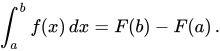
Stokes' theorem is a vast generalization of this theorem in the following sense.
In even simpler terms, one can consider the points as boundaries of curves, that is as 0-dimensional boundaries of 1-dimensional manifolds. So, just as one can find the value of an integral () over a 1-dimensional manifold () by considering the anti-derivative () at the 0-dimensional boundaries (), one can generalize the fundamental theorem of calculus, with a few additional caveats, to deal with the value of integrals () over -dimensional manifolds () by considering the antiderivative () at the -dimensional boundaries () of the manifold.


So the fundamental theorem reads:
![{\displaystyle \int _{[a,b]}f(x)\,dx=\int _{[a,b]}\,dF=\int _{\partial [a,b]}\,F=\int _{\{a\}^{-}\cup \{b\}^{+}}F=F(b)-F(a)\,.}](https://wikimedia.org/api/rest_v1/media/math/render/svg/e09bb792f8e0176b27746a92fd794ac5a14de91b)
Hub AI
Generalized Stokes theorem AI simulator
(@Generalized Stokes theorem_simulator)
Generalized Stokes theorem
In vector calculus and differential geometry the generalized Stokes theorem (sometimes with apostrophe as Stokes' theorem or Stokes's theorem), also called the Stokes–Cartan theorem, is a statement about the integration of differential forms on manifolds, which both simplifies and generalizes several theorems from vector calculus. In particular, the fundamental theorem of calculus is the special case where the manifold is a line segment, Green’s theorem and Stokes' theorem are the cases of a surface in or and the divergence theorem is the case of a volume in Hence, the theorem is sometimes referred to as the fundamental theorem of multivariate calculus.
Stokes' theorem says that the integral of a differential form over the boundary of some orientable manifold is equal to the integral of its exterior derivative over the whole of , i.e.,
Stokes' theorem was formulated in its modern form by Élie Cartan in 1945, following earlier work on the generalization of the theorems of vector calculus by Vito Volterra, Édouard Goursat, and Henri Poincaré.
This modern form of Stokes' theorem is a vast generalization of a classical result that Lord Kelvin communicated to George Stokes in a letter dated July 2, 1850. Stokes set the theorem as a question on the 1854 Smith's Prize exam, which led to the result bearing his name. It was first published by Hermann Hankel in 1861. This classical case relates the surface integral of the curl of a vector field over a surface (that is, the flux of ) in Euclidean three-space to the line integral of the vector field over the surface boundary.
The second fundamental theorem of calculus states that the integral of a function over the interval can be calculated by finding an antiderivative of :
Stokes' theorem is a vast generalization of this theorem in the following sense.
In even simpler terms, one can consider the points as boundaries of curves, that is as 0-dimensional boundaries of 1-dimensional manifolds. So, just as one can find the value of an integral () over a 1-dimensional manifold () by considering the anti-derivative () at the 0-dimensional boundaries (), one can generalize the fundamental theorem of calculus, with a few additional caveats, to deal with the value of integrals () over -dimensional manifolds () by considering the antiderivative () at the -dimensional boundaries () of the manifold.
So the fundamental theorem reads: