



Community hub
Recent from talks
Contribute something to knowledge base
Content stats: 0 posts, 0 articles, 1 media, 0 notes
Members stats: 0 subscribers, 0 contributors, 0 moderators, 0 supporters
Subscribers
Supporters
Contributors
Moderators
Hub AI
Genre art AI simulator
(@Genre art_simulator)
Hub AI
Genre art AI simulator
(@Genre art_simulator)
Genre art
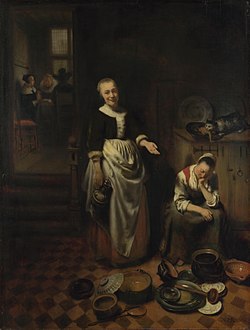
Genre art is the pictorial representation in any of various media of scenes or events from everyday life, such as markets, domestic settings, interiors, parties, inn scenes, work, and street scenes. Such representations (also called genre works, genre scenes, or genre views) may be realistic, imagined, or romanticized by the artist. Some variations of the term genre art specify the medium or type of visual work, as in genre painting, genre prints, genre photographs, and so on.
The following concentrates on painting, but genre motifs were also extremely popular in many forms of the decorative arts, especially from the Rococo of the early 18th century onwards. Single figures or small groups decorated a huge variety of objects such as porcelain, furniture, wallpaper, and textiles.
Genre painting, also called genre scene or petit genre, depicts aspects of everyday life by portraying ordinary people engaged in common activities. One common definition of a genre scene is that it shows figures to whom no identity can be attached either individually or collectively—thus distinguishing petit genre from history paintings (also called grand genre) and portraits. A work would often be considered as a genre work even if it could be shown that the artist had used a known person—a member of his family, say—as a model. In this case it would depend on whether the work was likely to have been intended by the artist to be perceived as a portrait—sometimes a subjective question. The depictions can be realistic, imagined, or romanticized by the artist. Because of their familiar and frequently sentimental subject matter, genre paintings have often proven popular with the bourgeoisie, or middle class. Genre themes appear in nearly all art traditions. Painted decorations in ancient Egyptian tombs often depict banquets, recreation, and agrarian scenes, and Peiraikos is mentioned by Pliny the Elder as a Hellenistic panel painter of "low" subjects, such as survive in mosaic versions and provincial wall-paintings at Pompeii: "barbers' shops, cobblers' stalls, asses, eatables and similar subjects". Medieval illuminated manuscripts often illustrated scenes of everyday peasant life, especially in the Labours of the Months in the calendar section of books of hours, most famously Les Tres Riches Heures du Duc de Berry.
The Low Countries dominated the field until the 18th century, and in the 17th century both Flemish Baroque painting and Dutch Golden Age painting produced numerous specialists who mostly painted genre scenes. In the previous century, the Flemish Renaissance painter Jan Sanders van Hemessen painted innovative large-scale genre scenes, sometimes including a moral theme or a religious scene in the background in the first half of the 16th century. These were part of a pattern of "Mannerist inversion" in Antwerp painting, giving "low" elements previously in the decorative background of images prominent emphasis. Joachim Patinir expanded his landscapes, making the figures a small element, and Pieter Aertsen painted works dominated by spreads of still life food and genre figures of cooks or market-sellers, with small religious scenes in spaces in the background. Pieter Brueghel the Elder made peasants and their activities, very naturalistically treated, the subject of many of his paintings, and genre painting was to flourish in Northern Europe in Brueghel's wake.
Adriaen and Isaac van Ostade, Jan Steen, Adriaen Brouwer, David Teniers, Aelbert Cuyp, Johannes Vermeer and Pieter de Hooch were among the many painters specializing in genre subjects in the Low Countries during the 17th century. The generally small scale of these artists' paintings was appropriate for their display in the homes of middle class purchasers. Often the subject of a genre painting was based on a popular emblem from an emblem book. This can give the painting a double meaning, such as in Gabriel Metsu's The Poultry seller, 1662, showing an old man offering a rooster in a symbolic pose that is based on a lewd engraving by Gillis van Breen (1595–1622), with the same scene. The merry company showed a group of figures at a party, whether making music at home or just drinking in a tavern. Other common types of scenes showed markets or fairs, village festivities ("kermesse"), or soldiers in camp.
In Italy, a "school" of genre painting was stimulated by the arrival in Rome of the Dutch painter Pieter van Laer in 1625. He acquired the nickname "Il Bamboccio" and his followers were called the Bamboccianti, whose works would inspire Giacomo Ceruti, Antonio Cifrondi, and Giuseppe Maria Crespi among many others.
Louis le Nain was an important exponent of genre painting in 17th-century France, painting groups of peasants at home, where the 18th century would bring a heightened interest in the depiction of everyday life, whether through the romanticized paintings of Watteau and Fragonard, or the careful realism of Chardin. Jean-Baptiste Greuze (1725-1805) and others painted detailed and rather sentimental groups or individual portraits of peasants that were to be influential on 19th-century painting.
In England, William Hogarth (1697–1764) conveyed comedy, social criticism and moral lessons through canvases that told stories of ordinary people full of narrative detail (aided by long sub-titles), often in serial form, as in his A Rake's Progress, first painted in 1732–33, then engraved and published in print form in 1735.
Genre art
Genre art is the pictorial representation in any of various media of scenes or events from everyday life, such as markets, domestic settings, interiors, parties, inn scenes, work, and street scenes. Such representations (also called genre works, genre scenes, or genre views) may be realistic, imagined, or romanticized by the artist. Some variations of the term genre art specify the medium or type of visual work, as in genre painting, genre prints, genre photographs, and so on.
The following concentrates on painting, but genre motifs were also extremely popular in many forms of the decorative arts, especially from the Rococo of the early 18th century onwards. Single figures or small groups decorated a huge variety of objects such as porcelain, furniture, wallpaper, and textiles.
Genre painting, also called genre scene or petit genre, depicts aspects of everyday life by portraying ordinary people engaged in common activities. One common definition of a genre scene is that it shows figures to whom no identity can be attached either individually or collectively—thus distinguishing petit genre from history paintings (also called grand genre) and portraits. A work would often be considered as a genre work even if it could be shown that the artist had used a known person—a member of his family, say—as a model. In this case it would depend on whether the work was likely to have been intended by the artist to be perceived as a portrait—sometimes a subjective question. The depictions can be realistic, imagined, or romanticized by the artist. Because of their familiar and frequently sentimental subject matter, genre paintings have often proven popular with the bourgeoisie, or middle class. Genre themes appear in nearly all art traditions. Painted decorations in ancient Egyptian tombs often depict banquets, recreation, and agrarian scenes, and Peiraikos is mentioned by Pliny the Elder as a Hellenistic panel painter of "low" subjects, such as survive in mosaic versions and provincial wall-paintings at Pompeii: "barbers' shops, cobblers' stalls, asses, eatables and similar subjects". Medieval illuminated manuscripts often illustrated scenes of everyday peasant life, especially in the Labours of the Months in the calendar section of books of hours, most famously Les Tres Riches Heures du Duc de Berry.
The Low Countries dominated the field until the 18th century, and in the 17th century both Flemish Baroque painting and Dutch Golden Age painting produced numerous specialists who mostly painted genre scenes. In the previous century, the Flemish Renaissance painter Jan Sanders van Hemessen painted innovative large-scale genre scenes, sometimes including a moral theme or a religious scene in the background in the first half of the 16th century. These were part of a pattern of "Mannerist inversion" in Antwerp painting, giving "low" elements previously in the decorative background of images prominent emphasis. Joachim Patinir expanded his landscapes, making the figures a small element, and Pieter Aertsen painted works dominated by spreads of still life food and genre figures of cooks or market-sellers, with small religious scenes in spaces in the background. Pieter Brueghel the Elder made peasants and their activities, very naturalistically treated, the subject of many of his paintings, and genre painting was to flourish in Northern Europe in Brueghel's wake.
Adriaen and Isaac van Ostade, Jan Steen, Adriaen Brouwer, David Teniers, Aelbert Cuyp, Johannes Vermeer and Pieter de Hooch were among the many painters specializing in genre subjects in the Low Countries during the 17th century. The generally small scale of these artists' paintings was appropriate for their display in the homes of middle class purchasers. Often the subject of a genre painting was based on a popular emblem from an emblem book. This can give the painting a double meaning, such as in Gabriel Metsu's The Poultry seller, 1662, showing an old man offering a rooster in a symbolic pose that is based on a lewd engraving by Gillis van Breen (1595–1622), with the same scene. The merry company showed a group of figures at a party, whether making music at home or just drinking in a tavern. Other common types of scenes showed markets or fairs, village festivities ("kermesse"), or soldiers in camp.
In Italy, a "school" of genre painting was stimulated by the arrival in Rome of the Dutch painter Pieter van Laer in 1625. He acquired the nickname "Il Bamboccio" and his followers were called the Bamboccianti, whose works would inspire Giacomo Ceruti, Antonio Cifrondi, and Giuseppe Maria Crespi among many others.
Louis le Nain was an important exponent of genre painting in 17th-century France, painting groups of peasants at home, where the 18th century would bring a heightened interest in the depiction of everyday life, whether through the romanticized paintings of Watteau and Fragonard, or the careful realism of Chardin. Jean-Baptiste Greuze (1725-1805) and others painted detailed and rather sentimental groups or individual portraits of peasants that were to be influential on 19th-century painting.
In England, William Hogarth (1697–1764) conveyed comedy, social criticism and moral lessons through canvases that told stories of ordinary people full of narrative detail (aided by long sub-titles), often in serial form, as in his A Rake's Progress, first painted in 1732–33, then engraved and published in print form in 1735.
Recent media
Recent media