


Community hub
Recent from talks
Contribute something
Nothing was collected or created yet.
Hellenistic period
View on Wikipedia| Hellenistic period | |||
|---|---|---|---|
| 323 – 30 BC | |||
| |||
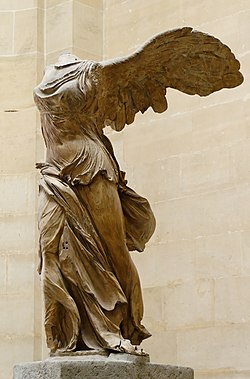
 The Winged Victory of Samothrace (The Winged Nike) is considered one of the greatest masterpieces of Hellenistic art. | |||
| Location | Eastern Mediterranean, Middle East, Central Asia, South Asia | ||


| History of Greece |
|---|
 |
 Greece portal Greece portal |
In classical antiquity, the Hellenistic period covers the time in Greek and Mediterranean history after Classical Greece, between the death of Alexander the Great in 323 BC and the death of Cleopatra VII in 30 BC,[1] which was followed by the ascendancy of the Roman Empire, as signified by the Battle of Actium in 31 BC and the Roman conquest of Ptolemaic Egypt the following year, which eliminated the last major Hellenistic kingdom.[2][3] Its name stems from the Ancient Greek word Hellas (Ἑλλάς, Hellás), which was gradually recognized as the name for Greece, from which the modern historiographical term Hellenistic was derived.[4] The term "Hellenistic" is to be distinguished from "Hellenic" in that the latter refers to Greece itself, while the former encompasses all the ancient territories of the period that had come under significant Greek influence, particularly the Hellenized Ancient Near East, after the conquests of Alexander the Great.
After the Macedonian conquest of the Achaemenid Empire in 330 BC and its disintegration shortly thereafter in the Partition of Babylon and subsequent Wars of the Diadochi, Hellenistic kingdoms were established throughout West Asia (Seleucid Empire, Kingdom of Pergamon), Northeast Africa (Ptolemaic Kingdom) and South Asia (Greco-Bactrian Kingdom, Indo-Greek Kingdom).[5][6] This resulted in an influx of Greek colonists and the export of Greek culture and language to these new realms, a breadth spanning as far as modern-day India. These new Greek kingdoms were also influenced by regional indigenous cultures, adopting local practices where deemed beneficial, necessary, or convenient. Hellenistic culture thus represents a fusion of the ancient Greek world with that of the Western Asian, Northeastern African, and Southwestern Asian worlds.[7] The consequence of this mixture gave rise to a common Attic-based Greek dialect, known as Koine Greek, which became the lingua franca throughout the ancient world.
During the Hellenistic period, Greek cultural influence reached its peak in the Mediterranean and beyond. Prosperity and progress in the arts, literature, theatre, architecture, music, mathematics, philosophy, and science characterize the era. The Hellenistic period saw the rise of New Comedy, Alexandrian poetry, translation efforts such as the Septuagint, and the philosophies of Stoicism, Epicureanism, and Pyrrhonism. In science, the works of the mathematician Euclid and the polymath Archimedes are exemplary. Sculpture during this period was characterized by intense emotion and dynamic movement, as seen in sculptural works like the Dying Gaul and the Venus de Milo. A form of Hellenistic architecture arose which especially emphasized the building of grand monuments and ornate decorations, as exemplified by structures such as the Pergamon Altar. The religious sphere of Greek religion expanded through syncretic facets to include new gods such as the Greco-Egyptian Serapis, eastern deities such as Attis and Cybele, and a syncretism between Hellenistic culture and Buddhism in Bactria and Northwest India.
Scholars and historians are divided as to which event signals the end of the Hellenistic era. There is a wide chronological range of proposed dates that have included the final conquest of the Greek heartlands by the expansionist Roman Republic in 146 BC following the Achaean War, the final defeat of the Ptolemaic Kingdom at the Battle of Actium in 31 BC, the end of the reign of the Roman emperor Hadrian in AD 138,[8] and the move by the emperor Constantine the Great of the capital of the Roman Empire to Constantinople in AD 330.[3][9] Though this scope of suggested dates demonstrates a range of academic opinion, a generally accepted date by most of scholarship has been that of 31/30 BC.[10][11][12]
Etymology
[edit]The word originated from Ancient Greek Ἑλληνιστής (Hellēnistḗs, "one who uses the Greek language"), from Ἑλλάς (Hellás, "Greece"); as if "Hellenist" + "ic".[13]

,_Temple_of_the_Oxus,_Takht-i-Sangin,_3rd-2nd_century_BC.jpg)
Right image: painted clay and alabaster head of a Zoroastrian priest wearing a distinctive Bactrian-style headdress, Takhti-Sangin, Tajikistan, 3rd–2nd century BC
The idea of a Hellenistic period is a 19th-century concept, and did not exist in ancient Greece. Although words related in form or meaning, e.g. Hellenist (Ancient Greek: Ἑλληνιστής, Hellēnistēs), have been attested since ancient times,[14] it has been attributed to the 19th-century German historian Johann Gustav Droysen, who in his classic work Geschichte des Hellenismus (History of Hellenism), coined the term Hellenistic to refer to and define the period when Greek culture spread in the non-Greek world after Alexander's conquest.[15] Following Droysen, Hellenistic and related terms, e.g. Hellenism, have been widely used in various contexts; a notable such use is in Culture and Anarchy by Matthew Arnold, where Hellenism is used in contrast with Hebraism.[16][17]
The major issue with the term Hellenistic lies in its convenience, as the spread of Greek culture was not the generalized phenomenon that the term implies. Some areas of the conquered world were more affected by Greek influences than others. The term Hellenistic also implies that the Greek populations were of majority in the areas in which they settled, but in many cases, the Greek settlers were actually the minority among the native populations. The Greek population and the native population did not always mix; the Greeks moved and brought their own culture, but interaction did not always occur.[citation needed]
Sources
[edit]
Literary works
[edit]While a few fragments exist, there are no complete surviving historical works that date to the hundred years following Alexander's death. The works of the major Hellenistic historians Hieronymus of Cardia (who worked under Alexander, Antigonus I and other successors), Duris of Samos and Phylarchus, which were used by surviving sources, are all lost.[19] The earliest and most credible surviving source for the Hellenistic period is Polybius of Megalopolis (c. 200–118), a statesman of the Achaean League until 168 BC when he was forced to go to Rome as a hostage.[19] His Histories eventually grew to a length of forty books, covering the years 220 to 167 BC.
The most important source after Polybius is Diodorus Siculus who wrote his Bibliotheca historica between 60 and 30 BC and reproduced some important earlier sources such as Hieronymus, but his account of the Hellenistic period breaks off after the battle of Ipsus (301 BC). Another important source, Plutarch's (c. AD 50 – c. 120) Parallel Lives although more preoccupied with issues of personal character and morality, outlines the history of important Hellenistic figures. Appian of Alexandria (late 1st century AD–before 165) wrote a history of the Roman Empire that includes information of some Hellenistic kingdoms.[citation needed]
Other sources include Justin's (2nd century AD) epitome of Pompeius Trogus' Historiae Philipicae and a summary of Arrian's Events after Alexander, by Photios I of Constantinople. Lesser supplementary sources include Curtius Rufus, Pausanias, Pliny, and the Byzantine encyclopedia the Suda. In the field of philosophy, Diogenes Laërtius' Lives and Opinions of Eminent Philosophers is the main source; works such as Cicero's De Natura Deorum also provide some further detail of philosophical schools in the Hellenistic period.[citation needed]
Inscriptions
[edit]
Inscriptions on stone or metal were commonly erected throughout the Greek world for public display, a practice which originated well before the time of Alexander the Great, but saw substantial expansion during the Hellenistic Period. The majority of these inscriptions are located on the Greek mainland, the Greek islands, and western Asia Minor. While they become increasingly rare towards the eastern regions, they are not entirely absent there, and they are most notably featured in public buildings and sanctuaries. The content of these inscriptions is diverse, encompassing royal correspondence addressed to cities or individuals, municipal and legal edicts, decrees commemorating rulers, officials, and individuals for their contributions, as well as laws, treaties, religious rulings, and dedications. Despite challenges in their interpretation, inscriptions are often the only source available for understanding numerous events in Greek history.[20]p:7-8
Papyri
[edit]Papyrus served as the predominant medium for handwritten documents across the Hellenistic world, though its production was confined to Egypt. Due to Egypt's arid climate, papyrus manuscripts were almost exclusively preserved there as well. That being said, the different historical periods are not represented equally in the papyrological documents. Texts from the reign of Ptolemy I are notably scarce, while those from the reign of Ptolemy II are more frequently encountered, this is owing in part to the large quantities of papyri which were stuffed into human and animal mummies during his rule. Papyri have been classified into public and private documents, including literary texts, laws and regulations, official correspondence, petitions, records, and archives or collections of documents belonging to individuals of position and authority. Significant information about the Ptolemaic Kingdom, which might otherwise have been lost, has been preserved in papyrological documents. This is particularly noteworthy given the limited documentation available for their Seleucid counterparts.[20]p:8-9
Background
[edit]
| ||
|---|---|---|
|
Early rule
Conquest of the Persian Empire
Expedition into India
Death and legacy
Cultural impact
|
||

Ancient Greece was a patchwork of independent city-states and kingdoms. After the Peloponnesian War (431-404 BC), Sparta held a hegemony that was later displaced by Thebes following the Battle of Leuctra (371 BC). The indecisive outcome at the Battle of Mantinea (362 BC) left the Greek world fragmented, creating conditions in which the northern Greek kingdom of Macedon rose to predominance under king Philip II. Macedon lay on the geographical periphery of the Greek world. Some contemporaries in the southern poleis disparaged it as less urbanised, although the royal Argead dynasty traced Greek descent. The kingdom controlled a large territory and possessed a comparatively strong centralised monarchy, unlike most poleis.[21]
Philip II pursued expansion wherever opportunity allowed. In 352 BC he annexed Thessaly and Magnesia. In 338 BC he defeated a combined Theban and Athenian army at the Battle of Chaeronea after a decade of intermittent conflict. In the aftermath Philip formed the League of Corinth, bringing most of Greece under his leadership. He was elected Hegemon of the League, and a campaign against the Achaemenid Empire was planned. In 336 BC, while preparations were under way, he was assassinated.[22]

Succeeding his father, Alexander took command of the Persian war. Over a decade of campaigning he overthrew the Achaemenid Empire and the king Darius III. The conquered lands included Asia Minor, Assyria, the Levant, Egypt, Mesopotamia, Media, Persia, and parts of modern Afghanistan, Pakistan, and the central Asian steppes. The strain of continuous campaigning was severe, and Alexander died in 323 BC.
After his death, the territories he had conquered experienced sustained Greek cultural influence (Hellenisation) for the next two or three centuries, until the rise of the Roman Empire in the west and the Parthian Empire in the east. As Greek and Levantine cultures interacted, a hybrid Hellenistic culture developed and persisted even when far from the principal Greek centres, for example in the Greco-Bactrian kingdom.
Scholars note that not all changes across the former empire can be attributed solely to Greek rule. As Peter Green observes, diverse phenomena of conquest are often grouped under the term Hellenistic period. In several regions, including Egypt and parts of Asia Minor and Mesopotamia, Alexander was sometimes received as a liberator rather than as a mere conqueror.[23]
In the subsequent era, much of the area continued under the Diadochi, Alexander’s generals and successors. The empire was initially divided among them, though some territories were quickly lost or only nominally acknowledged Macedonian authority. After about two centuries, the remaining successor states were much reduced, culminating in the Roman conquest of Ptolemaic Egypt.[9]
The Diadochi
[edit]
When Alexander the Great died (10 June 323 BC), he left behind a sprawling empire that was composed of many essentially autonomous territories called satrapies. Without a chosen successor, there were immediate disputes among his generals as to who should be king of Macedon. These generals became known as the Diadochi (Ancient Greek: Διάδοχοι, Diadokhoi, meaning "Successors").
Meleager and the infantry supported the candidacy of Alexander's half-brother, Philip Arrhidaeus, while Perdiccas, the leading cavalry commander, supported waiting until the birth of Alexander's child by Roxana. After the infantry stormed the palace of Babylon, a compromise was arranged – Arrhidaeus (as Philip III) should become king and should rule jointly with Roxana's child, assuming that it was a boy (as it was, becoming Alexander IV). Perdiccas himself would become regent (epimeletes) of the empire, and Meleager his lieutenant. Soon, however, Perdiccas had Meleager and the other infantry leaders murdered and assumed full control.[24] The generals who had supported Perdiccas were rewarded in the partition of Babylon by becoming satraps of the various parts of the empire, but Perdiccas' position was shaky because, as Arrian writes, "everyone was suspicious of him, and he of them".[25]
The first of the Diadochi wars broke out when Perdiccas planned to marry Alexander's sister Cleopatra and began to question Antigonus I Monophthalmus' leadership in Asia Minor. Antigonus fled for Greece, and then, together with Antipater and Craterus (the satrap of Cilicia who had been in Greece fighting the Lamian war) invaded Anatolia. The rebels were supported by Lysimachus, the satrap of Thrace and Ptolemy, the satrap of Egypt. Although Eumenes, satrap of Cappadocia, defeated the rebels in Asia Minor, Perdiccas himself was murdered by his own generals Peithon, Seleucus, and Antigenes (possibly with Ptolemy's aid) during his invasion of Egypt (c. 21 May to 19 June, 320 BC).[26] Ptolemy came to terms with Perdiccas's murderers, making Peithon and Arrhidaeus regents in his place, but soon these came to a new agreement with Antipater at the Treaty of Triparadisus. Antipater was made regent of the Empire, and the two kings were moved to Macedon. Antigonus remained in charge of Asia Minor, Ptolemy retained Egypt, Lysimachus retained Thrace and Seleucus I controlled Babylon.

The second Diadochi war began following the death of Antipater in 319 BC. Passing over his own son, Cassander, Antipater had declared Polyperchon his successor as Regent.[27] Cassander rose in revolt against Polyperchon (who was joined by Eumenes) and was supported by Antigonus, Lysimachus and Ptolemy. In 317 BC, Cassander invaded Macedonia, attaining control of Macedon, sentencing Olympias to death and capturing the boy king Alexander IV, and his mother. In Asia, Eumenes was betrayed by his own men after years of campaign and was given up to Antigonus who had him executed.
The third war of the Diadochi broke out because of the growing power and ambition of Antigonus. He began removing and appointing satraps as if he were king and also raided the royal treasuries in Ecbatana, Persepolis and Susa, making off with 25,000 talents.[28] Seleucus was forced to flee to Egypt and Antigonus was soon at war with Ptolemy, Lysimachus, and Cassander. He then invaded Phoenicia, laid siege to Tyre, stormed Gaza and began building a fleet. Ptolemy invaded Syria and defeated Antigonus' son, Demetrius Poliorcetes, in the Battle of Gaza of 312 BC which allowed Seleucus to secure control of Babylonia, and the eastern satrapies. In 310 BC, Cassander had young King Alexander IV and his mother Roxana murdered, ending the Argead dynasty which had ruled Macedon for several centuries.


Antigonus then sent his son Demetrius to regain control of Greece. In 307 BC he took Athens, expelling Demetrius of Phaleron, Cassander's governor, and proclaiming the city free again. Demetrius now turned his attention to Ptolemy, defeating his fleet at the Battle of Salamis and taking control of Cyprus.[27] In the aftermath of this victory, Antigonus took the title of king (basileus) and bestowed it on his son Demetrius Poliorcetes, the rest of the Diadochi soon followed suit.[29] Demetrius continued his campaigns by laying siege to Rhodes and conquering most of Greece in 302 BC, creating a league against Cassander's Macedon.
The decisive engagement of the war came when Lysimachus invaded and overran much of western Anatolia, but was soon isolated by Antigonus and Demetrius near Ipsus in Phrygia. Seleucus arrived in time to save Lysimachus and utterly crushed Antigonus at the Battle of Ipsus in 301 BC. Seleucus' war elephants proved decisive; Antigonus was killed, and Demetrius fled back to Greece to attempt to preserve the remnants of his rule, thereby recapturing a rebellious Athens. Meanwhile, Lysimachus took over Ionia, Seleucus took Cilicia, and Ptolemy captured Cyprus.
After Cassander's death in c. 298 BC, however, Demetrius, who still maintained a sizable loyal army and fleet, invaded Macedon, seized the Macedonian throne (294 BC) and conquered Thessaly and most of central Greece (293–291 BC).[30] He was defeated in 288 BC when Lysimachus of Thrace and Pyrrhus of Epirus invaded Macedon on two fronts, and quickly carved up the kingdom for themselves. Demetrius fled to central Greece with his mercenaries and began to build support there and in the northern Peloponnese. He once again laid siege to Athens after they turned on him, but then struck a treaty with the Athenians and Ptolemy, which allowed him to cross over to Asia Minor and wage war on Lysimachus' holdings in Ionia, leaving his son Antigonus Gonatas in Greece. After initial successes, he was forced to surrender to Seleucus in 285 BC and later died in captivity.[31] Lysimachus, who had seized Macedon and Thessaly for himself, was forced into war when Seleucus invaded his territories in Asia Minor and was defeated and killed in 281 BC at the Battle of Corupedium, near Sardis. Seleucus then attempted to conquer Lysimachus' European territories in Thrace and Macedon, but he was assassinated by Ptolemy Ceraunus ("the thunderbolt"), who had taken refuge at the Seleucid court and then had himself acclaimed as king of Macedon. Ptolemy was killed when Macedon was invaded by Gauls in 279 BC—his head stuck on a spear—and the country fell into anarchy. Antigonus II Gonatas invaded Thrace in the summer of 277 and defeated a large force of 18,000 Gauls. He was quickly hailed as king of Macedon and went on to rule for 35 years.[32]
At this point the tripartite territorial division of the Hellenistic age was in place, with the main Hellenistic powers being Macedon under Demetrius's son Antigonus II Gonatas, the Ptolemaic kingdom under Ptolemy's son Ptolemy II and the Seleucid empire under Seleucus' son Antiochus I Soter.
Southern Europe
[edit] | This section needs additional citations for verification. (February 2021) |
Kingdom of Epirus
[edit]Epirus was a northwestern Greek kingdom in the western Balkans ruled by the Molossian Aeacidae dynasty. Epirus was an ally of Macedon during the reigns of Philip II and Alexander.
In 281 Pyrrhus (nicknamed "the eagle", aetos) invaded southern Italy to aid the city state of Tarentum. Pyrrhus defeated the Romans in the Battle of Heraclea and at the Battle of Asculum. Though victorious, he was forced to retreat due to heavy losses, hence the term "Pyrrhic victory". Pyrrhus then turned south and invaded Sicily but was unsuccessful and returned to Italy. After the Battle of Beneventum (275 BC) Pyrrhus lost all his Italian holdings and left for Epirus.
Pyrrhus then went to war with Macedonia in 275 BC, deposing Antigonus II Gonatas and briefly ruling over Macedonia and Thessaly until 272. Afterwards, he invaded southern Greece and was killed in battle against Argos in 272 BC. After the death of Pyrrhus, Epirus remained a minor power. In 233 BC the Aeacid royal family was deposed and a federal state was set up called the Epirote League. The league was conquered by Rome in the Third Macedonian War (171–168 BC).
Kingdom of Macedon
[edit]
Antigonus II, a student of Zeno of Citium, spent most of his rule defending Macedon against Epirus and cementing Macedonian power in Greece, first against the Athenians in the Chremonidean War, and then against the Achaean League of Aratus of Sicyon. Under the Antigonids, Macedonia was often short on funds, the Pangaeum mines were no longer as productive as under Philip II, the wealth from Alexander's campaigns had been used up and the countryside pillaged by the Gallic invasion.[33] A large number of the Macedonian population had also been resettled abroad by Alexander or had chosen to emigrate to the new eastern Greek cities. Up to two-thirds of the population emigrated, and the Macedonian army could only count on a levy of 25,000 men, a significantly smaller force than under Philip II.[34]
Antigonus II ruled until his death in 239 BC. His son Demetrius II soon died in 229 BC, leaving a child (Philip V) as king, with the general Antigonus Doson as regent. Doson led Macedon to victory in the war against the Spartan king Cleomenes III, and occupied Sparta.
Philip V, who came to power when Doson died in 221 BC, was the last Macedonian ruler with both the talent and the opportunity to unite Greece and preserve its independence against the "cloud rising in the west": the ever-increasing power of Rome. He was known as "the darling of Hellas". Under his auspices the Peace of Naupactus (217 BC) brought the latest war between Macedon and the Greek leagues (the Social War of 220–217 BC) to an end, and at this time he controlled all of Greece except Athens, Rhodes and Pergamum.
In 215 BC Philip, with his eye on Illyria, formed an alliance with Rome's enemy Hannibal of Carthage, which led to Roman alliances with the Achaean League, Rhodes and Pergamum. The First Macedonian War broke out in 212 BC, and ended inconclusively in 205 BC. Philip continued to wage war against Pergamum and Rhodes for control of the Aegean (204–200 BC) and ignored Roman demands for non-intervention in Greece by invading Attica. In 198 BC, during the Second Macedonian War Philip was decisively defeated at Cynoscephalae by the Roman proconsul Titus Quinctius Flamininus and Macedon lost all its territories in Greece proper. Southern Greece was now thoroughly brought into the Roman sphere of influence, though it retained nominal autonomy. The end of Antigonid Macedon came when Philip V's son, Perseus, was defeated and captured by the Romans in the Third Macedonian War (171–168 BC).
Rest of Greece
[edit]
During the Hellenistic period, the importance of Greece proper within the Greek-speaking world declined sharply. The great centers of Hellenistic culture were Alexandria and Antioch, capitals of Ptolemaic Egypt and Seleucid Syria respectively. The conquests of Alexander greatly widened the horizons of the Greek world, making the endless conflicts between the cities that had marked the 5th and 4th centuries BC seem petty and unimportant. It led to a steady emigration, particularly of the young and ambitious, to the new Greek empires in the east. Many Greeks migrated to Alexandria, Antioch, and the many other new Hellenistic cities founded in Alexander's wake, as far away as modern Afghanistan and Pakistan.
Independent city states were unable to compete with Hellenistic kingdoms and were usually forced to ally themselves to one of them for defense, giving honors to Hellenistic rulers in return for protection. One example is Athens, which had been decisively defeated by Antipater in the Lamian war (323–322 BC) and had its port in the Piraeus garrisoned by Macedonian troops who supported a conservative oligarchy.[35] After Demetrius Poliorcetes captured Athens in 307 BC and restored the democracy, the Athenians honored him and his father Antigonus by placing gold statues of them on the agora and granting them the title of king. Athens later allied itself to Ptolemaic Egypt to throw off Macedonian rule, eventually setting up a religious cult for the Ptolemaic kings and naming one of the city's phyles in honour of Ptolemy for his aid against Macedon. In spite of the Ptolemaic monies and fleets backing their endeavors, Athens and Sparta were defeated by Antigonus II during the Chremonidean War (267–261 BC). Athens was then occupied by Macedonian troops, and run by Macedonian officials.
Sparta remained independent, but it was no longer the leading military power in the Peloponnese. The Spartan king Cleomenes III (235–222 BC) staged a military coup against the conservative ephors and pushed through radical social and land reforms in order to increase the size of the shrinking Spartan citizenry able to provide military service and restore Spartan power. Sparta's bid for supremacy was crushed at the Battle of Sellasia (222 BC) by the Achaean league and Macedon, who restored the power of the ephors.
Other city states formed federated states in self-defense, such as the Aetolian League (est. 370 BC), the Achaean League (est. 280 BC), the Boeotian league, the "Northern League" (Byzantium, Chalcedon, Heraclea Pontica and Tium)[36] and the "Nesiotic League" of the Cyclades. These federations involved a central government which controlled foreign policy and military affairs, while leaving most of the local governing to the city states, a system termed sympoliteia. In states such as the Achaean league, this also involved the admission of other ethnic groups into the federation with equal rights, in this case, non-Achaeans.[37] The Achean league was able to drive out the Macedonians from the Peloponnese and free Corinth, which duly joined the league.
One of the few city states who managed to maintain full independence from the control of any Hellenistic kingdom was Rhodes. With a skilled navy to protect its trade fleets from pirates and an ideal strategic position covering the routes from the east into the Aegean, Rhodes prospered during the Hellenistic period. It became a center of culture and commerce, its coins were widely circulated and its philosophical schools became one of the best in the Mediterranean. After holding out for one year under siege by Demetrius Poliorcetes (305–304 BC), the Rhodians built the Colossus of Rhodes to commemorate their victory. They retained their independence by the maintenance of a powerful navy, by maintaining a carefully neutral posture and acting to preserve the balance of power between the major Hellenistic kingdoms.[38]
Initially, Rhodes had very close ties with the Ptolemaic kingdom. Rhodes later became a Roman ally against the Seleucids, receiving some territory in Caria for their role in the Roman–Seleucid War (192–188 BC).
Balkans
[edit]
The west Balkan coast was inhabited by various Illyrian tribes and kingdoms such as the kingdom of the Dalmatae and of the Ardiaei, who often engaged in piracy under Queen Teuta (reigned 231–227 BC). Further inland was the Illyrian Paeonian Kingdom and the tribe of the Agrianes. Illyrians on the coast of the Adriatic were under the effects and influence of Hellenisation and some tribes adopted Greek, becoming bilingual[39][40][41] due to their proximity to the Greek colonies in Illyria. Illyrians imported weapons and armor from the ancient Greeks (such as the Illyrian type helmet, originally a Greek type) and also adopted the ornamentation of ancient Macedon on their shields[42] and their war belts[43] (a single one has been found, dated 3rd century BC at modern Selcë e Poshtme, a part of Macedon at the time under Philip V of Macedon[44]).
The Odrysian Kingdom was a union of Thracian tribes under the kings of the powerful Odrysian tribe. Various parts of Thrace were under Macedonian rule under Philip II of Macedon, Alexander the Great, Lysimachus, Ptolemy II, and Philip V but were also often ruled by their own kings. The Thracians and Agrianes were widely used by Alexander as peltasts and light cavalry, forming about one-fifth of his army.[45] The Diadochi also used Thracian mercenaries in their armies and they were also used as colonists. The Odrysians used Greek as the language of administration[46] and of the nobility. The nobility also adopted Greek fashions in dress, ornament, and military equipment, spreading it to the other tribes.[47] Thracian kings were among the first to be Hellenized.[48]
After 278 BC the Odrysians had a strong competitor in the Celtic Kingdom of Tylis ruled by the kings Comontorius and Cavarus, but in 212 BC they conquered their enemies and destroyed their capital.
Western Mediterranean
[edit]
Southern Italy (Magna Graecia) and south-eastern Sicily had been colonized by the Greeks during the 8th century BC. In 4th-century BC Sicily the leading Greek city and hegemon was Syracuse. During the Hellenistic period the leading figure in Sicily was Agathocles of Syracuse (361–289 BC) who seized the city with an army of mercenaries in 317 BC. Agathocles extended his power throughout most of the Greek cities in Sicily, fought a long war with the Carthaginians, at one point invading Tunisia in 310 BC and defeating a Carthaginian army there. This was the first time a European force had invaded the region. After this war he controlled most of south-east Sicily and had himself proclaimed king, in imitation of the Hellenistic monarchs of the east.[49] Agathocles then invaded Italy (c. 300 BC) in defense of Tarentum against the Bruttians and Romans, but was unsuccessful.
.png)
Greeks in pre-Roman Gaul were mostly limited to the Mediterranean coast of Provence, France. The first Greek colony in the region was Massalia, which became one of the largest trading ports of Mediterranean by the 4th century BC with 6,000 inhabitants. Massalia was also the local hegemon, controlling various coastal Greek cities like Nice and Agde. The coins minted in Massalia have been found in all parts of Liguro-Celtic Gaul. Celtic coinage was influenced by Greek designs,[50] and Greek letters can be found on various Celtic coins, especially those of Southern France.[51] Traders from Massalia ventured inland deep into France on the Rivers Durance and Rhône, and established overland trade routes deep into Gaul, and to Switzerland and Burgundy. The Hellenistic period saw the Greek alphabet spread into southern Gaul from Massalia (3rd and 2nd centuries BC) and according to Strabo, Massalia was also a center of education, where Celts went to learn Greek.[52] A staunch ally of Rome, Massalia retained its independence until it sided with Pompey in 49 BC and was then taken by Caesar's forces.
The city of Emporion (modern Empúries), originally founded by Archaic-period settlers from Phocaea and Massalia in the 6th century BC near the village of Sant Martí d'Empúries (located on an offshore island that forms part of L'Escala, Catalonia, Spain),[53] was reestablished in the 5th century BC with a new city (neapolis) on the Iberian mainland.[54] Emporion contained a mixed population of Greek colonists and Iberian natives, and although Livy and Strabo assert that they lived in different quarters, these two groups were eventually integrated.[55] The city became a dominant trading hub and center of Hellenistic civilization in Iberia, eventually siding with the Roman Republic against the Carthaginian Empire during the Second Punic War (218–201 BC).[56] However, Emporion lost its political independence around 195 BC with the establishment of the Roman province of Hispania Citerior and by the 1st century BC had become fully Romanized in culture.[57][58]
Hellenistic Near East
[edit] | This section needs additional citations for verification. (February 2021) |
The Hellenistic states of Asia and Egypt were run by an occupying imperial elite of Greco-Macedonian administrators and governors propped up by a standing army of mercenaries and a small core of Greco-Macedonian settlers.[59] Promotion of immigration from Greece was important in the establishment of this system. Hellenistic monarchs ran their kingdoms as royal estates and most of the heavy tax revenues went into the military and paramilitary forces which preserved their rule from any kind of revolution. Macedonian and Hellenistic monarchs were expected to lead their armies on the field, along with a group of privileged aristocratic companions or friends (hetairoi, philoi) which dined and drank with the king and acted as his advisory council.[60] The monarch was also expected to serve as a charitable patron of the people; this public philanthropy could mean building projects and handing out gifts but also promotion of Greek culture and religion.
Ptolemaic Kingdom
[edit]
_-_20110309.jpg)
Ptolemy, a somatophylax, one of the seven bodyguards who served as Alexander the Great's generals and deputies, was appointed satrap of Egypt after Alexander's death in 323 BC. In 305 BC, he declared himself King Ptolemy I, later known as "Soter" (saviour) for his role in helping the Rhodians during the siege of Rhodes. Ptolemy built new cities such as Ptolemais Hermiou in upper Egypt and settled his veterans throughout the country, especially in the region of the Faiyum. Alexandria, a major center of Greek culture and trade, became his capital city. As Egypt's first port city, it became the main grain exporter in the Mediterranean.
The Egyptians begrudgingly accepted the Ptolemies as the successors to the pharaohs of independent Egypt, though the kingdom went through several native revolts. Ptolemy I began to order monetary contributions from the people and, as a result, rewarded cities with high contributions with royal benefaction. This often resulted in the formation of a royal cult within the city. Reservations about this activity slowly dissipated as this worship of mortals was justified by the precedent of the worshipping of Greek heroes.[61] The Ptolemies took on the traditions of the Egyptian Pharaohs, such as marrying their siblings (Ptolemy II was the first to adopt this custom), having themselves portrayed on public monuments in Egyptian style and dress, and participating in Egyptian religious life. The Ptolemaic ruler cult portrayed the Ptolemies as gods, and temples to the Ptolemies were erected throughout the kingdom. Ptolemy I even created a new god, Serapis, who was a combination of two Egyptian gods: Apis and Osiris, with attributes of Greek gods. Ptolemaic administration was, like the ancient Egyptian bureaucracy, highly centralized and focused on squeezing as much revenue out of the population as possible through tariffs, excise duties, fines, taxes, and so forth. A whole class of petty officials, tax farmers, clerks, and overseers made this possible. The Egyptian countryside was directly administered by this royal bureaucracy.[62] External possessions such as Cyprus and Cyrene were run by strategoi, military commanders appointed by the crown.
Under Ptolemy II, Callimachus, Apollonius of Rhodes, Theocritus, and a host of other poets including the Alexandrian Pleiad made the city a center of Hellenistic literature. Ptolemy himself was eager to patronise the library, scientific research and individual scholars who lived on the grounds of the library. He and his successors also fought a series of wars with the Seleucids, known as the Syrian wars, over the region of Coele-Syria. Ptolemy IV won the great battle of Raphia (217 BC) against the Seleucids, using native Egyptians trained as phalangites. However these Egyptian soldiers revolted, eventually setting up a native breakaway Egyptian state in the Thebaid between 205 and 186/185 BC, severely weakening the Ptolemaic state.[63]
Ptolemy's family ruled Egypt until the Roman conquest of 30 BC. All the male rulers of the dynasty took the name Ptolemy. Ptolemaic queens, some of whom were the sisters of their husbands, were usually called Cleopatra, Arsinoe, or Berenice. The most famous member of the line was the last queen, Cleopatra VII, known for her role in the Roman political battles between Julius Caesar and Pompey, and later between Octavian and Mark Antony. Her suicide at the conquest by Rome marked the end of Ptolemaic rule in Egypt, though Hellenistic culture continued to thrive in Egypt throughout the Roman and Byzantine periods until the Muslim conquest.
Seleucid Empire
[edit]
Following division of Alexander's empire, Seleucus I Nicator received Babylonia. From there, he created a new empire which expanded to include much of Alexander's Near Eastern territories.[64][65][66][67] At the height of its power, it included central Anatolia, the Levant, Mesopotamia, Persia, today's Turkmenistan, Pamir, and parts of Pakistan. It included a diverse population estimated at fifty to sixty million people.[68] Under Antiochus I (c. 324/323 – 261 BC), however, the unwieldy empire was already beginning to shed territories. Pergamum broke away under Eumenes I who defeated a Seleucid army sent against him. The kingdoms of Cappadocia, Bithynia and Pontus were all practically independent by this time as well. Like the Ptolemies, Antiochus I established a dynastic religious cult, deifying his father Seleucus I. Seleucus, officially said to be descended from Apollo, had his own priests and monthly sacrifices. The erosion of the empire continued under Seleucus II, who was forced to fight a civil war (239–236 BC) against his brother Antiochus Hierax and was unable to keep Bactria, Sogdiana and Parthia from breaking away. Hierax carved off most of Seleucid Anatolia for himself, but was defeated, along with his Galatian allies, by Attalus I of Pergamon who now also claimed kingship.
The vast Seleucid Empire was, like Egypt, mostly dominated by a Greco-Macedonian political elite.[67][69][70][71] The Greek population of the cities who formed the dominant elite were reinforced by emigration from Greece.[67][69] These cities included newly founded colonies such as Antioch, the other cities of the Syrian tetrapolis, Seleucia (north of Babylon) and Dura-Europos on the Euphrates. These cities retained traditional Greek city state institutions such as assemblies, councils and elected magistrates, but this was a facade for they were always controlled by the royal Seleucid officials. Apart from these cities, there were also a large number of Seleucid garrisons (choria), military colonies (katoikiai) and Greek villages (komai) which the Seleucids planted throughout the empire to cement their rule. This 'Greco-Macedonian' population (which also included the sons of settlers who had married local women) could make up a phalanx of 35,000 men (out of a total Seleucid army of 80,000) during the reign of Antiochus III. The rest of the army was made up of native troops.[72] Antiochus III ("the Great") conducted several vigorous campaigns to retake all the lost provinces of the empire since the death of Seleucus I. After being defeated by Ptolemy IV's forces at Raphia (217 BC), Antiochus III led a long campaign to the east to subdue the far eastern breakaway provinces (212–205 BC) including Bactria, Parthia, Ariana, Sogdiana, Gedrosia and Drangiana. He was successful, bringing back most of these provinces into at least nominal vassalage and receiving tribute from their rulers.[73] After the death of Ptolemy IV (204 BC), Antiochus took advantage of the weakness of Egypt to conquer Coele-Syria in the fifth Syrian war (202–195 BC).[74] He then began expanding his influence into Pergamene territory in Asia and crossed into Europe, fortifying Lysimachia on the Hellespont, but his expansion into Anatolia and Greece was abruptly halted after a decisive defeat at the Battle of Magnesia (190 BC). In the Treaty of Apamea which ended the war, Antiochus lost all of his territories in Anatolia west of the Taurus and was forced to pay a large indemnity of 15,000 talents.[75]
Much of the eastern part of the empire was then conquered by the Parthians under Mithridates I of Parthia in the mid-2nd century BC, yet the Seleucid kings continued to rule a rump state from Syria until the invasion by the Armenian king Tigranes the Great and their ultimate overthrow by the Roman general Pompey.
Attalid Pergamum
[edit]| External videos | |
|---|---|
.jpg) | |
 The Pergamon Altar, Smarthistory[76] The Pergamon Altar, Smarthistory[76] |
After the death of Lysimachus, one of his officers, Philetaerus, took control of the city of Pergamum in 282 BC along with Lysimachus' war chest of 9,000 talents and declared himself loyal to Seleucus I while remaining de facto independent. His descendant, Attalus I, defeated the invading Galatians and proclaimed himself an independent king. Attalus I (241–197 BC), was a staunch ally of Rome against Philip V of Macedon during the first and second Macedonian Wars. For his support against the Seleucids in 190 BC, Eumenes II was rewarded with all the former Seleucid domains in Asia Minor. Eumenes II turned Pergamon into a centre of culture and science by establishing the Library of Pergamum which was said to be second only to the Library of Alexandria[77] with 200,000 volumes according to Plutarch. It included a reading room and a collection of paintings. Eumenes II also constructed the Pergamum Altar with friezes depicting the Gigantomachy on the acropolis of the city. Pergamum was also a center of parchment (charta pergamena) production. The Attalids ruled Pergamon until Attalus III bequeathed the Kingdom of Pergamon to the Roman Republic in 133 BC[78] to avoid a likely succession crisis.
Galatia
[edit]The Celts who settled in Galatia came through Thrace under the leadership of Leotarios and Leonnorios c. 270 BC. They were defeated by Seleucus I in the 'battle of the Elephants', but were still able to establish a Celtic territory in central Anatolia. The Galatians were well respected as warriors and were widely used as mercenaries in the armies of the successor states. They continued to attack neighboring kingdoms such as Bithynia and Pergamon, plundering and extracting tribute. This came to an end when they sided with the renegade Seleucid prince Antiochus Hierax who tried to defeat Attalus, the ruler of Pergamon (241–197 BC). Attalus severely defeated the Gauls, forcing them to confine themselves to Galatia. The theme of the Dying Gaul (a famous statue displayed in Pergamon) remained a favorite in Hellenistic art for a generation signifying the victory of the Greeks over a noble enemy. In the early 2nd century BC, the Galatians became allies of Antiochus the Great, the last Seleucid king trying to regain suzerainty over Asia Minor. In 189 BC, Rome sent Gnaeus Manlius Vulso on an expedition against the Galatians. Galatia was henceforth dominated by Rome through regional rulers from 189 BC onward.
After their defeats by Pergamon and Rome the Galatians slowly became Hellenized and they were called "Gallo-Graeci" by the historian Justin[79] as well as Ἑλληνογαλάται (Hellēnogalátai) by Diodorus Siculus in his Bibliotheca historica v.32.5, who wrote that they were "called Helleno-Galatians because of their connection with the Greeks."[80]
Bithynia
[edit]
The Bithynians were a Thracian people living in northwest Anatolia. After Alexander's conquests the region of Bithynia came under the rule of the native king Bas, who defeated Calas, a general of Alexander the Great, and maintained the independence of Bithynia. His son, Zipoetes I of Bithynia maintained this autonomy against Lysimachus and Seleucus I, and assumed the title of king (basileus) in 297 BC. His son and successor, Nicomedes I, founded Nicomedia, which soon rose to great prosperity, and during his long reign (c. 278 – c. 255 BC), as well as those of his successors, the Kingdom of Bithynia held a considerable place among the minor monarchies of Anatolia. Nicomedes also invited the Celtic Galatians into Anatolia as mercenaries, and they later turned on his son Prusias I, who defeated them in battle. Their last king, Nicomedes IV, was unable to maintain himself against Mithridates VI of Pontus, and, after being restored to his throne by the Roman Senate, he bequeathed his kingdom by will to the Roman Republic (74 BC).
Nabatean Kingdom
[edit]
The Nabatean Kingdom was an Arab state located between the Sinai Peninsula and the Arabian Peninsula. Its capital was the city of Petra, an important trading city on the incense route. The Nabateans resisted the attacks of Antigonus and were allies of the Hasmoneans in their struggle against the Seleucids, but later fought against Herod the Great. The hellenization of the Nabateans occurred relatively late in comparison to the surrounding regions. Nabatean material culture does not show any Greek influence until the reign of Aretas III Philhellene in the 1st century BC.[81] Aretas captured Damascus and built the Petra pool complex and gardens in the Hellenistic style. Though the Nabateans originally worshipped their traditional gods in symbolic form such as stone blocks or pillars, during the Hellenistic period they began to identify their gods with Greek gods and depict them in figurative forms influenced by Greek sculpture.[citation needed] Nabatean art shows Greek influences, and paintings have been found depicting Dionysian scenes.[82] They also slowly adopted Greek as a language of commerce along with Aramaic and Arabic.
Cappadocia
[edit]Cappadocia, a mountainous region situated between Pontus and the Taurus mountains, was ruled by a Persian dynasty. Ariarathes I (332–322 BC) was the satrap of Cappadocia under the Persians and after the conquests of Alexander he retained his post. After Alexander's death he was defeated by Eumenes and crucified in 322 BC, but his son, Ariarathes II managed to regain the throne and maintain his autonomy against the warring Diadochi.
In 255 BC, Ariarathes III took the title of king and married Stratonice, a daughter of Antiochus II, remaining an ally of the Seleucid kingdom. Under Ariarathes IV, Cappadocia came into relations with Rome, first as a foe espousing the cause of Antiochus the Great, then as an ally against Perseus of Macedon and finally in a war against the Seleucids. Ariarathes V also waged war with Rome against Aristonicus, a claimant to the throne of Pergamon, and their forces were annihilated in 130 BC. This defeat allowed Pontus to invade and conquer the kingdom.
Armenia
[edit]Orontid Armenia formally passed to the empire of Alexander the Great following his conquest of Persia. Alexander appointed an Orontid named Mithranes to govern Armenia. Armenia later became a vassal state of the Seleucid Empire, but it maintained a considerable degree of autonomy, retaining its native rulers. Towards the end 212 BC the country was divided into two kingdoms, Greater Armenia and Armenia Sophene, including Commagene or Armenia Minor. The kingdoms became so independent from Seleucid control that Antiochus III the Great waged war on them during his reign and replaced their rulers.
After the Seleucid defeat at the Battle of Magnesia in 190 BC, the kings of Sophene and Greater Armenia revolted and declared their independence, with Artaxias becoming the first king of the Artaxiad dynasty of Armenia in 188 BC. During the reign of the Artaxiads, Armenia went through a period of hellenization. Numismatic evidence shows Greek artistic styles and the use of the Greek language. Some coins describe the Armenian kings as "Philhellenes". During the reign of Tigranes the Great (95–55 BC), the kingdom of Armenia reached its greatest extent, containing many Greek cities, including the entire Syrian tetrapolis. Cleopatra, the wife of Tigranes the Great, invited Greeks such as the rhetor Amphicrates and the historian Metrodorus of Scepsis to the Armenian court, and—according to Plutarch—when the Roman general Lucullus seized the Armenian capital, Tigranocerta, he found a troupe of Greek actors who had arrived to perform plays for Tigranes.[83] Tigranes' successor Artavasdes II even composed Greek tragedies himself.
Parthia
[edit].jpg)
Parthia was a north-eastern Iranian satrapy of the Achaemenid Empire which later passed on to Alexander's empire. Under the Seleucids, Parthia was governed by various Greek satraps such as Nicanor and Philip. In 247 BC, following the death of Antiochus II Theos, Andragoras, the Seleucid governor of Parthia, proclaimed his independence and began minting coins showing himself wearing a royal diadem and claiming kingship. He ruled until 238 BC when Arsaces, the leader of the Parni tribe conquered Parthia, killing Andragoras and inaugurating the Arsacid dynasty. Antiochus III recaptured Arsacid controlled territory in 209 BC from Arsaces II. Arsaces II sued for peace and became a vassal of the Seleucids. It was not until the reign of Phraates I (c. 176–171 BC), that the Arsacids would again begin to assert their independence.[84]
During the reign of Mithridates I of Parthia, Arsacid control expanded to include Herat (in 167 BC), Babylonia (in 144 BC), Media (in 141 BC), Persia (in 139 BC), and large parts of Syria (in the 110s BC). The Seleucid–Parthian wars continued as the Seleucids invaded Mesopotamia under Antiochus VII Sidetes (reigned 138–129 BC), but he was eventually killed by a Parthian counterattack. After the fall of the Seleucid dynasty, the Parthians fought frequently against neighbouring Rome in the Roman–Parthian Wars (66 BC – AD 217). Abundant traces of Hellenism continued under the Parthian empire. The Parthians used Greek as well as their own Parthian language (though lesser than Greek) as languages of administration and also used Greek drachmas as coinage. They enjoyed Greek theater, and Greek art influenced Parthian art. The Parthians continued worshipping Greek gods syncretized together with Iranian deities. Their rulers established ruler cults in the manner of Hellenistic kings and often used Hellenistic royal epithets.
The Hellenistic influence in Iran was significant in terms of scope, but not depth and durability—unlike the Near East, the Iranian–Zoroastrian ideas and ideals remained the main source of inspiration in mainland Iran, and was soon revived in late Parthian and Sasanian periods.[85]
Judea
[edit]
During the Hellenistic period, Judea became a frontier region between the Seleucid Empire and Ptolemaic Egypt and therefore was often the frontline of the Syrian wars, changing hands several times during these conflicts.[86] Under the Hellenistic kingdoms, Judea was ruled by the hereditary office of the High Priest of Israel as a Hellenistic vassal. This period also saw the rise of a Hellenistic Judaism, which first developed in the Jewish diaspora of Alexandria and Antioch, and then spread to Judea. The major literary product of this cultural syncretism is the Septuagint translation of the Hebrew Bible from Biblical Hebrew and Biblical Aramaic to Koiné Greek. The reason for the production of this translation seems to be that many of the Alexandrian Jews had lost the ability to speak Hebrew and Aramaic.[87]
Between 301 and 219 BC the Ptolemies ruled Judea in relative peace, and Jews often found themselves working in the Ptolemaic administration and army, which led to the rise of a Hellenized Jewish elite class (e.g. the Tobiads). The wars of Antiochus III brought the region into the Seleucid empire; Jerusalem fell to his control in 198 BC and the Temple was repaired and provided with money and tribute.[88] Antiochus IV Epiphanes sacked Jerusalem and looted the Temple in 169 BC after disturbances in Judea during his abortive invasion of Egypt. Antiochus then banned key Jewish religious rites and traditions in Judea. He may have been attempting to Hellenize the region and unify his empire and the Jewish resistance to this eventually led to an escalation of violence. Whatever the case, tensions between pro- and anti-Seleucid Jewish factions led to the 174–135 BC Maccabean Revolt of Judas Maccabeus (whose victory is celebrated in the Jewish festival of Hanukkah).[89]
Modern interpretations see this period as a civil war between Hellenized and orthodox forms of Judaism.[90][91] Out of this revolt was formed an independent Jewish kingdom known as the Hasmonean dynasty, which lasted from 165 BC to 63 BC. The Hasmonean dynasty eventually disintegrated in a civil war, which coincided with civil wars in Rome. The last Hasmonean ruler, Antigonus II Mattathias, was captured by Herod and executed in 37 BC. In spite of originally being a revolt against Greek overlordship, the Hasmonean kingdom and also the Herodian kingdom which followed gradually became more and more hellenized. From 37 BC to 4 BC, Herod the Great ruled as a Jewish-Roman client king appointed by the Roman Senate. He considerably enlarged the Temple (see Herod's Temple), making it one of the largest religious structures in the world. The style of the enlarged temple and other Herodian architecture shows significant Hellenistic architectural influence. His son, Herod Archelaus, ruled from 4 BC to AD 7 when he was deposed for the formation of Roman Judea.[92]
Kingdom of Pontus
[edit]
The Kingdom of Pontus was a Hellenistic kingdom on the southern coast of the Black Sea. It was founded by Mithridates I in 291 BC and lasted until its conquest by the Roman Republic in 63 BC. Despite being ruled by a dynasty which was a descendant of the Persian Achaemenid Empire it became hellenized due to the influence of the Greek cities on the Black Sea and its neighboring kingdoms. Pontic culture was a mix of Greek and Iranian elements; the most hellenized parts of the kingdom were on the coast, populated by Greek colonies such as Trapezus and Sinope, the latter of which became the capital of the kingdom. Epigraphic evidence also shows extensive Hellenistic influence in the interior. During the reign of Mithridates II, Pontus was allied with the Seleucids through dynastic marriages. By the time of Mithridates VI Eupator, Greek was the official language of the kingdom, though Anatolian languages continued to be spoken.
The kingdom grew to its largest extent under Mithridates VI, who conquered Colchis, Cappadocia, Paphlagonia, Bithynia, Lesser Armenia, the Bosporan Kingdom, the Greek colonies of the Tauric Chersonesos and, for a brief time, the Roman province of Asia. Mithridates, himself of mixed Persian and Greek ancestry, presented himself as the protector of the Greeks against the 'barbarians' of Rome styling himself as "King Mithridates Eupator Dionysus"[93] and as the "great liberator". Mithridates also depicted himself with the anastole hairstyle of Alexander and used the symbolism of Herakles, from whom the Macedonian kings claimed descent. After a long struggle with Rome in the Mithridatic wars, Pontus was defeated; part of it was incorporated into the Roman Republic as the province of Bithynia, while Pontus' eastern half survived as a client kingdom.
Other realms
[edit]Greco-Bactrians
[edit]

The Greek kingdom of Bactria began as a breakaway satrapy of the Seleucid empire, which, because of the size of the empire, had significant freedom from central control. Between 255 and 246 BC, the governor of Bactria, Sogdiana and Margiana (most of present-day Afghanistan), one Diodotus, took this process to its logical extreme and declared himself king. Diodotus II, son of Diodotus, was overthrown in about 230 BC by Euthydemus, possibly the satrap of Sogdiana, who then started his own dynasty. In c. 210 BC, the Greco-Bactrian kingdom was invaded by a resurgent Seleucid empire under Antiochus III the Great. While victorious in the field, it seems Antiochus came to realise that there were advantages in the status quo (perhaps sensing that Bactria could not be governed from Syria), and married one of his daughters to Euthydemus's son, thus legitimizing the Greco-Bactrian dynasty. Soon afterwards the Greco-Bactrian kingdom seems to have expanded, possibly taking advantage of the defeat of the Parthian king Arsaces II by Antiochus.
According to Strabo, the Greco-Bactrians seem to have had contacts with Han China through the Silk Road trade routes (Strabo, XI.11.1). There is evidence of technology exchange between Bactria and China around this time in the form of metal alloys such as Copper-nickel, which was then unknown to the West.[94] An interesting facet of this cultural exchange was the Ferghana horse, renowned for its strength and endurance. These horses were highly valued and played a crucial role in military and trade activities. The Greco-Bactrians likely facilitated their exchange along the Silk Road, significantly enhancing their cultural and economic influence across Central Asia. The demand for these horses even reached the Han Dynasty in China, underscoring their importance and the interconnectedness of ancient civilizations.[95] Indian sources also maintain religious contact between Buddhist monks and the Greeks, and some Greco-Bactrians did convert to Buddhism. Demetrius, son and successor of Euthydemus, invaded north-western India around 180 BC, after the destruction of the Mauryan Empire there; the Mauryans were probably allies of the Bactrians (and Seleucids). The exact justification for the invasion remains unclear, but after 180 BC, the Greeks ruled over parts of northwestern India. This period also marks the beginning of the obfuscation of Greco-Bactrian history. Demetrius possibly died in about 180 BC; numismatic evidence suggests the existence of several other kings shortly thereafter. It is probable that at this point the Greco-Bactrian kingdom split into several semi-independent regions for some years, often warring amongst themselves. King Heliocles was the last Greek to clearly rule Bactria, his power collapsing in the face of central Asian tribal invasions (Scythian and Yuezhi), by about 130 BC. However, Greek urban civilisation seems to have continued in Bactria after the fall of the kingdom, having a hellenising effect on the tribes which had displaced Greek rule. The Kushan Empire which followed continued to use Greek on their coinage and Greeks continued being influential in the empire.
Indo-Greek kingdoms
[edit]

The separation of the Indo-Greek kingdom from the Greco-Bactrian kingdom resulted in an even more isolated position, and thus the details of the Indo-Greek kingdom are even more obscure than for Bactria. Many supposed kings in India are known only because of coins bearing their name. After the death of the Greco-Bactrian king Demetrius, civil wars between Bactrian kings in India allowed Apollodotus I (from c. 180/175 BC) to make himself independent as the first proper Indo-Greek king (who did not rule from Bactria). Large numbers of his coins have been found in India, and he seems to have reigned in Gandhara as well as western Punjab. Apollodotus I was succeeded by or ruled alongside Antimachus II, likely the son of the Bactrian king Antimachus I.[96]
In about 155 or 165 BC, a king named Menander rose to power. Menander was the most successful of the Indo-Greek kings and he seems to have been a great patron of Buddhism. He probably became a Buddhist and is remembered in some Buddhist texts as 'Milinda'. He also expanded the kingdom further east into Punjab, though these conquests were rather ephemeral. After the death of Menander (c. 130 BC), the Kingdom appears to have fragmented, with several 'kings' attested contemporaneously in different regions. This inevitably weakened the Greek position, and territory seems to have been lost progressively. Around 70 BC, the western regions of Arachosia and Paropamisadae were lost to tribal invasions, presumably by those tribes responsible for the end of the Bactrian kingdom. The resulting Indo-Scythian kingdom seems to have gradually pushed the remaining Indo-Greek kingdom towards the east. The Indo-Greek kingdom appears to have lingered on in western Punjab until about AD 10, at which time it was finally ended by the Indo-Scythians. Strato III was the last of the dynasty of Diodotus was the last of the line of Diodotus and independent Hellenistic king to rule at his death in 10 AD.[97][98]
After conquering the Indo-Greeks, the Kushan empire took over Greco-Buddhism, the Greek language, Greek script, Greek coinage and artistic styles. Greeks continued being an important part of the cultural world of India for generations. The depictions of the Buddha appear to have been influenced by Greek culture: Buddha representations in the Ghandara period often showed Buddha under the protection of Herakles.[99] Several references in Indian literature praise the knowledge of the Yavanas or the Greeks. The Mahabharata compliments them as "the all-knowing Yavanas" (sarvajñā yavanā); e.g., "The Yavanas, O king, are all-knowing; the Suras are particularly so. The mlecchas are wedded to the creations of their own fancy",[100] such as flying machines that are generally called vimanas. The "Brihat-Samhita" of the mathematician Varahamihira says: "The Greeks, though impure, must be honored since they were trained in sciences and therein, excelled others...".[101]
Rise of Rome
[edit]
Widespread Roman interference in the Greek world was probably inevitable given the general manner of the ascendancy of the Roman Republic. This Roman-Greek interaction began as a consequence of the Greek city-states located along the coast of southern Italy. Rome had come to dominate the Italian peninsula, and desired the submission of the Greek cities to its rule. Although they initially resisted, allying themselves with Pyrrhus of Epirus, and defeating the Romans at several battles, the Greek cities were unable to maintain this position and were absorbed by the Roman republic. Shortly afterward, Rome became involved in Sicily, fighting against the Carthaginians in the First Punic War. The result was the complete conquest of Sicily, including its previously powerful Greek cities, by the Romans.[102]
After the Second Punic War, the Romans looked to re-assert their influence in the Balkans, and to curb the expansion of Philip V of Macedon. A pretext for war was provided by Philip's refusal to end his war with Attalid Pergamum and Rhodes, both Roman allies.[103] The Romans, also allied with the Aetolian League of Greek city-states (which resented Philip's power), thus declared war on Macedon in 200 BC, starting the Second Macedonian War. This ended with a decisive Roman victory at the Battle of Cynoscephalae (197 BC).[104] Like most Roman peace treaties of the period, the resultant 'Peace of Flaminius' was designed utterly to crush the power of the defeated party; a massive indemnity was levied, Philip's fleet was surrendered to Rome, and Macedon was effectively returned to its ancient boundaries, losing influence over the city-states of southern Greece, and land in Thrace and Asia Minor. The result was the end of Macedon as a major power in the Mediterranean.[105]
In less than twenty years, Rome had destroyed the power of one of the successor states, crippled another, and firmly entrenched its influence over Greece. This was primarily a result of the over-ambition of the Macedonian kings, and their unintended provocation of Rome, though Rome was quick to exploit the situation. In another twenty years, the Macedonian kingdom was no more. Seeking to re-assert Macedonian power and Greek independence, Philip V's son Perseus incurred the wrath of the Romans, resulting in the Third Macedonian War (171–168 BC).[105][106] Victorious, the Romans abolished the Macedonian kingdom, replacing it with four puppet republics until it was formally annexed as a Roman province after yet another rebellion under Andriscus.[107] Rome now demanded that the Achaean League, the last stronghold of Greek independence, be dissolved. The Achaeans refused and declared war on Rome. Most of the Greek cities rallied to the Achaeans' side, even slaves were freed to fight for Greek independence.[108] The Roman consul Lucius Mummius advanced from Macedonia and defeated the Greeks at Corinth, which was razed to the ground. In 146 BC, the Greek peninsula, though not the islands, became a Roman protectorate. Roman taxes were imposed, except in Athens and Sparta, and all the cities had to accept rule by Rome's local allies.[109]

The Attalid dynasty of Pergamum lasted little longer; a Roman ally until the end, its final king Attalus III died in 133 BC without an heir, and taking the alliance to its natural conclusion, willed Pergamum to the Roman Republic.[110] The final Greek resistance came in 88 BC, when King Mithridates of Pontus rebelled against Rome, captured Roman held Anatolia, and massacred up to 100,000 Romans and Roman allies across Asia Minor. Many Greek cities, including Athens, overthrew their Roman puppet rulers and joined him in the Mithridatic wars. When he was driven out of Greece by the Roman general Lucius Cornelius Sulla, the latter laid siege to Athens and razed the city. Mithridates was finally defeated by Gnaeus Pompeius Magnus (Pompey the Great) in 65 BC.[111][112] Further ruin was brought to Greece by the Roman civil wars, which were partly fought in Greece. Finally, in 27 BC, Augustus directly annexed Greece to the new Roman Empire as the province of Achaea. The struggles with Rome had left Greece depopulated and demoralised.[113] Nevertheless, Roman rule at least brought an end to warfare, and cities such as Athens, Corinth, Thessaloniki and Patras soon recovered their prosperity.[114][115]
Eventually, instability in the near east resulting from the power vacuum left by the collapse of the Seleucid Empire caused the Roman proconsul Pompey the Great to abolish the Seleucid rump state, absorbing much of Syria into the Roman Republic.[110] Famously, the end of Ptolemaic Egypt came as the final act in the republican civil war between the Roman triumvirs Mark Anthony and Augustus Caesar. After the defeat of Anthony and his lover, the last Ptolemaic monarch, Cleopatra VII, at the Battle of Actium, Augustus invaded Egypt and took it as his own personal fiefdom.[110] He thereby completed the destruction of the Hellenistic kingdoms and transformed the Roman Republic into a monarchy, ending (in hindsight) the Hellenistic era.[116]
Hellenistic culture
[edit] | This section needs additional citations for verification. (February 2021) |
Spread
[edit]
Greek culture was at its height of world influence in the Hellenistic period. Hellenism or at least Philhellenism reached most regions on the frontiers of the Hellenistic kingdoms. Though some of these regions were not ruled by Greeks or even Greek speaking elites, Hellenistic influence can be seen in the historical record and material culture of these regions. Other regions had established contact with Greek colonies before this period, and simply saw a continued process of Hellenization and intermixing.[117][118]
The spread of Greek culture and language throughout the Near East and Asia owed much to the development of newly founded cities and deliberate colonization policies by the successor states, which in turn was necessary for maintaining their military forces. Settlements such as Ai-Khanoum, on trade routes, allowed Greek culture to mix and spread. The language of Philip II's and Alexander's court and army (which was made up of various Greek and non-Greek speaking peoples) was a version of Attic Greek, and over time this language developed into Koine, the lingua franca of the successor states. The spread of Greek influence and language is also shown through ancient Greek coinage. Portraits became more realistic, and the obverse of the coin was often used to display a propagandistic image, commemorating an event or displaying the image of a favored god. The use of Greek-style portraits and Greek language continued under the Roman, Parthian, and Kushan empires, even as the use of Greek was in decline.[119][120]
Institutions
[edit]In some fields Hellenistic culture thrived, particularly in its preservation of the past. The states of the Hellenistic period were deeply fixated with the past and its seemingly lost glories.[121] The preservation of many classical and archaic works of art and literature (including the works of the three great classical tragedians, Aeschylus, Sophocles, and Euripides) are due to the efforts of the Hellenistic Greeks. The Mouseion and Library of Alexandria were the center of this conservationist activity. With the support of royal stipends, Alexandrian scholars collected, translated, copied, classified, and critiqued every book they could find. Most of the great literary figures of the Hellenistic period studied at Alexandria and conducted research there. They were scholar poets, writing not only poetry but treatises on Homer and other archaic and classical Greek literature.[122]
Athens retained its position as the most prestigious seat of higher education, especially in the domains of philosophy and rhetoric, with considerable libraries and philosophical schools.[123] Alexandria had the monumental Mouseion (a research center) and Library of Alexandria, with a estimated collection of 500,000 or more volumes.[123] The city of Pergamon also had a large library and became a major center of book production.[123] The island of Rhodes had a library and also boasted a famous finishing school for politics and diplomacy. Libraries were also present in Antioch, Pella, and Kos. Cicero was educated in Athens and Mark Antony in Rhodes.[123] Antioch was founded as a metropolis and center of Greek learning which retained its status into the era of Christianity.[123] Seleucia replaced Babylon as the metropolis of the lower Tigris.
The identification of local gods with similar Greek deities, a practice termed 'Interpretatio graeca', stimulated the building of Greek-style temples, and Greek culture in the cities meant that buildings such as gymnasia and theaters became common. Many cities maintained nominal autonomy while under the rule of the local king or satrap, and often had Greek-style institutions. Greek dedications, statues, architecture, and inscriptions have all been found. However, local cultures were not replaced, and mostly went on as before, but now with a new Greco-Macedonian or otherwise Hellenized elite. An example that shows the spread of Greek theater is Plutarch's story of the death of Crassus, in which his head was taken to the Parthian court and used as a prop in a performance of The Bacchae. Theaters have also been found: for example, in Ai-Khanoum on the edge of Bactria, the theater has 35 rows – larger than the theater in Babylon.
Hellenization and acculturation
[edit].jpeg)
The concept of Hellenization, meaning the adoption of Greek culture in non-Greek regions, has long been controversial. Undoubtedly Greek influence did spread through the Hellenistic realms, but to what extent, and whether this was a deliberate policy or mere cultural diffusion, have been hotly debated.
It seems likely that Alexander himself pursued policies which led to Hellenization, such as the foundations of new cities and Greek colonies. While it may have been a deliberate attempt to spread Greek culture (or as Arrian says, "to civilise the natives"), it is more likely that it was a series of pragmatic measures designed to aid in the rule of his enormous empire.[28] Cities and colonies were centers of administrative control and Macedonian power in a newly conquered region. Alexander also seems to have attempted to create a mixed Greco-Persian elite class as shown by the Susa weddings and his adoption of some forms of Persian dress and court culture. He also brought Persian and other non-Greek peoples into his military and even the elite cavalry units of the companion cavalry. Again, it is probably better to see these policies as a pragmatic response to the demands of ruling a large empire[28] than to any idealized attempt to bringing Greek culture to the 'barbarians'. This approach was bitterly resented by the Macedonians and discarded by most of the Diadochi after Alexander's death. These policies can also be interpreted as the result of Alexander's possible megalomania[124] during his later years.
After Alexander's death in 323 BC, the influx of Greek colonists into the new realms continued to spread Greek culture into Asia. The founding of new cities and military colonies continued to be a major part of the Successors' struggle for control of any particular region, and these continued to be centers of cultural diffusion. The spread of Greek culture under the Successors seems mostly to have occurred with the spreading of Greeks themselves, rather than as an active policy.
Throughout the Hellenistic world, these Greco-Macedonian colonists considered themselves by and large superior to the native "barbarians" and excluded most non-Greeks from the upper echelons of courtly and government life. Most of the native population was not Hellenized, had little access to Greek culture and often found themselves discriminated against by their Hellenic overlords.[125] Gymnasiums and their Greek education, for example, were for Greeks only. Greek cities and colonies may have exported Greek art and architecture as far as the Indus, but these were mostly enclaves of Greek culture for the transplanted Greek elite. The degree of influence that Greek culture had throughout the Hellenistic kingdoms was therefore highly localized and based mostly on a few great cities like Alexandria and Antioch. Some natives did learn Greek and adopt Greek ways, but this was mostly limited to a few local elites who were allowed to retain their posts by the Diadochi and also to a small number of mid-level administrators who acted as intermediaries between the Greek speaking upper class and their subjects. In the Seleucid Empire, for example, this group amounted to only 2.5 percent of the official class.[126]
Hellenistic art nevertheless had a considerable influence on the cultures that had been affected by the Hellenistic expansion. As far as the Indian subcontinent, Hellenistic influence on Indian art was broad and far-reaching, and had effects for several centuries following the forays of Alexander the Great.
Despite their initial reluctance, the Successors seem to have later deliberately naturalized themselves to their different regions, presumably in order to help maintain control of the population.[127] In the Ptolemaic kingdom, we find some Egyptianized Greeks by the 2nd century onwards. In the Indo-Greek kingdom we find kings who were converts to Buddhism (e.g., Menander). The Greeks in the regions therefore gradually become 'localized', adopting local customs as appropriate. In this way, hybrid 'Hellenistic' cultures naturally emerged, at least among the upper echelons of society.
The trends of Hellenization were therefore accompanied by Greeks adopting native ways over time, but this was widely varied by place and by social class. The farther away from the Mediterranean and the lower in social status, the more likely that a colonist was to adopt local ways, while the Greco-Macedonian elites and royal families usually remained thoroughly Greek and viewed most non-Greeks with disdain. It was not until Cleopatra VII that a Ptolemaic ruler bothered to learn the Egyptian language of their subjects.
Religion
[edit].jpg)
In the Hellenistic period, there was much continuity in Greek religion: the Greek gods continued to be worshiped, and the same rites were practiced as before. However the socio-political changes brought on by the conquest of the Persian empire and Greek emigration abroad meant that change also came to religious practices. This varied greatly by location. Athens, Sparta and most cities in the Greek mainland did not see much religious change or new gods (with the exception of the Egyptian Isis in Athens),[128] while the multi-ethnic Alexandria had a very varied group of gods and religious practices, including Egyptian, Jewish and Greek. Greek emigres brought their Greek religion everywhere they went, even as far as India and Afghanistan. Non-Greeks also had more freedom to travel and trade throughout the Mediterranean and in this period we can see Egyptian gods such as Serapis, and the Syrian gods Atargatis and Hadad, as well as a Jewish synagogue, all coexisting on the island of Delos alongside classical Greek deities.[129] A common practice was to identify Greek gods with native gods that had similar characteristics and this created new fusions like Zeus-Ammon, Aphrodite Hagne (a Hellenized Atargatis) and Isis-Demeter. Greek emigres faced individual religious choices they had not faced on their home cities, where the gods they worshiped were dictated by tradition.
Hellenistic monarchies were closely associated with the religious life of the kingdoms they ruled. This had already been a feature of Macedonian kingship, which had priestly duties.[130] Hellenistic kings adopted patron deities as protectors of their house and sometimes claimed descent from them. The Seleucids for example took on Apollo as patron, the Antigonids had Herakles, and the Ptolemies claimed Dionysus among others.[131]
The worship of dynastic ruler cults was also a feature of this period, most notably in Egypt, where the Ptolemies adopted earlier Pharaonic practice, and established themselves as god-kings. These cults were usually associated with a specific temple in honor of the ruler such as the Ptolemaieia at Alexandria and had their own festivals and theatrical performances. The setting up of ruler cults was more based on the systematized honors offered to the kings (sacrifice, proskynesis, statues, altars, hymns) which put them on par with the gods (isotheism) than on actual belief of their divine nature. According to Peter Green, these cults did not produce genuine belief of the divinity of rulers among the Greeks and Macedonians.[132] The worship of Alexander was also popular, as in the long lived cult at Erythrae and of course, at Alexandria, where his tomb was located.
The Hellenistic age also saw a rise in the disillusionment with traditional religion.[133] The rise of philosophy and the sciences had removed the gods from many of their traditional domains such as their role in the movement of the heavenly bodies and natural disasters. The Sophists proclaimed the centrality of humanity and agnosticism; the belief in Euhemerism (the view that the gods were simply ancient kings and heroes), became popular. The popular philosopher Epicurus promoted a view of disinterested gods living far away from the human realm in metakosmia. The apotheosis of rulers also brought the idea of divinity down to earth. While there does seem to have been a substantial decline in religiosity, this was mostly reserved for the educated classes.[134]
Magic was practiced widely, and this, too, was a continuation from earlier times. Throughout the Hellenistic world, people would consult oracles, and use charms and figurines to deter misfortune or to cast spells. Also developed in this era was the complex system of astrology, which sought to determine a person's character and future in the movements of the sun, moon, and planets. Astrology was widely associated with the cult of Tyche (luck, fortune), which grew in popularity during this period.
Literature
[edit]
The Hellenistic period saw the rise of New Comedy, the only few surviving representative texts being those of Menander (born 342/341 BC). Only one play, Dyskolos, survives in its entirety. The plots of this new Hellenistic comedy of manners were more domestic and formulaic, stereotypical low born characters such as slaves became more important, the language was colloquial and major motifs included escapism, marriage, romance and luck (Tyche).[135] Though no Hellenistic tragedy remains intact, they were still widely produced during the period, yet it seems that there was no major breakthrough in style, remaining within the classical model. The Supplementum Hellenisticum, a modern collection of extant fragments, contains the fragments of 150 authors.[136]

Hellenistic poets now sought patronage from kings, and wrote works in their honor. The scholars at the libraries in Alexandria and Pergamon focused on the collection, cataloging, and literary criticism of classical Athenian works and ancient Greek myths. The poet-critic Callimachus, a staunch elitist, wrote hymns equating Ptolemy II to Zeus and Apollo. He promoted short poetic forms such as the epigram, epyllion and the iambic and attacked epic as base and common ("big book, big evil" was his doctrine).[137] He also wrote a massive catalog of the holdings of the library of Alexandria, the famous Pinakes. Callimachus was extremely influential in his time and also for the development of Augustan poetry. Another poet, Apollonius of Rhodes, attempted to revive the epic for the Hellenistic world with his Argonautica. He had been a student of Callimachus and later became chief librarian (prostates) of the library of Alexandria. Apollonius and Callimachus spent much of their careers feuding with each other. Pastoral poetry also thrived during the Hellenistic era, Theocritus was a major poet who popularized the genre.
Around 240 BC Livius Andronicus, a Greek slave from southern Italy, translated Homer's Odyssey into Latin. Greek literature would have a dominant effect on the development of the Latin literature of the Romans. The poetry of Virgil, Horace and Ovid were all based on Hellenistic styles.
Philosophy
[edit]_-_BEIC_6353768.jpg)
During the Hellenistic period, many different schools of thought developed, and these schools of Hellenistic philosophy had a significant influence on the Greek and Roman ruling elite.
Athens, with its multiple philosophical schools, continued to remain the center of philosophical thought. However, Athens had now lost her political freedom, and Hellenistic philosophy is a reflection of this new difficult period. In this political climate, Hellenistic philosophers went in search of goals such as ataraxia (un-disturbedness), autarky (self-sufficiency), and apatheia (freedom from suffering), which would allow them to wrest well-being or eudaimonia out of the most difficult turns of fortune. This occupation with the inner life, with personal inner liberty and with the pursuit of eudaimonia is what all Hellenistic philosophical schools have in common.[138]
The Epicureans and the Cynics eschewed public offices and civic service, which amounted to a rejection of the polis itself, the defining institution of the Greek world. Epicurus promoted atomism and an asceticism based on freedom from pain as its ultimate goal. The Cyrenaics and Epicureans embraced hedonism, arguing that pleasure was the only true good. Cynics such as Diogenes of Sinope rejected all material possessions and social conventions (nomos) as unnatural and useless. Stoicism, founded by Zeno of Citium, taught that virtue was sufficient for eudaimonia as it would allow one to live in accordance with Nature or Logos. The philosophical schools of Aristotle (the Peripatetics of the Lyceum) and Plato (Platonism at the Academy) also remained influential. Against these dogmatic schools of philosophy the Pyrrhonist school embraced philosophical skepticism, and, starting with Arcesilaus, Plato's Academy also embraced skepticism in the form of Academic Skepticism.
The spread of Christianity throughout the Roman world, followed by the spread of Islam, ushered in the end of Hellenistic philosophy and the beginnings of Medieval philosophy (often forcefully, as under Justinian I), which was dominated by the three Abrahamic traditions: Jewish philosophy, Christian philosophy, and early Islamic philosophy. In spite of this shift, Hellenistic philosophy continued to influence these three religious traditions and the Renaissance thought which followed them.
Sciences
[edit]
Science in the Hellenistic age differed from that of the previous era in at least two ways: first, it benefited from the cross-fertilization of Greek ideas with those that had developed in older civilizations; secondly, to some extent, it was supported by royal patrons in the kingdoms founded by Alexander's successors. The cultural competition among the Hellenistic kingdoms produced seats of learning throughout the Mediterranean, of which the most important was Alexandria in Egypt, which became a major center of scholarship in the 3rd century BC. In their scientific investigations, Hellenistic scholars frequently employed the principles developed earlier in ancient Greece: the application of mathematics to natural phenomena and the undertaking of deliberate empirical research.[140][141]
In mathematics, Hellenistic geometers built upon the work of mathematicians from the previous generation such as Theodorus, Archytas, Theaetetus, and Eudoxus. Euclid, whose Elements became the most important textbook in Western mathematics until the 19th century, presented proofs for the Pythagorean Theorem, for the infinitude of primes, and for the five Platonic solids.[142] Archimedes made use of a technique dependent on proof by contradiction to solve problems with an arbitrary degree of accuracy. Known as the method of exhaustion, Archimedes used it in several of his works, including to approximate the value of π (Measurement of the Circle) and to prove that the area enclosed by a parabola and a straight line is 4/3 times the area of a triangle with equal base and height (Quadrature of the Parabola).[143][144] The most characteristic product of Hellenistic mathematics was the theory of conic sections, reaching its greatest achievement in the work of Apollonius. It made no explicit use of either algebra or trigonometry, the latter appearing around the time of Hipparchus.[145]
In the exact sciences, Eratosthenes measured the Earth's circumference and calculated the tilt of the Earth's axis with remarkable accuracy.[146] He might have also determined the distance from the Earth to the Sun and invented the leap day.[147] Eratosthenes drew a map of the world incorporating parallels and meridians, based on the available geographical knowledge of the era. Another important figure is the astronomer Hipparchus, who used Babylonian astronomical data and discovered the phenomena of Earth's precession. Pliny reports that Hipparchus produced the first systematic star catalog after he observed a new star, wishing to preserve astronomical record of the stars so that new ones could be discovered.[148] A celestial globe based on Hipparchus' star catalog presumably sits atop the broad shoulders of a large 2nd-century Roman statue known as the Farnese Atlas.[149] Another astronomer, Aristarchos of Samos, measured the distances of the Earth, Sun, and Moon, and developed a heliocentric theory. In mechanics, Ctesibius wrote the first treatises on the science of compressed air and its uses in pumps, and allegedly designed a kind of cannon as reported by Hero of Alexandria.[150][151]
In the life sciences, medicine made significant advances within the framework of the Hippocratic tradition. Praxagoras theorized that blood traveled through the veins, while Herophilos and Erasistratus performed dissections and vivisections of humans and animals, providing accurate descriptions of the nervous system, liver and other key organs. Influenced by Philinus of Cos, a student of Herophilos, the Empiric school of medicine focused on strict observation and rejected the unseen causes of the Dogmatic school. In botany, Theophrastus was known for his work in plant classification while Crateuas wrote a compendium on botanic pharmacy. The library of Alexandria presumably included a zoo for research and Hellenistic zoologists include Archelaos, Leonidas of Byzantion, Apollodoros of Alexandria and Bion of Soloi.[152]
The technological achievement of the Hellenistic age is masterly displayed in the Antikythera mechanism, a 37-gear mechanical analog computer which calculated the motions of the Sun, Moon, and planets, including lunar and solar eclipses.[153] Devices of this sort are not found again until the 10th century, when a simpler eight-geared luni-solar calculator incorporated into an astrolabe was described by the Persian scholar, Al-Biruni.[154] Similarly complex devices were also developed by other Muslim engineers and astronomers during the Middle Ages.[153] Other technological developments of the Hellenistic age include cogged gears, pulleys, Archimedes' screw, the screw press, glassblowing, hollow bronze casting, surveying instruments, the odometer, the pantograph, the water clock, the watermill, the water organ, and the piston pump.
Past interpretations of Hellenistic science often downplayed its significance, as found for instance in the English classical scholar Francis Cornford, who believed that "all the most important and original work was done in the three centuries from 600 to 300 BC".[155] Recent interpretations tend to be more generous, leading a few people like mathematician Lucio Russo to claim that the scientific method was actually born in the 3rd century BC, to be largely forgotten during the Roman period and only revived in full during the Renaissance.[156]
Military science
[edit]
Hellenistic warfare was a continuation of the military developments of Iphicrates and Philip II of Macedon, particularly his use of the Macedonian phalanx, a dense formation of pikemen, in conjunction with heavy companion cavalry. Armies of the Hellenistic period differed from those of the classical period in being largely made up of professional soldiers and also in their greater specialization and technical proficiency in siege warfare. Hellenistic armies were significantly larger than those of classical Greece relying increasingly on Greek mercenaries (misthophoroi; men-for-pay) and also on non-Greek soldiery such as Thracians, Galatians, Egyptians and Iranians. Some ethnic groups were known for their martial skill in a particular mode of combat and were highly sought after, including Tarantine cavalry, Cretan archers, Rhodian slingers and Thracian peltasts. This period also saw the adoption of new weapons and troop types such as Thureophoroi and the Thorakitai who used the oval Thureos shield and fought with javelins and the machaira sword. The use of heavily armored cataphracts and also horse archers was adopted by the Seleucids, Greco-Bactrians, Armenians and Pontus. The use of war elephants also became common. Seleucus received Indian war elephants from the Mauryan empire, and used them to good effect at the battle of Ipsus. He kept a core of 500 of them at Apameia. The Ptolemies used the smaller African elephant.
Hellenistic military equipment was generally characterized by an increase in size. Hellenistic-era warships grew from the trireme to include more banks of oars and larger numbers of rowers and soldiers as in the Quadrireme and Quinquereme. The Ptolemaic Tessarakonteres was the largest ship constructed in Antiquity. New siege engines were developed during this period. An unknown engineer developed the torsion-spring catapult (c. 360 BC) and Dionysios of Alexandria designed a repeating ballista, the Polybolos. Preserved examples of ball projectiles range from 4.4 to 78 kg (9.7 to 172.0 lb).[157] Demetrius Poliorcetes was notorious for the large siege engines employed in his campaigns, especially during the 12-month siege of Rhodes when he had Epimachos of Athens build a massive 160 ton siege tower named Helepolis, filled with artillery.
Art
[edit]
The term Hellenistic is a modern invention; the Hellenistic World not only included a huge area covering the whole of the Aegean, rather than the Classical Greece focused on the Poleis of Athens and Sparta, but also a huge time range. In artistic terms this means that there is huge variety which is often put under the heading of "Hellenistic Art" for convenience.
Hardly any examples of Hellenistic paintings or sculptures survive, but we have many Roman copies. For Hellenistic sculpture we have some originals, including Laocoön and his Sons, the Venus de Milo, and the Winged Victory of Samothrace. Many surviving frescoes and mosaics from the Roman period are believed to be loose copies of Hellenistic paintings, but it is difficult to assess what the original artworks were like.
Hellenistic art saw a turn from the idealistic, perfected, calm and composed figures of classical Greek art to a style dominated by realism and the depiction of emotion (pathos) and character (ethos). The motif of deceptively realistic naturalism in art (aletheia) is reflected in stories such as that of the pre-Hellenistic painter Zeuxis, who was said to have painted grapes that seemed so real that birds came and pecked at them.[158] The female nude also became more popular as epitomized by the Aphrodite of Cnidos of Praxiteles and art in general became more erotic (e.g., Leda and the Swan and Scopa's Pothos). The dominant ideals of Hellenistic art were those of sensuality and passion.[159]
People of all ages and social statuses were depicted in the art of the Hellenistic age. Artists such as Peiraikos chose mundane and lower class subjects for his paintings. According to Pliny, "He painted barbers' shops, cobblers' stalls, asses, eatables and similar subjects, earning for himself the name of rhyparographos [painter of dirt/low things]. In these subjects he could give consummate pleasure, selling them for more than other artists received for their large pictures" (Natural History, Book XXXV.112). Even barbarians, such as the Galatians, were depicted in heroic form, prefiguring the artistic theme of the noble savage. The image of Alexander the Great was also an important artistic theme, and all of the diadochi had themselves depicted imitating Alexander's youthful look.
Developments in painting included experiments in chiaroscuro by Zeuxis and the development of landscape painting and still life painting.[160] Greek temples built during the Hellenistic period were generally larger than classical ones, such as the temple of Artemis at Ephesus, the temple of Artemis at Sardis, and the temple of Apollo at Didyma (rebuilt by Seleucus in 300 BC). The royal palace (basileion) also came into its own during the Hellenistic period, the first extant example being the massive 4th-century villa of Cassander at Vergina.
This period also saw the first written works of art history in the histories of Duris of Samos and Xenocrates of Athens, a sculptor and a historian of sculpture and painting.
There has been a trend in writing the history of this period to depict Hellenistic art as a decadent style, following the Golden Age of Classical Athens. Pliny the Elder, after having described the sculpture of the classical period, says: Cessavit deinde ars ("then art disappeared").[161] The 18th century terms Baroque and Rococo have sometimes been applied to the art of this complex and individual period. The renewal of the historiographical approach as well as some recent discoveries, such as the tombs of Vergina, allow a better appreciation of this period's artistic richness.
Sport
[edit]
Throughout the Hellenistic period, several sports were practiced and promoted across the different cities and kingdoms of the time. Sport was culturally associated as a major compositional component of the "Hellenic self-image" and the participation in athleticism was seen as an important civic quality for representing one's homeland or city-state. During this period, this Hellenic perception on sport would go on to spread throughout the Hellenistic world. One contrast to the classical period is that the increased fluidity of citizenship and civic identity during the Hellenistic period meant that there arose a greater emphasis on honoring the philanthropic sponsors of athletic festivals rather than the athletes themselves, observed by the "scarcity of Hellenistic honorific decrees praising athletes" as highlighted by Antiopi Argyriou-Casmeridis.[162]
Hunting was both a favorite pastime of the Macedonian kings and nobles of that age and a favorite subject for paintings. In Egypt, the Ptolemaic kings sponsored new athletic festivals, and subsidize 'Egyptian' or 'Alexandrian' athletes at major competitions.[163] Egyptian kings also provided funds for athletic facilities to be built, which housed ephebic education and encouraged citizens to partake in gymnasium classes. Ptolemaic and other Hellenistic royals often competed at athletic competitions like The Olympics or other Panathenaic games.
Women during the Hellenistic period were often given opportunities to show off their athletic abilities in similar ways to men. In Egypt, Ptolemaic women were well known in terms of court, and during equestrian competitions. Despite women being banned from watching sports and events like the male Olympics, in Hellenistic Empires, female sport (especially equestrian sport) flourished. Discoveries of poems in 2001 depicted eighteen different wins for equestrian sport. These wins took place at competitions like Olympia and Athens, and all originated from the royal court. Several of these wins resulted from women and confirmed the desires and self-representation of Hellenistic rulers as they tried to influence the Greek World.[164]
Other forms of leisure activities included public presentations and demonstrations. These performances were often orchestrated by the royals for their own enjoyment. It is noted that these events were catered for both the female and male audiences. These events would often contain displays of exotic animals and other paraphernalia that aided to display their wealth and the territories that they controlled. While empires during the Hellenistic period ruled, they witnessed "expansion of 'crown' or 'Iso-' (equal to) major athletic festivals".[163] This movement as well as the public displays for royalty were both trends what would continue into the Roman Empire.
Legacy
[edit]The focus on the Hellenistic period over the course of the 19th century by scholars and historians has led to an issue common to the study of historical periods; historians see the period of focus as a mirror of the period in which they are living. Many 19th-century scholars contended that the Hellenistic period represented a cultural decline from the brilliance of classical Greece. Though this comparison is now seen as unfair and meaningless, it has been noted that even commentators of the time saw the end of a cultural era which could not be matched again.[165] This may be inextricably linked with the nature of government. It has been noted by Herodotus that after the establishment of the Athenian democracy:
the Athenians found themselves suddenly a great power. Not just in one field, but in everything they set their minds to ... As subjects of a tyrant, what had they accomplished? ...Held down like slaves they had shirked and slacked; once they had won their freedom, not a citizen but he could feel like he was labouring for himself[166]
Thus, with the decline of the Greek polis, and the establishment of monarchical states, the environment and social freedom in which to excel may have been reduced.[167] A parallel can be drawn with the productivity of the city states of Italy during the Renaissance, and their subsequent decline under autocratic rulers.[citation needed]
However, William Woodthorpe Tarn, between World War I and World War II and the heyday of the League of Nations, focused on the issues of racial and cultural confrontation and the nature of colonial rule. Michael Rostovtzeff, who fled the Russian Revolution, concentrated predominantly on the rise of the capitalist bourgeoisie in areas of Greek rule. Arnaldo Momigliano, an Italian Jew who wrote before and after the Second World War, studied the problem of mutual understanding between races in the conquered areas. Moses Hadas portrayed an optimistic picture of synthesis of culture from the perspective of the 1950s, while Frank William Walbank in the 1960s and 1970s had a materialistic approach to the Hellenistic period, focusing mainly on class relations. Recently, however, papyrologist C. Préaux has concentrated predominantly on the economic system, interactions between kings and cities, and provides a generally pessimistic view on the period. Peter Green, on the other hand, writes from the point of view of late-20th-century liberalism, his focus being on individualism, the breakdown of convention, experiments, and a postmodern disillusionment with all institutions and political processes.[23]
Influence on Christianity
[edit]Alexander's conquests expanded the influence of Greek culture in Asia, which many centuries later contributed to the spread of Christianity (from: Greek Χρῑστῐᾱνισμός). One of Alexander's generals, Seleucus I Nicator who controlled most of Asia Minor, Syria, Mesopotamia, and the Iranian Plateau after Alexander's death, founded Antioch, which later became known as the cradle of Christianity, since the name "Christian" for Jesus' followers first emerged there. The New Testament of the Bible (from: Koine Greek τὰ βιβλία, tà biblía, "the books") was written in Koine Greek.[168]
See also
[edit]
References
[edit]- ^ [CHAMBERS Dictionary of WORLD HISTORY]
- ^ Art of the Hellenistic Age and the Hellenistic Tradition. Heilbrunn Timeline of Art History, Metropolitan Museum of Art, 2013. Retrieved 27 May 2013. Archived here.
- ^ a b "Hellenistic Age". Encyclopædia Britannica Online. Encyclopædia Britannica, Inc. Retrieved 8 September 2012.
- ^ "Alexander the Great and the Hellenistic Age". www.penfield.edu. Archived from the original on May 22, 2020. Retrieved 2017-10-08.
- ^ Professor Gerhard Rempel, Hellenistic Civilization (Western New England College) Archived 2008-07-05 at the Wayback Machine.
- ^ Ulrich Wilcken, Griechische Geschichte im Rahmen der Altertumsgeschichte.
- ^ Green 2008, pp. xv–xvii.
- ^ Chaniotis, Angelos (2018). Age of Conquests: The Greek World from Alexander to Hadrian. Cambridge, MA: Harvard University Press. p. 4.
- ^ a b Green, P (2008). Alexander The Great and the Hellenistic Age. Phoenix. p. xiii. ISBN 978-0-7538-2413-9.
- ^ Anderson, Terence J.; Twining, William (2015). "Law and archaeology: Modified Wigmorean Analysis". In Chapman, Robert; Wylie, Alison (eds.). Material Evidence: Learning from Archaeological Practice. Abingdon, UK; New York, NY: Routledge. p. 290. ISBN 978-1-317-57622-8. Retrieved 20 August 2019.
- ^ Andrew Erskine, A companion to the Hellenistic world. Blackwell companions to the ancient world. Ancient history. Oxford: Blackwell Publishing Lt, 2003.
- ^ R. Malcolm Errington: A History of the Hellenistic World. 323-30 B.C. (Oxford 2008)
- ^ Jumskie, Toram (2023-10-07). "Scribd Document". Scribd. Archived from the original on 2024-12-19. Retrieved 2024-12-17.
- ^ Ἑλληνιστής. Liddell, Henry George; Scott, Robert; A Greek–English Lexicon at the Perseus Project.
- ^ Chaniotis, Angelos (2011). Greek History: Hellenistic. Oxford Bibliographies Online Research Guide. Oxford University Press. p. 8. ISBN 978-0-19-980507-5.
- ^ Arnold, Matthew (1869). "Chapter IV". Culture and Anarchy. Smith, Elder & Co. p. 143.
- ^ Arnold, Matthew (2006). "Chapter IV". In Garnett, Jane (ed.). Culture and Anarchy. Oxford University Press. p. 96. ISBN 978-0-19-280511-9.
- ^ "Duane W. Roller, Cleopatra. A Biography. (Women in Antiquity.) Oxford/New York/Auckland, Oxford University Press 2010". Historische Zeitschrift. 298 (3): 752–754. 2014-06-01. doi:10.1515/hzhz-2014-0244. ISSN 2196-680X.
- ^ a b F.W. Walbank et al. THE CAMBRIDGE ANCIENT HISTORY, SECOND EDITION, VOLUME VII, PART I: The Hellenistic World, p. 1.
- ^ a b Austin, M. M. (2006-07-06). The Hellenistic World from Alexander to the Roman Conquest: A Selection of Ancient Sources in Translation. Higher Education from Cambridge University Press. doi:10.1017/CBO9780511818080. ISBN 978-0-521-82860-4. Retrieved 2024-09-08.
- ^ Bury, p. 684.[full citation needed]
- ^ Green, Peter (2008). Alexander The Great and the Hellenistic Age. London: Orion. ISBN 978-0-7538-2413-9.
- ^ a b Green, Peter (2007). The Hellenistic Age (A Short History). New York: Modern Library Chronicles.
- ^ Green, Peter (1990); Alexander to Actium, the historical evolution of the Hellenistic age. University of California Press. pp. 7–8.
- ^ Green, p. 9.
- ^ Green, p. 14.
- ^ a b Esposito, Gabriele (2019). Armies of the Hellenistic states 323 BC to AD 30: history, organization & equipment. Barnsley, South Yorkshire: Pen & Sword Military. ISBN 978-1-5267-3029-9.
- ^ a b c Green, p. 21.
- ^ Green, pp. 30–31.
- ^ Green, p. 126.
- ^ Green, p. 129.
- ^ Green, p. 134.
- ^ Green, p. 199
- ^ Bugh, Glenn R. (editor). The Cambridge Companion to the Hellenistic World, 2007. p. 35
- ^ Green, Peter; Alexander to Actium, the historical evolution of the Hellenistic age, p. 11.
- ^ McGing, BC. The Foreign Policy of Mithridates VI Eupator, King of Pontus, p. 17.
- ^ Green, p. 139.
- ^ Berthold, Richard M., Rhodes in the Hellenistic Age, Cornell University Press, 1984, p. 12.
- ^ Stanley M. Burstein, Walter Donlan, Jennifer Tolbert Roberts, and Sarah B. Pomeroy. A Brief History of Ancient Greece: Politics, Society, and Culture. Oxford University Press p. 255
- ^ The Cambridge Ancient History, Volume 6: The Fourth Century BC by D. M. Lewis (Editor), John Boardman (Editor), Simon Hornblower (Editor), M. Ostwald (Editor), ISBN 0-521-23348-8, 1994, p. 423, "Through contact with their Greek neighbors some Illyrian tribe became bilingual (Strabo Vii.7.8.Diglottoi) in particular the Bylliones and the Taulantian tribes close to Epidamnus"
- ^ Dalmatia: research in the Roman province 1970–2001 : papers in honour of J.J by David Davison, Vincent L. Gaffney, J. J. Wilkes, Emilio Marin, 2006, p. 21, "...completely Hellenised town..."
- ^ The Illyrians: history and culture, History and Culture Series, The Illyrians: History and Culture, Aleksandar Stipčević, ISBN 0-8155-5052-9, 1977, p. 174
- ^ The Illyrians (The Peoples of Europe) by John Wilkes, 1996, pp. 233, 236. "The Illyrians liked decorated belt-buckles or clasps (see figure 29). Some of gold and silver with openwork designs of stylised birds have a similar distribution to the Mramorac bracelets and may also have been produced under Greek influence."
- ^ Carte de la Macédoine et du monde égéen vers 200 av. J.-C.
- ^ Webber, Christopher; Odyrsian arms equipment and tactics.
- ^ The Odrysian Kingdom of Thrace: Orpheus Unmasked (Oxford Monographs on Classical Archaeology) by Z. H. Archibald, 1998, ISBN 0-19-815047-4, p. 3
- ^ The Odrysian Kingdom of Thrace: Orpheus Unmasked (Oxford Monographs on Classical Archaeology) by Z. H. Archibald, 1998, ISBN 0-19-815047-4, p. 5
- ^ The Peloponnesian War: A Military Study (Warfare and History) by J. F. Lazenby, 2003, p. 224, "... number of strongholds, and he made himself useful fighting 'the Thracians without a king' on behalf of the more Hellenized Thracian kings and their Greek neighbours (Nepos, Alc. ...
- ^ Walbank et al. (2008), p. 394.
- ^ Boardman, John (1993), The Diffusion of Classical Art in Antiquity, Princeton University Press, p. 308.
- ^ Celtic Inscriptions on Gaulish and British Coins by Beale Poste p. 135
- ^ Momigliano, Arnaldo. Alien Wisdom: The Limits of Hellenization, pp. 54–55.
- ^ Tang, Birgit (2005), Delos, Carthage, Ampurias: the Housing of Three Mediterranean Trading Centres, Rome: L'Erma di Bretschneider (Accademia di Danimarca), pp. 15–16, ISBN 8882653056
- ^ Lapunzina, Alejandro (2005), Architecture of Spain, London: Greenwoood Press, ISBN 0-313-31963-4, pp. 69–71.
- ^ Tang, Birgit (2005), Delos, Carthage, Ampurias: the Housing of Three Mediterranean Trading Centres, Rome: L'Erma di Bretschneider (Accademia di Danimarca), pp. 17–18, ISBN 8882653056
- ^ Lapunzina, Alejandro (2005), Architecture of Spain, London: Greenwoood Press, ISBN 0-313-31963-4, p. 70.
- ^ Lapunzina, Alejandro (2005), Architecture of Spain, London: Greenwoood Press, ISBN 0-313-31963-4, pp. 70–71.
- ^ Tang, Birgit (2005), Delos, Carthage, Ampurias: the Housing of Three Mediterranean Trading Centres, Rome: L'Erma di Bretschneider (Accademia di Danimarca), pp. 16–17, ISBN 8882653056
- ^ Green, p. 187
- ^ Green, p. 190
- ^ Price, S. R. F. (1984). Rituals and power : the Roman imperial cult in Asia Minor. Cambridge [Cambridgeshire]: Cambridge University Press. ISBN 0-521-25903-7. OCLC 10020504.
- ^ Green, p. 193.
- ^ Green, p. 291.
- ^ Jones, Kenneth Raymond (2006). Provincial reactions to Roman imperialism: the aftermath of the Jewish revolt, A.D. 66-70, Parts 66-70. University of California, Berkeley. p. 174. ISBN 978-0-542-82473-9.
... and the Greeks, or at least the Greco-Macedonian Seleucid Empire, replace the Persians as the Easterners.
- ^ Society for the Promotion of Hellenic Studies (London, England) (1993). The Journal of Hellenic studies, Volumes 113-114. Society for the Promotion of Hellenic Studies. p. 211.
The Seleucid kingdom has traditionally been regarded as basically a Greco-Macedonian state and its rulers thought of as successors to Alexander.
- ^ Baskin, Judith R.; Seeskin, Kenneth (2010). The Cambridge Guide to Jewish History, Religion, and Culture. Cambridge University Press. p. 37. ISBN 978-0-521-68974-8.
The wars between the two most prominent Greek dynasties, the Ptolemies of Egypt and the Seleucids of Syria, unalterably change the history of the land of Israel.... As a result the land of Israel became part of the empire of the Syrian Greek Seleucids.
- ^ a b c Glubb, John Bagot (1967). Syria, Lebanon, Jordan. Thames & Hudson. p. 34. OCLC 585939.
In addition to the court and the army, Syrian cities were full of Greek businessmen, many of them pure Greeks from Greece. The senior posts in the civil service were also held by Greeks. Although the Ptolemies and the Seleucids were perpetual rivals, both dynasties were Greek and ruled by means of Greek officials and Greek soldiers. Both governments made great efforts to attract immigrants from Greece, thereby adding yet another racial element to the population.
- ^ Bugh, Glenn R. (editor). The Cambridge Companion to the Hellenistic World, 2007. p. 43.
- ^ a b Steven C. Hause; William S. Maltby (2004). Western civilization: a history of European society. Thomson Wadsworth. p. 76. ISBN 978-0-534-62164-3.
The Greco-Macedonian Elite. The Seleucids respected the cultural and religious sensibilities of their subjects but preferred to rely on Greek or Macedonian soldiers and administrators for the day-to-day business of governing. The Greek population of the cities, reinforced until the second century BC by emigration from Greece, formed a dominant, although not especially cohesive, elite.
- ^ Victor, Royce M. (2010). Colonial education and class formation in early Judaism: a postcolonial reading. Continuum International Publishing Group. p. 55. ISBN 978-0-567-24719-3.
Like other Hellenistic kings, the Seleucids ruled with the help of their "friends" and a Greco-Macedonian elite class separate from the native populations whom they governed.
- ^ Britannica, Seleucid kingdom, 2008, O.Ed.
- ^ Bugh, Glenn R. (editor). The Cambridge Companion to the Hellenistic World, 2007, p. 44.
- ^ Green, pp. 293-295.
- ^ Green, p. 304.
- ^ Green, p. 421.
- ^ "The Pergamon Altar". Smarthistory at Khan Academy. Archived from the original on October 10, 2014. Retrieved April 5, 2013.
- ^ Pergamum.
{{cite book}}:|website=ignored (help) - ^ Shipley (2000) pp. 318–319.
- ^ Justin, Epitome of Pompeius Trogus, 25.2 and 26.2; the related subject of copulative compounds, where both are of equal weight, is exhaustively treated in Anna Granville Hatcher, Modern English Word-Formation and Neo-Latin: A Study of the Origins of English (Baltimore: Johns Hopkins University), 1951.
- ^ This distinction is remarked upon in William M. Ramsay (revised by Mark W. Wilson), Historical Commentary on Galatians 1997:302; Ramsay notes the 4th century AD Paphlagonian Themistius' usage Γαλατίᾳ τῇ Ἑλληνίδι.
- ^ Bedal, Leigh-Ann; The Petra Pool-complex: A Hellenistic Paradeisos in the Nabataean Capital, p. 178.
- ^ Alberge, Dalya (21 August 2010). "Discovery of ancient cave paintings in Petra stuns art scholars". Theguardian.
- ^ René Grousset (1946), Histoire de l'Arménie (in French), Paris, pp. 90–91
{{citation}}: CS1 maint: location missing publisher (link) - ^ Bivar, A.D.H. (1983), "The Political History of Iran under the Arsacids", in Yarshater, Ehsan, Cambridge History of Iran 3.1, Cambridge UP, pp. 21–99.
- ^ Yarshater, Ehsan (1983). The Cambridge History of Iran. Cambridge University Press. p. 1xi. ISBN 978-0-521-20092-9.
- ^ Green, p. 499.[clarification needed]
- ^ Green, p. 501.
- ^ Green, p. 504.
- ^ "Hanukkah". bbc.co.uk. 2014-12-17. Archived from the original on 2018-12-26.
- ^ Ponet, James (22 December 2005). "The Maccabees and the Hellenists". Faith-based. Slate. Retrieved 4 December 2012.
- ^ "The Revolt of the Maccabees". Simpletoremember.com. Retrieved 2012-08-13.
- ^ One or more of the preceding sentences incorporates text from a publication now in the public domain: Hart, John Henry Arthur (1911). "Archelaus, King of Judaea". In Chisholm, Hugh (ed.). Encyclopædia Britannica. Vol. 2 (11th ed.). Cambridge University Press. p. 362.
- ^ McGing, B. C. (1986). The Foreign Policy of Mithridates VI Eupator, King of Pontus. Leiden, The Netherlands: E. J. Brill. pp. 91–92.
- ^ "Copper-Nickel coinage in Greco-Bactria". Archived from the original on 2005-03-06. Retrieved 16 July 2024.
- ^ Álvarez, Jorge (2024-04-04). "How China's Han Dynasty Got the Heavenly Horses to Create its Mighty Cavalry". LBV Magazine English Edition. Retrieved 2024-09-22.
- ^ Bopearachchi, Osmund (1991). Monnaies Gréco-Bactriennes et Indo-Grecques, Catalogue Raisonné (in French). Bibliothèque Nationale de France. p. 63. ISBN 978-2-7177-1825-6.
- ^ The Dynastic Arts of the Kushans, John M. Rosenfield, University of California Press, 1967, p.135 [1]
- ^ R.C. Senior, Indo-Scythian coins and history. Volume IV. The Greek legend clearly implies that the two kings were father and son, and Senior dismisses the older reading "grandson" on the Kharosthi legend.
- ^ Ghose, Sanujit (2011). "Cultural links between India and the Greco-Roman world". Ancient History Encyclopedia.
- ^ "Chapter XXIX". lakdiva.org.
- ^ Mahabharata 3.188.34-36.
- ^ "Roman Conquest: Magna Graecia 350–270 BC", Rome and the Western Greeks, 350 BC - AD 200, Routledge, pp. 49–66, 2005-08-18, doi:10.4324/9780203974582-9, ISBN 978-0-203-97458-2, retrieved 2024-07-15
- ^ Green, P (2008). Alexander The Great and the Hellenistic Age. Phoenix. pp. 102–103. ISBN 978-0-7538-2413-9.
- ^ Widacki, Michał (2017-12-01). "Tuvya Amsel, Practicing Polygraph, best practice guide, CreateSpace Independent Publishing Platform, North Charleston, 2017". European Polygraph. 11 (4): 183–186. doi:10.1515/ep-2017-0018. ISSN 1898-5238.
- ^ a b Burton, Paul J. (2017-09-29). Rome and the Third Macedonian War. Cambridge University Press. doi:10.1017/9781316221631. ISBN 978-1-316-22163-1.
- ^ Wrightson, Graham (2024-01-30). The Third Macedonian War and Battle of Pydna: Perseus' Neglect of Combined-arms Tactics and the Real Reasons for the Roman Victory. Pen and Sword Military. ISBN 978-1-5267-9353-9.
- ^ Matyszak, Philip (2010-03-10). Roman Conquests: Macedonia and Greece. Casemate Publishers. ISBN 978-1-84884-950-1.
- ^ Gruen, Erich S. (1986-09-25). The Hellenistic World and the Coming of Rome. University of California Press. ISBN 978-0-520-05737-1.
- ^ Cartledge, Paul; Spawforth, Antony (2020-09-23). Hellenistic and Roman Sparta. Routledge. ISBN 978-1-000-15904-2.
- ^ a b c Holland, T (2004). Rubicon: Triumph and Tragedy in the Roman Republic. Abacus. ISBN 978-0-349-11563-4.
- ^ Mayor, Adrienne (2010). The Poison King: The Life and Legend of Mithradates, Rome's Deadliest Enemy. Princeton University Press. ISBN 978-0-691-12683-8.
- ^ Roller, Duane W. (2020). Empire of the Black Sea: The Rise and Fall of the Mithridatic World. Oxford University Press. ISBN 978-0-19-088784-1.
- ^ Waterfield, Robin (2014). Taken at the Flood: The Roman Conquest of Greece. Oxford University Press. ISBN 978-0-19-965646-2.
- ^ Cartledge, Paul; Spawforth, Antony (2020-09-23). Hellenistic and Roman Sparta. Routledge. ISBN 978-1-000-15904-2.
- ^ Worthington, Ian (2020). Athens After Empire: A History from Alexander the Great to the Emperor Hadrian. Oxford University Press. ISBN 978-0-19-063398-1.
- ^ Errington, R. Malcolm (2011-08-26). A History of the Hellenistic World: 323 - 30 BC. John Wiley & Sons. ISBN 978-1-4443-5959-6.
- ^ Claessen, Henri J. M.; Skalník, Peter, eds. (1978). The Early State. De Gruyter Mouton. p. 428. doi:10.1515/9783110813326. ISBN 978-90-279-7904-9.
- ^ Gent, John. The Scythie nations, down to the fall of the Western empire, p. 4.
- ^ Prag & Quinn (editors). The Hellenistic West, pp. 229–237.
- ^ Pârvan, Vasile. Dacia, p. 100.
- ^ Green (1990), pp. xx, 68–69.
- ^ Bugh, Glenn R. (editor). The Cambridge Companion to the Hellenistic World, 2007. p. 190.
- ^ a b c d e Roy M. MacLeod (2004). The Library Of Alexandria: Centre Of Learning In The Ancient World. I.B. Tauris. ISBN 1-85043-594-4.
- ^ Green, p. 23.
- ^ Green, p. 313.
- ^ Green, p. 315.
- ^ Green, p. 22.
- ^ Bugh, pp. 206–210.
- ^ Bugh, p. 209.
- ^ Walbank et al. (2008), p. 84.
- ^ Walbank et al. (2008), p. 86.
- ^ Green, p. 402.
- ^ Green, p. 396.
- ^ Green, p. 399.
- ^ Green, pp. 66-74.
- ^ Green, p. 65.
- ^ Green, p. 179.
- ^ Green, Peter; Alexander to Actium, the historical evolution of the Hellenistic age, p. 53.
- ^ Bill Casselman. "One of the Oldest Extant Diagrams from Euclid". University of British Columbia. Retrieved 2008-09-26.
- ^ Luce, J. V. (1988). "Greek Science in its Hellenistic Phase". Hermathena (145): 23–38. ISSN 0018-0750. JSTOR 23040930.
- ^ Lloyd (1973), p. 177.
- ^ Bugh, p. 245.
- ^ Knorr, W. R. (1976). "Archimedes and the Measurement of the Circle: A New Interpretation". Archive for History of Exact Sciences. 15 (2): 115–140. doi:10.1007/BF00348496. ISSN 0003-9519. JSTOR 41133444. S2CID 120954547.
- ^ Swain, G.; Dence, T. (1998). "Archimedes' Quadrature of the Parabola Revisited". Mathematics Magazine. 71 (2): 123–130. doi:10.2307/2691014. ISSN 0025-570X. JSTOR 2691014.
- ^ Toomer, G. J. (1974). "The Chord Table of Hipparchus and the Early History of Greek Trigonometry". Centaurus. 18 (1): 6–28. Bibcode:1974Cent...18....6T. doi:10.1111/j.1600-0498.1974.tb00205.x. ISSN 0008-8994.
- ^ Russo, Lucio (2004). The Forgotten Revolution. Berlin: Springer. pp. 273–277.
- ^ Alfred, Randy (June 19, 2008). "June 19, 240 B.C.E: The Earth Is Round, and It's This Big". Wired. Retrieved 2013-06-22.
- ^ Otto Neugebauer (1975). A History of Ancient Mathematical Astronomy. New York: Springer. pp. 284–5.; Lloyd (1973), pp. 69-71.
- ^ Schaefer, Bradley E. (2005). "The Epoch of the Constellations on the Farnese Atlas and Their Origin in Hipparchus's Lost Catalogue" (PDF). Journal for the History of Astronomy. 36 (2): 167–96. Bibcode:2005JHA....36..167S. doi:10.1177/002182860503600202. S2CID 15431718.; But see also Duke, Dennis W. (2006). "Analysis of the Farnese Globe". Journal for the History of Astronomy. 37 (126): 87–100. Bibcode:2006JHA....37...87D. doi:10.1177/002182860603700107. S2CID 36841784.
- ^ Hero (1899). "Pneumatika, Book ΙΙ, Chapter XI". Herons von Alexandria Druckwerke und Automatentheater (in Greek and German). Wilhelm Schmidt (translator). Leipzig: B.G. Teubner. pp. 228–232.
- ^ Research Machines plc. (2004). The Hutchinson dictionary of scientific biography. Abingdon, Oxon: Helicon Publishing. p. 546.
Hero of Alexandria (lived c. AD 60) Greek mathematician, engineer and the greatest experimentalist of antiquity
- ^ Green, p. 467.
- ^ a b Freeth, T.; et al. (2006). "Decoding the ancient Greek astronomical calculator known as the Antikythera Mechanism". Nature. 444 (7119): 587–91. Bibcode:2006Natur.444..587F. doi:10.1038/nature05357. PMID 17136087. S2CID 4424998.; Marchant, Jo (2006). "In Search of Lost Time". Nature. 444 (7119): 534–8. Bibcode:2006Natur.444..534M. doi:10.1038/444534a. PMID 17136067.;
- ^ Charette, François (2006). "High tech from Ancient Greece". Nature. 444 (7119): 551–2. Bibcode:2006Natur.444..551C. doi:10.1038/444551a. PMID 17136077. S2CID 33513516.; Noble Wilford, John (2006-11-30). "Early Astronomical 'Computer' Found to Be Technically Complex". The New York Times. Retrieved 2006-11-30.
- ^ F. M. Cornford. The Unwritten Philosophy and Other Essays. p. 83. quoted in Lloyd (1973), p. 154.
- ^ Russo, Lucio (2004). The Forgotten Revolution: How Science Was Born in 300 BC and Why It Had To Be Reborn. Berlin: Springer. ISBN 3-540-20396-6. But see the critical reviews by Mott Greene, Nature, vol 430, no. 7000 (5 Aug 2004):614 [2] and Michael Rowan-Robinson, Physics World, vol. 17, no. 4 (April 2004)[3] Archived 2007-04-04 at the Wayback Machine.
- ^ Bugh, p. 285.
- ^ Green, Peter; Alexander to Actium, the historical evolution of the Hellenistic age, p. 92.
- ^ Green, p. 342.
- ^ Green, Peter; Alexander to Actium, the historical evolution of the Hellenistic age, pp. 117–118.
- ^ Pliny the Elder, Natural History (XXXIV, 52)
- ^ Christian Mann, Sofie Remijsen, Sebastian Scharff, Athletics in the Hellenistic World. Stuttgart: Franz Steiner Verlag, 2016.
- ^ a b Kyle, Donald G. (2017). "Chapter 5, Ancient Greek and Roman Sport". In Edelman, Robert; Wilson, Wayne (eds.). The Oxford Handbook of Sports History (Robert ed.). Oxford University Press. pp. 87–88. ISBN 9780197520956.
- ^ Kyle, Donald G. (2017). "Chapter 5, Ancient Greek and Roman Sport". In Edelman, Robert; Wilson, Wayne (eds.). The Oxford Handbook of Sports History. Oxford University Press. ISBN 9780197520956.
- ^ Green, p. xv.
- ^ Herodotus (Holland, T. Persian Fire, p. 193.)
- ^ Green.[full citation needed]
- ^ "The mixture of Roman, Greek, and Jewish elements admirably adapted Antioch for the great part it played in the early history of Christianity. The city was the cradle of the church." — "Antioch," Encyclopaedia Biblica, Vol. I, p. 186 (p. 125 of 612 in online .pdf file. Warning: Takes several minutes to download).

Works cited
[edit]- Lloyd, G. E. R. Greek Science after Aristotle. New York: W.W. Norton & Co, 1973. ISBN 0-393-00780-4.
Further reading
[edit]- Austin, M. M. The Hellenistic World From Alexander to the Roman Conquest: A Selection of Ancient Sources In Translation. Cambridge: Cambridge University Press, 1981.
- Bugh, Glenn Richard (ed.). The Cambridge Companion to the Hellenistic World. Cambridge: Cambridge University Press, 2006.
- Börm, Henning and Nino Luraghi (eds.). The Polis in the Hellenistic World. Stuttgart: Franz Steiner Verlag, 2018.
- Cary, M. A History of the Greek World, From 323 to 146 B.C. London: Methuen, 1963.
- Chamoux, François. Hellenistic Civilization. Malden, MA: Blackwell Pub., 2003.
- Champion, Michael and Lara O'Sullivan. Cultural Perceptions of Violence In the Hellenistic World. New York: Routledge, 2017.
- Erskine, Andrew (ed.). A Companion to the Hellenistic World. Hoboken: Wiley, 2008.
- Goodman, Martin. "Under the influence: Hellenism in ancient Jewish life." Biblical Archaeology Review 36, no. 1 (2010), 60.
- Grainger, John D. Great Power Diplomacy In the Hellenistic World. New York: Routledge, 2017.
- Green, Peter. Alexander to Actium: The Historical Evolution of the Hellenistic Age. Berkeley: University of California Press, 1990.
- Green, Peter (2008). The Hellenistic Age. Random House Publishing Group. ISBN 978-1-58836-706-8.
- Kralli, Ioanna. The Hellenistic Peloponnese: Interstate Relations: a Narrative and Analytic History, From the Fourth Century to 146 BC. Swansea: The Classical Press of Wales, 2017.
- Lewis, D. M., John Boardman, and Simon Hornblower. Cambridge Ancient History Vol. 6: The Fourth Century BC. 2nd ed. Cambridge: Cambridge University Press, 1994.
- Rimell, Victoria and Markus Asper. Imagining Empire: Political Space In Hellenistic and Roman Literature. Heidelberg: Universitätsverlag Winter GmbH, 2017.
- Thonemann, Peter. The Hellenistic Age. First edition. Oxford: Oxford University Press, 2016.
- Walbank, F. W. The Hellenistic World. Cambridge: Harvard University Press, 1982.
External links
[edit] Media related to Hellenistic age at Wikimedia Commons
- Waterloo Institute for Hellenistic Studies
- Art of the Hellenistic Age and the Hellenistic Tradition at the MET
- Alexandria Center for Hellenistic Studies


| International | |
|---|---|
| National | |
| Other | |

Hellenistic period
View on GrokipediaDefinition and Chronology
Terminology and Etymology
The term Hellenistic derives from the ancient Greek Hellēn (Ἕλλην), denoting a Greek person, combined with the suffix -istikos or its Latin/German equivalents, signifying relation to or imitation of Greek language, culture, and customs.[9] This etymology reflects the period's hallmark: the widespread dissemination and adaptation of Greek (Hellenic) elements into non-Greek societies following Alexander the Great's conquests, rather than the insular city-state culture of classical Greece. German historian Johann Gustav Droysen coined "Hellenistic" (hellenistisch in German) in the 19th century to delineate a distinct historical epoch from Alexander's death in 323 BCE to the Roman conquest of the last major Greek kingdom (Ptolemaic Egypt) in 30 BCE.[10] He introduced it in his seminal work Geschichte des Hellenismus (1836–1843), portraying the era as a dynamic synthesis of Greek dynamism with Eastern monarchic traditions, supplanting earlier views that subsumed it under broader "Greek" or "Macedonian" history.[11] Ancient writers, such as Polybius or Diodorus Siculus, did not employ a comparable term, treating events as extensions of pan-Hellenic or imperial narratives without periodizing them separately.[12] Distinguished from Hellenic—which pertains to the pre-Alexander classical era centered on poleis like Athens and Sparta—"Hellenistic" underscores cosmopolitan kingdoms ruled by Alexander's successors (Diadochi) and the hellenization of diverse populations via cities, trade, and administration.[12] While alternatives like "Koan era" (from koinē Greek) or "Diadochan period" appear in niche scholarship, they fail to capture the cultural fusion emphasized by Droysen and lack standardization.[13]Temporal Boundaries and Internal Phases
The Hellenistic period is conventionally dated from the death of Alexander the Great in 323 BCE, which precipitated the fragmentation of his empire among his generals, to the Battle of Actium in 31 BCE, where Octavian's victory over Mark Antony and Cleopatra VII effectively dismantled the last major independent Hellenistic kingdom in Ptolemaic Egypt. This span of approximately three centuries marks the dissemination of Greek culture across the eastern Mediterranean, Near East, and beyond, under successor dynasties rather than unified imperial rule.[1] Some historians extend the endpoint to 30 BCE, coinciding with the formal Roman annexation of Egypt following Cleopatra's suicide, as this completed the absorption of Hellenistic territories into Roman control.[14] Internally, the period is often divided into three principal phases based on political and military developments: the era of the Diadochi (successors), characterized by intense conflicts from 323 to circa 280 BCE; a phase of relative stabilization and cultural efflorescence under the major kingdoms from roughly 280 to 200 BCE; and a final phase of decline amid Roman interventions from 200 to 31 BCE.[15] The initial phase, dominated by the Wars of the Diadochi, involved serial partitions and battles—such as the Battle of Ipsus in 301 BCE—that reduced the number of claimants and established the core Hellenistic realms: the Ptolemaic dynasty in Egypt, the Seleucid Empire in Asia, and the Antigonid kingdom in Macedonia.[16] This era's instability stemmed from the absence of a clear successor to Alexander, leading to over two decades of shifting satrapies and coalitions among figures like Ptolemy I, Seleucus I, and Antigonus I.[15] The middle phase saw the consolidation of these dynasties, with territorial borders stabilizing by around 281 BCE after the defeat of the last major rival claimants, fostering economic integration, urban foundations like Alexandria, and advancements in scholarship under royal patronage.[16] Conflicts persisted, including the Syrian Wars between Ptolemies and Seleucids, but the period emphasized Hellenistic kingship models blending Greek and local traditions, enabling cultural fusion without the earlier chaos.[17] The late phase began with escalating Roman involvement, triggered by Macedonian expansion under Philip V (r. 221–179 BCE) and Seleucid ambitions under Antiochus III (r. 223–187 BCE), culminating in defeats like the Battle of Cynoscephalae in 197 BCE and Magnesia in 190 BCE, which eroded Hellenistic autonomy. By 168 BCE, after Rome's victory at Pydna over Perseus of Macedon, the Greek mainland fell under indirect Roman influence, setting the stage for full incorporation via provinces like Achaea (146 BCE) and the eventual subjugation of eastern kingdoms.Primary Sources and Evidence
Literary and Historical Texts
The historiography of the Hellenistic period is characterized by a reliance on fragmentary works from contemporary authors, often preserved through excerpts in later compilations such as Diodorus Siculus' Bibliotheca historica (1st century BCE), which draws extensively from lost Hellenistic sources for its coverage of events from Alexander's death in 323 BCE through the early successor kingdoms.[18] Hieronymus of Cardia (c. 363–250 BCE), an eyewitness participant as a diplomat and officer under Eumenes of Cardia and Antigonos I Monophthalmos, composed a detailed history spanning Alexander's campaigns to the campaigns of Pyrrhus around 272 BCE; while the original text is lost, substantial portions survive indirectly via Diodorus' Books 18–20, which recount the Wars of the Diadochi with a focus on political and military maneuvers, though Hieronymus' pro-Antigonid bias likely influenced his selective emphasis on certain actors.[19] Duris of Samos (c. 350–281 BCE), a tyrant of Samos and contemporary of the Diadochi conflicts, wrote a history of Greece from 370 BCE onward, incorporating dramatic and anecdotal elements to highlight character and pathos over strict chronology, as critiqued by Polybius for prioritizing sensationalism; fragments preserved in Athenaeus and Plutarch reveal his coverage of events like the Lamian War (323–322 BCE) but underscore the challenges of reconstructing objective timelines from such stylistic approaches.[19] Phylarchus of Naukratis (3rd century BCE), active during the mid-Hellenistic era, authored works on Messene and a general history from 364 to 220 BCE, known for vivid, emotional narratives emphasizing tragedy and moral lessons, as seen in surviving fragments quoted by Polybius, who condemned his "theatrical" style for distorting facts in accounts of Cleomenes III's defeat at Sellasia in 222 BCE; these excerpts provide insights into Achaian and Spartan affairs but require cross-verification due to Phylarchus' rhetorical flourishes.[19] Polybius of Megalopolis (c. 200–118 BCE), a Greek statesman exiled to Rome after the fall of Macedonia in 168 BCE, produced The Histories in 40 books covering 264–146 BCE, with Books 1–5 fully extant and later sections fragmentary; drawing on autopsy, interviews with participants, and archival research, it offers causal analyses of Roman-Hellenistic interactions, such as the Achaian League's alliances and the Battle of Pydna in 168 BCE, establishing a standard for pragmatic historiography though limited by Polybius' pro-Roman perspective and omission of eastern kingdoms beyond Syria.[20] Native perspectives from conquered regions supplement Greek accounts: Berossus, a Babylonian priest (3rd century BCE), wrote Babyloniaca in Greek, chronicling Mesopotamian history to Alexander's conquest, with fragments in Josephus preserving details on Seleucid rulers like Antiochus I; similarly, Manetho, an Egyptian priest under Ptolemy II (c. 280–250 BCE), composed Aegyptiaca, dividing pharaonic history into 30 dynasties, fragments of which in Africanus and Eusebius aid in dating Ptolemaic synchronisms despite potential pro-Ptolemaic adjustments.[21] Beyond historiography, literary texts from the period illuminate cultural and intellectual currents informing historical contexts, though few directly narrate events. Philosophical treatises, such as Epicurus' Letter to Menoeceus and Principal Doctrines (c. 307–270 BCE), outline atomic materialism and hedonistic ethics developed in Athens and exported to Hellenistic courts, reflecting cosmopolitan dissemination via texts like those preserved in Diogenes Laërtius' later compilation. Stoic writings by Zeno of Citium (c. 334–262 BCE), including logical and ethical fragments quoted by Cicero and Sextus Empiricus, articulate cosmopolitanism suited to diverse successor realms, with causal emphasis on virtue amid political flux. Poetic works, such as Theocritus' Idylls (c. 270 BCE), depict pastoral life in Ptolemaic Alexandria, embedding references to royal patronage and urbanization, while Callimachus' Aetia (3rd century BCE) fragments explore mythological etiologies tied to Hellenistic scholarship at the Mouseion, preserved via scholia and papyri, offering indirect evidence of elite cultural priorities without overt historical narrative. These texts, often elitist and Alexandria-centric, contrast with the period's oral traditions and lost plays by contemporaries like Menander, whose New Comedy fragments reveal social norms in urban Hellenistic Greece.[22]Inscriptions, Papyri, and Numismatics
Inscriptions from the Hellenistic period, carved primarily on stone and occasionally on bronze or lead, number in the tens of thousands and document public and private life across the successor kingdoms and poleis. These texts include honorific decrees for rulers and benefactors, treaties between states, manumission records for slaves, and dedications to deities, offering direct evidence of diplomatic relations, legal practices, and cultic activities. For instance, epigrams inscribed on Delos from the 3rd to 1st centuries BCE celebrate royal victories and festivals, reflecting the island's role as a commercial and religious hub under Ptolemaic and later Attalid influence. In Doric-speaking regions, similar verse inscriptions preserve local poetic traditions adapted to honor Hellenistic monarchs, aiding reconstruction of linguistic evolution and cultural syncretism. Epigraphic corpora from sites like Pergamon and Didyma further illuminate architectural patronage and oracle consultations, though survival biases favor urban and elite contexts.[23][24] Papyri survive predominantly from arid Egyptian sites like the Fayum and Oxyrhynchus, yielding thousands of Greek-language documents from the 3rd century BCE onward that detail Ptolemaic administration absent from literary histories. The Zenon Archive, unearthed in 1915 at ancient Philadelphia and dating to approximately 257–240 BCE, includes around 1,000 letters, accounts, and contracts from the manager Zenon serving Apollonios under Ptolemy II Philadelphos, exposing mechanisms of royal land grants, tax collection, and multicultural workforce management. These texts demonstrate the kingdom's centralized bureaucracy, with Greek settlers overseeing native Egyptian labor in agriculture and trade, and reveal economic pressures like grain shipments to the crown. Beyond Zenon, papyri from the Memphite Serapeum record temple finances and oracles, while literary fragments preserve otherwise lost Hellenistic works, underscoring papyrus's role in bridging elite narratives with granular socioeconomic data. Preservation in Egypt skews evidence toward the Ptolemies, limiting comparability with wetter regions.[25][26] Numismatic evidence, comprising millions of surviving coins, furnishes precise chronological anchors through mint signatures, die sequences, and control marks, enabling dating of reigns to within years for successor dynasties. Post-Alexander tetradrachms initially mimicked his Heracles-Zeus types but shifted to royal portraits by circa 305 BCE, as with Ptolemy I's diademed issues from Alexandria signaling his self-proclamation as basileus. Seleucid coins, struck at Antioch and eastern mints from Seleucus I's era (circa 312–281 BCE), incorporated elephant motifs referencing Ipsus and Apollo types for legitimacy, with overstrikes and hoards tracing territorial expansions. In Bactria and Paropamisadae, silver drachms group into series reflecting satrapal transitions to independence around 250 BCE, corroborated by die-link studies. Beyond rulers' propaganda—evident in deification motifs—coins indicate monetary reforms, like the Ptolemaic bronze inflation post-260 BCE, and facilitate hoard analyses for battle sites, though counterfeits and recycling complicate attributions. Hellenistic coinage's volume and standardization underscore economic integration across the oikoumene, with royal mints producing standardized silver for interstate commerce.[27][28]Archaeological and Material Remains
Archaeological evidence from the Hellenistic period (323–31 BCE) includes urban settlements, monumental architecture, and portable artifacts that demonstrate the fusion of Greek, Persian, and local traditions across a vast geographic expanse from the Mediterranean to Central Asia. Excavations at sites like Ai-Khanoum in modern Afghanistan reveal planned Hellenistic cities with orthogonal street grids, palaces, theaters, and gymnasia, reflecting Alexander's foundational urban model adapted to diverse environments.[29] Similar grid plans appear in foundations of over 70 cities attributed to Alexander and his successors, such as Alexandria in Egypt, where harbor works and the Pharos lighthouse (constructed c. 280 BCE) facilitated maritime trade.[2] Hellenistic architecture emphasized scale and dramatic integration with terrain, as seen in Pergamon's acropolis (developed c. 3rd–2nd centuries BCE), featuring terraced platforms supporting temples to Athena and Trajan, a massive theater seating 10,000, and the Great Altar with its 113-meter-long gigantomachy frieze illustrating mythological battles symbolizing Hellenistic royal victories.[30] The site's library, rivaling Alexandria's, housed up to 200,000 scrolls, underscoring intellectual patronage by Attalid rulers. In Egypt, Ptolemaic temples like Edfu (construction begun 237 BCE) blend Greek columnar orders with Egyptian pylons and reliefs, evidencing syncretic religious practices.[31] Sculpture from this era exhibits heightened emotionalism, realism, and scale compared to Classical precedents, with examples like the Nike of Samothrace (c. 190 BCE), portraying the goddess in dynamic motion amid swirling drapery, originally positioned overlooking the sea to evoke naval triumph.[2] The Laocoön group (c. 200–100 BCE), depicting the Trojan priest and sons entangled by serpents, exemplifies baroque-style pathos and anatomical detail, recovered from Rome but reflecting Pergamene or Rhodian workshops.[32] Terracotta figurines, bronze vessels, and ivory carvings from sanctuaries like Delos illustrate everyday devotion and elite luxury, often fusing Greek motifs with Oriental elements such as Indian ivory inlays.[33] Material remains also encompass technological innovations, including the Antikythera mechanism (c. 150–100 BCE), a bronze-geared device for astronomical predictions recovered from a shipwreck, representing advanced mechanical engineering unmatched until the 14th century CE.[34] Pottery assemblages, such as Megarian bowls with molded reliefs (3rd–2nd centuries BCE), and sigillata wares distributed via trade routes, provide evidence of economic networks and stylistic diffusion. Tomb goods from Macedonian royal burials, like those at Vergina (though pre-323 BCE, influencing Hellenistic practices), include gold wreaths and armor, while chamber tombs in Thrace and Asia Minor yield weapons, jewelry, and frescoes depicting banquets and hunts.[35] These artifacts, analyzed through stratigraphy and typology, confirm the period's cultural cosmopolitanism while highlighting regional variations.[36]Prelude: Alexander's Empire
Conquests and Administrative Foundations
Alexander III ascended to the throne of Macedon in 336 BCE after the assassination of his father, Philip II, who had unified the Greek city-states under Macedonian hegemony through the League of Corinth.[37] He swiftly quelled rebellions in Greece, culminating in the destruction of Thebes in 335 BCE, which deterred further resistance among the city-states.[38] In spring 334 BCE, Alexander crossed the Hellespont with approximately 40,000 infantry and 5,000 cavalry, initiating his campaign against the Achaemenid Persian Empire under Darius III.[37] The conquests progressed rapidly through Asia Minor, with decisive victories at the Battle of the Granicus in May or June 334 BCE, where Alexander defeated Persian satraps and Greek mercenaries, securing the region.[38] He then outmaneuvered Darius at the Battle of Issus in November 333 BCE, capturing the Persian royal family despite being outnumbered.[38] Following the siege of Tyre in 332 BCE, which lasted seven months and involved constructing a causeway across the sea, Alexander entered Egypt, where he was welcomed as a liberator and founded Alexandria near the Nile Delta in 331 BCE.[39] The pivotal Battle of Gaugamela in October 331 BCE shattered Persian resistance, allowing Alexander to occupy Babylon, Susa, and Persepolis, the latter of which he burned in 330 BCE, possibly as revenge for Persia's earlier invasions of Greece.[38] Campaigns extended eastward to Bactria and Sogdia by 329 BCE, and culminated in the Battle of the Hydaspes against King Porus in 326 BCE, after which his exhausted army mutinied and refused further advance.[38] Administratively, Alexander adapted the Achaemenid satrapal system, dividing conquered territories into provinces governed by satraps responsible for taxation, local justice, and military recruitment, while central oversight was maintained through royal secretaries and the mobile court.[40] Initially, he retained many Persian satraps for continuity, such as Mazaeus in Babylon, but later replaced them with Macedonian loyalists to ensure reliability, conducting audits and executions for disloyalty, as in the case of the satraps of Bactria and Arachosia in 325 BCE.[41] To consolidate control and promote Hellenization, Alexander founded at least 20 cities bearing his name, serving as garrisons, trade hubs, and administrative centers populated by Greek settlers and veterans.[42] These foundations, including multiple Alexandrias in Egypt, Bactria, and India, facilitated cultural diffusion and economic integration across the vast empire spanning from the Adriatic to the Indus.[39] Policies such as intermarriage edicts at Susa in 324 BCE and the introduction of proskynesis aimed to fuse Macedonian and Persian elites, though they met resistance from his troops.[43] By his death in 323 BCE, the empire's administrative framework, reliant on personal loyalty to Alexander rather than institutionalized succession, set the stage for fragmentation among his successors.[40]Succession Crisis Upon Alexander's Death
Alexander the Great died in Babylon on 10 or 11 June 323 BCE, at the age of 32, following a fever that had persisted for about ten days.[44] His sudden death without a designated adult successor precipitated an immediate crisis among his generals and the Macedonian army, as the vast empire lacked a clear mechanism for transferring power.[45] Alexander's only potential heirs were his intellectually disabled half-brother Philip Arrhidaeus and the unborn child of his wife Roxana, creating competing claims that reflected divisions between the infantry and cavalry factions of the army. On his deathbed, when asked to whom he left his kingdom, Alexander reportedly replied to kraterō ("to the strongest"), and handed his royal signet ring to Perdiccas, his bodyguard and chiliarch, signaling trust in him to manage the transition.[46] The Macedonian assembly soon convened, where the infantry phalanx, led by Meleager, proclaimed Philip Arrhidaeus as Philip III, emphasizing legitimacy through blood ties to the Argead dynasty. In contrast, the cavalry, under Perdiccas, opposed this, preferring to await Roxana's child to preserve Alexander's direct lineage; this standoff nearly erupted into violence before a compromise was reached: Philip III would rule jointly with the posthumous son (born later that year as Alexander IV), with Perdiccas serving as regent for both.[47] To stabilize the empire, the generals known as the Diadochi convened the Partition of Babylon in mid-June 323 BCE, assigning satrapies without formal endorsement from the regent.[47] Key appointments included Ptolemy I as satrap of Egypt, Antipater retaining Macedonia and Greece, Lysimachus in Thrace, Leonnatus in Hellespontine Phrygia, and Antigonus in Phrygia; Perdiccas held no territorial command but authority over the royal treasury and kings.[45] Perdiccas quickly asserted control by executing Meleager and other infantry leaders opposed to him, solidifying his regency but sowing seeds of discord that led to the First War of the Diadochi within months. Roxana gave birth to Alexander IV in late August or early September 323 BCE, formalizing the dual kingship, though real power fragmented among ambitious satraps.[46]Fragmentation: Wars of the Diadochi
Initial Conflicts and Power Struggles (323–301 BCE)
Alexander the Great's death in Babylon on 10 June 323 BCE precipitated a succession crisis, as he left no capable heir, only his half-brother Philip III Arrhidaeus and posthumous son Alexander IV.[48] Perdiccas, as chiliarch, assumed regency over the empire, while the initial Partition of Babylon distributed satrapies among the Diadochi: Ptolemy received Egypt, Lysimachus Thrace, Antipater Macedonia and Greece, Leonnatus Hellespontine Phrygia, Antigonus Greater Phrygia, Eumenes Cappadocia, and Seleucus appointed to Babylon under Perdiccas' oversight.[48] These arrangements proved unstable, as ambitions for greater autonomy fueled early conflicts, compounded by the Lamian War (323–322 BCE) in Greece, where Antipater suppressed rebellions at the Battle of Crannon in September 322 BCE.[48] The First War of the Diadochi (322–320 BCE) erupted from Perdiccas' enforcement of satrapal loyalty, targeting Ptolemy's seizure of Alexander's body and Antigonus' flight to Europe.[48] A coalition of Antipater, Craterus, Antigonus, Ptolemy, and others opposed Perdiccas; Eumenes, loyal to Perdiccas, defeated Craterus in Cappadocia in 321 BCE, but Perdiccas' Egyptian campaign failed disastrously when his troops mutinied during a Nile crossing attempt, leading to his assassination by Seleucus, Peithon, and Antigenes in May 321 BCE.[48] The Partition of Triparadeisos in summer 320 BCE installed Antipater as regent, reassigning territories—Antigonus to Asia Minor, Seleucus to recover Babylon—and executed Meleager, stabilizing the regency temporarily.[48] Antipater's death in 319 BCE ignited the Second War of the Diadochi (319–315 BCE), as he named Polyperchon regent over his son Cassander, prompting Cassander to ally with Ptolemy, Antigonus, and Lysimachus against Polyperchon and Eumenes.[49] Polyperchon invoked Greek autonomy to gain support, but Cassander captured Macedonia, besieging and executing Olympias in Pydna by early 316 BCE after she and Roxane had killed Philip III in December 317 BCE.[49] In the East, Antigonus defeated Eumenes at Paraitakene and Gabiene in 316 BCE, executing him and consolidating Asia Minor; the war ended with Cassander dominant in Macedonia and Antigonus in Asia.[48] The Third War (315–311 BCE) formed when Cassander, Lysimachus, Ptolemy, and Seleucus coalesced against Antigonus' expanding power, demanding territorial concessions like Hellespontine Phrygia and Phoenicia.[50] Antigonus besieged Tyre until 314 BCE and repelled Demetrius' defeat at Gaza in autumn 312 BCE, while Seleucus reconquered Babylon on 1 June 311 BCE, advancing eastward.[50] The Peace of 311 BCE recognized Cassander's and Antigonus' commands in Europe and Asia, Ptolemy's and Lysimachus' holdings, and nominal Argead rule under Alexander IV until adulthood, though Cassander soon murdered the boy and Roxane.[50] Antigonus' proclamation of Greek freedom and refusal to fully honor the peace led to renewed conflict culminating in the Battle of Ipsus in summer 301 BCE, where Antigonus and Demetrius (with 70,000 infantry, 10,000 cavalry, and war elephants) faced a coalition of Lysimachus, Cassander's forces under Seleucus (80,000 infantry, 10,500 cavalry, 500 elephants).[48] Seleucus' elephants and archers disrupted Antigonus' cavalry, killing the 81-year-old Antigonus; Demetrius escaped, but the coalition partitioned Asia, with Seleucus gaining Syria and Lysimachus Asia Minor, marking the empire's fragmentation into enduring kingdoms.[48]Consolidation of Major Kingdoms
The Battle of Ipsus in 301 BCE marked a pivotal turning point, as a coalition comprising Seleucus I Nicator, Lysimachus, and Cassander decisively defeated Antigonus Monophthalmus and his son Demetrius Poliorcetes, preventing the reunification of Alexander's empire under a single ruler.[51] Antigonus' death in the battle led to the partition of his territories: Lysimachus gained most of Asia Minor, Seleucus acquired Syria and expanded his holdings from Babylon eastward, Ptolemy I Soter secured Phoenicia and Palestine in addition to Egypt, and Cassander retained Macedonia and much of Greece.[52] This division established the foundational contours of the major Hellenistic kingdoms, though initial stability was fragile due to ongoing ambitions among the Diadochi. Ptolemaic Egypt, under Ptolemy I who had assumed the royal title in 305 BCE, achieved relatively swift consolidation by leveraging Egypt's agricultural wealth, strategic Nile defenses, and naval supremacy in the eastern Mediterranean.[53] Ptolemy's administration integrated Greek settlers into a pharaonic framework, founding Alexandria as a cultural and economic hub, which bolstered the kingdom's resilience against external threats. By contrast, Cassander's Macedonia faced immediate succession crises following his death in 297 BCE, with his sons' murders sparking civil strife involving Demetrius and other claimants; stability returned only around 277 BCE when Antigonus II Gonatas, Demetrius' son, repelled a Galatian incursion and asserted Antigonid rule over the Macedonian heartland and Thessaly.[48] The Seleucid realm, originating from Seleucus' reconquest of Babylon in 312 BCE, underwent expansion post-Ipsus but encountered turbulence after Lysimachus' overthrow at Corupedium in 281 BCE, where Seleucus fell to assassination shortly after victory.[54] His son Antiochus I Soter then consolidated control over a vast domain spanning from the Levant to Persia and Bactria, establishing Antioch as a capital and blending Macedonian military structures with local satrapal traditions to manage diverse populations. These consolidations by circa 270 BCE delineated the core Hellenistic powers—Ptolemaic Egypt, Seleucid Asia, and Antigonid Macedonia—shaping regional dynamics for over a century, despite persistent border skirmishes.[48]Persistent Rivalries and Later Wars
The period following the Battle of Ipsus in 301 BCE saw the emergence of the principal Hellenistic kingdoms—Ptolemaic Egypt, the Seleucid Empire, and an Antigonid-dominated Macedonia—yet these states remained locked in territorial disputes and proxy conflicts that eroded their stability.[55] In Macedonia, succession struggles and external threats, including the Gallic invasion of the Balkans around 279 BCE, temporarily destabilized the region until Antigonus II Gonatas repelled the invaders at the Battle of Lysimachia in 277 BCE, consolidating Antigonid control over the Greek mainland.[56] These events highlighted the fragility of the post-Diadochi order, where alliances shifted rapidly and no kingdom achieved lasting hegemony. A central axis of rivalry pitted Ptolemaic Egypt against the Seleucid Empire in the Syrian Wars, a series of six conflicts spanning 274 to 168 BCE, primarily over Coele-Syria (modern Lebanon, Israel, and Palestine), a fertile corridor linking Egypt to the Near East.[57] The First Syrian War (274–271 BCE) began when Ptolemy II Philadelphus exploited Antiochus I Soter's distractions in Asia Minor to seize Damascus and other key sites, though the conflict ended in a stalemate with Ptolemy retaining influence in Phoenicia.[58] Subsequent wars, including the Third (Laodicean War, 246–241 BCE) triggered by Seleucid dynastic strife and the Fourth (219–217 BCE), saw fluctuating fortunes; Ptolemy IV's victory at Raphia in 217 BCE temporarily preserved Egyptian holdings using native troop levies, but Antiochus III's campaigns in the Fifth War (202–195 BCE) ultimately transferred Coele-Syria to Seleucid control via decisive battles like Paneion in 200 BCE.[59] These protracted engagements drained resources and fostered naval arms races, with Ptolemaic fleets dominating the eastern Mediterranean. In Greece, Ptolemaic ambitions to curb Macedonian influence fueled the Chremonidean War (267–261 BCE), where Athens, Sparta under King Areus I, and other city-states, backed by Ptolemy II's subsidies and fleet, challenged Antigonus II Gonatas's hegemony. The coalition aimed to restore autonomy via a "freedom" decree inscribed at Athens, but Macedonian forces besieged Athens, defeated Areus near Corinth, and forced the rebels' capitulation, affirming Antigonid dominance despite Ptolemaic naval blockades in the Saronic Gulf.[60] Similar tensions persisted, as seen in Sparta's Cleomenean War (229–222 BCE) against Antigonus III Doson, where Ptolemy III briefly intervened before Macedonian victory at Sellasia entrenched control over the Peloponnese.[61] These inter-kingdom wars extended into the 2nd century BCE, intertwining with rising external powers; Philip V of Macedon's alliances with the Seleucids against Attalid Pergamon and Ptolemaic Egypt during the Second Punic War drew Roman intervention, initiating the Macedonian Wars (214–148 BCE).[62] The First (214–205 BCE) ended inconclusively after Philip's failed Illyrian campaigns, but the Second (200–197 BCE) culminated in Roman victory at Cynoscephalae, where legionary flexibility overcame the Macedonian phalanx, curtailing Philip's expansion.[63] Perseus's defeat at Pydna in 168 BCE during the Third War dismantled the Antigonid monarchy, while the Fourth (150–148 BCE) quashed pretender Andriscus, fragmenting Macedonia into Roman provinces and signaling the Hellenistic kingdoms' vulnerability to Roman realpolitik.[64] Collectively, these conflicts, characterized by dynastic ambitions and strategic border skirmishes, prevented reunification and facilitated Rome's piecemeal conquest of the eastern Mediterranean.[65]Political Landscape of the Successor States
Macedonian Kingdom and Mainland Greece
The Antigonid dynasty governed the Macedonian kingdom from 306 BCE, following the proclamation of Antigonus I Monophthalmus as king, until Roman conquest in 168 BCE. Stability emerged under Antigonus II Gonatas (r. 283–239 BCE), who repelled a Gallic invasion at Lysimacheia in 277 BCE and maintained garrisons in key Greek fortresses including Corinth, Chalcis, and Demetrias to enforce hegemony over mainland Greece.[66] This control involved nominal autonomy for city-states but Macedonian oversight of foreign policy and military affairs, preventing unified resistance while extracting tribute and troops. Antigonus III Doson (r. 229–221 BCE) reformed the Macedonian army along phalanx lines and forged an alliance with the Achaean League against Spartan resurgence under Cleomenes III. Their combined forces decisively defeated Sparta at the Battle of Sellasia in 222 BCE, restoring order in the Peloponnese and reinstating Macedonian garrisons in Corinth as a condition of support.[67][68] The Achaean League, revived around 280 BCE and expanded under Aratus of Sicyon from 251 BCE, initially opposed Macedonian dominance but pragmatically allied against mutual threats like the Aetolian League and Sparta, promoting federal structures among Peloponnesian poleis. Philip V (r. 221–179 BCE) intensified efforts to consolidate influence, leading a Hellenic alliance—including Achaeans—against the Aetolian League, Sparta, and Elis in the Social War (220–217 BCE). Macedonian forces sacked the Aetolian sanctuary at Thermum, forcing the Peace of Naupactus that enhanced control over central Greece.[69] However, Philip's pact with Hannibal after Cannae in 216 BCE and expansion into Illyria triggered Roman opposition, sparking the inconclusive First Macedonian War (214–205 BCE), settled by the Peace of Phoenice. The Second Macedonian War (200–197 BCE) pitted Philip against Rome, allied with Pergamon and Rhodes; defeat at Cynoscephalae in 197 BCE compelled him to withdraw garrisons from Greece, pay 1,000 talents in indemnity, and surrender his fleet, effectively dismantling Macedonian hegemony.[69] Perseus (r. 179–168 BCE) sought revival through diplomacy and military buildup, but the Third Macedonian War culminated in Roman victory at Pydna on June 22, 168 BCE, where legions exploited phalanx vulnerabilities on uneven terrain, leading to 20,000 Macedonian casualties and Perseus's capture.[70] Rome dismantled the kingdom into four republics, banning monarchy and inter-regional unity, while mainland Greece saw fluctuating league powers—the Aetolians opposing Macedonia early but allying with Rome, and Achaeans shifting alliances until their own dissolution in 146 BCE—marking the transition to Roman provincial oversight.[68]Ptolemaic Egypt
Ptolemy I Soter, a Macedonian general under Alexander the Great, assumed control of Egypt as satrap immediately following Alexander's death in 323 BCE and proclaimed himself king in 305 BCE, thereby establishing the Ptolemaic dynasty that governed until 30 BCE.[71][72] He fortified Alexandria, originally founded by Alexander in 331 BCE, transforming it into a major Mediterranean port and administrative center.[73] The dynasty maintained a Hellenistic monarchy that adopted pharaonic titles and rituals to legitimize rule over Egyptian subjects while prioritizing Greek settlers in key positions.[74] The Ptolemaic administration featured a centralized bureaucracy emphasizing revenue extraction from Egypt's fertile Nile Valley, with taxes on agriculture, salt, and trade funding military and royal projects.[73] Under Ptolemy II Philadelphus (r. 282–246 BCE), reforms introduced widespread coinage, banking, and state monopolies on key goods like papyrus and oil, boosting economic integration and state control.[73] Agriculture remained the backbone, yielding surplus grain exports that positioned Egypt as a vital supplier to Greek cities and later Rome, while Alexandria's harbor facilitated trade in luxury items from India and the Red Sea.[73] Greek elites dominated land grants and military roles, creating social stratification where native Egyptians formed the labor base under royal oversight.[73] Ptolemaic rulers patronized scholarship, founding the Library of Alexandria and associated Mouseion around 295 BCE under Ptolemy I's influence, which amassed hundreds of thousands of scrolls and attracted figures like Euclid and Eratosthenes.[75] This institution advanced mathematics, astronomy, and textual criticism, though its scale and exact holdings remain debated due to limited contemporary records.[75] Dynastic cults blended Greek and Egyptian elements, with rulers depicted as pharaohs in temples like Edfu while promoting Hellenic festivals in urban centers.[74] Militarily, the Ptolemies clashed repeatedly with the Seleucid Empire in the Syrian Wars (274–168 BCE) over Coele-Syria and Palestine, securing victories such as Ptolemy III's campaign in the Third Syrian War (246–241 BCE).[76] Ptolemy IV's phalanx defeated Antiochus III at Raphia in 217 BCE, temporarily halting Seleucid expansion but relying on native Egyptian troops that later fueled revolts.[76] A strong navy protected trade routes and overseas possessions like Cyprus and Cyrene. From Ptolemy V (r. 204–180 BCE), internal dynastic strife and native uprisings in the south eroded authority, exacerbated by economic strains from prolonged wars.[77] Roman intervention intensified after 168 BCE, when Ptolemy VI sought alliance against Seleucid threats, leading to dependency.[77] The dynasty ended with Cleopatra VII's defeat by Octavian at Actium in 31 BCE and her suicide in 30 BCE, after which Egypt became a Roman province.[77]Seleucid Empire and the Near East
The Seleucid Empire originated in 312 BCE when Seleucus I Nicator established control over Babylonia, marking the era's start after his initial appointment as satrap in 320 BCE during the partition following Alexander the Great's death.[78] Seleucus expanded his domain through military campaigns, culminating in victory at the Battle of Ipsus in 301 BCE, where his alliance with Lysimachus and Cassander defeated Antigonus I Monophthalmus, securing Syria, Phoenicia, and Palestine for the Seleucids while Antigonus perished.[51] By 281 BCE, further conquests added Asia Minor after defeating Lysimachus at Corupedium, though Seleucus was assassinated shortly thereafter, leaving an empire spanning from the Aegean to the Indus.[79] Under subsequent rulers, the empire's core in the Near East solidified around Mesopotamia and Syria, with capitals shifting from Babylon to Antioch on the Orontes around 300 BCE to better administer western territories.[79] Antiochus III the Great (r. 223–187 BCE) restored imperial vigor through eastern campaigns reclaiming Parthian-held territories up to the borders of India by 209 BCE and western offensives against Ptolemaic Egypt, though his ambitions clashed with Rome, leading to defeats at Thermopylae in 191 BCE and Magnesia in 190 BCE, which curtailed Seleucid influence in Asia Minor via the Treaty of Apamea.[80] These losses imposed heavy indemnities and naval restrictions, weakening the dynasty's fiscal and military capacity.[81] Administration blended Macedonian satrapal structures with Achaemenid precedents, dividing the empire into provinces governed by strategoi and satraps responsible for taxation and local militias, while royal oversight via itinerant kings prevented entrenched power.[82] In Mesopotamia, Seleucid rulers patronized Babylonian temples like Esagila, integrating local priesthoods into the fiscal system without fully displacing indigenous cults, as evidenced by cuneiform chronicles recording royal benefactions.[83] Persian satrapies retained autonomy under local dynasts, with limited Greek settlement, preserving Zoroastrian practices amid nominal overlordship.[78] Hellenization manifested through over 70 new poleis founded across the Near East, such as Seleucia on the Tigris (c. 300 BCE) with a population exceeding 100,000, fostering Greek institutions like gymnasia and theaters, yet penetration varied regionally.[82] In Judea, Antiochus IV Epiphanes' (r. 175–164 BCE) aggressive promotion of Greek customs, including the desecration of the Jerusalem Temple in 167 BCE, ignited the Maccabean Revolt, highlighting resistance to cultural imposition and leading to semi-independent Hasmonean rule by 140 BCE.[84] Persian elites adopted Seleucid coinage and titles but maintained indigenous governance, underscoring the empire's pragmatic tolerance over uniform assimilation. Dynastic infighting and external pressures precipitated decline, with Parthian Arsacids under Mithridates I seizing Media by 148 BCE and Mesopotamia including Seleucia in 141 BCE, fragmenting the eastern provinces.[84] By 129 BCE, the Battle of Ecbatana confirmed Parthian dominance over Iran, reducing Seleucids to Syria amid civil wars between claimants like Demetrius II and Alexander Balas.[84] Armenian incursions under Tigranes the Great overran Syria in 83 BCE, paving the way for Roman annexation in 64 BCE by Pompey, ending Seleucid sovereignty.[79]Peripheral and Eastern Kingdoms
The peripheral kingdoms encompassed smaller Hellenistic states in Anatolia and adjacent regions, which maintained autonomy amid the rivalries of larger powers like the Seleucids and Ptolemies. The Attalid dynasty of Pergamon, originating from a treasury entrusted to Philetaerus after the Battle of Ipsus in 301 BCE, consolidated control over western Asia Minor by the mid-3rd century BCE.[85] Attalus I (r. 241–197 BCE) declared himself king around 230 BCE following victories over invading Galatians, fostering a cultural renaissance with patronage of arts and architecture, including the Great Altar of Pergamon, while aligning diplomatically with Rome against rivals.[85] The kingdom expanded to include territories from the Aegean to the Taurus Mountains but remained vulnerable to Seleucid pressures, ultimately bequeathing its realm to Rome in 133 BCE under Attalus III to avert civil war.[85] Further east along the Black Sea, the Kingdom of Pontus emerged under Mithridates I Ctistes around 281 BCE, exploiting Seleucid weaknesses to establish a Persian-influenced Hellenistic monarchy blending Greek urbanism with local Iranian nobility.[86] Mithridates III (r. c. 220–189 BCE) and successors like Pharnaces I expanded into Colchis and Paphlagonia, minting coins in Greek style and promoting Hellenic cults, though internal dynastic strife and Roman interventions limited longevity.[86] The kingdom peaked under Mithridates VI Eupator (r. 120–63 BCE), who waged three Mithridatic Wars against Rome (88–63 BCE), employing hybrid armies of Greek phalangites and Iranian cavalry before Pompey's conquest in 66 BCE incorporated Pontus as a client state.[86] In the far eastern peripheries, the Greco-Bactrian Kingdom declared independence from Seleucid oversight under Diodotus I circa 250 BCE, capitalizing on Antiochus II's distractions to control Bactria and Sogdia with fortified cities like Ai-Khanoum.[87] Euthydemus I (r. c. 230–200 BCE) repelled a Seleucid invasion led by Antiochus III in 208 BCE near the Arius River, securing recognition and tribute while promoting Greek-style coinage and urban planning amid Zoroastrian and Buddhist influences.[87] Demetrius I (r. c. 200–180 BCE) launched conquests into northwestern India, establishing the Indo-Greek Kingdom with over 30 rulers governing from Kabul to Punjab until Scythian incursions circa 10 CE displaced the last, Menander's successors.[88] These realms facilitated syncretic cultures, evidenced by bilingual coins and Hellenistic-style stupas, but fragmented due to nomadic pressures from Yuezhi tribes around 130 BCE.[87] Emerging concurrently, the Parthian realm under Arsaces I seized northeastern Iran from Diodotus II's allies around 247 BCE, initially as a nomadic confederation adopting Seleucid administrative models while innovating cataphract cavalry tactics.[89] By 141 BCE, Mithridates I captured Media and Mesopotamia from the weakening Seleucids, establishing Ctesiphon as capital and blending Arsacid Iranian kingship with Hellenistic coin iconography and urban foundations, though persistent conflicts with Rome from Crassus's defeat at Carrhae in 53 BCE underscored its role as a buffer against further Greek eastern expansion.[89] These peripheral entities preserved Hellenistic legacies through trade routes like the Silk Road precursors but increasingly yielded to indigenous revivals and migrations.[89]Socioeconomic Structures
Urban Development and Hellenistic Cities
The Hellenistic period witnessed a surge in urban foundations and expansions, driven by the strategic needs of Alexander the Great and his successors to secure territories, facilitate administration, and promote Greek culture. Alexander personally founded or refounded approximately 70 cities across his empire, from Egypt to Central Asia, often using Greek colonists and military settlers as the core population.[90] These urban centers served multifaceted roles as garrisons, trade hubs, and symbols of Hellenistic authority, with successors like Seleucus I Nicator and the Ptolemies establishing additional dozens of cities, including multiple Antiocheias and Seleucias in the Near East.[91] Urban planning emphasized orthogonal grid layouts, known as the Hippodamian system, featuring straight streets intersecting at right angles to form regular rectangular blocks, which improved defensibility, water management, and commercial efficiency compared to irregular archaic settlements.[92] This approach, adapted from earlier Greek precedents, was applied in new foundations like Alexandria (established 331 BCE) and Antioch (c. 300 BCE), where broad avenues accommodated processions and markets.[93] Cities typically included monumental public structures such as theaters for civic assemblies, gymnasia for elite education and athletics, agoras for commerce, and temples blending Greek and local styles to foster cultural integration.[31] Prominent examples illustrate regional variations. Alexandria in Egypt grew into a metropolis of over 300,000 inhabitants by the 2nd century BCE, centered around its harbor, the Pharos lighthouse (c. 280 BCE), and the Mouseion scholarly complex, which drew intellectuals and stimulated economic growth through grain exports and Mediterranean trade.[94] Antioch, on the Orontes River, featured colonnaded streets, a diverse populace exceeding 200,000, and strategic positioning that made it a Seleucid capital and key Silk Road terminus.[95] Pergamon, under the Attalid dynasty from c. 280 BCE, exemplified terraced acropolis design on steep terrain, with the Great Altar of Zeus (c. 180 BCE) and an expansive library rivaling Alexandria's, underscoring urban adaptation to topography for dramatic effect and defense.[96] While these cities projected Hellenistic ideals, practical constraints like local geography and resource availability led to hybrid forms, with indigenous influences in suburbs or non-Greek quarters; archaeological evidence from sites like Ai Khanoum in Bactria reveals fortified walls, palaces, and theaters coexisting with Persian-style elements, reflecting pragmatic governance over ideological purity.[97] Overall, this urban boom—estimated at hundreds of new or redeveloped poleis—facilitated population redistribution, with migrations of perhaps tens of thousands of Greeks eastward, sustaining economic vitality amid royal patronage but also straining agricultural hinterlands for food supply.[98]Economy, Trade, and Agriculture
The Hellenistic economy transitioned from the fragmented systems of Classical Greek poleis to more integrated royal domains, characterized by state-directed resource extraction, expanded monetization through royal coinages, and burgeoning long-distance trade networks opened by Alexander's conquests. Ptolemaic Egypt emerged as the era's economic engine, with centralized administration under the dioiketes overseeing finances and production, while the Seleucid Empire emphasized irrigation-dependent agriculture in Mesopotamia to sustain its vast territories. Banking practices advanced, with private trapezitai offering loans and exchanges alongside temple-based credit, fostering an international money economy that supported commerce across kingdoms.[73][99][100] Agriculture formed the foundation of production, reliant on regional environmental adaptations and royal initiatives to maximize yields. In Ptolemaic Egypt, the Nile's annual inundation enabled basin irrigation for staple grains like emmer wheat and barley, yielding one major crop per year, while perennial canals supported orchards of olives, grapes, and fruits; land reclamation in the Fayum depression during the late 3rd century BCE expanded cultivable area through dikes and reservoirs. The crown controlled 30-50% of arable land, leased to cleruchs (military settlers) and temples, with tenant farmers and corvée labor ensuring output; new introductions included durum wheat, flax for linen, and cotton. Seleucid domains in Mesopotamia and Syria prioritized irrigated cereal farming via canals from the Euphrates and Tigris, with kings granting hereditary plots to Greek settlers to intensify cultivation and secure loyalty, though yields fluctuated with flood reliability.[73][101][99] Trade flourished along overland routes from the Mediterranean to India and maritime paths via the Red Sea, exchanging bulk staples for luxuries amid royal monopolies and taxes. Egypt exported vast grain surpluses from the Delta to feed Hellenistic cities like Athens and Antioch, alongside papyrus and dyed textiles, importing spices, silk from the East, ivory, and war elephants via Berenike port established under Ptolemy II (r. 285-246 BCE). Seleucid commerce linked Babylonian salt and textiles to Persian Gulf entrepôts, with unified silver tetradrachms from royal mints—such as those in Antioch and Seleucia—facilitating transactions and standardizing value across diverse regions. This integration boosted overall exchange, though state controls like Ptolemaic closed-currency policies (enforced early 3rd century BCE, requiring foreign coins melted at par) prioritized royal revenue over free markets.[73][102][103]Slavery, Labor, and Social Hierarchies
Slavery was a foundational element of the Hellenistic socioeconomic order, with chattel slaves comprising a significant portion of the labor force across the successor kingdoms, sourced primarily from warfare, piracy, and market purchases.[104][105] Constant military conflicts following Alexander's conquests in 323 BCE supplied vast numbers of captives, particularly from eastern regions, fueling the expansion of slavery into areas like the Near East where it had previously been less prominent as a chattel institution.[105] In Ptolemaic Egypt after 305 BCE, Greek settlers introduced a more systematic form of hereditary slavery, documented in papyri, alongside purchases from Syrian markets and enslavement of debtors, marking a shift from the Pharaonic era's emphasis on foreign prisoners and compulsory temple service.[106] Slaves performed diverse roles, including domestic service, agricultural toil on estates, mining operations (as in the continued exploitation of Laurion silver mines in Greece), and skilled crafts such as tutoring or administrative support for elites.[107] Social hierarchies in the Hellenistic kingdoms were rigidly stratified, with absolute monarchs at the apex—exemplified by the Ptolemies adopting pharaonic titles for legitimacy—followed by a Greco-Macedonian aristocracy that monopolized high military and administrative posts.[108][109] In the Seleucid Empire, spanning from 312 BCE, a Greek-speaking Macedonian elite dominated governance and urban life, privileging Hellenistic customs while integrating local Persian and Babylonian nobles as intermediaries, though without granting them full equality.[109] Below this layer sat free Greek settlers (often metics in poleis), merchants, and artisans, who enjoyed varying civic privileges in new foundations like Alexandria or Antioch, while indigenous populations—Egyptian fellahin or Anatolian peasants—formed the bulk of rural laborers, subject to taxation and corvée duties under royal monopolies.[110] Women across classes held subordinate status, with elite females occasionally wielding influence through marriage or regency (e.g., Arsinoë II in Egypt circa 270 BCE), but generally excluded from political agency and confined to household management.[110] Labor systems blended slave exploitation with free and coerced work, reflecting the kingdoms' vast scales and diverse economies. In Ptolemaic Egypt, state-controlled agriculture relied on royal domains worked by slaves and tenant farmers, supplemented by compulsory labor for irrigation and temple projects, as evidenced in Zenon's archive papyri from the 250s BCE detailing estate management.[111] Free labor predominated in urban trades and guilds (ergasteria), where Greek craftsmen organized collectively, though slaves augmented production in workshops; in mining and quarrying, such as Nubian gold sites under Ptolemy II (285–246 BCE), chained slaves endured harsh conditions, per archaeological traces of restraints.[112] Across the Hellenistic world, manumission occurred sporadically—often as rewards for loyalty or via sacred dedications—but did not undermine slavery's prevalence, which economic analyses suggest offered owners advantages in scalability over free wage labor amid abundant captive supplies.[107] This structure perpetuated inequalities, with social mobility rare except through military service for select non-Greeks, reinforcing Greco-Macedonian dominance until Roman interventions after 168 BCE.[110]Cultural Dynamics
Hellenization Processes and Limits
Hellenization encompassed the dissemination of Greek language, urban planning, educational institutions, and artistic styles across the former Achaemenid territories following Alexander's conquests, peaking under the Diadochi from 323 BCE. Central to this was the foundation of over 70 new cities modeled on the Greek polis, featuring agoras, theaters, and gymnasia, which attracted Greek settlers and served as administrative hubs for promoting Koine Greek as a lingua franca in governance, trade, and scholarship.[113] In Ptolemaic Egypt, Alexandria, established by Alexander in 331 BCE, emerged as a prime exemplar, housing the Mouseion and Library by 280 BCE under Ptolemy II, where Greek scholars like Euclid advanced mathematics amid a cosmopolitan elite.[114] Similarly, Seleucid rulers like Seleucus I founded Antioch circa 300 BCE and Seleucia on the Tigris in 293 BCE, fostering Greek-style cults and festivals that integrated local elites through patronage.[115] These processes often involved deliberate royal policies, such as tax incentives for Greek immigration and the Hellenization of local deities—exemplified by the Ptolemaic fusion of Zeus and Amun into Zeus-Ammon or the Seleucid promotion of Apollo in Babylonian temples—to legitimize rule and encourage acculturation among subject peoples.[4] Archaeological evidence from sites like Ai-Khanoum in Bactria reveals Greek theaters and philosophical inscriptions alongside Persian administrative scripts, illustrating selective adoption in eastern peripheries by the 3rd century BCE.[116] However, penetration was uneven, with urban coastal enclaves experiencing deeper influence via military garrisons and merchant networks, while inland and rural populations retained indigenous agrarian customs and vernaculars.[117] Limits to Hellenization arose from structural segregations and active resistances, rendering it predominantly an elite, urban phenomenon rather than a total cultural overwrite. In Egypt, Ptolemaic decrees like the 258 BCE Canopus Decree maintained dual legal systems, confining Greek citizenship to settlers and preserving Egyptian temple economies under native priesthoods, which controlled 20-30% of arable land by the 2nd century BCE.[4] Seleucid efforts faced setbacks from Persian satrapal loyalties and nomadic incursions, culminating in the Parthian Arsacid dynasty's seizure of Iran by 247 BCE, which reinstated Zoroastrianism and Aramaic administration over Greek models.[118] Notable resistances underscored causal frictions between imposed Greek civic norms and entrenched local identities; the Maccabean Revolt in Judea from 167 BCE, triggered by Antiochus IV's edict mandating Zeus worship in the Jerusalem Temple, expelled Seleucid forces by 164 BCE and restored Jewish rites, highlighting rejection of coercive assimilation.[119] In Phoenicia and Anatolia, hybrid cults persisted without full Greek dominance, as native scripts and monarchic traditions endured amid Greek architectural overlays.[117] Scholarly assessments, such as Arnaldo Momigliano's analysis, emphasize that Greek curiosity toward "barbarian" wisdom was reciprocal but bounded, with eastern philosophies influencing Stoicism yet resisting wholesale adoption due to incompatible social hierarchies and religious exclusivities.[120] Ultimately, syncretism prevailed over uniformity, as demographic majorities and geographic isolation constrained Greek cultural hegemony beyond 200 BCE.[113]Acculturation and Local Resistances
In regions under Hellenistic rule, acculturation often proceeded unevenly, with urban elites and administrative classes adopting Greek language, art, and governance practices while rural and priestly populations preserved indigenous traditions, leading to periodic resistances against perceived cultural erasure or overreach.[121] These resistances took forms ranging from passive maintenance of local cults and languages to active revolts, reflecting causal tensions between Greek settler privileges—such as tax exemptions and military recruitment—and native socioeconomic grievances exacerbated by Hellenistic policies.[122] Empirical evidence from inscriptions, papyri, and archaeological sites indicates that full Hellenization rarely penetrated beyond coastal poleis and royal courts, with native resilience sustained by autonomous temple economies and kinship networks.[123] A prominent instance of organized resistance occurred in Judea under Seleucid rule, where King Antiochus IV Epiphanes' decrees in 167 BCE—banning circumcision, Sabbath observance, and Torah study while rededicating the Jerusalem Temple to Zeus Olympios—ignited the Maccabean Revolt.[124] Led initially by the priest Mattathias and continued by his son Judas Maccabeus, the uprising mobilized rural Jewish fighters against Hellenized urban elites and Seleucid garrisons, achieving the Temple's rededication on 25 Kislev 164 BCE after victories at Beth Horon and Emmaus.[125] The revolt, rooted in defense of ancestral laws rather than mere taxation disputes, secured partial autonomy by 160 BCE through guerrilla tactics and alliances, though full independence emerged later under the Hasmoneans; this event underscores how religious desecration catalyzed broader anti-Hellenistic sentiment among Semitic populations.[124][125] In Ptolemaic Egypt, native Egyptian resistance manifested in the Great Theban Revolt of 205–186 BCE, where indigenous leaders like Horwennefer and Chaonnophris proclaimed themselves pharaohs in Upper Egypt, minting coinage and restoring traditional temples amid Ptolemy IV's weakening grip following the Battle of Raphia in 217 BCE.[126] Driven by exploitative taxation, corvée labor demands, and favoritism toward Greek settlers in the bureaucracy, the revolt drew on Theban priesthoods' control over land and oracle networks, persisting until suppressed by Ptolemy V around 186 BCE with Roman assistance.[122] Despite military defeat, Egyptian religious institutions endured, as evidenced by demotic papyri showing continued veneration of gods like Amun into the Roman era, illustrating acculturation's limits where native elites leveraged pharaonic symbolism to negotiate power rather than fully assimilate.[123] Further east, in the Seleucid domains of Iran, Zoroastrian priestly and noble classes resisted Hellenistic impositions through cultural preservation and eventual secession, culminating in the Parthian revolt around 247 BCE led by Arsaces I of the Parni tribe.[127] Seleucid efforts to impose Greek urban planning and syncretic cults clashed with Achaemenid-era traditions, prompting localized uprisings that exploited the empire's overextension; the Parthians, drawing on nomadic mobility and Zoroastrian legitimacy, captured key satrapies like Parthia and Margiana, establishing a dynasty that revived Iranian fire temples and Median dress by the 2nd century BCE.[127] This shift, documented in Babylonian chronicles and Parthian rock reliefs, highlights how geographic peripheries enabled de facto independence, with Zoroastrian texts like the Bahman Yasht framing the resistance as restoration of pre-Alexandrian order against foreign "daevas" (demons equated with Greek gods).[128] Archaeological continuity in Median-Persian pottery and fire altar designs further evidences limited Greek penetration beyond military colonies.[127]Language, Education, and Elite Formation
Koine Greek emerged in the fourth century BCE as a simplified blend of Attic and other dialects, becoming the lingua franca across the Hellenistic world following Alexander's conquests, facilitating administration, trade, and cultural exchange from Egypt to Bactria during the period from 323 to 31 BCE.[129] In Ptolemaic Egypt, Greek dominated official documents and royal decrees by the mid-second century BCE, as evidenced by the 146 BCE mandate requiring Greek registration of Demotic contracts, though local Egyptian languages like Demotic persisted in private and literary contexts.[130] Similarly, in the Seleucid Empire, Greek served as the language of governance and elite communication, coexisting with Aramaic in everyday and regional administration, particularly in the Near East where Aramaic had long predominated. Bilingualism characterized many administrative elites, with scribal classes in Egypt acquiring Greek proficiency to maintain roles under Hellenistic rule, as seen in papyri documenting individuals like Ptolemaios who operated in both Greek and Demotic.[130] This linguistic duality enabled local elites to navigate imperial structures while preserving cultural ties, though full assimilation remained limited; royal families, such as the Ptolemies, were largely monolingual in Greek until Cleopatra VII.[130] In both kingdoms, Greek's prestige reinforced social hierarchies, with monolingual Greek speakers from Macedonian settler communities holding preferential access to power. Hellenistic education, rooted in paideia, encompassed training from age seven to nineteen or twenty, integrating physical exercises, grammar, rhetoric, poetry, music, mathematics, and philosophy to cultivate well-rounded character and civic virtue.[131] Gymnasia emerged as central institutions, combining athletic training with intellectual pursuits and serving as venues for male socialization through practices like pederasty, under royal patronage that linked them to urban welfare and Greek identity.[132] Elite formation hinged on mastery of paideia and Greek, primarily accessible to freeborn Greek and Macedonian males, fostering a cosmopolitan ruling class that bridged conquerors and subjects via Hellenized local notables who adopted gymnasium culture for advancement.[132] This system perpetuated exclusivity, as ephebeia programs for youths aged eighteen to twenty emphasized competitive preparation for military and administrative roles, while excluding most natives unless they demonstrated linguistic and cultural assimilation, thus sustaining Greek dominance amid diverse populations.[133]Intellectual and Scientific Advances
Philosophical Schools and Doctrines
The Hellenistic era marked a transition in Greek philosophy from the speculative inquiries of the Classical period to practical systems focused on achieving personal tranquility (ataraxia) and virtue amid widespread political instability and cultural upheaval. Major schools, including the Stoics, Epicureans, Skeptics, Cynics, and continuations of the Peripatetic and Platonic traditions, emphasized ethics over metaphysics, offering doctrines for individual resilience rather than civic ideals. These teachings spread across the Mediterranean through itinerant philosophers, royal patronage, and emerging urban centers like Alexandria and Athens.[134] Stoicism originated with Zeno of Citium (c. 334–262 BCE), a Phoenician merchant who, after a shipwreck, studied in Athens and began lecturing at the Stoa Poikile around 300 BCE. The school's core doctrine held that the universe operates under a rational divine principle (logos), and human happiness derives solely from virtue—rational self-control—rendering externals like wealth or pain indifferent provided one maintains apatheia (freedom from destructive passions). Zeno's successors, Cleanthes (head c. 262–232 BCE) and Chrysippus (c. 280–207 BCE), systematized these ideas into interconnected parts of logic, physics, and ethics, influencing later Roman thought.[135][136] Epicureanism was established by Epicurus (341–270 BCE), who founded "The Garden" school in Athens in 307 BCE, admitting women and slaves alongside men in a communal setting. Epicurus posited atomistic materialism, where the soul is corporeal and dissolves at death, eliminating fear of afterlife punishment; pleasure, defined as the absence of physical pain (aponia) and mental disturbance, constitutes the highest good, attainable through simple living, friendship, and prudent choices over excess. He rejected divine intervention in human affairs, viewing gods as blissful but uninvolved exemplars, and advocated empirical observation over abstract speculation.[137] Skepticism emerged in two forms: Pyrrhonism, inspired by Pyrrho of Elis (c. 360–270 BCE), who accompanied Alexander's campaigns and promoted suspending judgment (epochē) on all claims to achieve undisturbed peace, arguing that equal arguments exist for opposing views. Academic Skepticism developed under Arcesilaus (c. 316–241 BCE), head of Plato's Academy from c. 268 BCE, who revived dialectical questioning to challenge dogmatic assertions, influencing Carneades (head c. 155–129 BCE) in probabilistic beliefs rather than certainty.[138] Cynicism, building on Diogenes of Sinope (d. 323 BCE), persisted through figures like Crates of Thebes (c. 365–285 BCE), who renounced wealth for asceticism, public critique of social conventions, and self-sufficiency (autarkeia), viewing virtue as alignment with nature against artificial norms like luxury or nationalism. Cynics practiced philosophy as lived example, often through provocative acts, and influenced Stoicism via Crates' teaching of Zeno.[139] The Peripatetic school, led after Aristotle's death (322 BCE) by Theophrastus (c. 371–287 BCE) until c. 287 BCE, advanced empirical studies in biology and ethics while maintaining teleological views of nature; Theophrastus authored works on plants classifying over 500 species by habitat and properties. Strato of Lampsacus (head c. 287–269 BCE) emphasized physics and causality, shifting toward materialism, though the school gradually waned amid competition from newer doctrines. The Academy under Speusippus and Xenocrates initially dogmatized Plato's ideas before Arcesilaus' skeptical turn.[140]Mathematics, Astronomy, and Natural Sciences
In mathematics, Euclid of Alexandria compiled the Elements circa 300 BCE, presenting a comprehensive axiomatic treatment of geometry, number theory, and proportion that synthesized prior Greek knowledge into 13 books with definitions, postulates, and theorems. Archimedes of Syracuse (c. 287–212 BCE) advanced methods for calculating areas, volumes, and centers of gravity, including approximations of π between 3 10/71 and 3 1/7 using polygonal inscriptions and circumscriptions, and developed the principle of buoyancy through hydrostatic experiments.[141] Apollonius of Perga (c. 240–190 BCE) systematized the study of conic sections—parabola, ellipse, and hyperbola—in his eight-volume Conics, deriving their properties geometrically and applying them to astronomy and engineering.[142] Astronomy flourished in Alexandria and Rhodes, building on Babylonian data. Aristarchus of Samos (c. 310–230 BCE) proposed a heliocentric model where Earth orbits the Sun, estimating the Sun's diameter as 7 times Earth's (actual ~109) and distances via angular measurements during quarter moons, though his work was largely rejected in favor of geocentric views.[143] Eratosthenes (c. 276–194 BCE), as chief librarian in Alexandria, calculated Earth's circumference at approximately 252,000 stadia (roughly 39,690–46,100 km, depending on stadion length) by comparing noon shadows in Alexandria and Syene on the summer solstice, assuming a spherical Earth.[144] Hipparchus of Nicaea (c. 190–120 BCE) compiled a star catalog of over 850 fixed stars, discovered the precession of the equinoxes (about 1° per century), refined trigonometric tables using chords in a circle, and modeled planetary motions with eccentrics and epicycles.[145] In natural sciences, empirical observation gained prominence. Theophrastus of Eresos (c. 371–287 BCE), succeeding Aristotle at the Lyceum, authored Enquiry into Plants and On the Causes of Plants, classifying over 500 plant species by habitat, structure, and medicinal uses, emphasizing environmental influences on growth and distinguishing between trees, shrubs, and herbs based on observable traits.[146] These works laid foundational botanical taxonomy through direct fieldwork in diverse regions, prioritizing causal explanations over teleological ones. Advances in mechanics and pneumatics, as seen in devices like automated theaters and force pumps described in treatises from Alexandria, reflected experimental approaches to natural forces, though systematic physics remained tied to philosophical inquiry.[147]Medicine and Empirical Inquiry
In the Hellenistic period, medical practice advanced significantly through empirical methods centered in Alexandria, where Ptolemaic patronage enabled systematic anatomical investigation. Physicians like Herophilus of Chalcedon (c. 335–280 BCE) and Erasistratus of Chios (c. 304–250 BCE) conducted human dissections, marking a departure from prior reliance on animal analogies and theoretical speculation. These efforts yielded precise observations of internal structures, including the brain's role in cognition and the distinction between sensory and motor nerves.[148][149] Herophilus identified the brain as the seat of intelligence, described the optic, facial, and motor nerves, and differentiated the cerebrum from the cerebellum, while also noting the liver's role in blood production based on direct examination.[150] Erasistratus advanced vascular knowledge by distinguishing arteries from veins, identifying capillary connections, and proposing the heart as a pumping organ that distributed pneuma (vital spirit) through the body.[151] This empirical approach relied on dissection of cadavers, reportedly including condemned criminals provided by Ptolemaic rulers, and possibly vivisections, which were unprecedented in scale and sanctioned only briefly in Alexandria during the early third century BCE. Such practices facilitated over 600 anatomical terms still in use today and challenged Hippocratic humoral theories by prioritizing observable evidence over unverified causes.[152][153] Herophilus established the first school of anatomy there, training students in hands-on inquiry, while Erasistratus emphasized physiological functions like pulse variation and digestion mechanics through experimentation.[154] These innovations contrasted with dogmatic schools that inferred hidden mechanisms from symptoms alone, highlighting a methodological divide where Alexandrian medicine favored repeatable observations.[155] The Empirical School, emerging mid-third century BCE in Alexandria, formalized this shift by rejecting causal hypotheses in favor of three pillars: direct experience (historia), therapeutic outcomes from trial (diorisma), and analogies from similar cases.[156] Figures like Heraclides of Tarentum (fl. c. 75 BCE) later compiled pharmacopeias based on accumulated case histories, influencing Roman medicine via Celsus. However, systematic human dissection waned after Herophilus and Erasistratus, likely due to ethical revulsion, political changes, and Roman prohibitions, stalling progress until the Renaissance.[150][157] Despite this, Hellenistic empirical methods laid groundwork for evidence-based diagnostics, underscoring anatomy's primacy in understanding disease over speculative cosmology.[158]Religious Transformations
Civic and Ruler Cults
The ruler cult emerged in the Hellenistic period as a novel religious practice where monarchs received divine honors, often integrated into civic religious frameworks of Greek poleis and eastern kingdoms. Following Alexander the Great's death in 323 BCE, his body was enshrined in Alexandria by Ptolemy I, who established a state cult venerating Alexander as founder and divine protector, with annual festivals and priesthoods dedicated to him.[159] This set a precedent for successors, who promoted their own deification to legitimize rule over diverse populations, blending Greek heroic worship with eastern divine kingship traditions.[160] In civic contexts, poleis granted rulers divine status as euergetai (benefactors) in exchange for patronage, military aid, or grain donations, establishing priesthoods, altars, and sacrifices within existing civic cults of gods like Zeus and Athena. For instance, in 307 BCE, Athens honored Demetrius Poliorcetes with a cult featuring hymns likening him to a god descending to save the city, complete with a temenos (sacred precinct) and paeans performed at festivals.[161] Such civic ruler cults proliferated in Asia Minor and the Aegean, where inscriptions record priests of kings like Antiochus I serving alongside civic deities, funded by royal gifts and civic taxes, though their longevity varied with political fortunes.[162] Ptolemaic Egypt systematized ruler worship through the dynastic cult of the Theoi, starting with Ptolemy II and Arsinoe II as Theoi Adelphoi in 272 BCE, featuring temples, oracle consultations, and syncretic identification with Egyptian pharaonic divinity, such as linking Ptolemy I to Zeus and Osiris.[163] Seleucid kings similarly instituted cults, with Seleucus I associated with Apollo at temples like Didyma, where civic priesthoods honored living rulers alongside traditional gods, evidenced by decrees from cities like Miletus integrating royal festivals into local calendars.[164] These practices reinforced monarchical authority without fully supplanting civic cults of Olympian gods, which persisted with adaptations like increased emphasis on mystery rites and hero cults.[165] While traditional civic cults maintained worship of local heroes and deities through deme and phratry rituals, ruler cults introduced a political dimension, often critiqued by philosophers like the Cynics for blurring human-divine boundaries, yet pragmatically adopted for stability in multicultural realms.[166] Evidence from epigraphy shows variability: in independent poleis, ruler honors remained honorary and sporadic, whereas in royal territories, they formed institutionalized dynastic religion, with women like queen Arsinoe receiving independent cults emphasizing fertility and protection.[163] This dual structure—civic continuity alongside ruler innovation—reflected Hellenistic religion's adaptive realism, prioritizing empirical loyalty over doctrinal purity.Syncretism with Eastern Traditions
Alexander the Great initiated policies aimed at cultural fusion following his conquests, encouraging intermarriages between Macedonians and Persians, such as the mass weddings at Susa in 324 BCE involving 10,000 participants, and adopting elements of Persian court etiquette like proskynesis to foster unity across his empire.[167] These efforts laid the groundwork for religious syncretism in the Hellenistic kingdoms, where Greek deities were equated with Eastern counterparts to legitimize rule and integrate diverse populations.[168] In Ptolemaic Egypt, Ptolemy I Soter (r. 323–283 BCE) promoted the cult of Serapis, a syncretic deity combining the Egyptian Osiris-Apis bull with Greek attributes of Zeus, Hades, and Dionysus, established around 280 BCE to serve as a unifying patron for Alexandria's Greek and Egyptian communities.[169] The Serapeum in Alexandria, constructed in the early 3rd century BCE, became a major center for this worship, featuring rituals blending Greek oracles with Egyptian healing practices, reflecting pragmatic state policy rather than organic popular fusion.[170] Similarly, Isis was Hellenized as a universal goddess akin to Demeter or Aphrodite, facilitating her spread westward.[171] The Seleucid Empire exhibited syncretism through equating Greek gods with Mesopotamian and Persian deities, such as Apollo with Nabû, the Babylonian god of wisdom and writing, evident in bilingual inscriptions and temple dedications from the 3rd century BCE onward.[172] Seleucid rulers tolerated local priesthoods, leading to hybrid cults like Zeus-Bel in Syria, where Greek Zeus merged with Semitic storm gods, supported by royal patronage of Babylonian rituals at sites like Borsippa.[173] This approach preserved indigenous traditions while incorporating Hellenistic elements, contrasting with more imposed fusions elsewhere.[174] On the eastern fringes, Greco-Buddhism emerged in Bactria and northwestern India from the late 4th century BCE, peaking under Indo-Greek kings like Menander I (r. c. 165–130 BCE), who converted to Buddhism as recorded in the Milinda Panha dialogues.[175] Artistic manifestations included Gandharan sculptures from the 1st century BCE to 5th century CE, depicting Buddha in Hellenistic realistic styles with draped robes and idealized features, evidencing cultural exchange along trade routes rather than doctrinal merger.[176] Such syncretism extended Greek philosophical inquiry into Buddhist concepts of ataraxia paralleling nirvana, though primary evidence remains archaeological.[177]Persistence of Local Cults and Mysteries
Despite the proliferation of ruler cults and syncretistic practices across the Hellenistic kingdoms, longstanding local mystery religions in the Greek world retained their rituals, exclusivity, and appeal, serving as anchors of traditional piety amid cultural diffusion. The Eleusinian Mysteries, dedicated to Demeter and Persephone, exemplified this continuity; administered by Athenian families like the Eumolpids and Kerykes, the annual Greater Mysteries in Boedromion (September-October) drew initiates from poleis throughout Greece, promising esoteric knowledge of the afterlife without significant alteration to their secretive telestic rites during the 4th to 1st centuries BCE.[178] Archaeological evidence from the Eleusis sanctuary, including votive offerings and inscriptions, confirms ongoing activity under Macedonian oversight after 307 BCE, when Demetrios Poliorketes briefly controlled Attica, yet the cult's autonomy and core myth of seasonal renewal persisted unaltered.[179] The Samothracian Mysteries, honoring the Kabiroi or Great Gods, similarly endured and expanded as a panhellenic destination, with their nocturnal initiations offering protection at sea—a practical boon for Mediterranean mariners—maintaining appeal into the 2nd century BCE. Following Philip II's initiation in 340 BCE prior to the Battle of Chaeronea, the sanctuary became a Macedonian focal point, evidenced by massive Hellenistic constructions like the Nike monument (c. 190 BCE) and dedications from Ptolemaic and Seleucid rulers vying for prestige.[180] Inscriptions and architectural remains indicate that local Thracian elements blended minimally with Greek practices, preserving the cult's emphasis on anonymity and divine favor over syncretic overlays.[181] Rural and peripheral Greek cults further illustrated resistance to wholesale Hellenization, as village-level hero worship and chthonic rituals in regions like Arcadia and Boeotia continued without elite philosophical reinterpretation, supported by epigraphic records of local priesthoods and festivals into the 3rd century BCE.[179] Dionysiac mysteries, with their ecstatic thiasoi, proliferated modestly in Hellenistic inscriptions from Delos and Athens, reflecting grassroots persistence rather than state imposition, often among women and slaves excluded from civic religion.[178] These traditions' endurance stemmed from their embedded social functions—fostering community bonds and personal salvation—outlasting ephemeral dynastic loyalties, as evidenced by the scarcity of disruptions in cultic continuity during wars and regime changes from 323 to 146 BCE.[182]Military and Technological Innovations
Army Organization and Tactics
The Hellenistic armies of the successor kingdoms—primarily the Antigonids in Macedonia, Ptolemies in Egypt, and Seleucids in Asia—largely retained the Macedonian model established by Philip II and Alexander the Great, with the sarissa-armed phalanx as the central infantry formation.[183] This phalanx consisted of heavy infantry organized into syntagmata of 256 men arranged in files (lochoi) 16 men deep and 16 files wide, wielding sarissas measuring 4 to 7 meters in length, which projected forward in a dense bristle to deny enemy approach.[184] Soldiers carried small round shields (pelta) suspended from the shoulder via porpax and antilabe grips, freeing both hands for the two-handed pike, with linothorax or similar composite armor for protection.[185] Commanders and file-leaders (lochagoi) positioned themselves to the rear of formations to maintain cohesion amid the sarissas' restrictive length, enabling coordinated maneuvers like wheeling or oblique advances.[186] Elite units included the argyraspides ("silver shields") and chalkaspides ("bronze shields"), veteran phalangites with reinforced equipment, often serving as royal guards or decisive reserves, while hypaspists evolved into lighter, more mobile argyrides for flanking roles.[187] Armies supplemented the phalanx with professional mercenaries—Greeks, Thracians, Galatians, and others—providing peltasts (javelin-armed skirmishers), archers, slingers, and medium infantry (thorakitai) for screening and harassment.[188] Cavalry remained crucial, comprising heavy lancers (hippeis) with xyston spears for shock charges and lighter horse-archers or javelin cavalry for pursuit; numbers varied, but wings often fielded 3,000–5,000 troopers per side in major engagements.[183] Innovations from eastern conquests integrated war elephants (up to 100+ per army, sourced from India or Africa) for breaking lines via terror and mass, though vulnerable to archery and countermeasures like fire, and scythed chariots in Seleucid forces for disrupting infantry, with mixed efficacy.[188] Native levies, such as Egyptian machimoi phalangites under the Ptolemies, augmented ranks but often proved less reliable than Greco-Macedonian core troops.[189] Tactics emphasized combined arms over the phalanx alone, employing a "hammer and anvil" approach where the pike wall pinned and attrited the enemy frontally, allowing cavalry or elephants to envelop flanks for decisive breakthroughs.[183] Deployments typically featured the phalanx in the center, screened by light troops, with cavalry and elephants on the wings; reserves of elite phalangites or mercenaries enabled counterattacks or exploitation of gaps.[187] At the Battle of Ipsus in 301 BCE, a coalition against Antigonus I used elephants to neutralize his superior cavalry, exposing flanks to phalanx assaults and securing victory through maneuver.[54] Similarly, the Battle of Raphia in 217 BCE pitted Ptolemy IV's 70,000-man army— including 20,000 Greco-Egyptian phalangites and 73 elephants—against Antiochus III's comparable force; initial elephant routs disrupted wings, but phalanx clashes and Ptolemaic reserves turned the tide via disciplined holding and countercharges.[189] These engagements highlighted the phalanx's strength in open terrain against similar foes but vulnerabilities to disruption in broken ground or against agile opponents, prompting adaptations like deeper formations or integrated light troops, though rigidity persisted due to reliance on cohesive pike-handling.[183] By the late 3rd century BCE, armies grew to 50,000–70,000 combatants in dynastic wars, shifting toward professionalism with fewer citizen levies and more mercenaries, reducing training depth but enhancing flexibility through diverse ethnic units.[188] Antigonid forces in Macedonia emphasized traditional Macedonian levies with peltast screens, while Seleucids incorporated cataphract heavy cavalry and eastern auxiliaries for hybrid tactics, and Ptolemies prioritized defensive phalanx depth bolstered by riverine logistics.[190] Overall, Hellenistic warfare favored attritional battles with logistical superiority decisive, as phalanx dominance waned against evolving threats by the 2nd century BCE.[187]Naval Power and Fortifications
The Ptolemaic Kingdom emerged as the preeminent naval power in the Hellenistic world, leveraging Egypt's resources to build extensive fleets that safeguarded trade routes, island possessions, and grain supplies across the Aegean and eastern Mediterranean. Under Ptolemy II (r. 283–246 BC), the navy numbered approximately 336 warships, including 224 triremes and quadriremes, 17 penteremes, 37 heptaremes, and specialized larger vessels such as two "thirties" (dekateres) capable of carrying heavy artillery like ballistae.[191] This force enabled interventions in Aegean conflicts, though it suffered setbacks like the defeat at Salamis in Cyprus in 306 BC, where Demetrius I Poliorcetes's innovative use of larger ships and boarding tactics overwhelmed Ptolemy I's trireme-heavy fleet.[192] The Ptolemies compensated with shipbuilding innovations, emphasizing polyremes—multi-banked galleys like penteremes (five rows of oars, roughly 42 meters long with 260 rowers)—which dominated fleet compositions and supported ramming, periplous encirclement, and catapult barrages.[191][192] Antigonid Macedonia rebuilt its naval capabilities after Alexander's era, focusing on Aegean control to counter Ptolemaic influence; Antigonus II Gonatas's victory at the Battle of Cos in 255 BC shattered Ptolemaic dominance in the Cyclades, employing superior quadriremes and penteremes for diekplous breakthroughs and marine boarding actions.[192] The Seleucid Empire maintained more modest fleets oriented toward the Levant and eastern seas, comprising triremes, quadriremes, and penteremes, but these proved inadequate against Roman naval superiority, as evidenced by the loss at Myonessus in 190 BC, which reduced Seleucid kataphract (decked) warships to about 10 vessels.[191][192] Rhodes operated an independent but potent navy, often allied with the Ptolemies, utilizing fast triremes and quadriremes to repel sieges and piracy, with tactics emphasizing agility over sheer size.[192] Overall, Hellenistic naval warfare shifted toward heavier, artillery-equipped ships—such as the Antigonid hepteres and Ptolemaic tessarakonteres with up to 4,000 rowers—prioritizing firepower and troop transport over classical ramming alone, though these "super-galleys" proved cumbersome in open-water engagements by the late period.[191] Hellenistic fortifications advanced in response to siege warfare innovations, incorporating denser tower networks and materials resistant to battering rams and torsion artillery, with walls typically 4–6 meters thick at the base and constructed from ashlar blocks or pseudo-isodomic masonry for stability.[193] Curtain walls featured regular intervals of rounded or polygonal towers—often 10–20 meters in diameter—projecting for enfilading fire from archers, ballistae, and lithoboloi, as seen in defenses adapted from Macedonian engineering traditions.[194] Examples include the extensive circuit at Halikarnassos, exceeding 7 kilometers in length with integrated bastions from the late 4th century BC, and the Butrint system in Epirus, a 970-meter double-curtain wall with at least six gates built using local limestone in the 3rd century BC.[195][193] These structures often sloped at the base to deflect undermining or projectile impacts, with complex gatehouses featuring multiple chambers and killing zones, reflecting causal adaptations to the era's phalanx-supported assaults and countering the vulnerabilities exposed in earlier Greek city-states.[194] Urban centers like Priene and Messene extended such systems to enclose acropolises and lower towns, blending defensive utility with symbolic displays of royal power and deterring opportunistic raids amid dynastic rivalries.[194]Engineering and Siege Warfare
The Hellenistic period marked significant advancements in siege warfare, driven by the need to capture fortified cities in the expansive kingdoms established after Alexander the Great's death in 323 BCE. Engineers developed sophisticated torsion-powered artillery, mobile siege towers, and protective devices that emphasized mechanical precision over brute force, transforming sieges into technical contests between attackers and defenders.[196][197] Torsion catapults, utilizing twisted sinew or hair bundles to store and release energy, represented a core innovation, with early forms attributed to Macedonian engineers under Philip II around 353–341 BCE and refined extensively during the Hellenistic era for greater range and accuracy. These machines, including the oxybeles (bolt-shooter) and lithobolos (stone-thrower), could propel projectiles over 400 meters, enabling bombardment from standoff distances and breaching walls without direct exposure.[198] Engineers like Diades of Pella, who served Alexander, contributed designs for covered battering rams and compact field artillery that facilitated rapid deployment in campaigns across Asia and the Mediterranean.[199] Philo of Byzantium, active in the mid-3rd century BCE, systematized these technologies in his treatise Belopoeica, detailing catapult construction, testing methods, and variations for improved torsion efficiency, such as adjustable frames to counter wind and elevation. His work underscored empirical adjustments, like varying arm lengths for optimal projectile velocity, reflecting a shift toward quantifiable engineering principles. Siege tactics incorporated samaritanos (protected approaches) and testudos (shielded infantry advances) to shield sappers tunneling under walls or operators manning rams.[200][201] A pinnacle of Hellenistic engineering was the helepolis, a massive mobile tower used by Demetrius I Poliorcetes during the Siege of Rhodes in 305–304 BCE. Designed by Epimachus of Athens, this 40-meter-high structure, clad in iron plates and mounted on wheels, housed multiple catapults and archers, advancing under cover to overwhelm defenses; despite its scale, Rhodian counter-mines and artillery toppled it, highlighting defensive adaptations like counter-torsion engines. Such engagements, costing immense resources—Demetrius expended 1,000 talents on machines alone—demonstrated how engineering superiority often decided outcomes in prolonged sieges, influencing later Roman adaptations.[202][203]Artistic and Architectural Expressions
Sculpture and Visual Arts
Hellenistic sculpture departed from the balanced proportions and idealized calm of Classical Greek art, favoring dramatic poses, emotional intensity, and naturalistic details that conveyed motion and pathos. This shift aligned with the era's expansive empires and multicultural exchanges after Alexander the Great's death in 323 BCE, enabling sculptors to depict diverse subjects including ethnic portraits, old age, children, and grotesque figures alongside mythological themes. Bronze and marble works often captured fleeting actions or extreme expressions, using techniques like deep undercutting and intricate drapery to enhance three-dimensionality and viewer engagement.[2][31] Prominent examples include the Nike of Samothrace, carved circa 190 BCE from Parian marble, portraying the victory goddess descending upon a ship's prow with windswept garments clinging to her form, evoking triumphant propulsion through space. The statue, originally part of a fountain or sanctuary dedication, measures over 3 meters in height excluding its base and exemplifies Hellenistic baroque tendencies toward theatricality and scale. Similarly, the Seated Boxer, a bronze statue from circa 100 BCE, renders a weary athlete with battered features, inlaid copper wounds, and realistic anatomy, highlighting the period's interest in individual vulnerability and physical realism over heroic perfection.[204][205] Regional variations distinguished Hellenistic production, with the Pergamene school under the Attalid dynasty (241–133 BCE) producing exuberant, convoluted compositions such as the Gigantomachy frieze on the Great Altar of Pergamon, dated circa 180–160 BCE, where gods dynamically combat giants in a manner emphasizing turmoil and divine power. The Rhodian school, active from the 3rd century BCE, focused on poignant realism and suffering, as in the Laocoön and His Sons group attributed to sculptors Athanadoros, Hagesandros, and Polydoros circa 200 BCE, depicting the priest and his children writhing against serpents in a chiastic tangle of limbs and anguish. These styles reflected local patronage and materials while contributing to a broader eclecticism.[206][207] Visual arts extended to mosaics and panel paintings, though few paintings survive intact. Mosaics evolved with pebble and later tesserae methods, incorporating shading (skiagraphia) for depth, as in Delos floor mosaics from the late 2nd to early 1st century BCE portraying Dionysiac or Nilotic scenes. The Alexander Mosaic, a Roman copy from circa 100 BCE found in Pompeii, emulates a lost Hellenistic painting of Alexander's Battle of Issus circa 333 BCE, employing orthogonal perspective, chiaroscuro, and minute details to create immersive narrative scenes across large surfaces. These media adapted sculptural realism to flat formats, influencing later Roman art.[31]