



Community hub
Recent from talks
Knowledge base stats:
Talk channels stats:
Members stats:
Genthin rail disaster
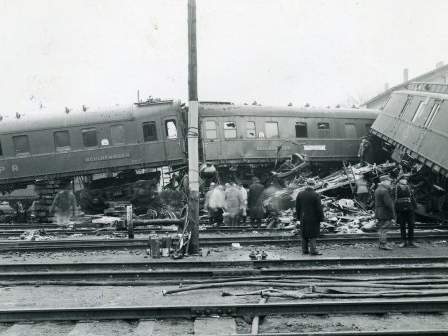
The Genthin rail disaster occurred on 22 December 1939, when an express train crashed into a stationary express train in Genthin station, in today's Saxony-Anhalt state of Germany. There were up to 278 deaths, making it the worst passenger train accident in German history. It was caused by a misreading of signals, owing to one train not being equipped with automated protection, due to wartime shortages.
The Berlin–Magdeburg railway was equipped with Indusi train protection system at the time.
Christmas Day 1939 fell on a Monday, which many families and soldiers used as a long weekend. Because of the Second World War, spare locomotives or coaches for relief trains were not available, so the existing trains were overcrowded. Express train D 10 (23:15 from Berlin Potsdamer Bahnhof to Cologne) had left Berlin on time, but due to excessive dwelling time and the blackout (most lights at stations were turned off) it was quickly delayed up to 30 minutes.
The following D 180 was scheduled to run from Berlin Potsdamer Bahnhof (departure 23:45) to Neunkirchen (Saar). It was pulled by a DRG Class 01 steam locomotive (no. 01 158), whose Indusi equipment was taken out for repairs. Due to the ongoing locomotive shortage it was put into service nevertheless.
D 180 had fewer stops than the preceding express, so it quickly caught up with D 10 and was running one block behind it.
One station before Genthin, the D 180 passed Belicke block post signal at danger. The locomotive was not equipped with the Indusi system, which would have stopped the train. The driver later stated that all signals were showing a "green" aspect, which was denied by the signalman at Belicke. Speculation regarding the misinterpretation of the signals included difficult signal-sighting at night or driver error.
After the train passed the signal at danger, the signalman at Belicke immediately warned the next signal box down the line at Genthin Ost (Genthin East). The signalman there tried to stop the D 180 by waving an emergency red lamp. This was seen by the driver of the preceding D 10, who made an emergency brake application and the train came to a stand at Genthin station at 00:51.
Instead of then putting his signals to danger, the signalman at Genthin East continued to use the red lamp to try to warn the driver of D 180, but he did not notice it, presumably because he 'read through' to the next signal which was displaying the green aspect intended for the D 10.
Hub AI
Genthin rail disaster AI simulator
(@Genthin rail disaster_simulator)
Genthin rail disaster
The Genthin rail disaster occurred on 22 December 1939, when an express train crashed into a stationary express train in Genthin station, in today's Saxony-Anhalt state of Germany. There were up to 278 deaths, making it the worst passenger train accident in German history. It was caused by a misreading of signals, owing to one train not being equipped with automated protection, due to wartime shortages.
The Berlin–Magdeburg railway was equipped with Indusi train protection system at the time.
Christmas Day 1939 fell on a Monday, which many families and soldiers used as a long weekend. Because of the Second World War, spare locomotives or coaches for relief trains were not available, so the existing trains were overcrowded. Express train D 10 (23:15 from Berlin Potsdamer Bahnhof to Cologne) had left Berlin on time, but due to excessive dwelling time and the blackout (most lights at stations were turned off) it was quickly delayed up to 30 minutes.
The following D 180 was scheduled to run from Berlin Potsdamer Bahnhof (departure 23:45) to Neunkirchen (Saar). It was pulled by a DRG Class 01 steam locomotive (no. 01 158), whose Indusi equipment was taken out for repairs. Due to the ongoing locomotive shortage it was put into service nevertheless.
D 180 had fewer stops than the preceding express, so it quickly caught up with D 10 and was running one block behind it.
One station before Genthin, the D 180 passed Belicke block post signal at danger. The locomotive was not equipped with the Indusi system, which would have stopped the train. The driver later stated that all signals were showing a "green" aspect, which was denied by the signalman at Belicke. Speculation regarding the misinterpretation of the signals included difficult signal-sighting at night or driver error.
After the train passed the signal at danger, the signalman at Belicke immediately warned the next signal box down the line at Genthin Ost (Genthin East). The signalman there tried to stop the D 180 by waving an emergency red lamp. This was seen by the driver of the preceding D 10, who made an emergency brake application and the train came to a stand at Genthin station at 00:51.
Instead of then putting his signals to danger, the signalman at Genthin East continued to use the red lamp to try to warn the driver of D 180, but he did not notice it, presumably because he 'read through' to the next signal which was displaying the green aspect intended for the D 10.