


Community hub
Recent from talks
Contribute something
Nothing was collected or created yet.
Geodetic Reference System 1980
View on Wikipedia | This article needs additional citations for verification. (February 2009) |
| Geodesy |
|---|
 |
The Geodetic Reference System 1980 (GRS80) consists of a global reference ellipsoid and a normal gravity model.[1][2][3] The GRS80 gravity model has been followed by the newer more accurate Earth Gravitational Models, but the GRS80 reference ellipsoid is still the most accurate in use for coordinate reference systems, e.g. for the international ITRS, the European ETRS89 and (with a 0,1 mm rounding error) for WGS 84 used for the American Global Navigation Satellite System (GPS).
Background
[edit]Geodesy is the scientific discipline that deals with the measurement and representation of the earth, its gravitational field and geodynamic phenomena (polar motion, earth tides, and crustal motion) in three-dimensional, time-varying space.
The geoid is essentially the figure of the Earth abstracted from its topographic features. It is an idealized equilibrium surface of sea water, the mean sea level surface in the absence of currents, air pressure variations etc. and continued under the continental masses. The geoid, unlike the ellipsoid, is irregular and too complicated to serve as the computational surface on which to solve geometrical problems like point positioning. The geometrical separation between it and the reference ellipsoid is called the geoidal undulation, or more usually the geoid-ellipsoid separation, N. It varies globally between ±110 m.
A reference ellipsoid, customarily chosen to be the same size (volume) as the geoid, is described by its semi-major axis (equatorial radius) a and flattening f. The quantity f = (a−b)/a, where b is the semi-minor axis (polar radius), is a purely geometrical one. The mechanical ellipticity of the earth (dynamical flattening, symbol J2) is determined to high precision by observation of satellite orbit perturbations. Its relationship with the geometric flattening is indirect. The relationship depends on the internal density distribution.
The 1980 Geodetic Reference System (GRS 80) posited a 6378137 m semi-major axis and a 1⁄298.257222101 flattening. This system was adopted at the XVII General Assembly of the International Union of Geodesy and Geophysics (IUGG) in Canberra, Australia, 1979.
The GRS 80 reference system was originally used by the World Geodetic System 1984 (WGS 84). The reference ellipsoid of WGS 84 now differs slightly due to later refinements.[citation needed]
The numerous other systems which have been used by diverse countries for their maps and charts are gradually dropping out of use as more and more countries move to global, geocentric reference systems using the GRS80 reference ellipsoid.
Definition
[edit]The reference ellipsoid is usually defined by its semi-major axis (equatorial radius) and either its semi-minor axis (polar radius) , aspect ratio or flattening , but GRS80 is an exception: four independent constants are required for a complete definition. GRS80 chooses as these , , and , making the geometrical constant a derived quantity.


- Defining geometrical constants
- Semi-major axis = Equatorial Radius = ;

- Defining physical constants
- Geocentric gravitational constant determined from the gravitational constant and the earth mass with atmosphere ;
- Dynamical form factor ;
- Angular velocity of rotation ;



Derived quantities
[edit]- Derived geometrical constants (all rounded)
- Flattening = = 0.003 352 810 681 183 637 418;
- Reciprocal of flattening = = 298.257 222 100 882 711 243;
- Semi-minor axis = Polar Radius = = 6 356 752.314 140 347 m;
- Aspect ratio = = 0.996 647 189 318 816 363;
- Mean radius as defined by the International Union of Geodesy and Geophysics (IUGG): = 6 371 008.7714 m;
- Authalic mean radius = = 6 371 007.1809 m;
- Radius of a sphere of the same volume = = 6 371 000.7900 m;
- Linear eccentricity = = 521 854.0097 m;
- Eccentricity of elliptical section through poles = = 0.081 819 191 0428;
- Polar radius of curvature = = 6 399 593.6259 m;
- Equatorial radius of curvature for a meridian = = 6 335 439.3271 m;
- Meridian quadrant = 10 001 965.7292 m;




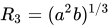
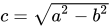


- Derived physical constants (rounded)
- Period of rotation (sidereal day) = = 86 164.100 637 s

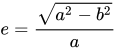
The formula giving the eccentricity of the GRS80 spheroid is:[1]

where

and (so ). The equation is solved iteratively to give
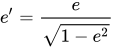


which gives

References
[edit]- ^ a b Moritz, Helmut (September 1980). "Geodetic Reference System 1980" (PDF). Bulletin Géodésique. 54 (3): 395–405. Bibcode:1980BGeod..54..395M. doi:10.1007/BF02521480. S2CID 198209711.
- ^ Moritz, H. (1992). "Geodetic Reference System 1980". Bulletin Géodésique. 66 (2). Springer Science and Business Media LLC: 187–192. Bibcode:1992BGeod..66..187M. doi:10.1007/bf00989270. ISSN 0007-4632. S2CID 122916060.
- ^ Moritz, Helmut (March 2000). "Geodetic Reference System 1980" (PDF). Journal of Geodesy. 74 (1): 128–162. doi:10.1007/S001900050278. S2CID 195290884. Archived from the original (PDF) on 2016-02-20. Retrieved 2018-12-15.
External links
[edit]Geodetic Reference System 1980
View on GrokipediaHistory and Development
Origins and Adoption
The Geodetic Reference System 1980 (GRS80) emerged in the late 1970s as part of international efforts to standardize geodetic parameters amid advancing satellite technology and global measurement needs. It was developed under the auspices of the International Association of Geodesy (IAG), specifically through Special Study Group 5.39 on fundamental geodetic constants, which focused on reconciling geometric, gravitational, and rotational parameters for a cohesive Earth model.[1] Key contributions came from Helmut Moritz, who led the formulation of the system's ellipsoidal and potential field definitions, and Richard H. Rapp, who provided critical analyses of gravity data and parameter estimation techniques to support the group's recommendations.[3] The primary purpose of GRS80 was to establish a geocentric equipotential reference ellipsoid that could serve as a unified framework for precise geometric and gravimetric positioning worldwide, addressing the limitations of disparate national datums such as various Clarke ellipsoids that had led to inconsistencies in global mapping and navigation.[1] This initiative built on prior IAG work, including the Geodetic Reference System 1967, but incorporated updated observations from satellite geodesy to enhance accuracy for geophysical and astronomical applications. By prioritizing a consistent set of defining parameters, GRS80 aimed to facilitate interoperability in international scientific collaborations and replace fragmented local systems with a single, authoritative standard.[1] GRS80 was formally adopted at the XVII General Assembly of the International Union of Geodesy and Geophysics (IUGG) held in Canberra, Australia, in December 1979, through Resolution No. 7.[4] This resolution recognized the need for an updated geocentric system and endorsed GRS80's parameters as the official IAG reference, urging its adoption in geodetic practice to promote uniformity.[5] The adoption marked a pivotal step in global geodesy, enabling subsequent developments in coordinate reference frames and gravity modeling.[1]Relation to Earlier Systems
The Geodetic Reference System 1980 (GRS80) represents a significant evolution in geodetic modeling, building upon a lineage of reference ellipsoids that began with regionally focused systems in the 19th and early 20th centuries. Earlier ellipsoids, such as the Clarke 1866 model—characterized by a semi-major axis of 6,378,206 m and flattening of 1/294.978—were designed primarily for North American surveys and exhibited regional biases, fitting local geoid undulations well but deviating substantially from a global, geocentric representation of Earth's shape. Similarly, the International Ellipsoid of 1924, based on Hayford's 1909 determinations with a semi-major axis of 6,378,388 m and flattening of 1/297, was optimized for European and broader international networks but suffered from similar limitations, as its center was offset from Earth's center of mass, leading to inconsistencies in global applications.[6] These regional systems gave way to more standardized global models in the mid-20th century, culminating in the Geodetic Reference System 1967 (GRS67), which served as the direct predecessor to GRS80. Adopted by the International Association of Geodesy (IAG) in 1967, GRS67 featured a semi-major axis of 6,378,160 m and flattening of 1/298.247, representing an improvement in accuracy based on terrestrial gravity and astronomical observations, although it was geocentric but relied on data that was less precise than subsequent satellite measurements. By the late 1970s, GRS67 was recognized as inadequate for emerging precision requirements, prompting its replacement as outlined in IUGG Resolution No. 7 (1979), which emphasized the need for updated constants to better reflect Earth's size, shape, and gravity field.[7][6] The development of GRS80 was motivated by the advent of space-based geodetic techniques in the 1970s, which necessitated a shift toward truly global, geocentric reference frames to accommodate data from satellite Doppler tracking (e.g., via the Transit system), satellite laser ranging (SLR), and other observations. These technologies provided unprecedented global coverage and accuracy, revealing discrepancies in older models' alignments with Earth's center of mass and rotation axis, thus driving the transition from regionally biased ellipsoids to a unified system suitable for international scientific and navigational purposes. This evolution marked a pivotal advancement in geodesy, enabling consistent worldwide coordinate referencing without the distortions inherent in prior systems.[6][7]Defining Parameters
Ellipsoidal Parameters
The Geodetic Reference System 1980 (GRS80) establishes the shape of its reference ellipsoid through two fundamental geometric parameters: the semi-major axis and the flattening. These parameters define an oblate spheroid that approximates the Earth's mean sea level surface, serving as the geometric foundation for coordinate transformations and geodetic computations.[7] The semi-major axis, denoted , is defined exactly as 6,378,137 meters, corresponding to the equatorial radius of the ellipsoid. This precise value was adopted to align with contemporary measurements of the Earth's equatorial dimensions.[7] The flattening, denoted , is defined exactly as , or equivalently . This ratio quantifies the ellipsoid's compression along the polar axis relative to the equator, reflecting the Earth's oblateness.[7] Both parameters were determined through a least-squares adjustment of global geodetic, gravimetric, and satellite data, aimed at minimizing discrepancies between observed and modeled Earth parameters. This adjustment process, conducted by the International Association of Geodesy (IAG), incorporated data from satellite orbits and gravity anomalies to achieve optimal fit for the reference ellipsoid.[7][8] Within GRS80, the authalic radius serves as an intermediate quantity in gravity field modeling, representing the radius of a sphere with the same surface area as the ellipsoid.[7]Gravitational and Rotational Parameters
The gravitational and rotational parameters of the Geodetic Reference System 1980 (GRS80) provide the dynamic foundation for modeling the Earth's normal gravity potential, essential for precise geodetic calculations. These parameters were adopted by the International Union of Geodesy and Geophysics (IUGG) at its XVII General Assembly in Canberra in 1979, through Resolution No. 7, to standardize global reference computations.[9] The geocentric gravitational constant, denoted , is defined as m³ s⁻². This value is the product of the Newtonian gravitational constant and the total mass of the Earth , encompassing the atmosphere, and serves as the central term in the gravitational potential expansion for GRS80.[9] The dynamical form factor is specified as , or equivalently . It represents the dominant oblateness effect due to the Earth's equatorial bulge, calculated as , where and are the polar and equatorial moments of inertia, respectively, excluding permanent tidal deformation, and is the equatorial radius.[9] The angular velocity of rotation is fixed at exactly rad s⁻¹. This precise value reflects the conventional mean sidereal rotation rate of the Earth, incorporating the centrifugal potential in the total gravity field model.[9] Collectively, these parameters were derived from analyses of satellite orbit perturbations—such as those observed in laser ranging and Doppler tracking—and surface gravity anomaly measurements, ensuring a consistent representation of the Earth's dynamic figure when combined with the static ellipsoidal geometry.[9]Derived Quantities
Geometric Quantities
The geometric quantities of the Geodetic Reference System 1980 (GRS80) ellipsoid are secondary properties computed directly from its defining semi-major axis m and flattening . These include lengths and measures that characterize the shape and size of the reference ellipsoid for geodetic computations, such as positioning and mapping.[7] The semi-minor axis , representing the polar radius, is derived as , yielding m. This value defines the ellipsoid's compression along the rotation axis, essential for converting between geodetic and Cartesian coordinates.[7] The first eccentricity squared quantifies the ellipsoid's deviation from a sphere and is calculated via . This parameter appears in formulas for meridian arcs and geodetic latitudes. The linear eccentricity , the distance from the ellipsoid's center to the focus, is given by m, influencing computations of ellipsoidal distances and curvatures.[7] The volume of the GRS80 ellipsoid, enclosed by the reference surface, is m³, providing a measure of the space within the model Earth. Its surface area , the total area of the ellipsoidal boundary, approximates km² and is computed using the exact formula for an oblate spheroid: where higher-order terms ensure precision for global-scale applications. This value is often referenced via the authalic radius m, the radius of a sphere with equivalent surface area ().[7][10] The volumetric mean radius , defined as the radius of a sphere with the same volume as the ellipsoid (), is approximately m for GRS80. In contrast, the arithmetic mean radius m serves as a simple average for preliminary spherical approximations in geodetic modeling.[7]Gravitational Constants
The gravitational constants in the Geodetic Reference System 1980 (GRS80) define the normal gravity field associated with the reference ellipsoid, enabling computations of theoretical gravity for geodetic applications. These constants are derived from the system's defining parameters, including the geocentric gravitational constant m³/s², the dynamical form factor , and the Earth's angular velocity rad/s.[1][11] The standard normal gravity at latitude is given by Somigliana's formula, which ensures the ellipsoid is an equipotential surface: where is the semi-major axis, is the semi-minor axis, is the equatorial normal gravity, and is the polar normal gravity. This closed-form expression depends on , , and through the derivation of and , as well as the ellipsoid's flattening, which incorporates rotational and gravitational effects via Clairaut's theorem.[1][11] The equatorial normal gravity is m/s², computed as , where , , and is a geodetic constant derived from the flattening. The polar normal gravity is m/s², given by . These values account for the combined gravitational attraction and centrifugal effects in the rotating frame.[12][1] An alternative parametric form of Somigliana's formula is , where is the gravity flattening parameter and is the squared first eccentricity of the ellipsoid. This form facilitates numerical evaluations while preserving the dependence on the core parameters , , and .[11][1] The centrifugal acceleration at the equator, arising from Earth's rotation, is m/s², which reduces the effective gravity there relative to the polar value.[1]Applications and Comparisons
Usage in Modern Coordinate Systems
The Geodetic Reference System 1980 (GRS80) serves as the foundational ellipsoid for several key modern coordinate systems, including the International Terrestrial Reference System (ITRS), the European Terrestrial Reference System 1989 (ETRS89), and the initial definition of the World Geodetic System 1984 (WGS84).[13][14][3] The ITRS, maintained by the International Earth Rotation and Reference Systems Service (IERS), relies on the GRS80 ellipsoid to define its geocentric coordinate frame, enabling precise global positioning through successive realizations such as ITRF2020.[13] Similarly, ETRS89 adopts GRS80 as its reference ellipsoid to support continent-wide European mapping and navigation, aligned with the ITRS but fixed to the Eurasian plate.[14] The original WGS84 specification incorporated GRS80 parameters with minimal adjustments to facilitate compatibility with emerging satellite technologies.[3] GRS80's adoption accelerated with the rollout of Global Positioning System (GPS) standards in 1984, when WGS84—built on GRS80—was designated as the official reference for GPS operations by the U.S. Department of Defense.[3] This integration marked a pivotal moment in geodesy, transitioning from disparate regional systems to a unified global framework. Post-2000, GRS80 continued to underpin numerous national datums, with many countries updating their geodetic infrastructures to ITRS realizations like ITRF2000 and ITRF2008, thereby enhancing interoperability in international applications.[15] As of 2023, the latest WGS84 realization (G2296) aligns with ITRF2020 for GPS operations.[16] In practical terms, GRS80 supports high-precision surveying, where it provides the ellipsoidal basis for accurate 3D coordinate measurements in engineering projects and cadastral mapping.[15] It is integral to satellite navigation systems like GPS, ensuring reliable positioning for aviation, maritime, and autonomous vehicles.[17] Additionally, GRS80 facilitates geophysical modeling by offering a consistent reference for gravity field computations and tectonic studies, with updated ITRS realizations such as ITRF2020 maintaining its ellipsoidal parameters for contemporary use.[13] The widespread implementation of GRS80 has driven a fundamental shift from local to global geodesy, minimizing positional distortions in mapping that could exceed 100 meters in regions previously reliant on outdated ellipsoids.[18] This transition has improved the accuracy of global datasets, supporting applications from climate monitoring to disaster response with reduced systematic errors across international boundaries.[15]Differences from WGS84 and Other Ellipsoids
The Geodetic Reference System 1980 (GRS80) shares nearly identical ellipsoidal parameters with the World Geodetic System 1984 (WGS84), differing only in minor rounding conventions. Both systems use a semi-major axis m, but GRS80 employs an inverse flattening of , while WGS84 uses . This subtle discrepancy in flattening results in a semi-minor axis that varies by less than 0.1 mm between the two ellipsoids. Additionally, the geocentric gravitational constant for GRS80 is m³/s², compared to m³/s² for WGS84, introducing a small variation in the normal gravity field of approximately 0.14 mGal.[7][1][2] In comparison to the earlier Geodetic Reference System 1967 (GRS67), GRS80 features a smaller semi-major axis by 23 m ( m for GRS67) and reduced flattening (inverse flattening for GRS67), reflecting refinements from global satellite and gravimetric data for a better fit to the Earth's mean sea level. GRS80's parameters provide improved consistency with modern observations, minimizing systematic biases present in GRS67's regional optimizations.[19][7] Relative to the Bessel 1841 ellipsoid, commonly used in 19th- and early 20th-century surveys for Europe and Asia, GRS80 is significantly rounder and larger. Bessel 1841 has m and , resulting in a more elongated shape that causes greater distortions—up to several hundred meters—in polar regions when applied globally, as it was not designed for worldwide coverage. GRS80's global optimization reduces these regional mismatches substantially.[20][7] These parameter differences have negligible impacts on most Global Positioning System (GPS) applications, where positional errors remain below 1 cm due to the sub-millimeter ellipsoidal variances and minimal gravity perturbations. However, for centimeter-level geodesy, such as precise orbit determination or high-accuracy surveying, the distinctions require explicit transformation models.[2]| System | Semi-major axis (m) | Inverse flattening | (×10¹⁴ m³/s²) |
|---|---|---|---|
| GRS80 | 6378137 | 298.257222101 | 3.986005 |
| WGS84 | 6378137 | 298.257223563 | 3.986004418 |
| GRS67 | 6378160 | 298.247167427 | 3.986044 |