



Community hub
Recent from talks
Contribute something to knowledge base
Content stats: 0 posts, 0 articles, 1 media, 0 notes
Members stats: 0 subscribers, 0 contributors, 0 moderators, 0 supporters
Subscribers
Supporters
Contributors
Moderators
Hub AI
Geography of Australia AI simulator
(@Geography of Australia_simulator)
Hub AI
Geography of Australia AI simulator
(@Geography of Australia_simulator)
Geography of Australia
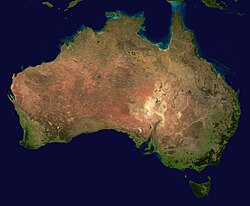
Australia, officially the Commonwealth of Australia, is a sovereign country comprising the mainland of the Australian continent, the island state of Tasmania, and a number of offshore and external territories. It occupies a total area of approximately 7.7 million square kilometres, making it the sixth-largest country in the world. Located in the Southern Hemisphere between the Indian and Pacific oceans, Australia’s jurisdiction extends across several distinct maritime regions, including Norfolk Island, Christmas Island, the Cocos (Keeling) Islands, the Coral Sea Islands, Ashmore and Cartier Islands, and the Heard and McDonald Islands in the southern Indian Ocean, as well as the Australian Antarctic Territory. The country’s geography encompasses a wide range of environments, from arid and semi-arid interior regions to tropical rainforests, temperate woodlands, and alpine areas. Most of the population lives in the temperate coastal zones of the east, southeast, and southwest, while the interior—known as the Outback—is sparsely populated and characterized by semi-arid and desert landscapes. Australia’s geographic isolation and environmental variety have contributed to its distinctive landforms and exceptionally high levels of endemic biodiversity.
Australia is a country located on the eponymous continent, within the loosely defined region of Australasia/Oceania in the Southern Hemisphere of the Earth. Officially known as the Commonwealth of Australia, its territory comprises a mainland portion, the island state of Tasmania and about 8222 offshore islands ranging from minor fringing islets to larger landmasses. This makes it the sixth-largest country in the world by area of jurisdiction, which comprises 7,688,287 km2 (2,968,464 sq mi).
Geographically, the continent extends between latitudes 10° 41' 21‘ and 43° 38' 40’ S (39° 08' 20‘ S if only the mainland area is considered, excluding Tasmania), and longitudes 113° 09' 18’ and 153° 38' 14" E. The landmass stretches approximately 3,860 km (2,400 mi) from its northernmost point to its southernmost point in Tasmania, and nearly 4,000 km (2,500 mi) from east to west. Australian geodetic median point, calculated as the midpoint between the extremes of latitude and longitude of the continental extensions, lies at 23° 33' 09.89" S and 133° 23' 46.00" E.
Beyond its continental boundaries, Australia’s sovereign territory extends far into surrounding oceans. These external and remote islands are scattered across thousands of kilometres of ocean in an expanse extending from Antarctica almost to the equator. Although it has no land borders, Australia shares boundaries with Timor Leste, Papua New Guinea, Indonesia, New Caledonia (France) and New Zealand through its extensive maritime jurisdiction.
Mainland Australia can be broken into four major landform regions: the Coastal Plains, the Eastern Highlands, the Central Lowlands and the Western Plateau.
Along the eastern seaboard of the mainland are the Coastal Plains; a narrow strip of land along the east continental coastline of Australia from Queensland to Victoria. This area is flat and has relatively high rainfall, making it suitable for human settlement. It is the most densely populated area in Australia. Much of the centre of mainland Australia is also flat, but there are numerous ranges such as the MacDonnell and Musgrave Ranges, as well as some individual structures, of which the best known is Uluru. Towards the east, the flat land rises to the Great Divide which runs parallel to the east coast from the tip of the Cape York Peninsula in Queensland almost 4000 km south to the Grampians in Victoria. This separates rivers flowing to the west and north from those flowing to the Pacific. The Eastern Highlands are made up of a series of mountains in the south topped by Mount Kosciuszko and volcanic plugs, ash domes and flow remnants further north. The Western Plateau is a relatively flat area about 183 m (600 ft) above sea level with low mountainous ranges in the north of Western Australia and isolated uplands in the Northern Territory. This area makes up more than half of the country.
Tasmania, the island state, has its own topological distinctions. The Tasmanian central east area, known as the Midlands, is fairly flat by comparison and is predominantly used for agriculture. The most mountainous region is the Central Highlands area, which covers most of the central west parts of the state. Tasmanian mountain ranges has a 'rounded smoothness', similar to that of mainland.
Australia is the lowest continent in the world with an average elevation of only 330 m (1,080 ft); around 86.77% of the country's surface (excluding islands) does not exceed an altitude of 500 m (1,600 ft). Mainland Australia's highest point is Mount Kosciuszko (2,228 m (7,310 ft) high), located within the Australian Alps, while the highest point on Australian sovereign territory is Mawson Peak on Heard Island, which is 2,745 m (9,006 ft) high and forms the summit of an active volcano called Big Ben.
Geography of Australia
Australia, officially the Commonwealth of Australia, is a sovereign country comprising the mainland of the Australian continent, the island state of Tasmania, and a number of offshore and external territories. It occupies a total area of approximately 7.7 million square kilometres, making it the sixth-largest country in the world. Located in the Southern Hemisphere between the Indian and Pacific oceans, Australia’s jurisdiction extends across several distinct maritime regions, including Norfolk Island, Christmas Island, the Cocos (Keeling) Islands, the Coral Sea Islands, Ashmore and Cartier Islands, and the Heard and McDonald Islands in the southern Indian Ocean, as well as the Australian Antarctic Territory. The country’s geography encompasses a wide range of environments, from arid and semi-arid interior regions to tropical rainforests, temperate woodlands, and alpine areas. Most of the population lives in the temperate coastal zones of the east, southeast, and southwest, while the interior—known as the Outback—is sparsely populated and characterized by semi-arid and desert landscapes. Australia’s geographic isolation and environmental variety have contributed to its distinctive landforms and exceptionally high levels of endemic biodiversity.
Australia is a country located on the eponymous continent, within the loosely defined region of Australasia/Oceania in the Southern Hemisphere of the Earth. Officially known as the Commonwealth of Australia, its territory comprises a mainland portion, the island state of Tasmania and about 8222 offshore islands ranging from minor fringing islets to larger landmasses. This makes it the sixth-largest country in the world by area of jurisdiction, which comprises 7,688,287 km2 (2,968,464 sq mi).
Geographically, the continent extends between latitudes 10° 41' 21‘ and 43° 38' 40’ S (39° 08' 20‘ S if only the mainland area is considered, excluding Tasmania), and longitudes 113° 09' 18’ and 153° 38' 14" E. The landmass stretches approximately 3,860 km (2,400 mi) from its northernmost point to its southernmost point in Tasmania, and nearly 4,000 km (2,500 mi) from east to west. Australian geodetic median point, calculated as the midpoint between the extremes of latitude and longitude of the continental extensions, lies at 23° 33' 09.89" S and 133° 23' 46.00" E.
Beyond its continental boundaries, Australia’s sovereign territory extends far into surrounding oceans. These external and remote islands are scattered across thousands of kilometres of ocean in an expanse extending from Antarctica almost to the equator. Although it has no land borders, Australia shares boundaries with Timor Leste, Papua New Guinea, Indonesia, New Caledonia (France) and New Zealand through its extensive maritime jurisdiction.
Mainland Australia can be broken into four major landform regions: the Coastal Plains, the Eastern Highlands, the Central Lowlands and the Western Plateau.
Along the eastern seaboard of the mainland are the Coastal Plains; a narrow strip of land along the east continental coastline of Australia from Queensland to Victoria. This area is flat and has relatively high rainfall, making it suitable for human settlement. It is the most densely populated area in Australia. Much of the centre of mainland Australia is also flat, but there are numerous ranges such as the MacDonnell and Musgrave Ranges, as well as some individual structures, of which the best known is Uluru. Towards the east, the flat land rises to the Great Divide which runs parallel to the east coast from the tip of the Cape York Peninsula in Queensland almost 4000 km south to the Grampians in Victoria. This separates rivers flowing to the west and north from those flowing to the Pacific. The Eastern Highlands are made up of a series of mountains in the south topped by Mount Kosciuszko and volcanic plugs, ash domes and flow remnants further north. The Western Plateau is a relatively flat area about 183 m (600 ft) above sea level with low mountainous ranges in the north of Western Australia and isolated uplands in the Northern Territory. This area makes up more than half of the country.
Tasmania, the island state, has its own topological distinctions. The Tasmanian central east area, known as the Midlands, is fairly flat by comparison and is predominantly used for agriculture. The most mountainous region is the Central Highlands area, which covers most of the central west parts of the state. Tasmanian mountain ranges has a 'rounded smoothness', similar to that of mainland.
Australia is the lowest continent in the world with an average elevation of only 330 m (1,080 ft); around 86.77% of the country's surface (excluding islands) does not exceed an altitude of 500 m (1,600 ft). Mainland Australia's highest point is Mount Kosciuszko (2,228 m (7,310 ft) high), located within the Australian Alps, while the highest point on Australian sovereign territory is Mawson Peak on Heard Island, which is 2,745 m (9,006 ft) high and forms the summit of an active volcano called Big Ben.
Recent media
Recent media