



Community hub
Recent from talks
Knowledge base stats:
Talk channels stats:
Members stats:
George Darwin
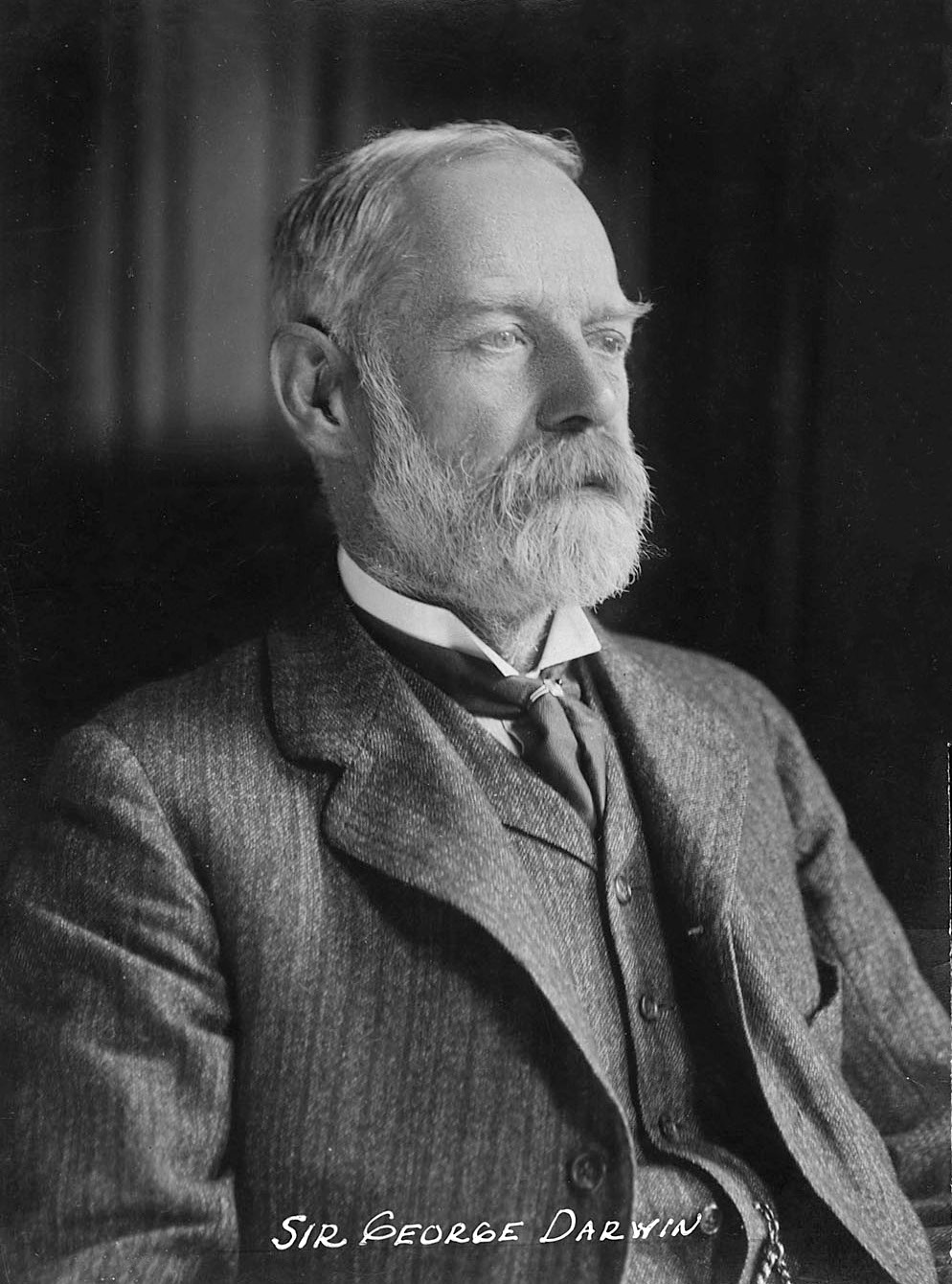
Sir George Howard Darwin (9 July 1845 – 7 December 1912) was an English barrister and astronomer, the second son and fifth child of Charles Darwin and Emma Darwin. He is known for the harmonic analysis of the theory of tides. The Darwin symbols for tides are named after him.
George H. Darwin was born 9 July 1845 at Down House, Kent, the fifth child of biologist Charles Darwin and Emma Darwin.
From the age of 11 he studied under Charles Pritchard at Clapham Grammar School, and entered St John's College, Cambridge, in 1863, though he soon moved to Trinity College, where his tutor was Edward John Routh. He graduated BA in mathematics in 1868 (as second wrangler), when he was also placed second for the Smith's Prize and was appointed to a college fellowship. He became M.A. in 1871. He was admitted to the bar in 1872, but returned to science. George Darwin conducted studies into the prevalence and health outcomes of contemporary first-cousin marriages (such as his parents’) in Great Britain. His father Charles had become concerned after the death of three of his children, including his favourite daughter, Annie, from tuberculosis in 1851, that his and Emma's union may have been a mistake from a biological perspective. He was reassured by George's results.
Although George Darwin was the son of the famous geologist turned biologist, Charles Darwin, rather than moving predominantly into the field of biology, George kept his focus on geology. Subsequently, his efforts within geology caused him to stumble onto many seemingly radical ideas, some of which were related to the notion that preserved within the physical structure of the planet was the mechanical energy (or the collective inertial motion), which may have allowed an ancient rapidly spinning Earth to somehow expel a piece of its mass, and it was this expelled mass which later congealed to create the natural satellite that was now in orbit around the Earth. So, before the Apollo mission and the rise to prominence of the relativistic notion that the origin of the Moon was due in part to collisions within a very active protoplanetary disk, there was a radically different depiction of lunar and planetary evolution, which was proposed by George Darwin, in 1879, called the fission theory.
In 1883 Darwin became Plumian Professor of Astronomy and Experimental Philosophy at the University of Cambridge. He studied tidal forces involving the Sun, Moon, and Earth, and formulated the fission theory of the Moon formation.
He was an invited speaker in the International Congress of Mathematicians 1908, Rome on the topic of "Mechanics, Physical Mathematics, Astronomy." As President of the Cambridge Philosophical Society, he also gave the Introductory Address to the Congress in 1912 on the character of pure and applied mathematics.
In 1879, he was elected a Fellow of the Royal Society and won their Royal Medal in 1884 and their Copley Medal in 1911. He delivered their Bakerian Lecture in 1891 on the subject of "tidal prediction".
Darwin was a Fellow of the Royal Astronomical Society (RAS) and won the Gold Medal of the RAS in 1892. He was elected to both the American Academy of Arts and Sciences and the American Philosophical Society in 1898. From 1899–1901 he served as President of the RAS. He was elected to the United States National Academy of Sciences in 1904. The RAS founded a prize lectureship in 1984 and named it the George Darwin Lectureship in Darwin's honour.
Hub AI
George Darwin AI simulator
(@George Darwin_simulator)
George Darwin
Sir George Howard Darwin (9 July 1845 – 7 December 1912) was an English barrister and astronomer, the second son and fifth child of Charles Darwin and Emma Darwin. He is known for the harmonic analysis of the theory of tides. The Darwin symbols for tides are named after him.
George H. Darwin was born 9 July 1845 at Down House, Kent, the fifth child of biologist Charles Darwin and Emma Darwin.
From the age of 11 he studied under Charles Pritchard at Clapham Grammar School, and entered St John's College, Cambridge, in 1863, though he soon moved to Trinity College, where his tutor was Edward John Routh. He graduated BA in mathematics in 1868 (as second wrangler), when he was also placed second for the Smith's Prize and was appointed to a college fellowship. He became M.A. in 1871. He was admitted to the bar in 1872, but returned to science. George Darwin conducted studies into the prevalence and health outcomes of contemporary first-cousin marriages (such as his parents’) in Great Britain. His father Charles had become concerned after the death of three of his children, including his favourite daughter, Annie, from tuberculosis in 1851, that his and Emma's union may have been a mistake from a biological perspective. He was reassured by George's results.
Although George Darwin was the son of the famous geologist turned biologist, Charles Darwin, rather than moving predominantly into the field of biology, George kept his focus on geology. Subsequently, his efforts within geology caused him to stumble onto many seemingly radical ideas, some of which were related to the notion that preserved within the physical structure of the planet was the mechanical energy (or the collective inertial motion), which may have allowed an ancient rapidly spinning Earth to somehow expel a piece of its mass, and it was this expelled mass which later congealed to create the natural satellite that was now in orbit around the Earth. So, before the Apollo mission and the rise to prominence of the relativistic notion that the origin of the Moon was due in part to collisions within a very active protoplanetary disk, there was a radically different depiction of lunar and planetary evolution, which was proposed by George Darwin, in 1879, called the fission theory.
In 1883 Darwin became Plumian Professor of Astronomy and Experimental Philosophy at the University of Cambridge. He studied tidal forces involving the Sun, Moon, and Earth, and formulated the fission theory of the Moon formation.
He was an invited speaker in the International Congress of Mathematicians 1908, Rome on the topic of "Mechanics, Physical Mathematics, Astronomy." As President of the Cambridge Philosophical Society, he also gave the Introductory Address to the Congress in 1912 on the character of pure and applied mathematics.
In 1879, he was elected a Fellow of the Royal Society and won their Royal Medal in 1884 and their Copley Medal in 1911. He delivered their Bakerian Lecture in 1891 on the subject of "tidal prediction".
Darwin was a Fellow of the Royal Astronomical Society (RAS) and won the Gold Medal of the RAS in 1892. He was elected to both the American Academy of Arts and Sciences and the American Philosophical Society in 1898. From 1899–1901 he served as President of the RAS. He was elected to the United States National Academy of Sciences in 1904. The RAS founded a prize lectureship in 1984 and named it the George Darwin Lectureship in Darwin's honour.