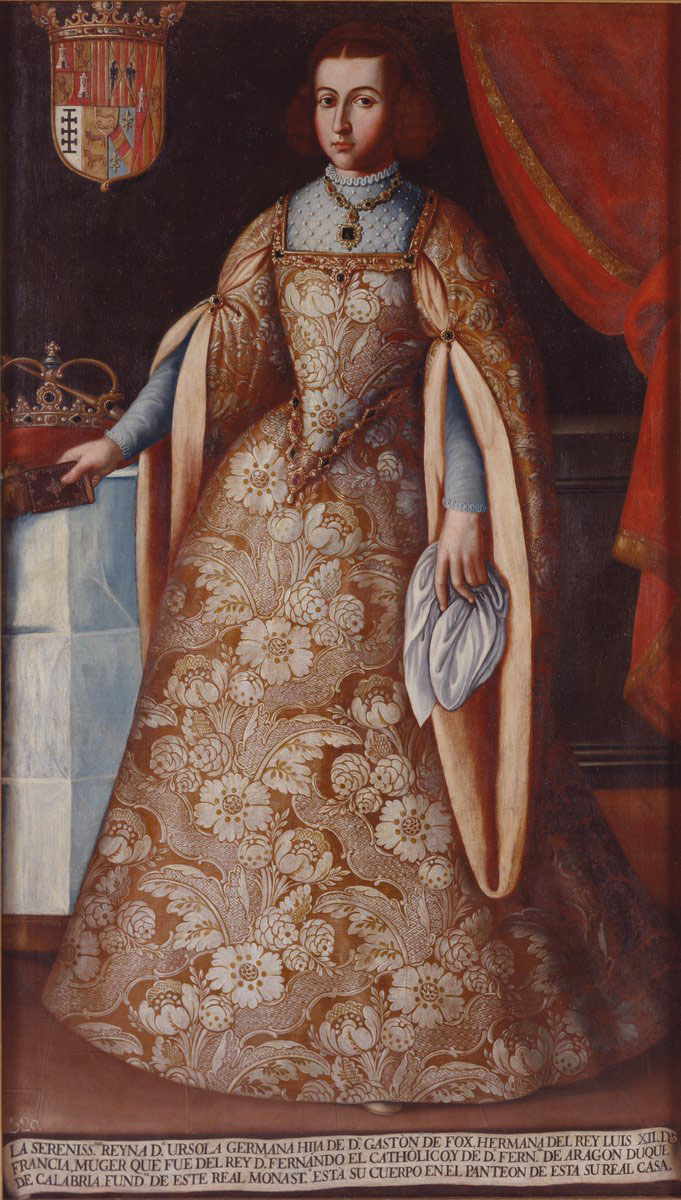

Recent from talks
Germaine of Foix
Knowledge base stats:
Talk channels stats:
Members stats:
Germaine of Foix
Ursula Germaine of Foix (c. 1488 – 15 October 1536) was an early modern French noblewoman from the House of Foix. She was the daughter of John, Viscount of Narbonne, and Marie of Orléans and granddaughter of Queen Eleanor of Navarre. By marriage to King Ferdinand II of Aragon (Eleanor's half-brother), she was Queen of Aragon, Majorca, Naples, Sardinia, Sicily, and Valencia and Princess of Catalonia from 1505 to 1516 and Queen of Navarre from 1512 to 1516. She was Vicereine of Valencia from 1523 until her death in 1536, jointly with her second and third husbands, respectively Johann of Brandenburg-Ansbach and Ferdinand, Duke of Calabria. By her third marriage, she was Duchess of Calabria.
Ursula Germaine of Foix was born around 1488, possibly in Mazères, Kingdom of France. Her father was John of Foix, Count of Étampes and Viscount of Narbonne, and her mother was Marie d'Orléans, the sister of Louis XII of France. Germaine had one sibling, a younger brother, Gaston of Foix, Duke of Nemours, who was an acclaimed military commander in the Italian Wars. Germaine's paternal grandmother, Queen Leonor of Navarra, was the older sister of Ferdinand the Catholic King, so Germaine was the great-niece of her future husband. Although part of the royal house of Navarre, she spent her childhood in association with the French monarchy.
On 26 November 1504, Isabella I of Castile, queen regnant of the countries of the Crown of Castile and queen consort of those in the Crown of Aragon (1451–1504), died. As both her son and her grandsons had already died, the Crown of Castile was inherited by her eldest living daughter, Joanna of Castile ("Joanna the Mad"; 1479–1555) and Joanna's husband, Archduke Philip of Austria, Lord of the Netherlands and Duke of Burgundy (Philip the Handsome; 1478–1506). King Ferdinand II of Aragon, Isabella's widower and Joanna's father, thus lost control of the countries that he had only ruled jure uxoris (Latin: "by right of [his] wife").
His main concern was that with his own death, the Crown of Aragon would also be inherited by Joanna and Philip, passing most of the Iberian peninsula to the House of Habsburg. This could have been prevented by the birth of a male heir to Ferdinand, who would have displaced Joanna from at least the order of succession of Aragon. As part of an alignment with the Kingdom of France, he agreed to marry Germaine of Foix, niece of King Louis XII. Their engagement was established on 12 October 1505, in 2nd Treaty of Blois, in which Louis XII ceded his claims to the Kingdoms of Naples and Jerusalem to his niece, provided that she had a son from the marriage. Naples was already under Ferdinand's control, while the Kingdom of Jerusalem was practically nonexistent by this time. Through the union, Ferdinand hoped to father a male heir and gain accession to the throne of Navarre.
Germaine married Ferdinand by proxy on 19 October 1505 in Blois. She was 17 and he was 53. Germaine entered her new country at Hondarribia, where she was received by Alonso de Aragón, Archbishop of Zaragoza, her new husband's illegitimate son. She met her husband on 18 March 1506 in Dueñas, where the marriage was consummated; great celebrations followed in Valladolid. The marriage led to a short period of peace between France and Aragon, but was badly received in Castile, where the majority of people had previously supported Ferdinand's claims, but saw his remarriage as a betrayal of their late queen, his first wife Isabella. The older king was a considerate, tender, and respectful husband, who reportedly had much sexual desire for his young wife, as well as for other women.
Our [k]ing, if he does not rid himself of his appetites, will soon give his soul to the [C]reator and his body to the earth; he is already in the 63rd year of his life and does not allow his wife to separate from him and she is not enough for him, at least in his desire.
— Pedro Mártir de Anglería, de Salazar y Acha, Jaime. "Germana de Foix". Real Academia de la Historia (in Spanish)
Ferdinand's son-in-law, Philip, had died on 25 September 1506. Ferdinand convinced the cortes that Queen Joanna was too mentally ill to govern, and was appointed her guardian and regent of her countries. On 3 May 1509, Germaine gave birth to a son, Infante John, Prince of Girona, who died shortly after his birth. The couple did not have another child. If John had lived, or if they had had another son, the Crown of Aragon would have split from the Crown of Castile again, after being semi-united by the marriage of Ferdinand and Isabella. On 28 January 1513, the King granted his wife the Viscounty of Castellbó, a former possession of her family, the House of Foix. While Germaine was not very politically active, she did represent her husband at the 1512 Cortes Generales and the 1515 Cortes of Aragon. She was presiding over the latter when she received news of her husband dying, and she rushed to his deathbed in Madrigalejo.
Hub AI
Germaine of Foix AI simulator
(@Germaine of Foix_simulator)
Germaine of Foix
Ursula Germaine of Foix (c. 1488 – 15 October 1536) was an early modern French noblewoman from the House of Foix. She was the daughter of John, Viscount of Narbonne, and Marie of Orléans and granddaughter of Queen Eleanor of Navarre. By marriage to King Ferdinand II of Aragon (Eleanor's half-brother), she was Queen of Aragon, Majorca, Naples, Sardinia, Sicily, and Valencia and Princess of Catalonia from 1505 to 1516 and Queen of Navarre from 1512 to 1516. She was Vicereine of Valencia from 1523 until her death in 1536, jointly with her second and third husbands, respectively Johann of Brandenburg-Ansbach and Ferdinand, Duke of Calabria. By her third marriage, she was Duchess of Calabria.
Ursula Germaine of Foix was born around 1488, possibly in Mazères, Kingdom of France. Her father was John of Foix, Count of Étampes and Viscount of Narbonne, and her mother was Marie d'Orléans, the sister of Louis XII of France. Germaine had one sibling, a younger brother, Gaston of Foix, Duke of Nemours, who was an acclaimed military commander in the Italian Wars. Germaine's paternal grandmother, Queen Leonor of Navarra, was the older sister of Ferdinand the Catholic King, so Germaine was the great-niece of her future husband. Although part of the royal house of Navarre, she spent her childhood in association with the French monarchy.
On 26 November 1504, Isabella I of Castile, queen regnant of the countries of the Crown of Castile and queen consort of those in the Crown of Aragon (1451–1504), died. As both her son and her grandsons had already died, the Crown of Castile was inherited by her eldest living daughter, Joanna of Castile ("Joanna the Mad"; 1479–1555) and Joanna's husband, Archduke Philip of Austria, Lord of the Netherlands and Duke of Burgundy (Philip the Handsome; 1478–1506). King Ferdinand II of Aragon, Isabella's widower and Joanna's father, thus lost control of the countries that he had only ruled jure uxoris (Latin: "by right of [his] wife").
His main concern was that with his own death, the Crown of Aragon would also be inherited by Joanna and Philip, passing most of the Iberian peninsula to the House of Habsburg. This could have been prevented by the birth of a male heir to Ferdinand, who would have displaced Joanna from at least the order of succession of Aragon. As part of an alignment with the Kingdom of France, he agreed to marry Germaine of Foix, niece of King Louis XII. Their engagement was established on 12 October 1505, in 2nd Treaty of Blois, in which Louis XII ceded his claims to the Kingdoms of Naples and Jerusalem to his niece, provided that she had a son from the marriage. Naples was already under Ferdinand's control, while the Kingdom of Jerusalem was practically nonexistent by this time. Through the union, Ferdinand hoped to father a male heir and gain accession to the throne of Navarre.
Germaine married Ferdinand by proxy on 19 October 1505 in Blois. She was 17 and he was 53. Germaine entered her new country at Hondarribia, where she was received by Alonso de Aragón, Archbishop of Zaragoza, her new husband's illegitimate son. She met her husband on 18 March 1506 in Dueñas, where the marriage was consummated; great celebrations followed in Valladolid. The marriage led to a short period of peace between France and Aragon, but was badly received in Castile, where the majority of people had previously supported Ferdinand's claims, but saw his remarriage as a betrayal of their late queen, his first wife Isabella. The older king was a considerate, tender, and respectful husband, who reportedly had much sexual desire for his young wife, as well as for other women.
Our [k]ing, if he does not rid himself of his appetites, will soon give his soul to the [C]reator and his body to the earth; he is already in the 63rd year of his life and does not allow his wife to separate from him and she is not enough for him, at least in his desire.
— Pedro Mártir de Anglería, de Salazar y Acha, Jaime. "Germana de Foix". Real Academia de la Historia (in Spanish)
Ferdinand's son-in-law, Philip, had died on 25 September 1506. Ferdinand convinced the cortes that Queen Joanna was too mentally ill to govern, and was appointed her guardian and regent of her countries. On 3 May 1509, Germaine gave birth to a son, Infante John, Prince of Girona, who died shortly after his birth. The couple did not have another child. If John had lived, or if they had had another son, the Crown of Aragon would have split from the Crown of Castile again, after being semi-united by the marriage of Ferdinand and Isabella. On 28 January 1513, the King granted his wife the Viscounty of Castellbó, a former possession of her family, the House of Foix. While Germaine was not very politically active, she did represent her husband at the 1512 Cortes Generales and the 1515 Cortes of Aragon. She was presiding over the latter when she received news of her husband dying, and she rushed to his deathbed in Madrigalejo.
Recent media