
Recent from talks
Germans of Romania
Knowledge base stats:
Talk channels stats:
Members stats:
Germans of Romania
The Germans of Romania (German: Rumäniendeutsche; Romanian: Germanii din România or germani-români; Hungarian: romániai németek) represent one of the most significant historical ethnic minorities of Romania from the modern period onwards.
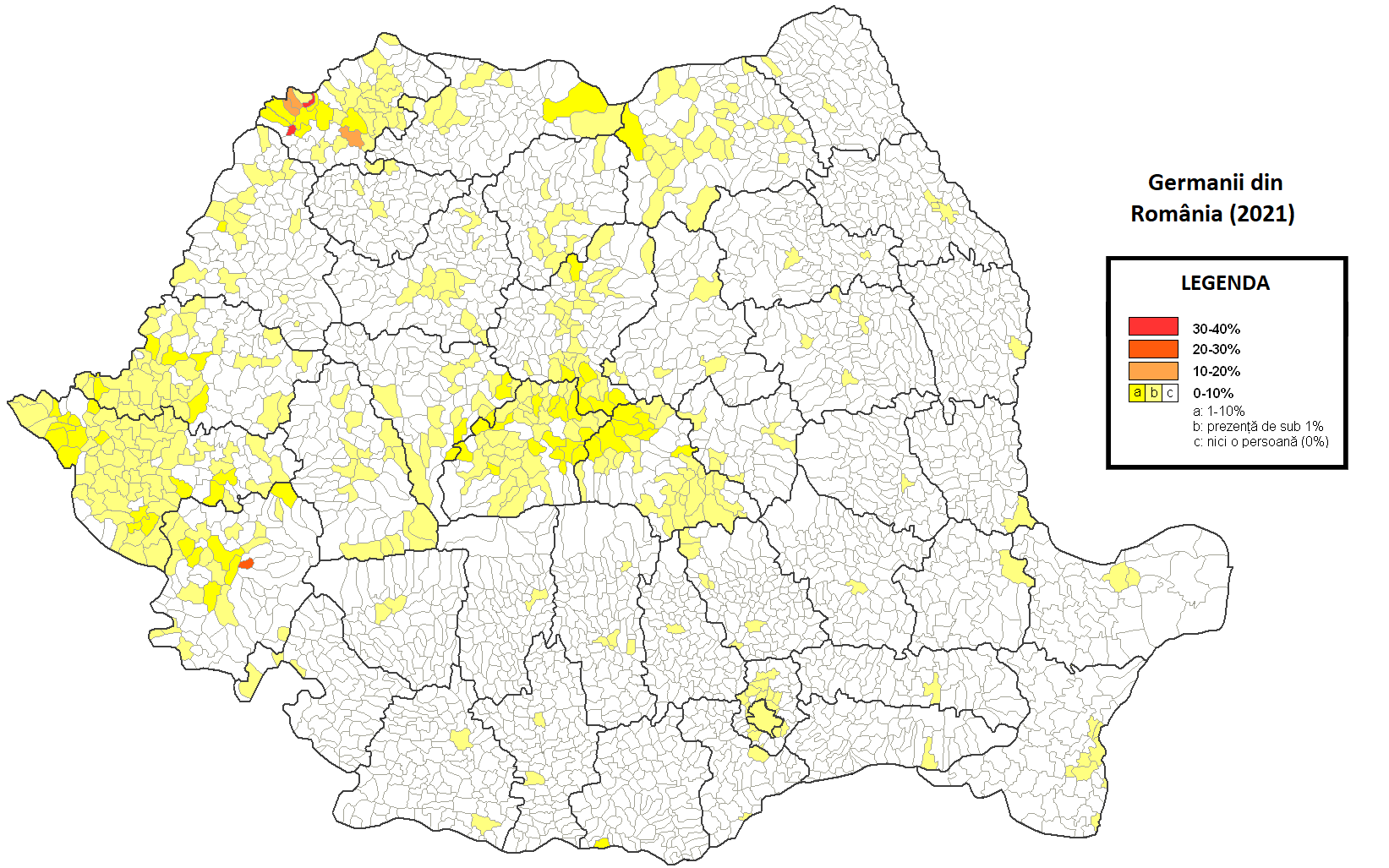
Throughout the interwar period, the total number of ethnic Germans in the country amounted to as many as c. 800,000 (according to some sources and estimates dating to 1939, just on the verge of World War II), a figure which has subsequently drastically fallen to c. 36,000 (according to the 2011 census) and dropped even more to c. 22,900 (as per the 2021 Romanian census, postponed one year because of the COVID-19 pandemic and conducted in 2022).
Following the decreasing trend of the overall population of Romania, the German community of the country is expected to continue shrinking in numbers as well, as it has already been officially reported by the partial results of the 2021 census.
The Germans of Romania (or Romanian-Germans) are not a single, unitary, homogeneous group, but rather a series of various regional sub-groups, each with their different culture, traditions, folklore, dialect or dialects, and history.
This claim stems from the fact that various German-speaking populations had previously arrived in the territory of present-day Romania in different waves or stages of settlement, initially starting with the High Middle Ages, firstly to southern and northeastern Transylvania, Kingdom of Hungary (some of them even crossing the outer Carpathians to neighbouring Moldavia and Wallachia), then subsequently during the Modern Age in other Habsburg-ruled lands (such as Bukovina, at the time part of Cisleithania, or the Banat).
Subsequently, the Romanian Old Kingdom (Romanian: Vechiul Regat, German: Altreich) was also colonized by Germans, firstly in Dobruja and then gradually in other areas of Moldavia and Wallachia.
Therefore, given their rather complex geographic background and the fact that major border changes took place in the region throughout history (after World War I, Romania expanded its territory from the pre-war 137,000 km2 (53,000 sq mi) to 295,049 km2 (113,919 sq mi)), the Germans of Romania are generally divided into the following independent sub-groups in an attempt to better understand their language, culture, customs, and history:
While an ancient Germanic presence on the territory of present-day Romania can be traced back to late antiquity and is represented by such migratory peoples as the Buri, Vandals, Goths (more specifically Visigoths), or the Gepids, the first waves of ethnic Germans on the territory of modern Romania came during the High Middle Ages, firstly to Transylvania (then part of the Kingdom of Hungary) and then to the neighbouring and emerging medieval principalities of Moldavia and Wallachia. The first major German group to arrive and settle in what is now Romania were the Transylvanian Saxons (German: Siebenbürger Sachsen, Romanian: Sași transilvăneni, Hungarian: erdélyi szászok), partly under the protection of the Teutonic Knights, who came to Transylvania (German: Siebenbürgen, meaning seven cities/citadels, i.e. from the seven fortified medieval cities/citadels which they founded) at the request of Hungarian King Géza II (Hungarian: Géza a második, German: Géza der Zweite, Romanian: Géza al II-lea) during the late 12th century. The main tasks of these settlers was to develop the areas of Transylvania where they settled as well as to defend them, and, implicitly, the rest of the Kingdom of Hungary, from the invading incursions of the migratory Asian peoples such as the Cumans, the Pechenegs, or, ultimately, the Mongols and then the Tatars. Later on, the Transylvanian Saxons further fortified both their rural and urban settlements against the invading Ottoman Empire.
Hub AI
Germans of Romania AI simulator
(@Germans of Romania_simulator)
Germans of Romania
The Germans of Romania (German: Rumäniendeutsche; Romanian: Germanii din România or germani-români; Hungarian: romániai németek) represent one of the most significant historical ethnic minorities of Romania from the modern period onwards.
Throughout the interwar period, the total number of ethnic Germans in the country amounted to as many as c. 800,000 (according to some sources and estimates dating to 1939, just on the verge of World War II), a figure which has subsequently drastically fallen to c. 36,000 (according to the 2011 census) and dropped even more to c. 22,900 (as per the 2021 Romanian census, postponed one year because of the COVID-19 pandemic and conducted in 2022).
Following the decreasing trend of the overall population of Romania, the German community of the country is expected to continue shrinking in numbers as well, as it has already been officially reported by the partial results of the 2021 census.
The Germans of Romania (or Romanian-Germans) are not a single, unitary, homogeneous group, but rather a series of various regional sub-groups, each with their different culture, traditions, folklore, dialect or dialects, and history.
This claim stems from the fact that various German-speaking populations had previously arrived in the territory of present-day Romania in different waves or stages of settlement, initially starting with the High Middle Ages, firstly to southern and northeastern Transylvania, Kingdom of Hungary (some of them even crossing the outer Carpathians to neighbouring Moldavia and Wallachia), then subsequently during the Modern Age in other Habsburg-ruled lands (such as Bukovina, at the time part of Cisleithania, or the Banat).
Subsequently, the Romanian Old Kingdom (Romanian: Vechiul Regat, German: Altreich) was also colonized by Germans, firstly in Dobruja and then gradually in other areas of Moldavia and Wallachia.
Therefore, given their rather complex geographic background and the fact that major border changes took place in the region throughout history (after World War I, Romania expanded its territory from the pre-war 137,000 km2 (53,000 sq mi) to 295,049 km2 (113,919 sq mi)), the Germans of Romania are generally divided into the following independent sub-groups in an attempt to better understand their language, culture, customs, and history:
While an ancient Germanic presence on the territory of present-day Romania can be traced back to late antiquity and is represented by such migratory peoples as the Buri, Vandals, Goths (more specifically Visigoths), or the Gepids, the first waves of ethnic Germans on the territory of modern Romania came during the High Middle Ages, firstly to Transylvania (then part of the Kingdom of Hungary) and then to the neighbouring and emerging medieval principalities of Moldavia and Wallachia. The first major German group to arrive and settle in what is now Romania were the Transylvanian Saxons (German: Siebenbürger Sachsen, Romanian: Sași transilvăneni, Hungarian: erdélyi szászok), partly under the protection of the Teutonic Knights, who came to Transylvania (German: Siebenbürgen, meaning seven cities/citadels, i.e. from the seven fortified medieval cities/citadels which they founded) at the request of Hungarian King Géza II (Hungarian: Géza a második, German: Géza der Zweite, Romanian: Géza al II-lea) during the late 12th century. The main tasks of these settlers was to develop the areas of Transylvania where they settled as well as to defend them, and, implicitly, the rest of the Kingdom of Hungary, from the invading incursions of the migratory Asian peoples such as the Cumans, the Pechenegs, or, ultimately, the Mongols and then the Tatars. Later on, the Transylvanian Saxons further fortified both their rural and urban settlements against the invading Ottoman Empire.
Recent media