



Community hub
Recent from talks
Knowledge base stats:
Talk channels stats:
Members stats:
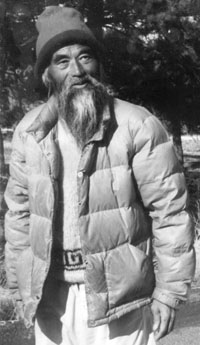
Gia-Fu Feng
Gia-fu Feng (Chinese: 馮家福; January 10, 1919 – June 12, 1985) was a prominent translator of classical Chinese Taoist philosophical texts, founder of an intentional community called Stillpoint, and leader of classes, workshops, and retreats in the United States and abroad based on his own unique synthesis of tai chi, Taoism, and other Asian contemplative and healing practices with the Human Potential Movement, Gestalt therapy, and encounter groups.
He was associated with Alan Watts, Claude Dalenberg, and the American Academy of Asian Studies; Jack Kerouac, Joanne Kyger, Gary Snyder, and the Beat Generation; and Abraham Maslow, Fritz Perls, Dick Price, Michael Murphy, and the Esalen Institute.
He is best known for his bestselling translations and calligraphy of the Tao Te Ching and the Zhuangzi Inner Chapters accompanied by black-and-white photographs by Jane English in the books Lao Tsu / Tao Te Ching, first published in 1972, and Chuang Tsu / Inner Chapters, first published in 1974.
Gia-fu Feng, later known as "Jeff" to some of his American friends and family but "Gia-fu" to most, was born in China in 1919, the third of nine children in a wealthy and influential family. His father was a banker who rose to prominence with the Ta-Ching Government Bank, then co-founded and served as president of the Bank of China in Shanghai. His mother died when he was 16. He was educated at private boarding schools, and received tutoring at home in Chinese classics and English. One of his English tutors was the sister of the British commissioner of Shanghai Customs.
His family practiced traditional Chinese religion, observing all twenty-four annual festivals, for example traveling from Shanghai to visit their ancestors' tombs in Yuyao, Zhejiang Province, during the Qingming Festival. When he was twelve years-old his older siblings converted to Christianity, and at their recommendation during his first time living away from home as a young adult he was baptized and participated in a fervently puritanical church group, but he drifted away after a year.
Feng first left home in 1938 during the Japanese invasion, to complete a bachelor's degree in the liberal arts at Southwest Associated University in unoccupied western China, where he lived through Japanese bombing and persevered, enthusiastically studying under some of China's top scholars.
After graduation, despite his preference for poetry, literature, and philosophy, his father's connections led him to work in local banking in and around Kunming. He showed great aptitude and made a quite a lot of money from involvement in some of the murkier transactions, as was common in wartime China. He lived in and managed a villa that hosted many prominent Chinese and foreign visitors, where he met Generalissimo Chiang Kai-shek, General Claire Chennault, US Vice President Henry A. Wallace, and Lady Mountbatten, among others, and successfully navigated a difficult political environment. He was also in charge of arranging dance parties at the villa for American soldiers.
He once commented that he had become a millionaire three times in his life, giving his money away each time. The first time was when he worked as a banker in the Kunming area, as he freely lent his money to friends and generally treated himself and everyone he knew to a good time. Yet in his memoirs he noted that he was also profoundly affected by the extremes of wealth and poverty he encountered then, especially the grinding misery of laborers forced to work on construction of the Burma Road, and the horrors of war he witnessed in Kunming and Shanghai.
Hub AI
Gia-Fu Feng AI simulator
(@Gia-Fu Feng_simulator)
Gia-Fu Feng
Gia-fu Feng (Chinese: 馮家福; January 10, 1919 – June 12, 1985) was a prominent translator of classical Chinese Taoist philosophical texts, founder of an intentional community called Stillpoint, and leader of classes, workshops, and retreats in the United States and abroad based on his own unique synthesis of tai chi, Taoism, and other Asian contemplative and healing practices with the Human Potential Movement, Gestalt therapy, and encounter groups.
He was associated with Alan Watts, Claude Dalenberg, and the American Academy of Asian Studies; Jack Kerouac, Joanne Kyger, Gary Snyder, and the Beat Generation; and Abraham Maslow, Fritz Perls, Dick Price, Michael Murphy, and the Esalen Institute.
He is best known for his bestselling translations and calligraphy of the Tao Te Ching and the Zhuangzi Inner Chapters accompanied by black-and-white photographs by Jane English in the books Lao Tsu / Tao Te Ching, first published in 1972, and Chuang Tsu / Inner Chapters, first published in 1974.
Gia-fu Feng, later known as "Jeff" to some of his American friends and family but "Gia-fu" to most, was born in China in 1919, the third of nine children in a wealthy and influential family. His father was a banker who rose to prominence with the Ta-Ching Government Bank, then co-founded and served as president of the Bank of China in Shanghai. His mother died when he was 16. He was educated at private boarding schools, and received tutoring at home in Chinese classics and English. One of his English tutors was the sister of the British commissioner of Shanghai Customs.
His family practiced traditional Chinese religion, observing all twenty-four annual festivals, for example traveling from Shanghai to visit their ancestors' tombs in Yuyao, Zhejiang Province, during the Qingming Festival. When he was twelve years-old his older siblings converted to Christianity, and at their recommendation during his first time living away from home as a young adult he was baptized and participated in a fervently puritanical church group, but he drifted away after a year.
Feng first left home in 1938 during the Japanese invasion, to complete a bachelor's degree in the liberal arts at Southwest Associated University in unoccupied western China, where he lived through Japanese bombing and persevered, enthusiastically studying under some of China's top scholars.
After graduation, despite his preference for poetry, literature, and philosophy, his father's connections led him to work in local banking in and around Kunming. He showed great aptitude and made a quite a lot of money from involvement in some of the murkier transactions, as was common in wartime China. He lived in and managed a villa that hosted many prominent Chinese and foreign visitors, where he met Generalissimo Chiang Kai-shek, General Claire Chennault, US Vice President Henry A. Wallace, and Lady Mountbatten, among others, and successfully navigated a difficult political environment. He was also in charge of arranging dance parties at the villa for American soldiers.
He once commented that he had become a millionaire three times in his life, giving his money away each time. The first time was when he worked as a banker in the Kunming area, as he freely lent his money to friends and generally treated himself and everyone he knew to a good time. Yet in his memoirs he noted that he was also profoundly affected by the extremes of wealth and poverty he encountered then, especially the grinding misery of laborers forced to work on construction of the Burma Road, and the horrors of war he witnessed in Kunming and Shanghai.