


Community hub
Recent from talks
Contribute something
Nothing was collected or created yet.
Kunming
View on Wikipedia
Key Information


| Kunming | |||||||||||||||||||||||||||||||||
|---|---|---|---|---|---|---|---|---|---|---|---|---|---|---|---|---|---|---|---|---|---|---|---|---|---|---|---|---|---|---|---|---|---|
.svg) "Kūnmíng" in Chinese characters | |||||||||||||||||||||||||||||||||
| Chinese | 昆明 | ||||||||||||||||||||||||||||||||
| Literal meaning | (transcription of an ancient tribal name) | ||||||||||||||||||||||||||||||||
| |||||||||||||||||||||||||||||||||
| Former names | |||||||||||||||
|---|---|---|---|---|---|---|---|---|---|---|---|---|---|---|---|
| Yunnan-Fu (former name used during imperial dynasties) | |||||||||||||||
| Traditional Chinese | 雲南府 | ||||||||||||||
| Simplified Chinese | 云南府 | ||||||||||||||
| |||||||||||||||
Kunming[a] is the capital and largest city of the province of Yunnan in China.[4] The political, economic, communications and cultural centre of the province, Kunming is also the seat of the provincial government. During World War II, Kunming was a Chinese military center and the location of the headquarters for the US Army Forces China-Burma-India.[5] Wujiaba Airport served as the home of the First American Volunteer Group (AVG) of the Republic of China Air Force, nicknamed the Flying Tigers.[6] Kunming was also a transport terminus for the Burma Road.
Kunming is at an altitude of 1,900 metres (6,234 feet) above sea level and a latitude just north of the Tropic of Cancer, and is situated in the middle of the Yunnan–Guizhou Plateau. Kunming is the fourth–most populous city in Western China, after Chongqing, Chengdu, and Xi'an, and the third–most populous city in Southwestern China after Chongqing and Chengdu. As of the 2020 census, Kunming had a total population of 8,460,088 inhabitants, of whom 5,604,310 lived in its built-up (or metro) area made of all urban districts except Jinning. It is at the northern edge of Dian Lake, surrounded by temples and lakes and karst topography.[7]
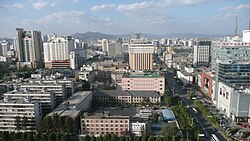
Kunming consists of an old, previously walled city, a modern commercial district, residential zones, and university areas. The city is also one of the major centers for scientific research and education in Southwestern China. As of 2024, it was listed among the top 100 cities in the world by scientific research output.[8] The city has an astronomical observatory, and its institutions of higher learning include Yunnan University, Kunming University of Science and Technology, Yunnan University of Finance and Economics, Kunming Medical University, Yunnan Normal University, Yunnan Agricultural University and Southwest Forestry University. Kunming is also home to the Golden Temple, China's largest bronze temple dating from the Ming dynasty.
Kunming is a major economic center in Western China. The city's economic importance derives from its geographical position, as it shares a border with various Southeast Asian countries, serving them as a transportation hub in Southwest China, linking by rail to Vietnam and Laos, and by road to Myanmar and Thailand. This positioning also makes the city an important commercial center of trade in the region. The city also acts as a gateway to Southeast Asia and South Asia, the Kunming Changshui International Airport is one of the top 50-busiest airports in the world.[9][10] As of 2024, the city is also home to six consulates from ASEAN countries.[11]
The headquarters of many of Yunnan's biggest corporations are based in the city, such as Hongta Group, Yunnan Copper Group, Hongyun Group, Yunnan Power Grid Co, and Fudian Bank.[12][13] Kunming also houses some manufacturing, chiefly the processing of copper, as well as various chemicals, machinery, textiles, paper and cement. Kunming has a nearly 2,400-year history, but its modern prosperity dates only to 1910, when the railway from Hanoi was built. The city has continued to develop rapidly under China's modernization efforts. Kunming was designated a special tourism center and, as such, has experienced a proliferation of high-rises and luxury hotels.[14]
Etymology
[edit]"Kunming" evolved from the name of an ancient ethnic group called the Kunming Yi or Kunming Barbarian (昆明夷). They were a branch of the Di-Qiang people. The Kunming Yi lived in the neighbouring region of Erhai Lake during the Western Han dynasty. The Han dynasty incorporated the territory of the Dian Kingdom and set up a commandery called Yizhou in 109 BC; the Han dynasty also incorporated the Kunming Yi into Yizhou Commandery soon after. Therefore, Kunming Yi expanded east to the Lake Dian area later. "Kunming" has acted as a place name since the Three Kingdoms period, but the reference was not clear because this ethnicity occupied a large region. In the Yuan dynasty, the central government set up "Kunming County" in modern Kunming; the name "Kunming" has continued to this day.[15]
A 2009 research paper proposes that the name "Kunming" of Kunming Yi is a cognate word of "Khmer" and "Khmu" that originally meant "people".[16]
History
[edit]Early history
[edit]Kunming long profited from its position on the caravan route through to Southeast Asia, India and Tibet. Early townships on the southern edge of Lake Dian (outside the contemporary city perimeter) can be dated back to 279 BC, although they have been long lost to history. Early settlements in the area around Lake Dian date back to Neolithic times. The Dian Kingdom, whose original language likely belonged to the Tibeto-Burman languages, was also established near the area.[17]
Dian was subjugated by the Chinese Han dynasty under the reign of Emperor Wu of Han in 109 BC. The Han dynasty incorporated the territory of the Dian Kingdom into their Yizhou Commandery, but left the King of Dian as the local ruler.[18]
The Han dynasty (205 BC–AD 220), seeking control over the Southern Silk Road running to Burma and India, brought small parts of Yunnan into China's orbit, but subsequent dynasties could do little to tame what was then a remote and wild borderland until the 13th century.[19][contradictory] During the Sui dynasty (581–618), two military expeditions were launched against the area, and it was renamed Kunzhou in Chinese sources.[20]
Medieval China
[edit]
Founded in 765, Kunming was known to the Chinese as Tuodong (拓東) city in the Kingdom of Nanzhao (737–902) during the 8th and 9th centuries.[20] Tuodong later became part of the successor Kingdom of Dali (937–1253). The possession of Tuodong changed hands when the city came under the control of the Yuan dynasty during its invasion of the southwest in 1252–1253. During the reign of provincial governor Ajall Shams al-Din Omar, a "Chinese Style" city named Zhongjing was founded where modern Kunming is today. Shams al-Din ordered the construction of a Buddhist temple, a Confucian temple, and two mosques in the city.[21] The Confucian temple, doubling as a school, was the first of its kind in Yunnan, attracting students from minority groups across the province.[22] Coupled with his promotion of Confucian ceremonies and customs, Shams al-Din has been largely credited with the sinicization of the region.[23] The city grew as a trading center between the southwest and the rest of China. It is considered by scholars to have been the city of Yachi Fu (鸭池府) where people had used cowries as cash and ate their meat raw, as described by the 13th-century Venetian traveler Marco Polo.[24] The area was first dubbed Kunming during the decline of the Yuan Dynasty.[citation needed]
Ming and Qing dynasties
[edit]
In the 14th century, Kunming was retaken from Mongolian control when the Ming dynasty defeated the Yuan dynasty. The Ming later built a wall surrounding present-day Kunming. 300 years later, Ming General Wu Sangui defected to Manchu invaders and held the city until his death in 1678, long after the rest of China had fallen under Manchu rule. During the beginning of Qing rule, the entirety of Yunnan and Guizhou were ruled from Kunming and Wu.[25] During the Revolt of the Three Feudatories, the seat of Wu's newly declared Zhou dynasty was moved to Hengzhou in Hunan.[citation needed] Later in 1678, when Wu died, his grandson Wu Shifan resisted the Qing for two more months before committing suicide, reverting control of the city back into Qing hands. During the Ming and Qing dynasties, it was the seat of the superior prefecture of Yunnan.[citation needed]
In 1832, the beginnings of a real city were acknowledged within the city walls and there were significant structures within their confines. The founding of the city can therefore be said to have been a predominantly 19th century affair.[26] It was also in this century that the city grew to become the major market and transport centre for the region. [citation needed] Many of the city's inhabitants were displaced as a result of the 1833 Kunming earthquake.[citation needed]
The rebel leader Du Wenxiu, the Muslim Han Sultan of Dali, attacked and besieged the city several times between 1858 and 1868. A great part of the city's wealth did not survive the 1856 Panthay Rebellion, when most of the Buddhist sites in the capital were badly damaged, converted to mosques or razed. Decades later, Kunming began to be influenced by the West, especially from the French Empire. In the late 1800s, the French started to build the Kunming-Haiphong railway between Kunming and Haiphong in what was then French Indochina.[27] In the 1890s, an uprising against working conditions on the Kunming–Haiphong rail line saw many laborers executed after France shipped in weapons to suppress the revolt. The meter-gauge rail line, only completed by around 1911, was designed by the French so that they could tap into Yunnan's mineral resources for their colonies in Indochina.
Kunming was a communications center during this time and a junction of two major trading routes, one westward via Dali and Tengchong County into Myanmar, the other southward through Mengzi County to the Red River in Indochina. Eastward, a difficult mountain route led to Guiyang in Guizhou province and thence to Hunan province. To the northeast was a well-established trade trail to Yibin in Sichuan province on the Yangtze River. But these trails were all extremely difficult, passable only by mule trains or pack-carrying porters. [citation needed]

After Qing dynasty
[edit]The opening of the Kunming area began in earnest with the completion in 1906–1910 of the Kunming-Haiphong Railway to Haiphong in north Vietnam (part of French Indochina).
Kunming became a treaty port opening to foreign trade in 1908 and became a commercial center soon after.[20] A university was set up in 1922. In the 1930s, the first highways connected to Kunming were built, linking Kunming with Chongqing in Sichuan and Guiyang in Guizhou to the east.[citation needed]
The local warlord General Tang Jiyao established the Wujiaba Aerodrome in 1922; an additional 23 airports would be established in Yunnan from 1922 to 1929.[28]
.svg)
Second World War (1937–1945)
[edit]Kunming was transformed into a modern city as a result of fighting of the Second Sino-Japanese War/World War II in 1937 with the outbreak of the Battles of Shanghai, Nanking and Taiyuan, forcing a great movement of refugees from the north and eastern coastal regions of China,[30] bringing much commerce and industry into the southwest of China, including Kunming. They carried dismantled industrial plants with them, which were then re-erected beyond the range of Japanese bombers. [citation needed] In addition, a number of universities and institutes of higher education were evacuated there. The increased trade and expertise quickly established Kunming as an industrial and manufacturing base for the wartime government in Chongqing. [citation needed]
As the battles of Shanghai, Taiyuan and Nanjing were lost by the end of 1937, and with Wuhan falling into Japanese occupation by the end of 1938, many more of China's military forces and civilians retreated to cities outside the reach of the Japanese military ground forces a year prior to the outbreak of the Second World War in Europe in 1939, including the relocation of the Chinese Air Force Academy from Jianqiao Airbase to Kunming's Wujiaba Airbase, where the airfield was vastly expanded, becoming the new training hub for the battered but regrouped Chinese Air Force in which Lieutenant General Claire Lee Chennault took command of cadet training duties in the summer of 1938. The Chinese Air Force command established the 41st Pursuit Squadron based in Kunming, also known as the French Volunteer Group squadron in June 1938, and with them they brought Dewoitine D.510 fighters, with the intention of securing the sale of the planes to the Chinese Air Force; the French participated in some combat engagements against Japanese raids, including dogfights against Mitsubishi A5M fighters with Chinese Hawk III fighters over Nanchang, but after several setbacks, including a fighter pilot KIA, the group was disbanded in October 1938.[31]
Although Japan was focused on ending Chinese resistance at the Battle of Chongqing and Chengdu, Kunming was not out of the reach of Japanese air raids, facing attacks by IJAAF and IJNAF bombers.[32] Chinese military assets and infrastructure were under regular attack, while the RoCAF 18th Fighter Squadron and units of the Air Force Academy at Wujiaba were tasked with aerial defense of Kunming.[33] The city of Kunming was prepared as an alternate National Redoubt in case the temporary capital in Chongqing fell, with an elaborate system of caves to serve as offices, barracks and factories, but it was never utilised. Kunming was to have served again in this role during the ensuing Chinese Civil War, but the Nationalist garrison there switched sides and joined the Communists. Instead, Taiwan would become the last redoubt and home of the Republic of China government, a role it fulfills to this day.[34]
When the city of Nanning fell to the Japanese during the Battle of South Guangxi, China's sea-access was cut off. However, the Chinese victory at the Battle of Kunlun Pass kept the Burma Road open. When the Japanese began occupying French Indochina in 1940, the Burma Road that linked Kunming and the outside-world with unoccupied China grew increasingly vital as much of the essential support and materials were imported through Burma. After the attack on Pearl Harbor, and the start of the Pacific War in December 1941, Kunming acted as an Allied military command center, which grouped the Chinese, American, British and French forces together for operations in Southeast Asia. Kunming became the northern and easternmost terminus of the vital war-supply line into China known as "The Hump", which stretched over the Himalayas from British bases in India to port-of-entry Kunming. The Office of Strategic Services' Service Unit Detachment 101 (predecessor to the 1st Special Forces Group) was also headquartered in Kunming. Its mission was to divert and disrupt Japanese combat operations in Burma.[35]

Kunming, the northern terminus of all three of the Burma Road, the Ledo Road, and "The Hump" supply-line, was increasingly targeted by the IJAAF. When the Burma Road was lost to the Japanese, the Hump became China's primary lifeline to the outside world. The 1st American Volunteer Group, known as the "Flying Tigers", was based in Kunming and tasked with defense of The Hump supply-line against Japanese aerial interceptions.[36]
Industry became important in Kunming during World War II. The large state-owned Central Machine Works[37] was transferred there from Hunan, while the manufacture of electrical products, copper, cement, steel, paper, and textiles expanded.
After World War II
[edit]Until 1952, Kunming was a walled city. The city government in 1952 ordered hundreds of young people to tear down the wall and use its bricks to make a new road running north–south.[citation needed] To show its appreciation for the young people that demolished the east wall, the city government named the new street, Qingnian Lu, after them.[citation needed] The existence of the walls still echoes today at place names like the district of Xiaoximen (小西门; 'Lesser West Gate') and Beimen Jie (北门街; 'North Gate Street'). There are also less obvious connections to the wall, such as Qingnian Lu (青年路; 'Youth Road'), in the location of Kunming's east wall.
After 1949, Kunming developed rapidly into an industrial metropolis with the construction of large iron and steel and chemical complexes, along with Chongqing, Chengdu and Guiyang in the southwest. A Minorities' Institute was set up in the 1950s to promote mutual understanding and access to university education among Yunnan's multiethnic population. The city consolidated its position as a supply depot during the Vietnam War and subsequent border clashes. Until Mao Zedong's death, in much of the rest of the country Kunming was still generally thought as a remote frontier settlement. Accordingly, the government utilized Kunming as a place where to exile people who had fallen politically out of favor, especially during the Cultural Revolution.
In 1957, Kunming's rail link to Haiphong and Hanoi was re-opened (after being cut during World War II). It was cut again in 1979 and re-opened again in 1996.[citation needed]

Since the economic reforms of the mid-1980s, Kunming has enjoyed increased tourism and foreign investment. Several Thai Chinese banks have offices in Kunming, for example, Kasikorn Bank and Krung Thai Bank. Princess Maha Chakri Sirindhorn of Thailand has visited Kunming many times to study Chinese culture and promote friendly relations. [citation needed]
In the 1980s and 1990s, the city center was rebuilt, with Swiss help, in its current 'modern' style to impress visitors attending the 1999 World Horticultural Exposition.[38] It was primarily during 1997 and 1998 that much of the city's roads, bridges and high rises were built. Today the after-effects of the Expo are apparent in more than just the physical improvements to the city—it was the Expo that made the outside world take notice of Kunming, which was relatively unknown at the time.[dubious – discuss]
In July 2005, the second Greater Mekong Subregion (GMS) Summit was held in Kunming, with government leaders from China, Laos, Myanmar (Burma), Thailand, Cambodia, and Vietnam participating.[citation needed] There, China agreed to lend its neighbors more than $1 billion for a series of projects. China promoted GMS cooperation as a first step toward building an eventual China-ASEAN Free Trade Area.[citation needed]
Bus bombings occurred on 21 July 2008 when explosions aboard two public buses in downtown Kunming killing 2 people.
Infrastructure improvements were underway to improve links between Kunming and Southeast Asia in time for the 2010 establishment of the China-ASEAN Free Trade Area. The FTA made Kunming a trade and financial center for Southeast Asia.[citation needed] In addition to physical improvements to enhance Kunming's trade with Southeast Asia, the central and provincial governments have made financial preparations to assist the city's emergence.
In July 2006, talks at the ASEAN Regional Forum, China, Bangladesh and Myanmar (Burma) agreed to construct a highway from Kunming to Chittagong through Mandalay for trade and development.[39]
On 1 March 2014, 29 people were killed, and more than 130 were injured at Kunming Railway Station in a terrorist attack.[40]
Geography
[edit]


Kunming is located in east-central Yunnan province. Its administrative area is located between latitudes 24°23' and 26°22' N, and longitudes 102°10' and 103°40' E, with a total area of 21,600 square kilometres (8,340 square miles). Its widest stretch from the east to the west amounts to 140 kilometres (87 miles) while its longest stretch from the north to the south amounts to 220 kilometres (137 miles).
Situated in a fertile lake basin on the northern shore of the Lake Dian and surrounded by mountains to the north, west, and east, Kunming has always played a pivotal role in the communications of southwestern China. Lake Dian, known as "the Pearl of the Plateau"[citation needed], is the largest lake in Yunnan and the sixth largest freshwater lake in China. It has an area of approximately 340 square kilometres (130 square miles). Kunming's highest point is Mazong Ridge of the Jiaozi Snow Mountain in Luquan with an elevation of 4,247 metres (13,934 feet), and its lowest point is the joint of the Xiao River and the Jinsha River in Dongchuan District, with an elevation of 695 metres (2,280 feet). Its downtown area is 1,891 metres (6,204 feet) above sea level[citation needed].
Climate
[edit]Located at an elevation of 1,888 metres (6,194 feet) on the Yunnan–Guizhou Plateau with low latitude and high elevation, Kunming has one of the mildest climates in China, characterized by short, cool dry winters with mild days and crisp nights, and long, balmy and humid summers. With its perpetual spring-like weather which provides the ideal climate for plants and flowers, Kunming is known as the "City of Eternal Spring".[41] The weather has seldom reached high temperatures in summer, only exceeding 30 °C (86 °F) on a handful of occasions. However, freak snowfalls occur in occasional winters. Controlled by a subtropical highland climate (Köppen Cwb), the monthly 24-hour average temperature ranges from 9.3 °C (48.7 °F) in January to 20.7 °C (69.3 °F) in June, with daily high temperatures reaching their lowest point and peak in December and May, respectively. The city is covered with blossoms and lush vegetation all-year round.[42] The period from May to October is the monsoon season and the rest of the year is dry. The city has an annual mean temperature of 16.0 °C (60.8 °F), rainfall of 991.0 millimetres (39.0 in) (nearly three-fifths occurring from June to August) and a frost-free period of 230 days. With monthly percent possible sunshine ranging from 29% in July to 70% in February, the city receives 2,240.9 hours of bright sunshine annually. Extreme temperatures in the city have ranged from −7.8 to 32.9 °C (18.0 to 91.2 °F) on 29 December 1983 and 25 May 2014 respectively.
| Climate data for Kunming, elevation 1,888 m (6,194 ft), (1991–2020 normals, extremes 1951–present) | |||||||||||||
|---|---|---|---|---|---|---|---|---|---|---|---|---|---|
| Month | Jan | Feb | Mar | Apr | May | Jun | Jul | Aug | Sep | Oct | Nov | Dec | Year |
| Record high °C (°F) | 24.0 (75.2) |
26.4 (79.5) |
28.8 (83.8) |
32.1 (89.8) |
32.9 (91.2) |
32.6 (90.7) |
31.0 (87.8) |
30.9 (87.6) |
30.4 (86.7) |
29.1 (84.4) |
26.4 (79.5) |
25.1 (77.2) |
32.9 (91.2) |
| Mean daily maximum °C (°F) | 16.3 (61.3) |
18.5 (65.3) |
21.8 (71.2) |
24.3 (75.7) |
25.2 (77.4) |
25.4 (77.7) |
24.8 (76.6) |
25.0 (77.0) |
23.5 (74.3) |
21.1 (70.0) |
18.7 (65.7) |
16.0 (60.8) |
21.7 (71.1) |
| Daily mean °C (°F) | 9.3 (48.7) |
11.5 (52.7) |
14.8 (58.6) |
17.8 (64.0) |
19.6 (67.3) |
20.7 (69.3) |
20.5 (68.9) |
20.2 (68.4) |
18.8 (65.8) |
16.2 (61.2) |
12.5 (54.5) |
9.5 (49.1) |
16.0 (60.8) |
| Mean daily minimum °C (°F) | 4.0 (39.2) |
5.8 (42.4) |
8.9 (48.0) |
12.0 (53.6) |
14.9 (58.8) |
17.3 (63.1) |
17.6 (63.7) |
17.2 (63.0) |
15.7 (60.3) |
12.9 (55.2) |
8.2 (46.8) |
4.8 (40.6) |
11.6 (52.9) |
| Record low °C (°F) | −5.7 (21.7) |
−2.6 (27.3) |
−5.2 (22.6) |
−0.2 (31.6) |
5.1 (41.2) |
8.8 (47.8) |
10.1 (50.2) |
10.4 (50.7) |
5.4 (41.7) |
0.1 (32.2) |
−2.4 (27.7) |
−7.8 (18.0) |
−7.8 (18.0) |
| Average precipitation mm (inches) | 23.8 (0.94) |
11.9 (0.47) |
19.6 (0.77) |
25.4 (1.00) |
80.1 (3.15) |
173.1 (6.81) |
215.7 (8.49) |
195.9 (7.71) |
119.3 (4.70) |
82.4 (3.24) |
30.1 (1.19) |
13.7 (0.54) |
991.0 (39.02) |
| Average precipitation days (≥ 0.1 mm) | 4.3 | 3.7 | 5.4 | 6.5 | 11.1 | 16.5 | 19.7 | 18.9 | 13.9 | 12.0 | 5.3 | 3.7 | 121.0 |
| Average snowy days | 1.0 | 0.4 | 0.2 | 0 | 0 | 0 | 0 | 0 | 0 | 0 | 0.1 | 0.4 | 2.1 |
| Average relative humidity (%) | 66 | 58 | 54 | 55 | 64 | 75 | 79 | 78 | 78 | 78 | 74 | 71 | 69 |
| Mean monthly sunshine hours | 223.6 | 223.9 | 253.3 | 252.2 | 217.2 | 148.0 | 122.6 | 142.9 | 127.1 | 143.2 | 191.5 | 195.4 | 2,240.9 |
| Percentage possible sunshine | 67 | 70 | 68 | 66 | 52 | 36 | 29 | 36 | 35 | 40 | 59 | 60 | 52 |
| Source 1: China Meteorological Administration[43][44] | |||||||||||||
| Source 2: The Yearbook of Indochina (1937-1938, extremes 1907-1938)[45] | |||||||||||||
Natural resources
[edit]Mineral resources include phosphorus, salt, magnesium, titanium, coal, quartz sand, clay, silica, copper. Phosphorus and salt mines are the most plentiful. Kunyang Phosphorus Mine is one of the three major phosphorus mines in the country. Rock salt reserves are 1.222 billion tonnes (1.203 billion long tons; 1.347 billion short tons) and mirabilite reserves are 1.908 billion tonnes (1.878 billion long tons; 2.103 billion short tons). Dongchuan is a major copper production base.[citation needed]
Proven reserves of Coal bed gas is about 500 billion cubic metres (18,000 billion cubic feet), equal to 720 million tonnes (710 million long tons; 790 million short tons) of standard coal.[46] Geothermal resources are widely distributed.[citation needed]
Environment and horticulture
[edit]Kunming has 2,585 hectares (6,390 acres) of lawns, trees and flowers, averaging 4.96 square metres (53.4 square feet) per capita and a green space rate of 21.7 percent. The city's smoke control area is 115 square kilometres (44 square miles) and noise control area 87 square kilometres (34 square miles). [citation needed]
Kunming is a significant horticultural center in China, providing products such as grain, wheat, horsebeans, corn, potato and fruit such as peaches, apples, oranges, grapes and chestnuts. [citation needed] Kunming is world-famous for its flowers and flower-growing exports. More than 400 types of flowers are commonly grown in Kunming. The camellia, Yulan magnolia, azalea, fairy primrose, lily and orchid are known as the six famous flowers of the city.[citation needed]
The camellia was confirmed by the Municipality of Kunming as its city flower in 1983.
The Kunming city government plans to create an environmental trial court to deal with environment-related lawsuits. It is to be part of the city's intermediate people's court and will have jurisdiction over appeals by companies that have been found guilty of violating environmental laws in cities throughout Yunnan.[47]
Demographics
[edit]The population of Han is 5,542,314, accounting for 86.16%; the population of all ethnic minorities add up to 889,898, accounting for 13.84%. Some of the 26 nationalities in the province live in Kunming, and the average life expectancy of the city's population is 76 years old.
| National name | Han | Yi | Hui | Bai | Hmong | Hani | Zhuang | Dai | Lisu | Naxi | Others |
|---|---|---|---|---|---|---|---|---|---|---|---|
| Population | 5,542,394 | 444,261 | 158,384 | 82,560 | 59,925 | 25,807 | 23,283 | 20,831 | 19,756 | 11,010 | 43,998 |
| Proportion of total population (%) | 86.17 | 6.91 | 2.46 | 1.28 | 0.93 | 0.40 | 0.36 | 0.32 | 0.31 | 0.17 | 0.68 |
| Proportion of minority population (%) | --- | 49.93 | 17.80 | 9.28 | 6.73 | 2.90 | 2.62 | 2.34 | 2.22 | 1.24 | 4.94 |
Cityscape
[edit]
The city center has three major squares and six major streets: Jinma Biji Square, Nanping Square and Dongfeng Square are the main squares, while Beijing Road, Zhengyi Road, Renmin Road, Dongfeng Road, Jinbi Road, and Qingnian Road are the main streets. Jingxing Street, Guanghua Street, Zhengyi Road, Nanping Street (built on top of a section of Dongfeng Road), Qingnian Road, and Renmin Road are the main commercial areas in Kunming; the most popular pedestrian streets are Nanping Street, Zhengyi Road, and Jingxing Street.
Kunming's modern city center is Nanping Square on the west bank of the Panlong River, at the intersection of Nanping Street and Zhengyi Street. This area is where Kunming's southern city wall once stood. This area is a crowded and dense modern shopping precinct packed with clothing and electronics stores. Surrounding the area are plenty of new high-rises, along with an area of preserved old city to the north. The area formerly considered the city center is Dongfeng Square, located on the east bank of the Panlong River outside of the old city walls at the intersection of Beijing Road and Dongfeng Road, where in the mornings there are crowds doing taijiquan and playing badminton. Weekend amateur theatre is also performed in the square.[citation needed] The Panlong River has had an artificial flow ever since the construction of the Songhua Dam, and the river has been developed into effectively a canal. The river receives sewage and wastewater from surrounding pipes.[49]
The center is an area of importance to Kunming's Hui population, with Shuncheng Street, one of the last old streets in the center of the city, previously forming a Muslim quarter. Under Kunming's rapid modernisation, however, the street has been demolished to make way for apartments and shopping centers.[citation needed] Rising behind a supermarket one block north off Zhengyi Road, Nancheng Qingzhen Si is the city's new mosque, its green dome and chevron-patterned minaret visible from afar and built on the site of an earlier Qing edifice.
Running west off Zhengyi Road just past the mosque, Jingxing Street leads into one of the more bizarre corners of the city, with Kunming's huge Bird and Flower Market convening daily in the streets connecting it with the northerly, parallel Guanghua Street. The market offers many plants such as orchids that have been collected and farmed across the province. [citation needed]
Jinbi Road runs south of Dongfeng Road. Both of them connect to Beijing Road. Two large Chinese pagodas rise south of Jinbi Road and the city center, each a solid thirteen stories of whitewashed brick crowned with four iron cockerels. The West Pagoda was built between 824 and 859, during the Tang dynasty; its original counterpart, the East Pagoda, was built at the same time, but was destroyed by an earthquake in 1833 and rebuilt in the same Tang style in 1882.[citation needed] South down Dongsi Road, past another mosque, the entrance to the West Pagoda is along a narrow lane on the right. The East Pagoda is a more cosmetic, slightly tilted duplicate standing in an ornamental garden a few minutes' walk east on Shulin Jie. The temples associated with both pagodas are closed to the public.

Many streets are lined with Jacaranda trees, which can be seen blooming abundantly in mid to late April, particularly on Jiaochang Middle Road. The trees are not native to Kunming, but originate from seeds exchanged with Algeria, which were grown in the Kunming Botanical Garden. Seeds from the botanical garden were then used by the city to plant the trees along streets.[50][51]

Parks
[edit]
Cuihu Park (Green Lake Park) is one of Kunming's major parks and is predominately a lake surrounded by greenery. Located in the west side of the park is a statue of Nie Er, the composer of China's national anthem.
Another monument to Nie Er is located in Xishan Park, most well known for the Longmen Grottoes (not to be confused with the identically named grottoes in Luoyang), containing several ancient temples and the titular Longmen ("dragon gate").
Daguan Park lies on Dian Chi in Kunming's southwestern limits. Originally laid out by the Kangxi Emperor in the Qing dynasty, it has been modified over the years to include a noisy funfair, food stalls and emporiums.
Kunming's zoo, founded in 1950, is adjoined to Yuantong Park, known for the Yuantong Temple within. The zoo houses 5,000 animals from 140 species and receives 3 million visitors a year.[52]
Other parks in Kunming include Black Dragon Pool and the Kunming Botanical Gardens in the north, the World Horti-Expo Garden in the northeast, and Wenmiao Tea Garden in Wuhua District.
Landmarks
[edit]The World Horti-Expo Garden is located in the northern suburbs of Kunming and was built for the 1999 World Horticulture Exposition, which ran from 1 May to 31 October 1999. It had the theme of "Man and Nature—Marching Toward the 21st Century". Golden Temple Park, located on Mingfeng Hill nearby, is connected by cable car to the World Horti-Expo Garden. Constructed in 1602 (the 30th year of the Wanli reign period of the Ming dynasty), all of its beams, pillars, arches, doors, windows, tiles, Buddhist statues, and horizontal inscribed boards are made of copper, weighing more than 200 tons. It is the largest copper building in China.[citation needed]
Yuantong Temple is Kunming's major Buddhist temple. It is Kunming's largest and most famous temple with the original structure being first constructed more than 1,200 years ago during the Tang dynasty. The temple sits in a depression on the southern side of Yuantong Park. Northwest about 12 km (7.5 mi) from the city center is the Qiongzhu Si (Bamboo Temple) built in 639 and rebuilt in 1422 to 1428. Numerous Buddhist temples line the road to the Dragon Gate (龙门) in the Western Mountains.
Notable museums in Kunming include:
- Yunnan Provincial Museum
- Kunming City Museum (redeveloped in 2014)
- Kunming Natural History Museum of Zoology (opened in November 2006)
- Yunnan Ethnology Museum (opened 1995)

Administrative divisions
[edit]The prefecture-level city of Kunming has jurisdiction over 14 subdivisions; seven districts, one county-level city, three counties and three autonomous counties. Kunming also borders with Panzhihua prefecture level city and Liangshan Yi Autonomous Prefecture of Sichuan province.
The historical city and current city center of Kunming is in southeastern Wuhua District, close to where the four main districts converge. However, after integrating it into Kunming in 2011, the Kunming city government has built a masterplanned new city center in Chenggong District and moved the city government offices there.
Kunming plans to add two new districts (Chenggong and Jinning) to its existing four urban districts (Panlong, Wuhua, Guandu, Xishan) over the next few years.
| Map | ||||||
|---|---|---|---|---|---|---|
| Name | Simplified Chinese | Hanyu Pinyin | Population (2020 census) |
Area (km2) | Density (/km2) | |
| City Proper | ||||||
| Chenggong District | 呈贡区 | Chénggòng Qū | 649,501 | 510 | 1,273.5 | |
| Panlong District | 盘龙区 | Pánlóng Qū | 987,955 | 869 | 1,136.9 | |
| Wuhua District | 五华区 | Wǔhuá Qū | 1,143,085 | 315 | 3,628.8 | |
| Guandu District | 官渡区 | Guāndù Qū | 1,602,279 | 633 | 2,531.2 | |
| Xishan District | 西山区 | Xīshān Qū | 960,746 | 880 | 1,091.8 | |
| Suburban and satellite city | ||||||
| Jinning District | 晋宁区 | Jìnníng Qū | 346,268 | 1,337 | 259.0 | |
| Dongchuan District | 东川区 | Dōngchuān Qū | 260,744 | 1,866 | 139.7 | |
| Anning city | 安宁市 | Ānníng Shì | 483,753 | 1,303 | 371.2 | |
| Rural | ||||||
| Fumin County | 富民县 | Fùmín Xiàn | 149,506 | 1,060 | 141 | |
| Yiliang County | 宜良县 | Yíliáng Xiàn | 384,875 | 1,913 | 201 | |
| Songming County | 嵩明县 | Sōngmíng Xiàn | 410,929 | 826 | 497.5 | |
| Shilin Yi Autonomous County | 石林彝族自治县 | Shílín Yízú Zìzhìxiàn | 240,827 | 1,680 | 143.3 | |
| Luquan Yi and Miao Autonomous County | 禄劝彝族苗族自治县 | Lùquàn Yízú Miáozú Zìzhìxiàn | 378,881 | 4,234 | 89.5 | |
| Xundian Hui and Yi Autonomous County | 寻甸回族彝族自治县 | Xúndiàn Huízú Yízú Zìzhìxiàn | 460,739 | 3,588 | 128.4 | |

Society and culture
[edit]
Leisure and entertainment
[edit]
Within Kunming, the entertainment district has its focus around Kundu Square, with many cinemas, bars, clubs and restaurants. Food aside, one feature of less formal Yunnanese restaurants is that they often have a communal bamboo water pipe and tobacco for their customers.[citation needed] There are plenty of student bars and clubs. The city has several operatic troupes and indigenous entertainments which include huadeng, a lantern dance. Although indoor performances are lacking, there are often informal shows at the weekend outside the Workers' Cultural Hall and in Cuihu Park. There are similar shows at the Yunnan Arts Theater on Dongfeng Xi Lu. Kunming's main cinema house is on the south side of the Dongfeng Lu/Zhengyi Lu intersection. The other main multiplex, the XJS, at the junction of Wenlin Jie and Dongfeng Xi Lu.
Language
[edit]The Kunming dialect is very similar to that of Sichuan and Guizhou but uses the third tone much less than standard Chinese. Many terms are used only in Kunming dialect, such as "板扎" meaning 'terrific'.
The pronunciations of certain Chinese characters are very different from Mandarin Chinese. For example, "鱼 (fish)" would be pronounced as "yi" in Kunming dialect instead of "yu" in Mandarin Chinese; "街 (street)" would be pronounced as "gai" instead of "jie".
When someone speaks Mandarin Chinese with a strong Kunming accent, it'll be called Mapu (马普), short for Majie (马街, a place in Kunming) Mandarin Chinese.
The Kunming Dialect is slowly dying due to it being 'informal' and is being replaced by Mandarin Chinese. Nevertheless, it is still spoken by a decent number of residents today. Sometimes this is called dirt language or slum language (土话)[citation needed]
Tourism
[edit]
Kunming attracts domestic and foreign tourists year-round. At the center of Yunnan and as its capital, Kunming is also a transport hub for tourists heading to other parts of Yunnan such as Dali, Lijiang and Shangrila.
Conference and exhibition venues in Kunming include the Kunming International Convention and Exhibition Center and the Yunnan Provincial Science and Technology Hall.
Kingdom of the Little People, a theme park featuring performers with dwarfism, is also located near Kunming.[53]
Other famous attractions include Stone Forest and Yunnan's Ethnic Village.
Sports
[edit]Every year, many Chinese and international athletes come to Kunming for high-altitude training. The city has been China's national high-elevation training base for more than 30 years. There are two major training complexes, Hongta Sports Center and Haigeng National Training Center.[54]
Hongta Sports Center was built in 2000 by Hongta (Red Pagoda) cigarette company, at a cost of US$58 million. Located near Haigeng Park, the complex is mostly used by professional athletes, but also acts as a sports club for the general public. Every weekend, it hosts amateur football matches. Aside from about 10 football pitches, including one surrounded by a running track, Hongta also has a 50-metre (160-foot) swimming pool, a badminton gymnasium, tennis courts and a basketball court. It also has one of China's few ice hockey rinks, and a workout room with treadmills and weightlifting machines. There are also game rooms for air hockey; also pool tables and a basement bowling alley. The complex comes complete with a 101-room hotel and restaurant.[54]
Haigeng National Training Center is located ten minutes away from Hongta on Dianchi (Lake Dian) near Kunming's award-winning Lakeview Golf Club and new condominium developments. This complex dates from the late 1970s and was built by the government specifically to specialize in high-altitude training.[54]
Golf
[edit]Golf is a major attraction in Kunming. There are four golf courses within an hour's drive of downtown. For the last six years [when?], Spring City Golf and Lake Resort in nearby Yiliang County has reigned as the best golf course in China and Hong Kong according to US Golf Digest. In 2004, it was named Asia's best golf resort by Asian Golf Monthly.[55] It hosts the Kunming Leg of the Omega China Tour.
Kunming has attracted foreign investment in golf course development. "Spring City" Golf Resort is a US$600 million project that began as an investment led by Singapore's Keppel Land Group in 1992. Jack Nicklaus and course designer Robert Trent Jones, Jr designed the two courses.[55]
Sport facilities
[edit]Major sports facilities include:
- Tuodong Sports Center, a multi-purpose venue
- Golf: Spring City Golf and Lake Resort, its 'Mountain Course' was designed by Jack Nicklaus
- Lakeview Golf Villa
- Cuihu Park tennis courts
- Kunming Municipal Athletic Center
- Kunming Gymnasium
- Yunnan Provincial Stadium, home to Hongta Yunnan Football Club
- Wuhua District Stadium
Economy
[edit] |

Kunming has three economic advantages over other cities in southwest China: significant natural resources, a large consumer market and a mild climate. Due to its position at the center of Yunnan, one of China's largest producers of agricultural products, minerals and hydroelectricity, Kunming is the main commercial hub for most of the province's resources.
Kunming's chief industries are copper, lead and zinc production. Its iron and steel industry has been expanded. Salt and phosphate mines around Kunming are some of the largest in China. Yunnan Copper Company Limited, based in Kunming, is one of Yunnan's largest mining corporations. From the late 1970s, Kunming's main industries also came to include food and tobacco processing and the manufacture of construction equipment and machines. [citation needed]
In May 1995, the State Council approved Kunming as an Open City. By the end of 1995, the city had approved 929 overseas-funded enterprises with a total investment of $2.3 billion including $1.1 billion of foreign capital. More than 40 projects each had an investment of more than $9 million.
Kunming is a center of engineering and the manufacture of machine tools, electrical machinery, equipment and automobiles (including heavy goods vehicles). It has a chemical industry, and plastics, cement works and textile factories. Its processing plants, which include tanneries, woodworking and papermaking factories, use local agricultural products. In 1997, Yunnan Tire Co. opened a tire plant in Kunming, with a capacity to produce two million tires per year. [citation needed]
Development zones
[edit]Kunming has two major development zones, Kunming High-tech Industrial Development Zone (biological medicine, new materials, electronic information, photoelectron, agriculture) and Kunming Economic and Technology Development Zone (mechanical equipment production, biological science and food industry, information industry, software).
Industrial parks
[edit]There are 30 key industrial parks promulgated and recognized by National Development and Reform Commission in Yunnan Province.[56]
The largest include:
- Chenggong Industrial Park
- Anning Industrial Park
- Songming Yanglin Industrial Development Zone
- Dongchuan Special Industrial Park
- Xundian Special Industrial Park
- Kunming Haikou Industrial Park.
Companies
[edit]As of 2008[update], Kunming is home to 65 of the Top 100 Enterprises in Yunnan Province. The top 100 enterprises were based on their revenues for 2007. Hongta Group, with revenues of some RMB39.88 billion for 2007 topped the list. The tobacco sector remains the largest sector in the province.
Flower industry
[edit]Yunnan has developed into the largest flower export base in Asia, with many Dutch experts having transferred technology to the area. The Dounan Flower Market, located in suburban Kunming, is the largest in China with daily sales of 2.5 million yuan (US$300,000) from the 2 million sprays of flowers (as of 2006[update]). The provincial government agency, the Yunnan Flower Association, regulates the industry.[57]
Logistics
[edit] |
Kunming East Station is at present Yunnan province's only container handling depot, with direct links to only three provinces; Guangdong, Guizhou and Sichuan. It also has direct access to the metropolitan district of Chongqing.
The Jiaying Depot is connected with the new system of highways built linking Yunnan to the increasingly important markets of Southeast Asia, facilitating cheap Chinese exports to the region and granting resource-poor China greater access to the region's massive raw material resources. Yunnan has thereby become a progressively important area in the Southwest's rail logistics both in terms of national and international logistics.
Solar energy
[edit]In July 2008, Kunming began to implement a program to transform the city's solar energy industry into a US$8.8 billion industrial base in China by 2013. Kunming receives an annual average sunshine of more than 2,400 hours[citation needed].
As of 2007[update], the Kunming Economic Committee listed about 130 solar energy enterprises in the city. Of these, 118 enterprises produce solar lamps and solar water heaters, with a combined total production value of about US$43.8 million, and 10 enterprises are engaged in solar photovoltaic cells manufacturing, with a total production value of about US$51.2 million.[58]
Suntech Power announced in December 2008 that it was jointly constructing a solar energy project with Yunnan Provincial Power Investment and other investors. The 1MW first-phase of the Shilin 66MW on-grid solar power station began generating power on 28 December 2009. The initial phase of the 66MW project was originally scheduled to start production in first half of 2010 while the 20MW second phase and 36 MW third phase were under construction.
Transport
[edit]
Kunming is situated on the Yunnan–Guizhou Plateau. Rail and air are the main two methods to travel to or from Kunming from outside Yunnan.
Air transport
[edit]Kunming has air connections with several Chinese and Southeast Asian cities. Kunming is served by Kunming Changshui International Airport (KMG), which opened in June 2012, replacing the older international airport, which was located 4–5 km (2.5–3.1 mi) southeast of central Kunming.
The now defunct Yunnan Airlines was headquartered in Kunming until it was acquired by China Eastern Airlines. China Southwest Airlines used to operate routes to and from Kunming, until it was merged with Air China.
Lucky Air is a budget airline based in Kunming and operates scheduled services from Dali to Kunming and Xishuangbanna, and plans to expand to other areas of China.
Currently, the longest non-stop flight from Kunming is to Paris, France, operated by China Eastern Airlines since 18 December 2014.[59]
Highway
[edit]
China National Highways 108, 213 and 320 intersect in Kunming. Highways link Kunming to Thailand, Vietnam and Laos, and provide Yunnan province access to seaports of Southeast Asia.
Rail
[edit] | This section needs to be updated. (April 2025) |
Kunming is the main rail hub of Yunnan province. The Chengdu–Kunming railway from Sichuan, Shanghai–Kunming railway from Guizhou, and Nanning–Kunming railway from Guangxi converge in Kunming from the north, northeast and east. The Yunnan–Vietnam Railway runs from Kunming southeast to Hekou and Lao Cai on the Sino-Vietnamese border and then on to Haiphong The Kunming–Yuxi railway runs south to Yuxi, where a second rail line to Vietnam is being planned and built. To the west of Kunming, the Guangtong–Dali railway extends off the Chengdu–Kunming Line to Dali (Xiaguan Town).
Kunming has three major railway stations:
- Kunming railway station is at the southern end of Beijing Xi Lu. Compared with the other railway station (North Railway Station), Kunming Railway Station services most of the "conventional" (not high-speed) trains to places to other provinces of China. Trains run north to Chengdu, southeast via Xingyi to Baise and Nanning in Guangxi, and east through Guizhou, via Liupanshui, Anshun, Guiyang, into the rest of the country.
- Kunming South railway station, opened at the end of 2016, is located in Chenggong District, many miles southeast from the historical city center. It is the western terminal of the Shanghai–Kunming high-speed railway and the Guangzhou–Nanning–Kunming high-speed railway, and has high-speed service to destinations along these lines and elsewhere on the nation's high-speed network.
- Kunming North railway station (serviced by the No. 23 Bus) is on the heritage 1,000 mm (3 ft 3+3⁄8 in) metre gauge Kunming–Hai Phong Railway, which runs to Hekou and Vietnam. Most of the station has been converted into a museum. Due to the deterioration of the railway line, the long distance narrow-gauge service has been cancelled; however, as of 2012[update], some local narrow gauge service still operates at Kunming North Railway Station, in particular two daily trains to Shizui (石咀) Station on the western outskirts of Kunming, and to Wangjiaying (王家营) east of the city.[60]
As of 2017, railway development projects continue to proceed in the Kunming metropolitan area. In February 2017, the railway authorities announced that a connector between the new Kunming South railway station and the old Kunming railway station (also known as the Nanyao Station; 南窑火车站) will open by the end of 2017, making it possible for some high-speed train to serve Kunming railway station as well.[61]
Urban rail plan
[edit]In May 2010, Kunming began construction on its first urban rail lines, line 1 and 2 of the Kunming Metro. An elevated test section had been under construction since 2009. Parts of lines 1 and 2 opened in April 2014.[62] Construction on line 3 began in August 2010 and the Phase 1 was completed in 2018. The entire system consisting of 6 lines and covering a total of 164 kilometres (102 miles).

High-speed rail plan
[edit] | This section needs to be updated. (April 2025) |
Kunming will be the hub and terminus for the "Pan Asia High Speed Network" using high-speed trains to connect China, Cambodia, Laos, Myanmar, Thailand, Malaysia and Singapore.[63]
Completed but under trial high-speed railways:
- Kunming–Shanghai. The construction completed on 16 June 2016. It goes through 6 provincial capital cities: Shanghai, Hangzhou, Nanchang, Changsha, Guiyang and Kunming. The overall length is 2,266 kilometres (1,408 miles). As estimated it would take 3 hours from Shanghai to Nanchang, 2.5 hours from Hangzhou to Nanchang, 4 hours from Kunming to Changsha, 8 hours from Kunming to Hangzhou and 9 hours from Shanghai to Kunming. It is expected to start operating on 30 December 2016.
Construction is underway for the following high-speed railways:
- Kunming–Shanghai. The speed will be 350 km/h (220 mph).
- Kunming–Nanning. The speed will be 200 km/h (120 mph). Later the speed may be improved to 250 km/h (160 mph) or 156 miles/h.
- Kunming–Vietnam via Honghe Prefecture.
- Kunming–Singapore via Laos, Thailand, and Malaysia.
Study or planning is being done for the following railways:
- Kunming–Chengdu. The speed will be 250 km/h (160 mph).
- Kunming–Chongqing. The speed will be 350 km/h (220 mph).
- Intercity rail will connect three neighboring cities: Qujing, Chuxiong, and Yuxi. The line to Chuxiong will then be extended to Dali. The speed will be 250 km/h (160 mph).
- Kunming to Kolkata, India via Myanmar
- Kunming to Kyaukphyu, Myanmar.[64]

Road and transit
[edit]
Yunnan has built a comprehensive highway system with roads reaching almost all the major cities or towns in the region. Bus travel across the region is extensive. Buses head from Kunming to destinations such as Dali and Lijiang several times a day.
There are four major long-distance bus stations in Kunming with the South Bus Station and Railway Square Bus Station being the most primary.
- South Bus Station faces the Kunming Railway Station in Beijing Xi Lu, with standard, luxury, express and sleeper buses departing for all over Yunnan and neighboring provinces.
- Railway Square Bus Station is smaller than SBS and the majority of the buses depart from the station are private-run. Usually no fixed schedules are available and buses will leave when they are full. There are standard and sleeper services to Dali, Jinghong and elsewhere in Yunnan.
Leaving China by road into Vietnam and Laos is also possible through the respective crossings at Hekou in southeastern Yunnan or Bian Mao Zhan in Xishuangbanna.
The Kunming–Bangkok Expressway is the first expressway from China to Bangkok via Laos. The 1,800 km (1,100 mi) long Kunming–Bangkok Expressway begins at Kunming going down to Ban Houayxay in Laos; it then crosses the Mekong River to Chiangkhong in Thailand and eventually reaches Bangkok.
At the 14th Greater Mekong Subregion Ministerial Conference in July 2007, China, Laos and Thailand signed an agreement on the construction of a new bridge over the Mekong River to connect Chiangkhong in Thailand and Ban Houayxay in Laos, to the Kunming–Bangkok Highway.[citation needed] The completion of the new bridge over the Mekong River will help connect China's southeast provinces with Bangkok. With capital investments from both China and Thailand, the bridge is expected to be completed in 2011 and will be the last link in the highway system that winds through the Mekong River region.[citation needed]
Local transit
[edit]Public buses and metro are the two main means of transport within the city.
Nearly two hundred[citation needed] public bus lines crisscross the city center, covering the whole prefecture.
Cycling is common, and many hotels around the Kunming Railway Station provide bicycle rental services.
Central Kunming
[edit]
The city hangs off two main thoroughfares: Beijing Lu forms the north–south axis, passing just east of the center as it runs for 5 km (3.1 mi) between the city's two trains stations; while Dongfeng Lu crosses it halfway along, divided into east (Dongfeng Dong Lu), middle (Dongfeng Zhong Lu) and west (Dongfeng Xi Lu) sections as it cuts right through the business center. The far end runs out of the city as Renmin Xi Lu, the first leg of the Burma Road. Most of the city's famous hotels and foreign consulates lies along Dongfeng Dong Lu and the southern half of Beijing Lu, while the majority of specific landmarks and shopping district are north and west of the center around Dongfeng Xi Lu and Cuihu Park (Green Lake Park). Circling most of this is the city's first highway ring road, Huancheng Lu, though others are planned.
Education and research
[edit]Kunming remains a major educational and cultural center in the southwest region of China, with universities, medical and teacher-training colleges, technical schools, and scientific research institutes. As of 2024, it was listed among the top 100 cities in the world by scientific research output.[8]
Colleges and universities
[edit]- Kunming Medical University
- Kunming Metallurgy College
- Kunming University
- Kunming University of Science and Technology (1925)
- Southwest Forestry University
- Yunnan Agricultural University
- Yunnan Arts University
- Yunnan Normal University
- Yunnan Normal University Business School
- Yunnan University (1922)
- Yunnan University of Finance and Economics
- Yunnan Nationalities University
- Yunnan University of Traditional Chinese Medicine
Yunnan University
[edit]Yunnan University (云南大学), located in Kunming, is one of the largest and the most prestigious universities in China and is the only university in Yunnan province which has been developed into a "National Key University". It was founded in 1922, as "University of the Eastern Land". Its name has been changed six times subsequently. The institution has 17 schools on the local campus and 3 independent schools located in other cities. It claims the largest and best law school in Yunnan province.
Yunnan Normal University
[edit]Yunnan Normal University (云南师范大学) was founded in 1938 as the National Normal College of Southwestern Union University. In 1946, when some faculties returned to the north of China, it changed its name to National Kunming Normal College. It now as 6 campuses in Kunming itself and other cities. With 22 schools, it has an enrollment of some 33000 undergraduate students.
Kunming University of Science and Technology
[edit]Kunming University of Science and Technology (昆明理工大学) was established in 1954 and was given "key university" status in 2010. In 2017, it had 3 campuses in Kunming housing 24 schools and had an enrollment of 27000 undergraduates.
Yunnan Nationalities University
[edit]Yunnan Nationalities University was founded in 1951 as Yunnan Nationalities College. It is now one of six "key" universities in the province. It has established cooperative relations with 26 foreign universities including University of Bergen in Norway, La Trobe University in Australia, and University of Virginia in the United States. The university has a Nationalities Museum, which contains more than 20000 rare exhibits. There are more than 23000 undergraduates on campus.
Huayang Academy
[edit]Huayang Academy is a specialist Chinese language training centre considered unique for offering training Kunming dialect as well as standard Mandarin. Its locality is a popular centre of Western culture in Kunming, attracting numerous foreign-owned businesses.[65]
Management training
[edit]The Shanghai-based China Europe International Business School, aka CEIBS, will launch in 2009 its Business Development Certificate Programme in Kunming. With the Business Development Certificate Programme, CEIBS and program partner Frankfurt School of Finance & Management aim to train approximately 500 Chinese managers in the coming four years, with the first phase of the program beginning in 2008 in Hefei, the capital of Anhui province. Kunming and Harbin will be the focus of the program's expansion in 2009. The program is part of a two million Euro umbrella project funded by the EU, which also includes another program that provides scholarships for MBA students from China's less-developed regions.[66]
Research institutes
[edit]- Solar Energy Research Institute of Yunnan Normal University
- Kunming Municipal Planning and Design Research Institute
Chinese Academy of Sciences
[edit]The Kunming Branch of the Chinese Academy of Sciences (CAS) was established in 1957. It was formerly known as Kunming Office of CAS and was promoted and renamed into a branch in 1958. In 1962, Yunnan Branch combined with Sichuan Branch and Guizhou Branch to establish Southwest China Branch of CAS in Chengdu. In October 1978, Kunming Branch was reestablished at the approval of the State Council.
As a working department of CAS, Kunming Branch now administers five research institutes:
- Kunming Institute of Botany, Chinese Academy of Sciences
- Kunming Institute of Medical Biology, Chinese Academy of Sciences
- Kunming Institute of Zoology, Chinese Academy of Sciences
- Kunming Primate Research Center, Chinese Academy of Sciences
- Xishuangbanna Tropical Botanical Gardens in Menglun, Mengla County, Xishuangbanna Dai Autonomous Prefecture, far southern Yunnan.
At present, it has a total staff of 1,160, of whom 808 are professional researchers, seven are academicians and 343 are senior researchers. There are also 447 PhD degree students and 530 master's degree students. The retired staff is 1,090. The Branch has set up three national key open labs, two CAS key open labs, five key labs set up by CAS and local province, three engineering centers, five doctoral sites, five post doctoral stations and national famous plant herbariums and halls of wildlife specimens and has a series of up-to-date research instruments and apparatus, computer networks and biodiversity information systems. The Branch has become an advanced comprehensive science research base in astronomy, geology and biology.
Libraries
[edit]Twin towns and sister cities
[edit]Kunming currently maintains sister city agreements with the following foreign cities.[67]
In April 2020, Wagga Wagga's city council voted to cut sister city ties with Kunming. A week later, the city council voted again and restored the sister city relationship.[70][71][72]
Health
[edit]Currently, there are 2,774 medical institutes of various kinds and 33,600 medical professionals in the city. The 170 medical service institutes based on communities cover a population of 1.86 million.[73] China Health Management Corp (CNHC) is the main private healthcare provider in the city. It has been predicted that private hospitals will provide 70 percent of total medical health care services by 2012 within Kunming City.[74]
Hospitals in Kunming include:
- Yunnan Provincial Red Cross Hospital and Emergency Center, is the main general hospital in Kunming.
- Yunnan Provincial First People's Hospital
- First Affiliated Hospital of Kunming Medical College
- Kunming Mental Hospital, founded in 1955, houses over 400 patients.
- Kunming Physical Rehabilitation Center
HIV/AIDS
[edit]In late 2006, China's first provincial-level HIV/AIDS treatment center was built. The US$17.5 million center is located 28 km (17 mi) from downtown Kunming. The center has six main departments: clinical treatment, technical consulting, research and development, international exchange and cooperation, clinical treatment training and psychological therapy.
Yunnan, with a population of more than 45 million, leads China in HIV/AIDS infections: primarily spread through intravenous drug use and unsafe sex, often involving the sex industry. According to official statistics, by the end of 2005, Yunnan was home to more than 48,000 HIV-infected patients, 3,900 patients with AIDS and a death toll of 1,768.[75]
Military
[edit]Kunming is the headquarters of the 75th Group Army.
Public security and crime
[edit]The headquarters of the Kunming Municipal Public Security Bureau is on Beijing Lu. Its foreign affairs department, located on Jinxing Huayuan, Jinxing Xiao Lu in the northeast of the city, handles immigration and travel visas.[76]
Drug trafficking
[edit]Kunming has a pivotal role as a major conduit point in international drug trafficking as it is the closest major Chinese city to the Golden Triangle in Southeast Asia. The Kunming Municipal Public Security Bureau Narcotics Squad is the specialist counter-narcotics police service.
Police confiscated at least three tons of drugs in Yunnan in 2005. Yunnan province seized 10 tons of illegal drugs in 2006, accounting for 80 percent of the total drugs confiscated nationwide during the period, according to Sun Dahong, then deputy director of Yunnan's provincial Public Security Bureau. The total is more than double the amount seized in the province in 2005.[77]
Heroin and methamphetamine seem to be the main targets of the 30,000+ strong anti-drug police in Yunnan. The majority of heroin coming into China from the Golden Triangle passes through Dali[citation needed] from where it is then distributed to the rest of China and internationally via China's coastal cities.
Kunming Municipal Compulsory Rehabilitation Center in Kunming is the main rehabilitation center for drug addicts, mostly recovering from heroin addiction. International drug rings have used Yunnan and Kunming to channel new synthetic drugs (like methamphetamine) as well as traditional drugs like heroin.
International relations
[edit]The following countries have a diplomatic mission in Kunming:
- Consulates:[78]
- Trade offices:
- Australia
- Netherlands
Notable residents
[edit]Notable people from Kunming include:
- Benedict Anderson, scholar (born in Kunming)
- Cai Xitao, botanist
- Chih-Kung Jen, physicist
- Wang Xiji, aerospace engineer and recipient of the "Two Bombs, One Satellite" Meritorious Award
- Pierre Jean Marie Delavay, 19th-century French missionary, lived and died in Kunming
- Lamu Gatusa, professor and writer
- He Yunchang, Chinese performance artist born in Kunming whose early, seminal works were also performed there[81]
- Li Weiwei, Olympics handball player
- Liu Fang, pipa player
- Maran Brang Seng, Burmese politician (died in Kunming)
- Ma Yashu, actress
- Nie Er, composer (born in Kunming)
- Frank Shu, Chinese-American astrophysicist, born in Kunming
- Xing Ruan, Chinese-Australian author and architect, born in Kunming
- Song Wencong, aerospace engineer and aircraft designer
- Tang Jiyao, general and warlord of Yunnan, died in Kunming
- Tong Yao, actress
- Tu Wei-ming, ethicist (born in Kunming)
- Wang Hongni, triathlete and Asian Games gold medallist
- Wen Yiduo, poet and scholar, (lived and assassinated in Kunming)
- Anthony Zee, physicist
- Zhang Xiaogang, artist, born in Kunming
- Zheng He, Ming dynasty explorer
- Zhu De, military leader (studied in Kunming)
- Zhu Youlang (Ming dynasty emperor), (fought and was executed in Kunming)
Diplomats:
- Auguste François, French consul in south China
- George Soulié de Morant, French diplomat
- John S. Service, American diplomat served in Kunming for two years
National Southwestern Associated University:
- Chen Ning Yang, physicist
- Chen Yinke, linguist
- Feng Youlan, philosopher
- Shiing-Shen Chern, mathematician
- Ta-You Wu, physicist
- Tsung-Dao Lee, physicist
- Wang Yuan, mathematician
- Wu Ningkun, professor emeritus
- Zhang Boling, founder of Nankai University
See also
[edit]
Notes
[edit]References
[edit]- ^ "China: Yúnnán (Prefectures, Cities, Districts and Counties) - Population Statistics, Charts and Map".
- ^ 云南省统计局、国家统计局云南调查总队 (December 2023). 《云南统计年鉴-2023》. China Statistics Press. ISBN 978-7-5037-9653-1.
- ^ "Kunming". Lexico UK English Dictionary. Oxford University Press. Archived from the original on 18 May 2021.
- ^ "Illuminating China's Provinces, Municipalities and Autonomous Regions". PRC Central Government Official Website. Archived from the original on 18 June 2014. Retrieved 17 May 2014.
- ^ "Records of U.S. Army Forces in the China-Burma-India Theaters of Operations". www.archives.gov. Retrieved 7 June 2024.
- ^ Magazine, Smithsonian; Bergin, Bob. "Kunming Remembers the Flying Tigers". Smithsonian Magazine. Retrieved 7 June 2024.
- ^ Centre, UNESCO World Heritage. "South China Karst". UNESCO World Heritage Centre. Retrieved 7 June 2024.
- ^ a b "Leading 200 science cities | | Supplements | Nature Index". www.nature.com. Retrieved 20 November 2024.
- ^ "2020 Airport Traffic Report" (PDF). Port Authority of New York and New Jersey. July 2021. p. 30. Retrieved 26 September 2021.
- ^ 2019 Annual Airport Traffic Report (PDF). United States: Port Authority of New York and New Jersey. 2020.
- ^ "Foreign consulates in Kunming". www.embassypages.com. Retrieved 11 June 2024.
- ^ Horton, Chris (13 November 2007). "Rankings: Yunnan's strongest companies". GoKunming. Retrieved 8 August 2024.
- ^ "Fudian Bank". english.fudian-bank.com. Retrieved 8 August 2024.
- ^ "Kunming tour". www.chinaexploration.com. Retrieved 7 September 2025.
- ^ 《云南各民族历史大事概略》编写组古代史组 (1975). "云南历史上几个族名、地名的由来和演变" [The origin and the evolvement of some ethnic names and the place names in the history of Yunnan]. 思想战线 (Thinking) (in Chinese) (6): 83–86.
- ^ Tu, Liang-jun (2009). ""昆明"得名来源考" [The Original Meaning of the Word "昆明"]. Journal of Yunnan Normal University (Humanities and Social Sciences Edition) (in Chinese). 41 (6): 124–131.
- ^ The Peopling of East Asia, pp. 192
- ^ Theobald, Ulrich. "Dian 滇". www.chinaknowledge.de. Retrieved 2 June 2019.
- ^ General History of Yunnan. China Social Sciences Press. 2011. ISBN 978-7500496854.
- ^ a b c The geography of China : sacred and historic places. Pletcher, Kenneth. (1st ed.). New York, NY: Britannica Educational Pub. in association with Rosen Education Services. 2011. pp. 260. ISBN 9781615301829. OCLC 656841273.
{{cite book}}: CS1 maint: others (link) - ^ Gaubatz, Piper Rae, 1962- (1996). Beyond the Great Wall : urban form and transformation on the Chinese frontiers. Stanford, Calif.: Stanford University Press. p. 78. ISBN 0804723990. OCLC 31970027.
{{cite book}}: CS1 maint: multiple names: authors list (link) CS1 maint: numeric names: authors list (link) - ^ Tan, Ta Sen. (2010). Cheng Ho and Islam in Southeast Asia. ISEAS. p. 92. ISBN 9789812308375. OCLC 917840557.
- ^ Dillon, Michael (7 December 2015). China's Muslim Hui community : migration, settlement and sects. Routledge. p. 23. ISBN 978-1138970441. OCLC 941876321.
- ^ The travels of Marco Polo the Venetian. 1914. pp.243-245.
- ^ Spence, Jonathan D. (2002), "The K'ang-hsi Reign", in Peterson, Willard J. (ed.), Cambridge History of China, Vol. 9, Part 1: The Ch'ing Dynasty to 1800, Cambridge: Cambridge University Press, pp. 120–182, ISBN 0521243343
- ^ "Kunming History – Yunnan Tour, Yunnan Travel, Yunnan Travel Agency, Yunnan Trip, Yunnan Guide". www.yunnanexploration.com (in Simplified Chinese). Archived from the original on 25 June 2025. Retrieved 10 October 2025.
- ^ Leung, Chi-Cheung; Lo, Sonny Shiu-Hing (June 2015). "Social Needs and Aspirations: Heritage, Urbanization, Revitalization, Lifestile, and Accessibility". Creativity and Culture in Greater China: The Role of Government, Individuals, & Groups. Transaction Publishers. ISBN 9781626430099.
- ^ 杨亚伦(策划), 李晓明. "民航资源网". 民航资源网 机场新闻. Retrieved 4 December 2020.
从1922年巫家坝机场建成到1929年,云南又建成了23个机场,机场数翻了24倍,在中国机场建设史上绝无仅有,机场建设速度之快,创造了一个世界第一!抗战爆发后,出动150万民工再建28个机场,机场总数达到52个,密度之大,堪称亚洲第一,世界少有,云南由此成为中国最主要的抗日空军作战基地。与此同时,云南人民向抗日前线捐献的飞机数量,名列全国第一!修一个机场最快只用20多天...
- ^ 【原创】“昆明”的由来与释义. yunnan.cn (in Chinese). 26 April 2020.
- ^ Sun, Vlasova, Lianggang, Evgenia. "Shanghai 1937 – Where World War II Began". SHANGHAI 1937: WHERE WORLD WAR II BEGAN. Retrieved 15 January 2021.
When did World War II begin? Shanghai 1937: Where World War II Began answers that question in a way most audiences will find surprising. Americans might say December 7, 1941… The day the Japanese Imperial Navy attacked the American naval base at Pearl Harbor, Hawaii. For Europeans, it was September 1, 1939… When Nazi Germany invaded Poland. But in China, people will tell you a different date. August 13, 1937.
{{cite web}}: CS1 maint: multiple names: authors list (link) - ^ Gustavsson, Hakans. "Hakans Aviation page - Sino-Japanese Air War 1938". Biplane Fighter Aces - China. Retrieved 17 January 2021.
In June the 41st PS was organised in Kunming (Yunan Province), and with it served French advisors-volunteers. Their main assignment seemed to have been the securing the purchase of the Dewoitine D.510 from France. At this time the Japanese began continuous attacks on the city... French volunteers... fought the Japanese... repulsing one of the attacks by A5Ms... they lost four machines, from which two pilots baled out. After several days, the Japanese shot down three more and one pilot was killed. After this the group ceased to exist. Machin perceived the reason to be the significant superiority of the A5M over the Hawk.
- ^ "KUNMING BOMBED". Argus (Melbourne, Vic. : 1848 - 1957). 18 June 1940. p. 1. Retrieved 15 January 2021.
Tuesday, 18 June 1940, Japanese planes bombed Kunming, on the French Indo-China railway line... causing speculation of possible attack on Haiphong, which for two years an important entry point for imports to China.
- ^ Gustavsson, Hakans. "Håkans Aviation page – Sino-Japanese Air War 1939". Biplane Fighter Aces - China. Retrieved 15 January 2021.
In January 1939 the 18th PS relocated to Kunming for defence of the city from air attacks while continuing training on the Hawk 75Ms. Reportedly Claire Chennault led it (but the Squadron Commander was Major Yang Yibai)... 11 January 1939 Led by Squadron Commander Liu Yi-Jun (劉依鈞), the five remaining Hawk 75Ms of 25th PS were flown to Chongqing and transferred to the 18th PS. On returning aboard an air transport plane, all five pilots were killed when the transport plane crashed in an accident. In April, 18th PS took part in intercepting operations over Kunming as part of the Pursuit Group led by Group Commander Hu Zhengyu (胡莊如).
- ^ "Last Stand". Time magazine. 19 December 1949. Archived from the original on 2 January 2008. Retrieved 3 December 2007.
- ^ "Special Operations Association" (2005) By Special Operations Association. Turner Publishing. ISBN 1-59652-156-2
- ^ Rossi, J.R. "History: The Flying Tigers — American Volunteer Group — Chinese Air Force". Archived from the original on 22 July 2013. Retrieved 7 June 2012.
- ^ "AIM25 collection description". Aim25.ac.uk. Archived from the original on 30 March 2012. Retrieved 23 December 2011.
- ^ "China hosts giant horticultural expo". BBC World Service. 1 May 1999. Retrieved 21 January 2008.
- ^ "(Xinhua)". English.people.com.cn. 31 July 2006. Archived from the original on 18 March 2011. Retrieved 23 December 2011.
- ^ "Chinese security official vows harsh punishment for terrorists". Xinhua News Agency. 2 March 2014. Archived from the original on 5 March 2014. Retrieved 2 March 2014.
- ^ "China's Kunming: An unexplored 'tourism paradise' in India's vicinity". Business Standard India. Press Trust of India. 8 December 2018. Retrieved 23 August 2019.
- ^ "Climate of Kunming". Chinakunming.travel. Archived from the original on 27 January 2012. Retrieved 23 December 2011.
- ^ 中国气象数据网 – WeatherBk Data (in Simplified Chinese). China Meteorological Administration. Retrieved 20 September 2023.
- ^ "Experience Template" 中国气象数据网 (in Simplified Chinese). China Meteorological Administration. Retrieved 20 September 2023.
- ^ The Yearbook of Indochina (1937-1938)
- ^ "ref". km.gov.cn.[permanent dead link]
- ^ Kunming Plans to Establish Environment Court Archived 4 October 2008 at the Wayback Machine (CRIENGLISH.com 22 September 2008)
- ^ Yunnan Provincial Census Office, Yunnan Provincial Bureau of Statistics (September 2012). "Yunnan Provincial Census Data in 2010". China Statistics Press. ISBN 978-7-5037-6548-3.
- ^ Duan, Chang-Qun; Hu, Bin; Wang, Zheng-Hong; Wen, Chuan-Hao; Yan, Shen-Qi; Jiang, Xiao-Hua; Wang, Ding-Kang; Li, Qing; Liang, Xiao-Feng (19 May 1999). "Tradescantia bioassays for the determination of genotoxicity of water in the Panlong River, Kunming, People's Republic of China". Mutation Research/Fundamental and Molecular Mechanisms of Mutagenesis. 426 (2): 127–131. Bibcode:1999MRFMM.426..127D. doi:10.1016/S0027-5107(99)00054-8. ISSN 0027-5107. PMID 10350584.
- ^ "蓝花楹-昆明初夏街边独特的一抹蓝----中国科学院昆明植物研究所". www.kib.cas.cn. Retrieved 9 June 2024.
- ^ "【七彩文韵】昆明的蓝花楹". m.yunnan.cn. Retrieved 9 June 2024.
- ^ Ma, Guihua (29 June 2004). "A farewell to two zoos?". China Daily. Archived from the original on 5 November 2007. Retrieved 21 January 2008.
- ^ LaFraniere, Sharon (26 March 2010). "A Miniature World Magnifies Dwarf Life". The New York Times. Archived from the original on 6 October 2011. Retrieved 13 May 2011.
- ^ a b c "China's high-altitude training centers". Gokunming.com. 24 March 2008. Archived from the original on 11 July 2011. Retrieved 23 December 2011.
- ^ a b Spring City Blooming Archived 4 January 2008 at the Wayback Machine
- ^ "Kunming - China.GOV". Archived from the original on 6 October 2008. Retrieved 17 November 2008.
- ^ Bradsher, Keith (25 September 2006). "Bouquet of Roses May Have Note: 'Made in China'". The New York Times. Archived from the original on 17 October 2015. Retrieved 17 February 2017.
- ^ "Kunming aims to build a city run by solar energy". emerging-china.com. Archived from the original on 8 August 2008. Retrieved 12 December 2018.
- ^ "Direct flights between Kunming and Paris launched - CITS". Archived from the original on 9 December 2018. Retrieved 7 December 2018.
- ^ 滇越铁路徒步第一程(昆明——宜良). Mafengwo. Archived from the original on 30 December 2012. Retrieved 19 November 2012.
- ^ Qiao, Changhong (乔长红) (28 February 2017). 昆明南窑火车站年底有望通高铁. 昆明铁路枢纽扩能改造工程年底完工,滇池环线铁路将闭合. yunnan.cn (in Chinese (China)). Archived from the original on 28 February 2017. Retrieved 1 March 2017.
- ^ "Kunming opens more metro lines". Railway Gazette International. Railwaygazette. Archived from the original on 28 July 2014. Retrieved 25 July 2014.
- ^ "China continues building the Pan Asian High speed railway network". Next Big Future. 28 April 2016. Archived from the original on 30 April 2016. Retrieved 29 April 2016.
- ^ Myanmar in China's Push into the Indian Ocean Archived 20 January 2017 at the Wayback Machine, Joshy M Paul, 14 March 2016, retrieved 20 January 2017
- ^ "Chinese language school Kunming – Huayang Academy". learnchineseinyunnan.com. Archived from the original on 28 October 2018. Retrieved 29 April 2016.
- ^ "CEIBS Launches Business Development Certificate Programme in Hefei". CEIBS. Ceibs.edu. 5 September 2008. Archived from the original on 22 March 2012. Retrieved 22 July 2012.
- ^ 全国各省、自治区、直辖市建立友好城市统计-云南 [Friendly city statics – Yunnan]. www.cifca.org.cn (in Chinese). 中国国际友好城市联合会. Retrieved 30 August 2018.[permanent dead link]
- ^ InKunming (20 April 2012). "Kunming and Kuching build sister city relations". en.kunming.cn. Archived from the original on 4 June 2014. Retrieved 9 August 2012.
- ^ "Städtepartnerschaft | Dietzenbach – Kunming".
- ^ Gorman, Verity; Gorman, Mollie (15 April 2020). "City council severs China relations over 'death and destruction across the world with COVID-19'". ABC News. Australia. Retrieved 11 January 2023.
- ^ Smee, Ben (15 April 2020). "Wagga Wagga severs ties with Chinese sister city over 'death and destruction' from coronavirus". The Guardian. Retrieved 11 January 2023.
- ^ "Wagga council reverses controversial decision to cut ties with Chinese sister city". ABC News. 22 April 2020. Retrieved 11 January 2023.
- ^ "Economic Situation-Kunming Tour". Chinakunming.travel. Archived from the original on 14 July 2012. Retrieved 22 July 2012.
- ^ China Health Management Corp.: Members of the Standing Committee of Yunnan Province and Government Officials Pay Visit to Richland International Hospital Archived 5 September 2008 at the Wayback Machine 16 June 2008
- ^ Bacaër, Nicolas; Xamxinur Abdurahman; Jianli Ye (April 2006). "Modeling the HIV/AIDS Epidemic Among Injecting Drug Users and Sex Workers in Kunming, China". Bulletin of Mathematical Biology. 68 (3). Springerlink.com: 525–550. doi:10.1007/s11538-005-9051-y. PMID 16794944. S2CID 352971. Archived from the original (PDF) on 4 August 2020. Retrieved 26 March 2020.
- ^ 昆明市公安局西山分局涉外网络警务室. 8599999.net. Archived from the original on 24 June 2012. Retrieved 22 July 2012.
- ^ "Yunnan Witnesses Record Drug-busting 2006". china.org.cn. 31 December 2006. Archived from the original on 20 July 2012. Retrieved 22 July 2012.
- ^ "Kunming - China.GOV". en.km.gov.cn. Archived from the original on 7 October 2008. Retrieved 11 January 2022.
- ^ "Welcoming to the Website of the Consulate-General of the Union of Myanmar in Kunming,P.R.China". www.mcg-kunming.com. Archived from the original on 4 October 2003. Retrieved 11 January 2022.
- ^ "Redirecting". Archived from the original on 27 August 2016. Retrieved 30 June 2016.
- ^ Berghuis, Thomas J. (2006). Performance Art in China. Timezone 8 Limited. pp. 113–114. ISBN 978-988-99265-9-5.
Further reading
[edit]- Kunming Statistical Yearbook-2007 (in Chinese) China Statistics Press [1].
- Qi Duxia (1999). A Complete Guide Series of Travel and Tourism in China – Kunming. China Travel & Tourism Press. ISBN 978-7-5032-1491-2.
- Carl Fingerhuth, Ernst Joos (2002). The Kunming Project: Urban Development in China — A Dialogue. Birkhauser Verlag AG. ISBN 978-3-7643-6742-8.
- Sustainable Urban Development – the Case Study of Kunming, China Willy Schmid, Markus Eggenberger, 1997.
- NSL – Network City and Landscape – contains Kunming sustainable development papers
- Franklin, B. Evans (2005). 600 Days in Kunming China, 1944–45. AuthorHouse. ISBN 978-1-4208-2117-8.
- Maochun Yu (1997). OSS in China: Prelude to Cold War. Yale University Press. ISBN 978-0-300-06698-2.
- Cai, Le; Chongsuvivatwong, Virasakdi (2006). "Rural-urban differentials of premature mortality burden in south-west China". International Journal for Equity in Health. 5 13. doi:10.1186/1475-9276-5-13. PMC 1617105. PMID 17040573.
- Remick, Elizabeth J. (2007). "Police-Run Brothels in Republican Kunming". Modern China. 33 (4): 423–461. doi:10.1177/0097700407304804. S2CID 145794588. Archived from the original on 8 December 2008.
- Chin, K. and Zhang, S. "Street-Level Heroin Sales in Kunming, China". American Society of Criminology (ASC) 2008-06-26
- Kunming Communiqué on Cross-border Collaboration for Drug Demand Reduction and HIV/AIDS Prevention Social Development Division, United Nations ESCAP
- Kobusingye KA. "Voluntary counseling and testing among injecting drug users in Kunming city, Yunnan Province" Int Conf AIDS. 2004 Jul 11–16; 15: abstract no. WePeC5999.
- "China's Disabled Get Helping Hand in High Places" Kunming Journal. Nicholas D. Kristof. 30 May 1991
- Book about Kunming's regional cooperation with Southeast Asia: ASEAN-China Relations: Realities and Prospects (2005) Saw Swee Hock, Lijun Sheng, Sheng Lijun, Kin Wah Chin, Chin Kin Wah. Institute of Southeast Asian Studies (ISEAS) ISBN 981-230-342-1
- Wei Xing. "Prevalence of ethnic intermarriage in Kunming: Social exchange or insignificance of ethnicity?" Asian Ethnicity, Volume 8, Issue 2 June 2007, pages 165–179
- Jianli Li; Mary Francis Marx. "A Survey of Four Libraries in Kunming: Library Automation and Modernization in a Far Removed Province in China" Journal of Southern Academic and Special Librarianship (2000)
External links
[edit]


- Official Kunming Municipal Government Website Archived 3 December 2010 at the Wayback Machine
- Official Kunming Website Archived 10 October 2018 at the Wayback Machine (in Chinese and English)

| International | |
|---|---|
| National | |
| Geographic | |
| Other | |

Kunming
View on GrokipediaEtymology and Naming
Historical and Modern Names
The name Kunming (昆明; Kūnmíng) derives from the ancient Kunming ethnic group (昆明夷), a branch of the Di-Qiang peoples recorded in Han dynasty (206 BCE–220 CE) texts as inhabiting regions southwest of the ancient Shu commandery in present-day Yunnan.[3] This tribal name, possibly originating from Yi-language roots with characters kun (昆) denoting kinship or elder siblings and ming (明) implying brightness or clarity, transitioned to a toponym during the Yuan dynasty (1271–1368 CE).[4] The site's administrative designations evolved distinctly from the ethnic origin. In the Sui dynasty (581–618 CE), the area was organized as Kunzhou (昆州), a prefecture reflecting early Sinicization efforts.[5] Under the Nanzhao kingdom (738–902 CE), it served as Tuodongcheng (拓东城), the eastern capital established in 765 CE during conflicts with Tang forces.[5] The Yuan regime formalized Kunming County (昆明县) in 1276 CE as part of the Yunnan Branch Secretariat, reviving the ancient tribal name for the growing settlement around Lake Dian.[6] During the Ming (1368–1644 CE) and Qing (1644–1912 CE) dynasties, it functioned as Yunnanfu (云南府), the eponymous seat of Yunnan Province with a walled urban core expanded in the 14th century.[5] In the Republican era, following the 1911 Revolution, Yunnanfu was redesignated Kunming in 1913 CE, reverting to the Yuan-era name amid administrative reforms, and elevated to special municipality status in 1928 CE.[7] The contemporary official designation remains Kunming City (昆明市), a prefecture-level division governing an urban area of approximately 21,600 square kilometers with a 2020 population exceeding 8 million in its core districts.[8]Geography
Location and Topography
Kunming serves as the capital of Yunnan Province in southwestern China, positioned in the central region of the province within the Yunnan-Guizhou Plateau.[9] The city's administrative jurisdiction spans longitudes 102°10′ to 103°40′ E and latitudes 24°23′ to 26°33′ N, encompassing an area of approximately 21,501 square kilometers.[9] [10] Its central urban coordinates are roughly 25°02′ N, 102°43′ E.[11] The urban core lies at an elevation of about 1,895 meters above sea level, contributing to its temperate highland characteristics.[12] Topographically, Kunming occupies a basin formation on the plateau, bordered by mountains on three sides and opening southward to Dianchi Lake, the largest freshwater lake in Yunnan at around 300 square kilometers in surface area.[13] This basin structure features asymmetric terraced landforms centered on the lake, transitioning outward from plains and low hills to higher mountains, with elevations rising gradually from the lake's basin floor.[14] Dianchi Lake, a tectonic fault lake formed approximately 3.2 million years ago, anchors the southern extent of the city's topography, measuring about 40 kilometers in length and up to 12 kilometers in width.[15] The surrounding terrain includes karst features and forested hills, such as those in the nearby Stone Forest region, exemplifying the plateau's dissected landscape shaped by erosion and uplift processes.[13] This configuration influences local hydrology, with rivers draining into Dianchi and supporting the region's biodiversity despite historical pollution challenges.[16]Climate and Weather Patterns
Kunming experiences a subtropical highland climate (Köppen classification Cwb), influenced by its elevation of approximately 1,900 meters above sea level on the Yunnan-Guizhou Plateau, resulting in mild temperatures, moderate humidity, and distinct wet and dry seasons without extreme heat or cold.[17][18] This climate profile, often described as perpetually spring-like, features an annual mean temperature of about 15°C, with short frost periods and abundant sunshine averaging over 2,200 hours per year.[17][18] Temperatures remain comfortable throughout the year, with January averages around 9–10°C (daytime highs near 15–16°C and lows above freezing most nights) and July peaks at 20–22°C (highs up to 25–27°C but rarely exceeding 30°C due to highland cooling).[17][18] Absolute extremes include summer highs occasionally reaching 32°C and winter lows dipping to -5°C, though snow is infrequent and melts quickly; the plateau's topography buffers against continental cold fronts from the north.[17] Seasonal variations are subdued compared to lowland subtropical regions, with spring (March–May) and autumn (September–November) offering the most stable mild weather, while summer humidity rises modestly during monsoon inflows.[18] Precipitation totals around 1,000 mm annually, concentrated in a distinct monsoon wet season from May to October, peaking in July with averages of 130–150 mm monthly; the dry season (November–April) sees less than 20 mm per month, enabling clear skies but occasional drought risks.[17][18] Influenced by the East Asian monsoon and Indian Ocean moisture, rainfall events are typically convective thunderstorms rather than prolonged downpours, with low typhoon risk due to inland location; relative humidity averages 70–80% year-round, higher in summer.[17]| Month | Avg High (°C) | Avg Low (°C) | Precipitation (mm) |
|---|---|---|---|
| January | 16 | 3 | 10 |
| April | 20 | 9 | 30 |
| July | 25 | 17 | 190 |
| October | 21 | 10 | 40 |
Natural Resources and Environmental Features
Kunming's geological foundation lies on the Yunnan-Guizhou Plateau, featuring karst topography, sedimentary rock formations from the Early Cambrian period, and basin structures that host extensive mineral deposits, including phosphorite beds embedded in dolomite and argillaceous shale.[19] These formations, combined with tectonic influences, support mining activities in areas like Jinning and Dongchuan districts.[20] The region's primary natural resource is phosphate ore, with major operations at the Haikou and Kunyang mines; Yunnan Phosphate Haikou Co., Ltd., established in 1966, maintains an annual mining capacity of 3.5 million tons, while affiliated groups control reserves exceeding 1.1 billion tons across surface mines in the area.[21][22] Phosphate extraction has historically driven economic output but also generated environmental challenges, such as soil erosion and water contamination from tailings, prompting ecological restoration efforts at sites like Haikou since the late 20th century.[23] Other minerals include rock salt with proven reserves of 1.222 billion tonnes, alongside iron, titanium, coal, copper, quartz sand, clay, and silica, though phosphorus and salt dominate local abundance.[24][9] Key environmental features encompass Dianchi Lake, the sixth-largest freshwater body in China with a surface area of approximately 300 square kilometers and a drainage basin of 2,920 square kilometers, surrounded by mountains, terraces, and river valleys that foster wetland ecosystems.[15] The lake basin qualifies as a freshwater biodiversity hotspot, historically supporting 24 indigenous fish species and diverse zooplankton communities, though eutrophication from urban sewage and agricultural runoff has reduced native populations since the mid-20th century.[25][26] Restoration initiatives since the 1990s, including wetland reconnection and pollution controls, have interconnected 54 wetlands by 2023, enhancing habitats for aquatic birds and mitigating blue-green algae outbreaks.[27] The surrounding topography, with elevations averaging 1,900 meters, promotes subtropical biodiversity, including varied flora adapted to the plateau's mild, stable climate.[9]History
Prehistoric and Ancient Settlements
Archaeological evidence from the Longtanshan Cave site in Chenggong District reveals Paleolithic human activity, including dental remains associated with anatomically modern Homo sapiens, with preliminary estimates placing the minimum age between 60,000 and 83,000 years ago based on stratigraphic and faunal correlations, though further dating is needed to confirm.[28][29] The site's brecciated deposits also contain stone tools and fauna indicative of late Pleistocene occupation, suggesting early hunter-gatherer use of the region's karst caves for shelter.[30] Neolithic settlements emerged near Kunming by approximately 9500 BC, marking a transition to more sedentary communities with evidence of early agriculture and pottery, though specific sites in the immediate Kunming basin remain less documented compared to broader Yunnan patterns.[31] By the late Neolithic to early Bronze Age transition around 3000–2000 BC, villages along Dianchi Lake shores, such as at Gucheng, featured pit houses, millet cultivation, and rice consumption inferred from residue analysis on pottery, indicating adaptation to the plateau's lacustrine environment.[32][33] Ancient settlements proliferated during the Dian Kingdom (c. 5th–1st century BC), centered around Dianchi Lake in what is now Kunming's Jinning District, with hierarchical patterns including elite cemeteries and residential clusters.[34] Key sites like Shizhaishan yielded over 80 tombs from the Warring States period (475–221 BC), containing bronze drums, weapons, and cowrie-shell currencies that reflect a stratified society reliant on wet-rice farming, cattle herding, and metalworking.[35] The nearby Hebosuo complex, encompassing 16 interconnected Bronze Age loci within a 6.5 km radius, served as a core residential and ritual area, with artifacts demonstrating local copper production and trade links to central China.[36] These settlements ended with Han conquest in 109 BC, after which Dian sites were overlaid by imperial administration.[37]Imperial Dynasties and Medieval Period
During the Western Han dynasty, following the conquest of the Dian kingdom in 109 BC, the area around modern Kunming was incorporated into the newly established Yizhou Commandery, with the locality designated as Guchang County under this administrative unit centered near Dianchi Lake.[38] [39] This integration marked the onset of sustained Han influence in the region, though control remained tenuous amid local tribal resistance and geographic isolation. By the Western Jin dynasty (265–316 AD), the county was reorganized as Dianchi County, reflecting evolving imperial administrative adjustments in southwestern frontiers.[38] In the Tang dynasty era (618–907 AD), central authority waned as the Nanzhao kingdom, a multi-ethnic polity dominated by Bai and Yi peoples, asserted independence over Yunnan, including the Kunming basin. Founded around 738 AD, Nanzhao repelled Tang incursions, notably defeating a large expeditionary force in 762 AD near the Erhai Lake region, thereby securing autonomy while intermittently allying with the Tang against Tibetan threats.[40] Kunming, then known as Tuodong City from 765 AD, served as a peripheral settlement under Nanzhao rule, with the kingdom constructing enduring Buddhist structures such as the Eastern and Western Pagodas south of the city to symbolize cosmological alignment.[5] Nanzhao's collapse amid internal strife and invasions by 902 AD ushered in fragmentation, but its cultural imprint—blending Indic Buddhism, local animism, and Central Asian influences—persisted in the area's material record.[40] ![Eastern Pagoda in Kunming, constructed during the Nanzhao period][float-right] The subsequent Dali kingdom (937–1253 AD), established by the Duan clan as a Bai-led successor state during the Song dynasty (960–1279 AD), maintained nominal tributary relations with the Song while exercising de facto sovereignty over Yunnan. Kunming functioned as an administrative outpost where Dali governors resided, supporting regional governance distant from the capital at Dali City; a royal palace was erected there to underscore its strategic role in trade routes linking the southwest to Southeast Asia.[38] This period saw economic vitality from salt, horse, and tea commerce, alongside the patronage of esoteric Buddhism, evidenced by artifacts like dhāraṇī pillars blending Bai burial rites with tantric elements.[38] Dali's isolation from Song heartlands preserved ethnic diversity but limited technological diffusion, with agriculture reliant on terraced wet-rice systems adapted to highland topography.[41] Under the Yuan dynasty (1271–1368 AD), Mongol forces under Kublai Khan subdued Dali in 1253 AD, integrating Yunnan into the imperial fold as a province with enhanced garrison infrastructure. In 1271 AD, the name "Kunming" was formally applied to a military garrison of two thousand households within the Shanchan Circuit, formalizing its urban identity.[38] By 1275 AD, the Yuan established the Yunnan Branch Secretariat and Zhongqing Circuit, designating Kunming County as the latter's seat, which facilitated Mongol oversight through semu (non-Han) administrators and spurred Han migration for colonization.[42] This era introduced paper currency and postal relays, boosting connectivity, though ethnic tensions and revolts underscored the fragility of centralized rule in the periphery.[43]Ming-Qing Eras and Regional Influence
The Ming conquest of Yunnan culminated in the capture of Kunming, then known as Yunnanfu, by General Fu Youde in early 1382, marking the establishment of direct Ming imperial control over the region following the expulsion of Yuan Mongol remnants.[44] This event transformed Kunming into the administrative seat of the Chengxuan Zhengshi Si, a provincial oversight office that centralized governance and facilitated the integration of Yunnan's multi-ethnic societies into the Han-dominated imperial structure.[45] Ming policies emphasized military colonization through the tuntian system, where soldier-farmers cultivated lands around Kunming to sustain garrisons and reduce logistical dependencies, thereby extending Han agricultural practices and demographic influence into peripheral tribal areas.[44] Urban development in Kunming accelerated under Ming rule, with extensive construction of masonry city walls totaling 1,493 segments built between 1368 and the mid-15th century, averaging 5.41 annually during peak periods from 1368 to 1456, enhancing defensive capabilities against local unrest and affirming the city's role as a regional bulwark.[46] Institutions like the Xuning Temple, founded by the Daoist Changchun lineage and active through the Ming era, underscored cultural assimilation efforts by blending Han religious practices with local elements, fostering stability amid the tusi native chieftain system that retained semi-autonomous ethnic leaders under imperial oversight. Economically, Kunming emerged as a nexus for overland trade caravans, with Hui merchants routing goods like tea, salt, and horses southwest to Chiang Mai, bolstering fiscal revenues and linking Yunnan to Southeast Asian markets.[47][48] During the Qing Dynasty, Kunming retained its status as Yunnanfu, the provincial capital, after Qing forces subdued Wu Sangui's forces following his 1673 rebellion and death in 1678, achieving full control by 1681 through the suppression of the Revolt of the Three Feudatories.[49] The Qing perpetuated the tusi framework for managing ethnic minorities while incrementally replacing hereditary chieftains with appointed officials, a process known as gaitu guiliu, which centralized authority and mitigated rebellions, thereby solidifying Kunming's influence over Yunnan's diverse frontiers. Military garrisons stationed in the city enforced tax collection and border security, particularly against Burmese incursions, while Han settler influxes promoted rice cultivation and mining, with copper production surging in response to empire-wide demand post-1682.[49][50] Kunming's regional sway extended through trade networks revitalized in the 17th-19th centuries, channeling Southwest China's resources—such as timber, minerals, and opium precursors—into imperial coffers via routes connecting to Burma and Vietnam, amid demographic shifts that doubled local populations through migration.[51] This economic pivot, coupled with administrative reforms, positioned the city as a conduit for Qing expansion into internal frontiers, though persistent ethnic tensions, exemplified by the Panthay Rebellion precursors in the mid-19th century, highlighted limits to assimilation. By the late Qing, in 1905, Kunming's designation as a treaty port presaged further integration, yet its foundational role in provincial governance endured, shaping Yunnan's socio-economic contours into the Republican era.[52]Republican and Wartime Developments (1912-1949)
Following the Xinhai Revolution of 1911, which overthrew the Qing dynasty, Kunming became the capital of Yunnan province within the newly established Republic of China in 1912.[53] Yunnan maintained significant autonomy under local warlords during the early Republican era. Cai E, a key revolutionary figure, governed from Kunming and led the National Protection War against Yuan Shikai's monarchical ambitions in 1915-1916. After Cai's death in 1916, Tang Jiyao assumed control as military governor from 1913 to 1927, basing his administration in Kunming and aligning with Sun Yat-sen's republican forces while suppressing internal rivals.[54] Tang's successor, Long Yun, an ethnic Yi general, ruled Yunnan from 1927 to 1945, continuing the province's semi-independence from central authorities in Nanjing. Long, operating primarily from Kunming, invested in provincial infrastructure, including roads and education, fostering modest modernization amid the warlord fragmentation of China. However, Yunnan's peripheral status limited broader Republican reforms in Kunming until the Sino-Japanese War escalated national reliance on the southwest.[55][56] The Second Sino-Japanese War (1937-1945) transformed Kunming into a critical rear-area hub. In 1938, Peking University, Tsinghua University, and Nankai University relocated to Kunming due to Japanese advances, merging into National Southwest Associated University (1938-1946), which operated under austere conditions in makeshift facilities like temples and homes, graduating thousands and preserving elite education.[57] The Yunnan-Burma Road, completed in 1938, terminated at Kunming, serving as a vital Allied supply lifeline until its cutoff in 1942 following the fall of Burma.[58] Japanese aircraft conducted multiple bombing raids on Kunming, including devastating attacks in 1941 and 1944 that caused significant destruction.[59] In response to aerial threats, the American Volunteer Group (Flying Tigers), led by Claire Chennault, established its base at Kunming's airfield in 1941. On December 20, 1941—mere days after Pearl Harbor—the group achieved its first combat success, downing several Japanese bombers en route to Kunming, thereby thwarting a major raid and establishing air superiority over the region.[60][61] The influx of refugees, military personnel, and war-related industry spurred economic activity and urban growth in Kunming, though opium production remained a provincial staple under Long's regime. In 1945, Chiang Kai-shek's Nationalists deposed Long Yun, installing Lu Han as governor. The Chinese Civil War reached Yunnan in late 1949, with People's Liberation Army forces entering Kunming on December 9 without resistance, marking the end of Republican control.[55]Post-1949 Modernization and Reforms
Following the establishment of the People's Republic of China, Kunming was incorporated peacefully in December 1949 after Nationalist forces withdrew from Yunnan Province.[5] In the ensuing decades, the city transformed from a regional hub into an industrial center under centrally planned five-year plans, emphasizing heavy industry to support national self-sufficiency.[5] Industrial expansion accelerated in the 1950s, with the founding of the Kunming Machine Tool Plant in 1950, which trial-produced over 100 new machine models by the 1960s to aid infrastructure projects nationwide.[62] Steelworks, chemical plants, and copper-smelting facilities proliferated in the Kunming region, forming a key complex for resource processing and manufacturing, though growth was hampered by policy-driven campaigns like the Great Leap Forward (1958–1962) and the Cultural Revolution (1966–1976), which caused widespread economic disruptions.[5] The onset of economic reforms under Deng Xiaoping from 1978 shifted priorities toward market mechanisms and openness, enabling Kunming to leverage its strategic location and mild climate for diversification beyond heavy industry.[63] By the mid-1980s, reforms facilitated foreign investment and tourism promotion, positioning the city as a gateway for southwest China's trade with Southeast Asia.[64] Deng Xiaoping's 1992 southern tour catalyzed accelerated liberalization, leading to the establishment of the Kunming Economic and Technological Development Zone in 1992, which attracted high-tech industries and export-oriented manufacturing.[65] Subsequent urban reforms included the 2003 launch of Chenggong New District, involving redevelopment of rural settlements into modern administrative and residential areas to accommodate population influx and economic expansion.[66] These initiatives drove Kunming's GDP growth, transitioning it toward a service- and innovation-based economy while retaining its industrial foundation.[64]Demographics
Population Statistics and Trends
As of the end of 2023, Kunming's permanent resident population (常住人口) totaled 8.68 million, marking an increase of 80,000 from the end of 2022.[67] This figure encompasses all individuals residing in the municipality for over six months, including migrants, and reflects official estimates derived from the 2020 census, administrative records, and sample surveys conducted by the Kunming Municipal Bureau of Statistics.[68] In contrast, the registered (hukou) population stood at 5.998 million in 2023, highlighting a substantial influx of non-local residents attracted by employment and urbanization.[69] The 2020 national population census reported a total of 8,460,088 residents, up from 6,432,212 in the 2010 census, yielding an average annual growth rate of 2.8% over that decade. [70] This expansion was driven primarily by net inward migration and rural-to-urban shifts rather than natural increase, as fertility rates have declined amid China's broader demographic transition. Post-2020 growth has moderated to about 0.9% annually through 2023, aligning with national patterns of slowing population expansion due to low birth rates—Kunming recorded 65,400 births in 2023, for a rate of 7.57 per mille.[67] Urbanization has accelerated markedly, with 7.145 million permanent residents in urban areas by end-2023, comprising 82.3% of the total—a rise from roughly 66% in 2020 based on built-up area figures.[67] This trend underscores Kunming's role as a regional hub, drawing labor from Yunnan's rural prefectures and beyond, though it strains infrastructure and contributes to uneven development between core districts like Panlong and peripheral counties. Age demographics in 2023 showed 14.86% under 16, 69.07% aged 16-59, and 16.07% over 60, indicating an aging profile consistent with low fertility and extended life expectancy.[71] Projections suggest continued modest growth through 2035, tempered by national policies on migration and family planning, though official forecasts remain conservative amid economic uncertainties.[72]Ethnic Composition and Diversity
Kunming is home to representatives of 25 of China's 56 officially recognized ethnic groups, reflecting the province's broader ethnic diversity while maintaining a predominantly Han Chinese population. The Han constitute the vast majority, with ethnic minorities comprising a smaller share than in rural Yunnan, due to historical urbanization and migration patterns favoring Han settlement in the capital.[73][74] As of early 21st-century municipal statistics, ethnic minorities numbered approximately 760,000 residents, including significant populations of the Yi (the largest minority group, exceeding 100,000 individuals), Hui, Bai, Miao, Lisu, Zhuang, Dai, Hani, and Buyi. These nine groups are considered native to the region, with the Yi maintaining the strongest presence through cultural institutions and communities within the city. Other minorities, such as the Naxi and Tibetan, are present in smaller numbers, often concentrated in specific districts or suburbs.[75][8] This composition underscores Kunming's role as a cultural hub for minority integration, though assimilation pressures and economic opportunities have led to higher Han dominance compared to Yunnan's provincial average of 33.12% ethnic minorities as per the 2020 census. Minority populations have shown modest growth relative to the Han, driven by internal migration and family policies favoring larger minority families.[76]Languages, Religions, and Cultural Practices
The predominant language in Kunming is the Kunming dialect (Kunminghua), a variety of Southwestern Mandarin Chinese spoken by the Han majority, which constitutes over 85 percent of the city's population.[77] This dialect has incorporated phonetic and lexical influences from ethnic minority languages due to centuries of interaction and migration in the region.[77] Ethnic minorities, comprising approximately 13 percent of residents as of recent estimates, maintain their native tongues alongside Mandarin; prominent examples include Northern Yi (Nuosu) and other Yi dialects from the Loloish branch, Bai, and Hani languages belonging to the Tibeto-Burman family, as well as Tai languages spoken by groups like the Zhuang and Dai.[77][78][79] Religions in Kunming blend Han Chinese folk traditions with practices tied to its ethnic minorities. The Han population primarily engages in Chinese folk religion, incorporating ancestor veneration and Taoist elements.[80] Buddhism, followed by about 6 percent of Yunnan's overall population, maintains a strong presence through temples such as Yuantong Temple, a key site for Mahayana practices dating back to the Tang Dynasty.[81] The Hui Muslim minority, numbering around 1.4 percent province-wide, observes Sunni Islam with mosques like the Cheng Hoon Mosque serving as centers for prayer and community.[81] Yi communities practice Bimoism, a shamanistic faith involving ritual specialists (bimo) for ceremonies addressing health, agriculture, and spirits, while other minorities retain animistic beliefs.[80] Christianity, particularly Protestantism, has historical roots from missionary activities and claims about 1.2 percent adherence in Yunnan, with active house churches in Kunming despite regulatory constraints.[81][82] Cultural practices in Kunming emphasize ethnic diversity through festivals and communal events. The Torch Festival (Huobajie), celebrated by Yi people on the 24th and 25th days of the sixth lunar month, involves lighting bonfires, wrestling matches, horse races, and folk dances symbolizing purification and harvest gratitude.[8][83] Bai and other groups participate in the Third Month Fair, featuring trading, singing competitions, and traditional attire displays.[84] Ethnic villages within the city, such as those representing Miao and Dai, host performances of lusheng (reed pipe) music, dances, and costume parades during holidays, preserving minority customs amid urbanization.[85] These activities, often supported by local tourism initiatives, highlight cross-ethnic exchanges while maintaining distinct traditions like Yi shamanistic rituals and Hui halal culinary observances.[83]Government and Administration
Administrative Structure
Kunming functions as a prefecture-level city within Yunnan Province, subdivided into 14 county-level administrative units consisting of seven districts, six counties (three of which are autonomous counties), and one county-level city.[86] These divisions encompass both urban core areas primarily governed by the districts—such as Wuhua, Panlong, Guandu, and Xishan—and peripheral rural and ethnic minority regions managed by the counties and autonomous counties, including Yiliang County and Shilin Yi Autonomous County.[87] The county-level city of Anning operates with a degree of administrative independence similar to districts, focusing on industrial and suburban development.[86] The municipal government, known as the Kunming Municipal People's Government, oversees these divisions under the leadership of the Communist Party of China Kunming Municipal Committee, with the Party secretary holding ultimate authority and the mayor managing executive functions.[88] As a sub-provincial city, Kunming enjoys elevated administrative status, allowing direct reporting to provincial and central authorities on key matters, which facilitates policy implementation in areas like economic development and ethnic affairs.[89] This structure supports centralized control while accommodating local variations in governance for ethnic autonomous areas, where policies incorporate minority representation in local people's congresses.[86]Local Governance and Policies
The Kunming Municipal People's Government oversees local governance, implementing central and provincial directives while addressing regional challenges such as ethnic diversity and environmental fragility. Led by a mayor and supervised by the Communist Party of China Kunming Municipal Committee, the administration coordinates across bureaus for economy, urban planning, and ecology to formulate policies promoting sustainable development. In 2023, industrial policies drove a 6.6% increase in added value above designated size, reflecting efforts to balance growth with ecological constraints.[90][91] Economic policies prioritize emerging industries, with the 2024 plan targeting a 30% rise in new energy battery output, alongside advancements in AI, bio-manufacturing, and low-altitude economy sectors. Development zones are slated for approximately 8% value-added growth, supported by digital economy integration and enhanced financial services. Investment incentives encourage foreign capital in modern services and high-tech fields, aiming to position Kunming as a regional innovation hub.[92][93] Environmental initiatives focus on Dianchi Lake restoration, including river diversions initiated in 2016 to achieve swimmability by 2020 and ongoing biodiversity projects emphasizing habitat recovery and water quality improvement. Kunming's hosting of COP15 in 2021 spurred local adoption of the Kunming-Montreal Global Biodiversity Framework, with policies for green infrastructure and ecological agriculture. However, persistent pollution and urbanization pressures highlight tensions between growth imperatives and sustainability, as local evaluations often emphasize GDP targets.[94][95][96][97][98] Social policies uphold national ethnic minority frameworks, granting autonomy, cultural preservation, and preferential access to education and relaxed family planning in Kunming's multi-ethnic context, home to over 20 groups. The 2024 agenda seeks rural income growth exceeding 6% through eco-tourism and village revitalization, fostering integration of agriculture, culture, and high-quality education systems.[99][92][100]Economy
Industrial and Commercial Sectors
Kunming's industrial sector encompasses manufacturing clusters focused on tobacco processing, bio-pharmaceuticals, electronic information, equipment manufacturing, and food processing, supported by specialized development zones.[1][101] In 2023, the city's industrial parks generated a total output value of 448.62 billion yuan, reflecting a 3.7 percent year-on-year increase, with emphasis on high-tech and green industries such as biomedicine and new building materials.[101] The industrial sector as a whole contributed 38.4 percent to Kunming's GDP, marking the highest share since 2009, driven by policies promoting advanced manufacturing and resource-based industries like metallurgy and chemicals.[90] Key subsectors include tobacco and related products, which leverage Yunnan's agricultural resources, alongside bio-pharmaceuticals and electronic manufacturing in zones like the Kunming Economic and Technological Development Zone.[101] The Kunming High-tech Industrial Development Zone targets biomedicine for annual growth exceeding 15 percent, fostering innovation in natural botanical drugs and related technologies.[102] Equipment manufacturing and IT integration further bolster output, with clusters producing machinery, diesel engines, and machine tools from local non-ferrous metals and building materials.[1] Commercial activities center on trade facilitation, wholesale markets, and business services, positioning Kunming as a gateway for commerce with Southeast Asia via cross-border routes and exhibition centers.[1] Professional and business services form a significant portion of employment, supporting logistics and export-oriented trade in agricultural products, minerals, and manufactured goods.[103] Development zones integrate commercial functions, such as green food deep processing for export, enhancing regional supply chains amid Yunnan's resource-driven economy.[101]Economic Growth and Key Industries
Kunming's gross domestic product (GDP) reached 827.5 billion RMB in 2024, reflecting a 4.0% year-on-year growth from 786.5 billion RMB in 2023, when growth stood at 3.3%.[1] This expansion aligns with broader provincial trends in Yunnan, where GDP grew 4.4% in 2023, driven by industrial and service sector contributions.[104] The city's economic structure emphasizes the tertiary sector, accounting for 66.5% of GDP, followed by secondary industries at 29.0% and primary at 4.5%, underscoring a shift toward services amid moderated manufacturing reliance.[1] Key industries include floriculture, with Kunming serving as Yunnan's primary hub for cut flower production and exports, handling over 70% of the province's output and supporting international trade in roses, carnations, and lilies.[105] Tobacco processing remains a cornerstone, with the Yunnan Tobacco Co. Ltd. Kunming Branch producing high-quality cigarettes that contribute significantly to provincial revenues, alongside machinery manufacturing, electronic information, and biotechnology sectors.[106][107] In 2023, industrial added value rose 6.6%, bolstering GDP by 38.4 percentage points, fueled by clusters in advanced equipment and green chemicals, while industrial parks hosted 918 enterprises above designated size, generating substantial output.[90][101] Tourism drives tertiary growth, leveraging Kunming's temperate climate and ethnic diversity to attract domestic and regional visitors, complemented by commerce in minerals processing like copper and emerging high-tech zones.[65] Challenges persist in balancing resource-dependent sectors with sustainable development, as industrial investment exceeded 20% growth in early 2024, yet overall GDP growth lags national averages amid post-pandemic recovery.[90]Development Zones, Challenges, and Criticisms
Kunming hosts several state-level development zones aimed at fostering industrialization, high-tech innovation, and trade connectivity. The Kunming Economic and Technological Development Zone (KETDZ), established in 2000 in eastern Kunming, spans approximately 9 square kilometers and serves as a primary base for new industrialization, attracting investment in sectors like equipment manufacturing and foreign trade. In 2019, its main business income reached 206.8 billion yuan, reflecting a 12.7% year-on-year increase, positioning it as Yunnan's largest platform for such activities.[108][109] The Kunming High-tech Industrial Development Zone (KMHNZ), founded in 1992 in northwest Kunming, covers 11.5 square kilometers across sub-areas including Liangjiahe New Area and Jinding Science Park, emphasizing rare and precious metal new materials, biomedicine, and advanced manufacturing. By 2023, it had solidified leadership in these industries amid broader industrial growth in Kunming's parks.[110][101] Additionally, the Kunming Area of the China (Yunnan) Pilot Free Trade Zone, integrated since 2019, spans part of the 119.86 square kilometers total for Yunnan's pilot zone and focuses on linking with South and Southeast Asia through reforms in investment, trade, and cross-border logistics; by August 2022, it had enacted 141 such measures to enhance openness.[111][112] These zones have driven economic expansion but face environmental and sustainability challenges tied to rapid urbanization. Urban expansion in Kunming has led to significant water pollution and overconsumption of resources, particularly in central areas, exacerbating ecological pressures from industrial activities.[113] Land use changes between 2019 and 2023 have notably degraded livability, with shifts toward built-up areas reducing green spaces and amplifying urban heat effects, as evidenced by remote sensing analyses.[114] Development zones generally correlate with higher regional carbon emissions due to intensified manufacturing, though spatial spillovers may mitigate this in adjacent areas; Kunming's zones exhibit high emergy intensity—measuring resource transformation efficiency—coupled with population pressures that strain internal sustainability.[115][116] Local debt burdens, amid China's broader fiscal strains on municipalities, prompted concerns in 2023 over repayment capacities, though Kunming officials denied acute difficulties, highlighting risks to long-term infrastructure funding.[117] Criticisms of Kunming's development model center on insufficient integration of conservation amid growth priorities, particularly post-hosting COP15 in 2021, where global biodiversity commitments clashed with local industrial expansion. Balancing economic development with environmental protection remains contentious, as rapid zone buildup has unstable environmental indices and overlooks indigenous knowledge in resource management, per analyses of urbanization dynamics.[118][119] Official metrics from government-affiliated sources often emphasize output gains while underreporting ecological costs, such as biodiversity loss from habitat fragmentation, underscoring a causal gap between promotional data and empirical sustainability indicators.[120] These issues reflect broader tensions in plateau cities like Kunming, where high-altitude sensitivities amplify the impacts of unchecked industrialization on water and air quality.[113]Infrastructure and Transport
Air and Rail Connectivity
Kunming Changshui International Airport (KMG), the primary aviation gateway for the city and Yunnan province, features two runways measuring 4,000 meters and 4,500 meters, with a single main terminal building supplemented by a satellite hall.[121] Designed as a hub for southwest China and Southeast Asia, it supports flights to 145 destinations operated by 42 airlines, including extensive domestic routes to Beijing, Shanghai, and Guangzhou, as well as international links to Singapore, Hanoi, and Bangkok.[122] In 2023, the airport handled over 42 million passengers, ranking among China's top facilities for traffic volume.[121] The airport serves as a base for carriers such as China Eastern Airlines, Kunming Airlines, Lucky Air, Sichuan Airlines, and Ruili Airlines, facilitating cargo throughput of up to 950,000 tons annually in its initial design phase.[123] Ongoing expansions, including the construction of Terminal 2 announced in September 2024, aim to enhance capacity amid rising demand from regional trade and tourism.[124] In December 2024, it earned a four-star rating—the highest among Chinese airports—for sustainability and operational efficiency.[125] Rail connectivity in Kunming centers on multiple stations integrated into the national high-speed network, with Kunming South Railway Station acting as the primary hub for high-speed services. Key lines include the Shanghai-Kunming high-speed railway, spanning over 2,200 kilometers and enabling travel to eastern China in under 11 hours; the Beijing-Kunming line, covering 2,760 kilometers with journeys of 11 to 12.5 hours; and the Nanning-Kunming high-speed railway linking to Guangxi.[126] Additional domestic routes connect to Yuxi and Dali, supporting intra-provincial mobility.[127] Internationally, Kunming anchors the eastern segment of the Pan-Asian Railway Network, with the Laos-China Railway—opened for passengers in December 2023—providing semi-high-speed links from Kunming to Vientiane in Laos, covering approximately 1,000 kilometers.[128] This infrastructure extends toward Thailand and beyond, with plans for further cross-border extensions by 2025 to bolster trade corridors. Kunming's rail facilities, including integration with the airport via high-speed connections, handled over 1,000 international cargo trains annually by mid-decade targets.[129][130]Road Networks and Urban Transit
Kunming functions as the primary hub for Yunnan's extensive road infrastructure, with seven national highways—G108, G213, G214, G320, G321, G323, and G326—radiating outward to connect the city to surrounding regions and beyond.[131] Key expressways include the G80 Guangzhou–Kunming Expressway, G78 Shantou–Kunming Expressway, and segments of the G5 Beijing–Kunming Expressway, facilitating high-speed links to eastern and northern China.[132] Regional connectivity is enhanced by the Kunming–Bangkok Expressway, whose Chinese sections were completed by 2008, supporting cross-border trade routes toward Southeast Asia via Laos and Thailand.[133] Local expressways such as the Kunming–Yuxi, Kunming–Anning, Kunming–Shilin, and Kunming–Songming further integrate suburban areas into the metropolitan framework.[134] By the end of 2024, the five main urban districts of Kunming encompassed 2,741.5 kilometers of road mileage, yielding a road density of 5.88 kilometers per square kilometer, which supports intra-city mobility but has not fully mitigated persistent slowdowns, particularly in eastern and western zones where partial congestion prevails.[135][136] Overall traffic speeds in the city remain low, averaging below efficient thresholds due to high vehicle volumes and topographic constraints in the plateau-mountainous terrain.[136] Urban transit in Kunming relies on a multimodal system dominated by the Kunming Metro, which operates six lines totaling 165.85 kilometers with 103 stations, including 10 transfer points, to address growing commuter demands.[137] Complementary to the metro, the Bus Rapid Transit (BRT) network features one primary corridor spanning 47 kilometers, serving approximately 156,000 passengers daily across integrated routes.[138] A cross-grid layout of five dedicated bus lanes underpins the conventional bus fleet, which includes rapid, district, and feeder services originally totaling over 500 kilometers in route length as of earlier assessments, though expansions continue to prioritize efficiency amid rising urbanization.[139][140] These systems aim to reduce reliance on private vehicles, yet empirical analyses indicate ongoing challenges in peak-hour capacity and integration with road networks.[141]Energy Production and Logistics
Kunming's local energy production relies primarily on coal-fired and waste-to-energy facilities, supplemented by the province's broader hydroelectric output. The Kunming No. 2 Power Plant, a 600 MW coal-fired facility owned by China Huadian Corporation, was commissioned between 2005 and 2006, contributing to the city's baseload power needs.[142] Similarly, the Kunming Waste to Energy Plant processes municipal solid waste to generate 85,588 MWh of electricity annually, supporting waste management alongside power production.[143] Although Kunming hosts few major hydropower installations within its urban jurisdiction, it draws extensively from Yunnan's regional grid, where installed hydroelectric capacity reached 78.2 million kilowatts by 2022, second only to Sichuan province; however, output fluctuates due to seasonal droughts, as seen in 2022-2023 when reduced precipitation led to hydropower shortages and increased reliance on coal imports elsewhere in the supply chain.[144][145] Logistics in Kunming emphasize rail-based and multimodal transport as an inland hub connecting southwest China to Southeast Asia and beyond, with no seaports but extensive dry port operations. The city operates as Yunnan's primary rail freight center, with facilities like the Taohuacun Railway Freight Station and Dalongshan Railway Spur Line enabling international cargo handling for the Anning Industrial Park; by mid-2025, the Kunming Dry Port had launched 25 regular multimodal services under initiatives like the "Zheng He" sea-road-rail route.[146] Kunming targeted 1,000 international cargo trains and 7 million tons of annual railway throughput by 2024 as part of its ambition to become a Pan-Asian logistics node, supported by corridors such as the July 2025 freight route linking Yunnan to Indian Ocean rim countries via rail and road.[130][147] The Kunming-Mohan land port further integrates these networks, facilitating exports to Laos, Vietnam, Myanmar, and Thailand through eight provincial rail links and five international exits.[148] Recent infrastructure expansions, including four new railway lines and five freight corridors completed by October 2025 at the Kunming International Dry Port North, enhance capacity for bulk goods and energy-related shipments like coal and equipment.[149]Culture and Society
Cultural Heritage and Traditions
Kunming's cultural heritage reflects its position as a hub for 25 ethnic minority groups alongside the Han majority, fostering traditions rooted in multi-ethnic integration and historical continuity.[150] Ethnic villages such as Haigeng host events like the Double Third Festival, where locals in traditional attire participate in singing, dancing, and communal gatherings to honor ancestral customs.[151] Religious sites embody longstanding spiritual practices, with Yuantong Temple, originally built during the Nanzhao period of the Tang Dynasty around 766 AD, serving as Kunming's premier Buddhist complex spanning over 1,200 years.[152] The temple features multi-level architecture housing ancient statues and scriptures, drawing practitioners from various sects and underscoring Buddhism's enduring role in local identity.[153] Festivals preserve ethnic traditions, notably the Torch Festival celebrated by the Yi people on the 24th and 25th days of the sixth lunar month in areas like Shilin County, involving torch-lighting, folk dances, wrestling, and bullfights to commemorate mythological origins and ensure bountiful harvests.[154] The Ethnic Culture Village in Kunming simulates habitats of 25 minorities, hosting performances of dances like Guozhuang and Xianzi during such events, alongside archery and song contests that maintain oral histories and social bonds.[85] Intangible cultural heritage encompasses over 500 registered items, including the Yanglao Drum Dance of local minorities and crafts such as Wutong Zouyin, a black copper inlay technique with silver designated as national-level heritage for its intricate motifs depicting daily life and nature.[155][156] Ancient villages like Wolong and Haiyan, revitalized through tourism, safeguard vernacular architecture, folk arts, and ecological knowledge passed down generations, with facilities like museums exhibiting these elements to educate on pre-modern livelihoods.[157][158]Tourism and Horticulture
Kunming's tourism sector benefits from its subtropical highland climate, which supports year-round mild temperatures averaging 15–20°C, earning it the moniker "City of Eternal Spring." In 2023, the city welcomed over 261 million tourists from January to November, reflecting a 27.71% year-on-year increase, driven by domestic visitors seeking natural landscapes and ethnic cultural experiences.[159] Inbound tourism has also surged, with 446,600 foreign traveler trips recorded in recent years, bolstered by visa-free policies; Kunming Changshui International Airport handled 860,000 foreign entries and exits in 2024, including 289,000 visa-free arrivals.[160][161] Key attractions include the Stone Forest, a UNESCO tentative-listed karst geological park 120 km southeast of the city center, featuring towering limestone formations resembling petrified trees and drawing hikers and photographers.[162] Green Lake Park, located centrally, offers pavilions, lotus ponds, and seasonal red-beaked gull migrations, serving as a popular urban oasis for locals and visitors.[163] Dianchi Lake, Yunnan's largest freshwater body, spans 300 square kilometers and supports boating and views from the adjacent Western Hills, where the Dragon Gate grottoes provide panoramic vistas.[162] Yuantong Temple, Kunming's oldest Buddhist site dating to the Tang Dynasty, features multi-level architecture blending Han and ethnic styles.[164] Horticulture underpins both the local economy and tourism, with Kunming as the epicenter of China's floriculture industry, producing the world's largest volume of fresh-cut flowers. The Dounan Flower Market, Asia's largest wholesale hub, transacted nearly 14.18 billion stems in 2024, a 5% increase from the prior year, facilitating exports that reached 760 million yuan for Yunnan cut flowers alone.[165] Yunnan's flower planting area exceeds 100,000 hectares, employing over 800,000 people and supporting diversification into roses and other species for global markets like Russia.[166] Tourism integrates horticulture through sites like the World Horticultural Exposition Garden, legacy of the 1999 Expo that attracted international visitors to showcase 3,000 plant species across themed zones.[167] Annual events such as the Kunming International Flower Expo further blend floral displays with cultural tourism, highlighting innovations and drawing trade professionals.[168]Leisure, Sports, and Entertainment
Kunming offers diverse leisure options centered on its abundant green spaces and lakes, facilitated by the city's temperate climate averaging 15–20°C year-round. Green Lake Park, located in the urban core, serves as a primary venue for pedestrian activities, boating on its ponds, and seasonal birdwatching, with thousands of red-beaked gulls migrating there annually from November to March.[169] Dianchi Lake, the largest freshwater body in Yunnan, supports recreational boating, fishing, and shoreline cycling paths spanning over 40 kilometers, drawing locals for picnics and water-based leisure.[170] Additional sites include Kunming Waterfall Park for family-oriented walks amid artificial cascades and the Yunnan Wild Animal Park for interactive wildlife viewing.[171][172] Sports infrastructure in Kunming emphasizes football and multi-use athletics, with the Tuodong Sports Center functioning as the main stadium since its construction in the early 2000s, accommodating up to 40,000 spectators for matches and events.[173][174] The facility has hosted China national team qualifiers, including the 2016 match against Qatar, underscoring its role in regional competitions.[175] Other venues like the Hongta Sports Center and Kunming Sports Training Base provide training grounds for track, field, and team sports, supporting amateur and professional athletes. Golf enthusiasts frequent the Kunming Sunshine Golf Club, a 27-hole course established in the 1990s near Dianchi Lake.[171][170] Entertainment in Kunming blends traditional performances with modern nightlife, particularly highlighting Yunnan's ethnic diversity through shows at venues like the Yunnan Grand Theatre, which features operas, ballets, and minority folk dances drawing from the province's 25 recognized groups.[176] The Chuncheng Theater hosts multimedia spectacles including Yunnan opera and acrobatics, operating as a hub for cultural evenings since its opening.[177] Nightlife thrives in the Kundu district, where bars such as Moondog and Turtle Club offer live music and craft beverages, alongside KTV parlors popular for group singing. Night markets near Jinma Biji Archways provide street food and casual entertainment, active daily until late.[178][179][180]Education and Research
Higher Education Institutions
Yunnan University, established on December 8, 1922, as the Private University of Donglu and officially opened in April 1923, stands as the oldest and most comprehensive higher education institution in Yunnan province.[181] It evolved into Provincial Yunnan University in 1934 before adopting its current name, encompassing disciplines in sciences, engineering, humanities, and social sciences.[182] The university maintains multiple campuses in Kunming and emphasizes research in fields like ethnology and biodiversity, reflecting Yunnan's ethnic diversity and ecological richness.[183] Kunming University of Science and Technology, founded in 1954, is a key engineering-focused public university and the largest in Yunnan by enrollment, with approximately 53,539 students across its Lianhua, Xinying, and Bailong campuses.[184] It specializes in metallurgy, materials science, and mining engineering, with 11 disciplines ranking in the global top 1% by Essential Science Indicators (ESI).[184] The institution integrates theory and application, supporting provincial industries like nonferrous metals through applied research and technical training.[185] Yunnan Normal University, tracing its origins to teacher training efforts and formally named in 1984 after operating as Kunming Normal College from 1950, focuses on education, psychology, and ethnic studies.[186] It serves as a primary source of educators for the province, offering programs in pedagogy and languages of Yunnan's minority groups.[186] The university contributes to regional development by training personnel for multicultural education systems. Kunming Medical University, established in 1933 as the Donglu University Medical School and reorganized in 1956, concentrates on clinical medicine, public health, and biomedical research tailored to tropical and infectious diseases prevalent in southwest China.[187] It operates affiliated hospitals in Kunming and enrolls students in MBBS programs with English instruction for international cohorts.[187] The university addresses local health challenges, including those from border regions, through specialized training in parasitology and epidemiology.[188] These institutions collectively form the core of Kunming's higher education sector, which emphasizes applied sciences, ethnic studies, and regional economic needs, with combined enrollments exceeding 100,000 students and contributions to Yunnan's innovation ecosystem.[188] They benefit from Kunming's strategic location but face challenges like funding disparities compared to coastal universities, relying on provincial support for expansion.[189]Research Facilities and Innovations
The Kunming Institute of Botany, affiliated with the Chinese Academy of Sciences and founded in 1938, serves as a primary research facility focused on plant sciences, including taxonomy, phytochemistry, resource development, and conservation biology. Covering 68 hectares, it houses divisions such as the State Key Laboratory of Photochemistry and Plant Molecular Sciences, which investigates plant metabolic pathways and bioactive compounds derived from Yunnan's diverse flora. The institute maintains a herbarium with over 600,000 specimens and supports national initiatives on biodiversity preservation and sustainable utilization of ethnic medicinal plants.[190][191][192] The Kunming Institute of Zoology, also under the CAS Kunming Branch, conducts research on animal genetics, evolutionary biology, and disease vectors, with emphasis on primate models and infectious diseases endemic to Southwest China. Established as part of the CAS network, it operates facilities for ecological and biomedical studies, contributing to projects on zoonotic pathogens and wildlife conservation in border regions.[193] Kunming's National High-Level Biosafety Laboratory (BSL-4), operational since 2018, enables research on high-risk pathogens, including filoviruses and coronaviruses, under stringent containment protocols. This facility supports advancements in vaccine development and antiviral therapies, with applications in regional public health threats.[194] The Kunming High-tech Industrial Development Zone, designated in 1992 and spanning 11.5 square kilometers, fosters innovations in biotechnology, new materials, and information technology through incubation centers and enterprise clusters. It prioritizes vaccine production and pharmaceutical R&D, hosting over 1,000 high-tech firms that have driven industrial upgrades, such as clean zinc smelting technologies and stem cell regenerative medicine applications. Provincial awards in 2023 recognized 178 scientific projects from Kunming-based teams, including breakthroughs in natural product pharmacology and engineering technologies.[110][102][195]Health and Social Welfare
Public Health Systems
Kunming's public health system operates within China's national framework of universal basic medical insurance, achieving near-complete coverage among urban and rural residents, with studies in the surrounding region reporting participation rates exceeding 98% as of recent surveys. The system emphasizes tertiary care through a network of Grade 3A hospitals affiliated with Kunming Medical University, including the First Affiliated Hospital, founded in 1914, which maintains 36 clinical departments, 16 laboratories, 2,100 beds, and over 3,300 staff to handle comprehensive diagnostics and treatment. Similarly, the Second Affiliated Hospital, established in 1952, functions as a provincial hub for organ transplantation and burn care, supported by advanced surgical capabilities. Other key facilities include the Yunnan Cancer Hospital, a specialized Grade 3A institution integrating oncology services, research, and prevention programs, and the Kunming City Maternal and Child Health Hospital, operational since 1902, focusing on reproductive and pediatric care.[196][197][198][199][200] Preventive health initiatives in Kunming prioritize infectious disease surveillance and control, leveraging the city's role as a regional hub near international borders prone to cross-border pathogens. Local virological monitoring has applied the Moving Epidemic Method to define influenza thresholds, enabling timely outbreak responses based on historical data from 2013 onward. Yunnan Province, including Kunming, has achieved leprosy elimination criteria in 116 counties through integrated case detection, multidrug therapy, and community education, reducing incidence to below one per 100,000 by 2025. Dengue prevention incorporates vector control, environmental management, and rapid case reporting, aligned with national strategies that have curtailed urban outbreaks despite the subtropical climate. These efforts are bolstered by academic programs at Kunming Medical University in epidemiology, biostatistics, and maternal-child health, fostering research into local disease patterns.[201][202][203][204] Emerging developments include expanded infrastructure like the Perennial Healthcare City, incorporating a 520-bed general hospital and specialized rehabilitation facilities to address growing demands from aging populations and medical tourism, with Kunming's hospitals noted for affordable, technology-equipped services attracting patients from Southeast Asia. Community-level access is supported by primary care institutions, though disparities persist in rural outskirts, where insurance reimbursements and facility distribution influence equity in continuous care utilization.[205][206][207]Epidemics and Disease Management
Kunming, situated in Yunnan Province, has experienced recurrent outbreaks of plague (Yersinia pestis), with historical epidemics documented during the Qing dynasty, driven by factors such as military migrations and trade routes.[208] The region's plague activity traces back to at least 1772, positioning Yunnan as the origin of the global third plague pandemic, which began in the mid-19th century and spread beyond the province.[209] Post-1949 epidemics in Yunnan, including areas near Kunming, peaked between 1950 and 1956, affecting multiple counties with human and rodent cases linked to sylvatic foci.[210] Cholera outbreaks marked wartime challenges in Kunming. In 1939, a significant epidemic swept Yunnan, with Kunming reporting elevated cases amid poor sanitation and population influxes from conflict zones.[211] By 1942, another acute cholera surge prompted innovative local responses, including mass vaccination campaigns that administered over 100,000 doses in Kunming, representing an early large-scale immunization effort in China despite logistical constraints like refugee movements and supply shortages.[212] Contemporary disease management in Kunming emphasizes surveillance and control of endemic threats like plague and seasonal influenza. Yunnan's plague foci, including those proximate to Kunming, involve ongoing monitoring of rodent reservoirs and human cases, with genomic studies confirming persistent Y. pestis strains adapted to local wildlife.[210] The Yunnan Center for Disease Control and Prevention coordinates these efforts, integrating virological data for early detection; for influenza, Kunming applies the Moving Epidemic Method to define thresholds based on 2011–2023 surveillance, identifying winter-spring peaks with subtypes like A(H3N2) predominant.[213] Public health infrastructure, bolstered by institutions like Kunming Medical University, supports training in epidemiology and outbreak response, though challenges persist from border proximity and ecological factors favoring zoonoses.[204] During the COVID-19 pandemic, Kunming adhered to national zero-COVID protocols, including lockdowns and testing, which aligned with broader Yunnan containment but yielded limited localized outbreak data beyond national trends.[214]Security and Crime
Drug Trafficking and Border Issues
Kunming, as the capital and logistical hub of Yunnan Province, plays a central role in China's efforts to combat drug inflows from the neighboring Golden Triangle region, where Myanmar, Laos, and Thailand intersect to form a major opium and synthetic drug production area. Yunnan's 2,185-kilometer border with Myanmar, coupled with porous terrain and ethnic cross-border ties, enables traffickers to move heroin, methamphetamine, and precursor chemicals northward via land routes, often through remote passes before consolidating in urban centers like Kunming for domestic distribution or further smuggling.[215][216] Instability in Myanmar's Shan State, driven by armed conflicts and weak governance, has sustained high opium yields—estimated at 1,080 metric tons in 2023—and fueled methamphetamine labs, with organized networks exploiting these conditions to export over 1,000 tons of meth annually into Southeast Asia and China.[217][216] Drug seizures in Yunnan underscore the province's status as China's primary intercept point, accounting for approximately 80% of national heroin hauls and 70% of methamphetamine captures between 2011 and 2015, with trends persisting into the 2020s amid rising synthetic drug volumes.[218] In 2019, authorities seized 21.22 kilograms of heroin and methamphetamine hidden in suitcases at a Yunnan border crossing, highlighting concealment tactics like body packing, which emerged in the province near Golden Triangle frontiers.[219][220] Kunming facilitates onward movement via its rail, air, and highway networks, serving as a transshipment node for drugs destined for eastern China, though intensified patrols have shifted some flows to maritime routes or internal concealment.[221] Chinese authorities have responded with aggressive border enforcement, including specialized units like Yunnan's all-female anti-narcotics team, which targets heroin, methamphetamine, and opium inflows, and historical mass executions—such as 35 traffickers in 1991—to deter syndicates.[222][223] Despite these measures, challenges persist due to transnational organized crime groups, often linked to Myanmar-based militias, that leverage corruption, technology like drones, and migrant smuggling corridors overlapping with drug paths.[224][215] United Nations data indicate that while seizures reflect robust interdiction, underreporting in production estimates and varying source reliability—such as state media versus independent monitors—complicate assessments of trafficking scale.[217]Terrorism Incidents and Ethnic Tensions
On March 1, 2014, eight assailants armed with knives and machetes launched a coordinated attack on civilians at Kunming railway station, killing 31 people—including 28 civilians and three security personnel—and injuring 143 others.[225] The perpetrators, five men and three women originating from Xinjiang Uyghur Autonomous Region, targeted passengers indiscriminately in what Chinese authorities described as a premeditated terrorist act aimed at non-Uyghurs.[226] Police killed four attackers at the scene, including the purported ringleader, while the remaining four were captured shortly after; subsequent investigations linked the group to Uyghur separatist networks advocating for an independent East Turkestan.[227] The Turkistan Islamic Party (TIP), a Uyghur militant organization designated as terrorist by China, the United Nations, and several Western governments, claimed responsibility via propaganda videos, framing the assault as retaliation against perceived Han Chinese oppression in Xinjiang.[227] Chinese state media and officials rejected foreign skepticism—often voiced in Western outlets questioning the separatism narrative—as biased toward Uyghur grievances over evidence of organized violence, emphasizing the attack's execution as evidence of external jihadist influence rather than spontaneous ethnic unrest.[228] In response, authorities heightened security nationwide, executing four convicted perpetrators in 2015 after trials that convicted over 100 accomplices in related networks, while intensifying counterterrorism measures in Xinjiang, including surveillance and re-education programs criticized internationally as exacerbating Uyghur alienation but defended domestically as necessary to curb radicalization.[229] This incident underscored spillover from Xinjiang's ethnic tensions into inland cities like Kunming, where Han-Uyghur frictions—rooted in demographic shifts, resource competition, and cultural assimilation policies—manifested violently despite Kunming's relative ethnic harmony among local minorities such as the Yi and Bai, who comprise about one-third of Yunnan's population but face fewer separatist dynamics.[230] No major subsequent terrorist attacks have been recorded in Kunming, though the event amplified perceptions of vulnerability to Uyghur extremism, with economic migration from Xinjiang contributing to localized distrust rather than broad Yunnan-wide ethnic strife.[231] Historical precedents, such as 19th-century Hui Muslim uprisings in Yunnan, highlight recurring patterns of religious-ethnic conflict, but modern incidents remain tied predominantly to Uyghur militancy amid China's centralized governance.[232]Military Role and Public Order
Kunming's strategic location in southwestern China, adjacent to Myanmar, Laos, and Vietnam, has historically positioned it as a key military hub for border defense and regional stability. During World War II, the city served as a major Allied base, hosting the headquarters of the U.S. Army Forces China-Burma-India Theater and functioning as a primary operational center for the American Volunteer Group, known as the Flying Tigers, who flew combat missions from Wujiaba Airport against Japanese forces starting in December 1941.[61] [233] The Flying Tigers achieved notable success, destroying over 200 Japanese aircraft while suffering fewer than 10 losses in the unit's initial seven months, bolstering Allied supply lines via the Burma Road and Hump airlift routes.[61] Post-1949, Kunming hosted the Yunnan Provincial Military District, which commands People's Liberation Army (PLA) ground forces in the province, including infantry brigades, artillery units, and support elements stationed in the city and surrounding areas such as Dali and Kaiyuan.[234] These units fall under the PLA Southern Theater Command and focus on territorial defense, mobilization of reserves, and rapid response to contingencies along the southwestern borders, where ethnic tensions and cross-border threats necessitate robust military presence. In September 2020, over 500 new PLA recruits underwent induction ceremonies in Kunming, highlighting the city's ongoing role in military personnel training and deployment.[235] Regarding public order, the PLA's involvement in Kunming is primarily supportive rather than primary, with the People's Armed Police (PAP) handling routine internal security, riot control, and counter-terrorism operations.[236] The U.S. Department of Defense notes that PLA missions can extend to assisting in public order maintenance during major disruptions, such as natural disasters or large-scale unrest, though day-to-day policing remains with civilian and PAP forces.[237] In border regions like Yunnan, military districts coordinate with local militias for stability operations, including anti-smuggling and ethnic harmony initiatives, but direct PLA deployment for urban public order in Kunming is rare outside of emergencies. The Yunnan Military Academy, established in the early 20th century, has trained generations of officers who contributed to provincial defense and order maintenance, underscoring Kunming's enduring military-educational infrastructure.[238]International Relations
Regional Diplomacy and Trade
Kunming functions as a pivotal center for China's engagement with Southeast Asia, capitalizing on Yunnan's shared borders with Myanmar, Laos, and Vietnam to advance infrastructure-led diplomacy under the Belt and Road Initiative (BRI).[239] The city anchors projects like the China-Laos Railway, operational since December 2021, which spans 1,035 kilometers from Kunming to Vientiane, reducing travel time to three hours and boosting cross-border cargo volume to over 20 million tons by mid-2024.[240] This line exemplifies BRI's emphasis on connectivity, facilitating trade in commodities such as fruits, minerals, and electronics while integrating Laos into China's rail network.[241] Complementary efforts include the proposed Singapore-Kunming Rail Link, evolving into a high-speed corridor via Laos and Thailand, aimed at linking mainland Southeast Asia economically.[242] Regional diplomacy extends to capacity-building, with Yunnan authorities, including Kunming-based institutions, conducting specialized training programs for administrative cadres from Myanmar, Laos, and Vietnam since the early 2010s, focusing on governance, economic policy, and border management to foster bilateral stability.[243] Kunming hosts forums like the annual Media Cooperation Forum on BRI, which in September 2025 convened participants to discuss narrative alignment and policy support across participating nations.[244] The China-South Asia Exposition, held biennially in Kunming since 2010, underscores this outreach; the 2024 edition generated intended trade deals exceeding $1.12 billion, emphasizing sectors like agriculture and manufacturing with partners in India, Pakistan, and Bangladesh.[245] Trade volumes reflect these ties: Yunnan's exchanges with ASEAN totaled 109.32 billion yuan (approximately $15.1 billion) in 2024, with first-quarter 2025 figures at 28.5 billion yuan, driven by border ports near Kunming handling imports of tropical produce and exports of machinery.[246] ASEAN accounted for 51% of Yunnan's exports in 2023, valued at $6.7 billion, amid a provincial surplus in regional commerce.[247] Key corridors, such as the China-Myanmar Economic Corridor, channel investments into ports and pipelines terminating near Kunming, supporting energy imports and mitigating Myanmar's internal disruptions through diversified routes.[248] These dynamics position Kunming as a linchpin in Lancang-Mekong Cooperation mechanisms, where China coordinates with five downstream nations on water resources, agriculture, and health, though implementation has faced scrutiny over environmental impacts and debt sustainability in recipient countries.[249][241]Sister Cities and Global Ties
Kunming maintains formal sister city relationships with more than 20 international partners to facilitate cultural, economic, and educational exchanges, with agreements dating back to the 1980s.[250] Notable examples include Denver, Colorado, United States, established in 1986 to promote mutual understanding and government cooperation.[251] Another key partnership is with Kolkata, West Bengal, India, formalized in 2013 through an official agreement signed by municipal representatives.[252] These ties often involve youth ambassador programs, trade delegations, and joint events, though some relationships, such as with Wagga Wagga, Australia (initiated in 1988), have been terminated amid geopolitical tensions in 2020.[253] Other established sister cities encompass Chiang Mai, Thailand; Mandalay, Myanmar; Chefchaouen, Morocco; Cochabamba, Bolivia; and Jyväskylä, Finland, among others documented in global twinning directories.[254] These partnerships emphasize practical collaboration, such as tourism promotion and environmental initiatives, reflecting Kunming's position as a regional gateway. Beyond bilateral sister city pacts, Kunming advances global ties through multilateral forums and initiatives. In November 2024, the city hosted the China International Friendship Cities Conference, attended by over 700 representatives from 41 countries, culminating in the launch of the Kunming Initiative to expand city-level diplomacy, technological innovation, and green development cooperation.[255] This event facilitated eight new sister city agreements involving Chinese municipalities. Kunming also supports broader connectivity via China's Belt and Road Initiative, hosting dialogues like the 2025 Global South Media and Think Tank Forum to amplify voices from developing nations and strengthen media, think-tank, and trade links with Asia, Africa, and Latin America.[256]Notable Residents
[Notable Residents - no content]References
- https://commons.wikimedia.org/wiki/Category:Expressways_in_Kunming