



Community hub
Recent from talks
Contribute something to knowledge base
Content stats: 0 posts, 0 articles, 1 media, 0 notes
Members stats: 0 subscribers, 0 contributors, 0 moderators, 0 supporters
Subscribers
Supporters
Contributors
Moderators
Hub AI
Tao Te Ching AI simulator
(@Tao Te Ching_simulator)
Hub AI
Tao Te Ching AI simulator
(@Tao Te Ching_simulator)
Tao Te Ching
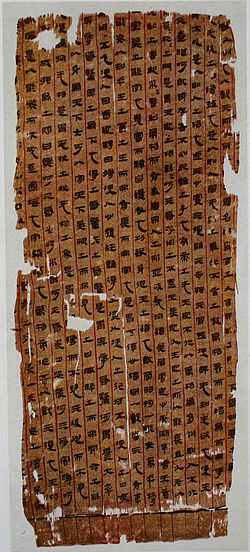
The Tao Te Ching (traditional Chinese: 道德經; simplified Chinese: 道德经; lit. 'Classic of the Way and its Virtue') or Laozi is a Chinese classic text and foundational work of Taoism traditionally credited to the sage Laozi, although the text's authorship and date of composition and compilation are debated. The oldest excavated portion dates to the late 4th century BCE. While tradition places Laozi earlier, modern versions of the text could more conservatively be estimated to date back to the late Warring States period (475 – 221 BCE), not having been recovered that early.
The Tao Te Ching is central to both philosophical and religious Taoism, and has been highly influential on Chinese philosophy and religious practice in general. It is generally taken as preceding the Zhuangzi, the other core Taoist text. Terminology originating within the text has been reinterpreted and elaborated upon by Legalist thinkers, Confucianists, and particularly Chinese Buddhists, introduced to China significantly after the initial solidification of Taoist thought. One of the most translated texts in world literature, the text is well known in the West.
In English, the title is commonly rendered Tao Te Ching, following the Wade–Giles romanization, or as Daodejing, following pinyin. It can be translated as The Classic of the Way and its Power, The Book of the Tao and Its Virtue, The Book of the Way and of Virtue, The Tao and its Characteristics, The Canon of Reason and Virtue, The Classic Book of Integrity and the Way,, The Book of Virtues,[citation needed] or A Treatise on the Principle and Its Action.
Ancient Chinese books were commonly referenced by the name of their real or supposed author, in this case the "Old Master", Laozi. As such, the Tao Te Ching is also sometimes called the Laozi, especially in Chinese sources.
The title Tao Te Ching, designating the work's status as a classic, was first applied during the reign of Emperor Jing of Han (157–141 BCE). Other titles for the work include the honorific Sutra of the Way and Its Power (道德真經; Dàodé zhēnjing) and the descriptive Five Thousand Character Classic (五千文; Wǔqiān wén).
The Tao Te Ching is traditionally ascribed to Laozi, whose historical existence has been a matter of scholarly debate. His name, which means "Old Master", has only fueled controversy on this issue. Legends claim variously that Laozi was "born old" and that he lived for 996 years, with 12 previous incarnations starting around the time of the Three Sovereigns before the 13th as Laozi. Some scholars have expressed doubts about Laozi's historicity.
The first biographical reference to Laozi is in the Records of the Grand Historian, by Chinese historian Sima Qian (c. 145–86 BCE), which combines three stories. In the first, Laozi was a contemporary of Confucius (551–479 BCE). His surname was Li (李), and his personal name was Er (耳) or Dan (聃). He was an official in the imperial archives, and wrote a book in two parts before departing to the West; at the request of the keeper of the Han-ku Pass, Yinxi, Laozi composed the Tao Te Ching. In the second story, Laozi, also a contemporary of Confucius, was Lao Laizi (老萊子), who wrote a book in 15 parts. Third, Laozi was the grand historian and astrologer Lao Dan (老聃), who lived during the reign of Duke Xian of Qin (r. 384–362 BCE).
Among the many transmitted editions of the Tao Te Ching text, the three primary ones are named after early commentaries. The "Yan Zun Version", which is only extant for the Te Ching, derives from a commentary attributed to Han dynasty scholar Yan Zun (巖尊, fl. 80 BCE – 10 CE). The "Heshang Gong" version is named after the legendary Heshang Gong ("legendary sage"), who supposedly lived during the reign of Emperor Wen of Han (180–157 BCE). This commentary has a preface written by Ge Xuan (164–244 CE), granduncle of Ge Hong, and scholarship dates this version to c. the 3rd century CE. The origins of the "Wang Bi" version have greater verification than either of the above. Wang Bi (226–249 CE) was a Three Kingdoms-period philosopher and commentator on the Tao Te Ching and I Ching.
Tao Te Ching
The Tao Te Ching (traditional Chinese: 道德經; simplified Chinese: 道德经; lit. 'Classic of the Way and its Virtue') or Laozi is a Chinese classic text and foundational work of Taoism traditionally credited to the sage Laozi, although the text's authorship and date of composition and compilation are debated. The oldest excavated portion dates to the late 4th century BCE. While tradition places Laozi earlier, modern versions of the text could more conservatively be estimated to date back to the late Warring States period (475 – 221 BCE), not having been recovered that early.
The Tao Te Ching is central to both philosophical and religious Taoism, and has been highly influential on Chinese philosophy and religious practice in general. It is generally taken as preceding the Zhuangzi, the other core Taoist text. Terminology originating within the text has been reinterpreted and elaborated upon by Legalist thinkers, Confucianists, and particularly Chinese Buddhists, introduced to China significantly after the initial solidification of Taoist thought. One of the most translated texts in world literature, the text is well known in the West.
In English, the title is commonly rendered Tao Te Ching, following the Wade–Giles romanization, or as Daodejing, following pinyin. It can be translated as The Classic of the Way and its Power, The Book of the Tao and Its Virtue, The Book of the Way and of Virtue, The Tao and its Characteristics, The Canon of Reason and Virtue, The Classic Book of Integrity and the Way,, The Book of Virtues,[citation needed] or A Treatise on the Principle and Its Action.
Ancient Chinese books were commonly referenced by the name of their real or supposed author, in this case the "Old Master", Laozi. As such, the Tao Te Ching is also sometimes called the Laozi, especially in Chinese sources.
The title Tao Te Ching, designating the work's status as a classic, was first applied during the reign of Emperor Jing of Han (157–141 BCE). Other titles for the work include the honorific Sutra of the Way and Its Power (道德真經; Dàodé zhēnjing) and the descriptive Five Thousand Character Classic (五千文; Wǔqiān wén).
The Tao Te Ching is traditionally ascribed to Laozi, whose historical existence has been a matter of scholarly debate. His name, which means "Old Master", has only fueled controversy on this issue. Legends claim variously that Laozi was "born old" and that he lived for 996 years, with 12 previous incarnations starting around the time of the Three Sovereigns before the 13th as Laozi. Some scholars have expressed doubts about Laozi's historicity.
The first biographical reference to Laozi is in the Records of the Grand Historian, by Chinese historian Sima Qian (c. 145–86 BCE), which combines three stories. In the first, Laozi was a contemporary of Confucius (551–479 BCE). His surname was Li (李), and his personal name was Er (耳) or Dan (聃). He was an official in the imperial archives, and wrote a book in two parts before departing to the West; at the request of the keeper of the Han-ku Pass, Yinxi, Laozi composed the Tao Te Ching. In the second story, Laozi, also a contemporary of Confucius, was Lao Laizi (老萊子), who wrote a book in 15 parts. Third, Laozi was the grand historian and astrologer Lao Dan (老聃), who lived during the reign of Duke Xian of Qin (r. 384–362 BCE).
Among the many transmitted editions of the Tao Te Ching text, the three primary ones are named after early commentaries. The "Yan Zun Version", which is only extant for the Te Ching, derives from a commentary attributed to Han dynasty scholar Yan Zun (巖尊, fl. 80 BCE – 10 CE). The "Heshang Gong" version is named after the legendary Heshang Gong ("legendary sage"), who supposedly lived during the reign of Emperor Wen of Han (180–157 BCE). This commentary has a preface written by Ge Xuan (164–244 CE), granduncle of Ge Hong, and scholarship dates this version to c. the 3rd century CE. The origins of the "Wang Bi" version have greater verification than either of the above. Wang Bi (226–249 CE) was a Three Kingdoms-period philosopher and commentator on the Tao Te Ching and I Ching.
Recent media
Recent media