
Recent from talks
Giant Mountains
Knowledge base stats:
Talk channels stats:
Members stats:
Giant Mountains
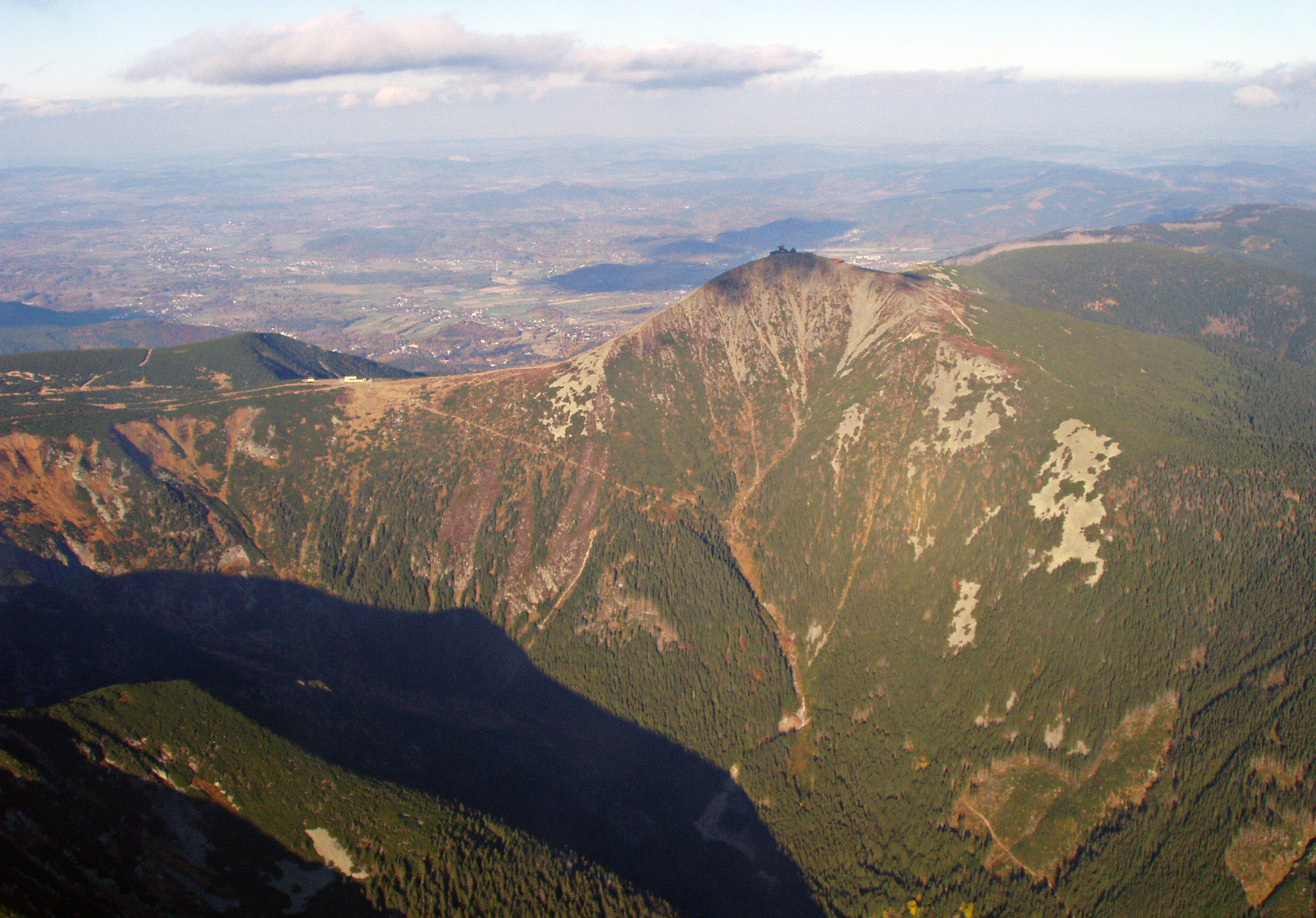
The Giant Mountains (Czech: Krkonoše, pronounced [ˈkr̩konoʃɛ] ⓘ; Polish: Karkonosze [karkɔˈnɔʂɛ] ⓘ) are a mountain range located in the north of the Czech Republic and the south-west of Poland, part of the Sudetes mountain system (part of the Bohemian Massif). The Czech–Polish border, which divides the historic regions of Bohemia and Silesia, runs along the main ridge. The highest peak, Sněžka (Polish: Śnieżka), is the Czech Republic's highest natural point with an elevation of 1,603 metres (5,259 ft).
On both sides of the border, large areas of the mountains are designated national parks (Krkonoše National Park in the Czech Republic and Karkonosze National Park in Poland), and these together comprise the Krkonoše/Karkonosze Transboundary Biosphere Reserve under the UNESCO Man and the Biosphere Programme. The source of the River Elbe is within the Giant Mountains. The range has a number of major ski resorts, and is a popular destination for tourists engaging in downhill and cross-country skiing, hiking, cycling and other activities.
The range has been called the Giant Mountains in English literature since at least 1719.
The Czech name "Krkonoše" is first mentioned (in the singular, as "Krkonoš") in a 1492 record of the division of the Manor of Štěpanice into two parts. The first map occurrence of the name dates back to 1518 to Klaudyán map of Bohemia, when it is referred to the mountains as "Krkonoss". The origin of the name is usually interpreted as a compound of "krk" or "krak", an Old Slavonic word for Krummholz (a reference to the local vegetation) – and "noš", derived from "nosit" (to carry). Alternative linguistic theories mention a connection with the pre–Indo-European word Corconti, which is first listed by Ptolemy and refers to a pre-Celtic or Germanic people.
In Simon Hüttel's chronicle of Trautenau (Trutnov) from 1549 the names Hrisenpergisches Gebirge, Hrisengepirge, Hrisengebirge, Risengepirge appeared for the first time, but in the following centuries several other names were still used too. Martin Helwig's map of Silesia mentions Riſenberg (Risenberg).
In 1380, Přibík Pulkava called the mountains the Sněžné hory (Snowy Mountains). The Czech writer Bohuslav Balbín recorded in 1679 that the mountains were known under various names: Krkonoše (Cerconossios), Rhipaeos Montes, Obrovski Mountains, Snow Mountains or Riesen Gebirge.
The modern names of Krkonoše (Czech), Riesengebirge (German) and Karkonosze (Polish) became widely accepted only in the 19th century.
The area of the Giant Mountains amounts to 631 square kilometres (244 square miles), 454 square kilometres (175 square miles) within the Czech Republic and 177 square kilometres (68 square miles) in Poland.[citation needed] While most of the Sudetes are middle-sized Mittelgebirge mountains, the Giant Mountains have a few characteristics of proper high mountains such as glacial cirques, small periglacial landforms and an elevation significantly above the tree line.
Hub AI
Giant Mountains AI simulator
(@Giant Mountains_simulator)
Giant Mountains
The Giant Mountains (Czech: Krkonoše, pronounced [ˈkr̩konoʃɛ] ⓘ; Polish: Karkonosze [karkɔˈnɔʂɛ] ⓘ) are a mountain range located in the north of the Czech Republic and the south-west of Poland, part of the Sudetes mountain system (part of the Bohemian Massif). The Czech–Polish border, which divides the historic regions of Bohemia and Silesia, runs along the main ridge. The highest peak, Sněžka (Polish: Śnieżka), is the Czech Republic's highest natural point with an elevation of 1,603 metres (5,259 ft).
On both sides of the border, large areas of the mountains are designated national parks (Krkonoše National Park in the Czech Republic and Karkonosze National Park in Poland), and these together comprise the Krkonoše/Karkonosze Transboundary Biosphere Reserve under the UNESCO Man and the Biosphere Programme. The source of the River Elbe is within the Giant Mountains. The range has a number of major ski resorts, and is a popular destination for tourists engaging in downhill and cross-country skiing, hiking, cycling and other activities.
The range has been called the Giant Mountains in English literature since at least 1719.
The Czech name "Krkonoše" is first mentioned (in the singular, as "Krkonoš") in a 1492 record of the division of the Manor of Štěpanice into two parts. The first map occurrence of the name dates back to 1518 to Klaudyán map of Bohemia, when it is referred to the mountains as "Krkonoss". The origin of the name is usually interpreted as a compound of "krk" or "krak", an Old Slavonic word for Krummholz (a reference to the local vegetation) – and "noš", derived from "nosit" (to carry). Alternative linguistic theories mention a connection with the pre–Indo-European word Corconti, which is first listed by Ptolemy and refers to a pre-Celtic or Germanic people.
In Simon Hüttel's chronicle of Trautenau (Trutnov) from 1549 the names Hrisenpergisches Gebirge, Hrisengepirge, Hrisengebirge, Risengepirge appeared for the first time, but in the following centuries several other names were still used too. Martin Helwig's map of Silesia mentions Riſenberg (Risenberg).
In 1380, Přibík Pulkava called the mountains the Sněžné hory (Snowy Mountains). The Czech writer Bohuslav Balbín recorded in 1679 that the mountains were known under various names: Krkonoše (Cerconossios), Rhipaeos Montes, Obrovski Mountains, Snow Mountains or Riesen Gebirge.
The modern names of Krkonoše (Czech), Riesengebirge (German) and Karkonosze (Polish) became widely accepted only in the 19th century.
The area of the Giant Mountains amounts to 631 square kilometres (244 square miles), 454 square kilometres (175 square miles) within the Czech Republic and 177 square kilometres (68 square miles) in Poland.[citation needed] While most of the Sudetes are middle-sized Mittelgebirge mountains, the Giant Mountains have a few characteristics of proper high mountains such as glacial cirques, small periglacial landforms and an elevation significantly above the tree line.
Recent media