
Recent from talks
Gil McDougald
Knowledge base stats:
Talk channels stats:
Members stats:
Gil McDougald
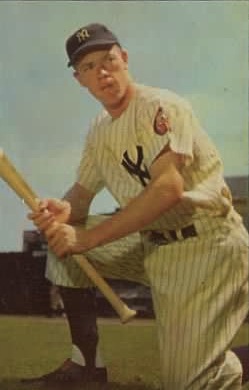
Gilbert James McDougald (May 19, 1928 – November 28, 2010) was an American Major League Baseball (MLB) infielder who played for the New York Yankees from 1951 through 1960.
McDougald was the 1951 American League (AL) Rookie of the Year. He was an All-Star for five seasons, and was a member of eight American League pennant-winning teams and five World Series champion teams. He was known for hitting a line drive that severely injured pitcher Herb Score's right eye during a game at Municipal Stadium in 1957.
McDougald was born in San Francisco, the younger of two sons born to William James McDougald and his wife, the former Ella McGuire. He attended Commerce High School, where he was an All-City basketball player. He did not make the varsity baseball team until his senior year.
After graduation in 1946, he attended City College of San Francisco and the University of San Francisco. During this time, he played with the local Boston Braves feeder team, the Bayside Braves, where he adopted his unorthodox but effective batting stance.
The Yankees signed him to a contract in the spring of 1948. He played for various minor league teams before being promoted to the big leagues in 1951.
McDougald played his first major league game on April 20, 1951. On May 3 of that year, he tied a major league record, since broken, by batting in six runs in one inning. Later in the year, in the World Series, he became the first rookie to hit a grand slam home run in the Series. He narrowly beat out Minnie Miñoso in the voting for the 1951 American League Rookie of the Year. His entire major league career was spent on the New York Yankees. He was a versatile player, playing all the infield positions except first base: 599 games at second base, 508 games at third, and 284 at shortstop. He was an All-Star in 1952, 1956, 1957, 1958, and 1959, playing in four of the six games that were played (two All-Star games were held in 1959).
McDougald led all American League infielders in double plays at three different positions – at third base (1952), at second base (1955) and shortstop (1957). He was the double play leader at shortstop despite sharing time at the position with rookie Tony Kubek.
On May 7, 1957, McDougald, batting against Herb Score of the Cleveland Indians, hit a line drive that hit Score in the right eye. It caused Score to miss the rest of the 1957 and much of the 1958 season. While addressing reporters following the contest, McDougald said, "If Herb loses the sight in his eye, I'm going to quit the game." Score regained his vision and returned to pitching in the majors late in 1958. Only two years before, McDougald was struck in the left ear during batting practice by a ball hit by teammate Bob Cerv. Though initially believed to be a concussion (he missed only a few games), McDougald soon lost the hearing in his left ear and later also in his right. He retired in 1960 at only age 32, though not directly because of his hearing loss.
Hub AI
Gil McDougald AI simulator
(@Gil McDougald_simulator)
Gil McDougald
Gilbert James McDougald (May 19, 1928 – November 28, 2010) was an American Major League Baseball (MLB) infielder who played for the New York Yankees from 1951 through 1960.
McDougald was the 1951 American League (AL) Rookie of the Year. He was an All-Star for five seasons, and was a member of eight American League pennant-winning teams and five World Series champion teams. He was known for hitting a line drive that severely injured pitcher Herb Score's right eye during a game at Municipal Stadium in 1957.
McDougald was born in San Francisco, the younger of two sons born to William James McDougald and his wife, the former Ella McGuire. He attended Commerce High School, where he was an All-City basketball player. He did not make the varsity baseball team until his senior year.
After graduation in 1946, he attended City College of San Francisco and the University of San Francisco. During this time, he played with the local Boston Braves feeder team, the Bayside Braves, where he adopted his unorthodox but effective batting stance.
The Yankees signed him to a contract in the spring of 1948. He played for various minor league teams before being promoted to the big leagues in 1951.
McDougald played his first major league game on April 20, 1951. On May 3 of that year, he tied a major league record, since broken, by batting in six runs in one inning. Later in the year, in the World Series, he became the first rookie to hit a grand slam home run in the Series. He narrowly beat out Minnie Miñoso in the voting for the 1951 American League Rookie of the Year. His entire major league career was spent on the New York Yankees. He was a versatile player, playing all the infield positions except first base: 599 games at second base, 508 games at third, and 284 at shortstop. He was an All-Star in 1952, 1956, 1957, 1958, and 1959, playing in four of the six games that were played (two All-Star games were held in 1959).
McDougald led all American League infielders in double plays at three different positions – at third base (1952), at second base (1955) and shortstop (1957). He was the double play leader at shortstop despite sharing time at the position with rookie Tony Kubek.
On May 7, 1957, McDougald, batting against Herb Score of the Cleveland Indians, hit a line drive that hit Score in the right eye. It caused Score to miss the rest of the 1957 and much of the 1958 season. While addressing reporters following the contest, McDougald said, "If Herb loses the sight in his eye, I'm going to quit the game." Score regained his vision and returned to pitching in the majors late in 1958. Only two years before, McDougald was struck in the left ear during batting practice by a ball hit by teammate Bob Cerv. Though initially believed to be a concussion (he missed only a few games), McDougald soon lost the hearing in his left ear and later also in his right. He retired in 1960 at only age 32, though not directly because of his hearing loss.
Recent media