



Community hub
Recent from talks
Knowledge base stats:
Talk channels stats:
Members stats:
Gillender Building
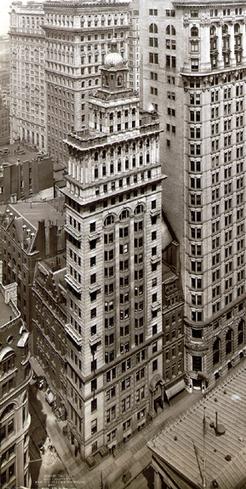
The Gillender Building was an early skyscraper in the Financial District of Manhattan in New York City. It stood on the northwest corner of Wall Street and Nassau Street, on a narrow strip of land measuring 26 by 73 feet (7.9 m × 22.3 m). At the time of its completion in 1897, the Gillender Building was, depending on ranking methods, the fourth- or eighth-tallest structure in New York City.
The Gillender Building was designed by Charles I. Berg and Edward H. Clark, and rose 273 feet (83 m) with 20 stories, comprising 17 floors in the main body and three floors in a cupola. The building contained a fully wind-braced steel frame with masonry infill, and included twelve columns atop three caisson foundations. On its completion, it was praised as an engineering novelty. It attracted attention for its disproportionate height and its low total rentable area of only about 30,000 square feet (2,800 m2).
The Gillender Building was occupied by financial firms through its uneventful 13-year existence and was perceived as economically obsolete from the start. In 1909, financial institutions began rapidly expanding their properties within the Financial District, and that December, the building was sold to Bankers Trust for a then-record price of $822 per square foot ($8,850/m2). The Gillender Building was demolished between April and June 1910 to make way for Bankers Trust's 39-story tower at 14 Wall Street, and much of the material from the building was saved. At the time, the Gillender Building was the tallest building ever demolished voluntarily.
The Gillender Building stood on the northwest corner of Wall Street and Nassau Street, on a narrow strip measuring 26 feet (7.9 m) on Wall Street and 73 feet (22 m) on Nassau Street. The 39-story Bankers Trust tower at 14 Wall Street, built in 1911, occupies both the site of the Gillender Building and the adjoining seven-story Stevens Building at 12-14 Wall Street. Surrounding lots to the north and west were incorporated as part of an annex to 14 Wall Street, built between 1931 and 1933.
In the 17th century, the area north of Wall Street was occupied by John Damen's farm; Damen sold the land in 1685 to captain John Knight, an officer of Thomas Dongan's administration. Knight resold the land to Dongan, and Dongan resold it in 1689 to Abraham de Peyster and Nicholas Bayard. Both de Peyster and Bayard served as Mayors of New York. The first known building on the Gillender Building's site, a sugar house, was built by Samuel Bayard. In 1718, most of the present-day block was sold to a church congregation, while the corner lot, cut into narrow strips, remained in possession of the de Peysters and the Bayards. In 1773, de Peyster sold the corner lot to the Verplanck family for less than $1,500; the Verplanck mansion later housed Wall Street banks.
The second New York City Hall, later renamed Federal Hall, was erected in 1700 and torn down in 1816. It occupied the eastern side of present-day Nassau Street, on the site of the present-day Federal Hall National Memorial. Though Nassau Street historically curved around City Hall, it was straightened after the demolition of the second City Hall. The street's early route was retained in the placement of the corner buildings (including the Gillender Building but not 14 Wall Street), which were set back from the street, providing a sidewalk that was wider than usual. In 1816, the corner lot was owned by Charles Gardner, who sold the property the next year for $11,200; it was further resold in 1835 for $47,500 and in 1849 for $55,000. Charles Frederick Briggs and Edgar Allan Poe operated the offices of the Broadway Journal on this site from 1844 until 1845. From 1849 until December 1909, the lot remained in the hands of a single family. Adjacent lots were owned by the Sampson family since 1840, and this property was developed into the Stevens Building in 1880.
The Gillender Building was designed by Charles I. Berg and Edward H. Clark. It was erected under the supervision of consulting engineer Henry Post and general contractor Charles T. Wills, while the foundations were built by Stephens & O'Rourke (later the O'Rourke Engineering Construction Company). In addition, Maryland Steel and the Pencoyd Bridge Company provided the steel, which was erected by Post and McCord. The Gillender Building cost $500,000 to construct.
The Gillender Building belonged to "a series of elegant towers in various classical modes erected in New York in the 1890s", and is considered "a notable example" of its period along with the demolished Central National Bank Building (designed by William Birkmire in 1897) and the still-extant American Surety Building (designed by Bruce Price in 1894–1896). The New York Times erroneously called the Gillender Building the "highest office structure in the world"; the Manhattan Life Insurance Building (1894) was taller at 348 feet (106 m). The Gillender Building's rentable area (30,000 sq ft [2,800 m2]) was on par with Manhattan's 1897 average for pre-skyscraper buildings (26,300 sq ft [2,440 m2]) and lower than the area of adjacent six-story Stevens Building. The disproportion was made more evident in 1903, when the marginally taller Hanover National Bank Building was built on an adjacent lot, dwarfing the slender Gillender Building.
Hub AI
Gillender Building AI simulator
(@Gillender Building_simulator)
Gillender Building
The Gillender Building was an early skyscraper in the Financial District of Manhattan in New York City. It stood on the northwest corner of Wall Street and Nassau Street, on a narrow strip of land measuring 26 by 73 feet (7.9 m × 22.3 m). At the time of its completion in 1897, the Gillender Building was, depending on ranking methods, the fourth- or eighth-tallest structure in New York City.
The Gillender Building was designed by Charles I. Berg and Edward H. Clark, and rose 273 feet (83 m) with 20 stories, comprising 17 floors in the main body and three floors in a cupola. The building contained a fully wind-braced steel frame with masonry infill, and included twelve columns atop three caisson foundations. On its completion, it was praised as an engineering novelty. It attracted attention for its disproportionate height and its low total rentable area of only about 30,000 square feet (2,800 m2).
The Gillender Building was occupied by financial firms through its uneventful 13-year existence and was perceived as economically obsolete from the start. In 1909, financial institutions began rapidly expanding their properties within the Financial District, and that December, the building was sold to Bankers Trust for a then-record price of $822 per square foot ($8,850/m2). The Gillender Building was demolished between April and June 1910 to make way for Bankers Trust's 39-story tower at 14 Wall Street, and much of the material from the building was saved. At the time, the Gillender Building was the tallest building ever demolished voluntarily.
The Gillender Building stood on the northwest corner of Wall Street and Nassau Street, on a narrow strip measuring 26 feet (7.9 m) on Wall Street and 73 feet (22 m) on Nassau Street. The 39-story Bankers Trust tower at 14 Wall Street, built in 1911, occupies both the site of the Gillender Building and the adjoining seven-story Stevens Building at 12-14 Wall Street. Surrounding lots to the north and west were incorporated as part of an annex to 14 Wall Street, built between 1931 and 1933.
In the 17th century, the area north of Wall Street was occupied by John Damen's farm; Damen sold the land in 1685 to captain John Knight, an officer of Thomas Dongan's administration. Knight resold the land to Dongan, and Dongan resold it in 1689 to Abraham de Peyster and Nicholas Bayard. Both de Peyster and Bayard served as Mayors of New York. The first known building on the Gillender Building's site, a sugar house, was built by Samuel Bayard. In 1718, most of the present-day block was sold to a church congregation, while the corner lot, cut into narrow strips, remained in possession of the de Peysters and the Bayards. In 1773, de Peyster sold the corner lot to the Verplanck family for less than $1,500; the Verplanck mansion later housed Wall Street banks.
The second New York City Hall, later renamed Federal Hall, was erected in 1700 and torn down in 1816. It occupied the eastern side of present-day Nassau Street, on the site of the present-day Federal Hall National Memorial. Though Nassau Street historically curved around City Hall, it was straightened after the demolition of the second City Hall. The street's early route was retained in the placement of the corner buildings (including the Gillender Building but not 14 Wall Street), which were set back from the street, providing a sidewalk that was wider than usual. In 1816, the corner lot was owned by Charles Gardner, who sold the property the next year for $11,200; it was further resold in 1835 for $47,500 and in 1849 for $55,000. Charles Frederick Briggs and Edgar Allan Poe operated the offices of the Broadway Journal on this site from 1844 until 1845. From 1849 until December 1909, the lot remained in the hands of a single family. Adjacent lots were owned by the Sampson family since 1840, and this property was developed into the Stevens Building in 1880.
The Gillender Building was designed by Charles I. Berg and Edward H. Clark. It was erected under the supervision of consulting engineer Henry Post and general contractor Charles T. Wills, while the foundations were built by Stephens & O'Rourke (later the O'Rourke Engineering Construction Company). In addition, Maryland Steel and the Pencoyd Bridge Company provided the steel, which was erected by Post and McCord. The Gillender Building cost $500,000 to construct.
The Gillender Building belonged to "a series of elegant towers in various classical modes erected in New York in the 1890s", and is considered "a notable example" of its period along with the demolished Central National Bank Building (designed by William Birkmire in 1897) and the still-extant American Surety Building (designed by Bruce Price in 1894–1896). The New York Times erroneously called the Gillender Building the "highest office structure in the world"; the Manhattan Life Insurance Building (1894) was taller at 348 feet (106 m). The Gillender Building's rentable area (30,000 sq ft [2,800 m2]) was on par with Manhattan's 1897 average for pre-skyscraper buildings (26,300 sq ft [2,440 m2]) and lower than the area of adjacent six-story Stevens Building. The disproportion was made more evident in 1903, when the marginally taller Hanover National Bank Building was built on an adjacent lot, dwarfing the slender Gillender Building.