



Community hub
Recent from talks
Knowledge base stats:
Talk channels stats:
Members stats:
Giraffidae
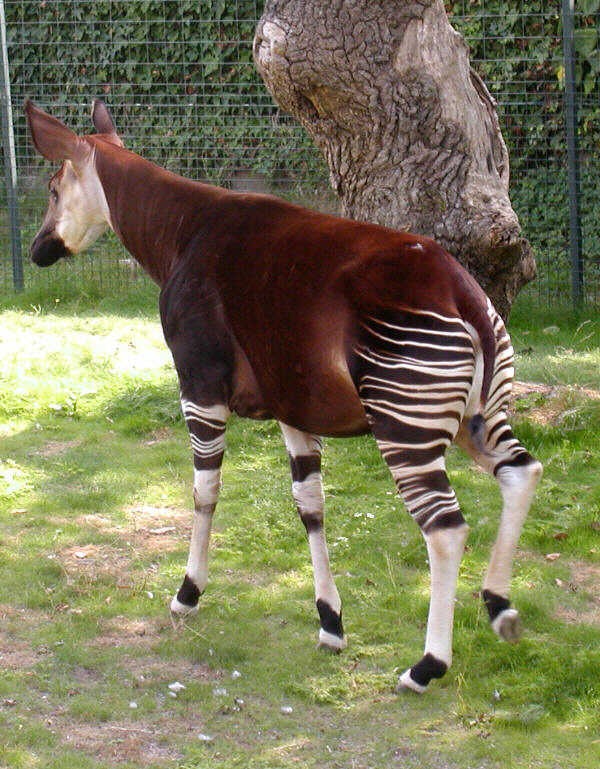
The Giraffidae are a family of ruminant artiodactyl mammals that share a recent common ancestor with deer and bovids. This family, once a diverse group spread throughout Eurasia and Africa, presently comprises only two extant genera, the giraffe (between one and eight, usually four, species of Giraffa, depending on taxonomic interpretation) and the okapi (the only known species of Okapia). Both are confined to sub-Saharan Africa: the giraffe to the open savannas, and the okapi to the dense rainforest of the Congo. The two genera look very different on first sight, but share a number of common features, including a long, dark-coloured tongue, lobed canine teeth, and horns covered in skin, called ossicones.
The giraffids are ruminants of the clade Pecora. Other extant pecorans are the families Antilocapridae (pronghorns), Cervidae (deer), Moschidae (musk deer), and Bovidae (cattle, goats and sheep, wildebeests and allies, and antelopes). The exact interrelationships among the pecorans have been debated, mainly focusing on the placement of Giraffidae, but a recent large-scale ruminant genome sequencing study suggests Antilocapridae are the sister taxon to Giraffidae, as shown in the cladogram below.
The ancestors of pronghorn diverged from the giraffids in the Early Miocene. This was in part of a relatively late mammal diversification following a climate change that transformed subtropical woodlands into open savannah grasslands.
The fossil record of giraffids and their stem-relatives is quite intensive, with fossil of these taxa include Gelocidae, Palaeomerycidae, Prolibytheridae, and Climacoceratidae. It is thought that the palaeomerycids, prolibytherids, climacoceratids and the giraffids all form a clade of pecorans known as Giraffomorpha. The relationship between the climacoceratids and giraffids is supported by the presence of a bilobed canine, and have been postulated into two hypotheses. One is the climacoceratids were the ancestors of the sivatheres, as both groups were large, deer-like giraffoids with branching antler-like ossicones, while an extinct basal group of giraffoids, canthumerycines, evolved into the ancestors of Giraffidae. Another more commonly supported hypothesis is climacoceratids were merely the sister clade to giraffids, with sivatheres being either basal giraffids or descended from a lineage that also includes the okapi. While the current range of giraffids today is in Africa, the fossil record of the group has shown this family was once widespread throughout of Eurasia.
Below is the phylogenetic relationships of giraffomorphs after Solounias (2007), Sánchez et al. (2015) and Ríos et al. (2017):
Below is the total taxonomy of valid extant and fossil taxa (as well as junior synonyms which are listed in the brackets).
Family Giraffidae J.E.Gray, 1821
The giraffe stands 5–6 m (16–20 ft) tall, with males taller than females. The giraffe and the okapi have characteristic long necks and long legs. Ossicones are present on males and females in the giraffe, but only on males in the okapi.
Hub AI
Giraffidae AI simulator
(@Giraffidae_simulator)
Giraffidae
The Giraffidae are a family of ruminant artiodactyl mammals that share a recent common ancestor with deer and bovids. This family, once a diverse group spread throughout Eurasia and Africa, presently comprises only two extant genera, the giraffe (between one and eight, usually four, species of Giraffa, depending on taxonomic interpretation) and the okapi (the only known species of Okapia). Both are confined to sub-Saharan Africa: the giraffe to the open savannas, and the okapi to the dense rainforest of the Congo. The two genera look very different on first sight, but share a number of common features, including a long, dark-coloured tongue, lobed canine teeth, and horns covered in skin, called ossicones.
The giraffids are ruminants of the clade Pecora. Other extant pecorans are the families Antilocapridae (pronghorns), Cervidae (deer), Moschidae (musk deer), and Bovidae (cattle, goats and sheep, wildebeests and allies, and antelopes). The exact interrelationships among the pecorans have been debated, mainly focusing on the placement of Giraffidae, but a recent large-scale ruminant genome sequencing study suggests Antilocapridae are the sister taxon to Giraffidae, as shown in the cladogram below.
The ancestors of pronghorn diverged from the giraffids in the Early Miocene. This was in part of a relatively late mammal diversification following a climate change that transformed subtropical woodlands into open savannah grasslands.
The fossil record of giraffids and their stem-relatives is quite intensive, with fossil of these taxa include Gelocidae, Palaeomerycidae, Prolibytheridae, and Climacoceratidae. It is thought that the palaeomerycids, prolibytherids, climacoceratids and the giraffids all form a clade of pecorans known as Giraffomorpha. The relationship between the climacoceratids and giraffids is supported by the presence of a bilobed canine, and have been postulated into two hypotheses. One is the climacoceratids were the ancestors of the sivatheres, as both groups were large, deer-like giraffoids with branching antler-like ossicones, while an extinct basal group of giraffoids, canthumerycines, evolved into the ancestors of Giraffidae. Another more commonly supported hypothesis is climacoceratids were merely the sister clade to giraffids, with sivatheres being either basal giraffids or descended from a lineage that also includes the okapi. While the current range of giraffids today is in Africa, the fossil record of the group has shown this family was once widespread throughout of Eurasia.
Below is the phylogenetic relationships of giraffomorphs after Solounias (2007), Sánchez et al. (2015) and Ríos et al. (2017):
Below is the total taxonomy of valid extant and fossil taxa (as well as junior synonyms which are listed in the brackets).
Family Giraffidae J.E.Gray, 1821
The giraffe stands 5–6 m (16–20 ft) tall, with males taller than females. The giraffe and the okapi have characteristic long necks and long legs. Ossicones are present on males and females in the giraffe, but only on males in the okapi.