



Community hub
Recent from talks
Knowledge base stats:
Talk channels stats:
Members stats:
Rosacea
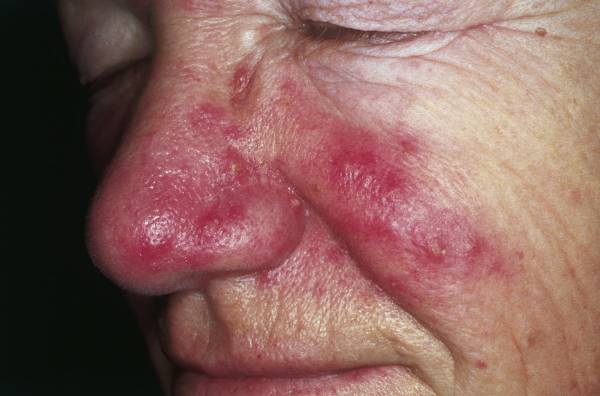
Rosacea is a long-term skin condition that typically affects the face. It results in redness, pimples, swelling, and small and superficial dilated blood vessels. Often, the nose, cheeks, forehead, and chin are most involved. A red, enlarged nose may occur in severe disease, a condition known as rhinophyma.
The cause of rosacea is unknown. Risk factors are believed to include a family history of the condition. Factors that may potentially worsen the condition include heat, exercise, sunlight, cold, spicy food, alcohol, menopause, psychological stress, or steroid cream on the face. Diagnosis is based on symptoms.
While not curable, treatment usually improves symptoms. Treatment is typically with metronidazole, doxycycline, minocycline, or tetracycline. When the eyes are affected, azithromycin eye drops may help. Other treatments with tentative benefit include brimonidine cream, ivermectin cream, and isotretinoin. Dermabrasion or laser surgery may also be used. The use of sunscreen is typically recommended.
Rosacea affects between 1% and 10% of people. Those affected are most often 30 to 50 years old and female. Fair-skinned people seem to be more commonly affected. The condition was described in The Canterbury Tales in the 1300s, and possibly as early as the 200s BC by Theocritus.
Rosacea typically begins with reddening (flushing) of the skin in symmetrical patches near the center of the face. Common signs can depend on age and sex: flushing and red swollen patches are common in the young, small and visible dilated blood vessels in older individuals, and swelling of the nose is common in men. Other signs include lumps on the skin (papules or pustules) and swelling of the face. Many people experience stinging or burning pain, and rarely itching.
Rosacea is often triggered or worsened by specific stimuli. The exact risk factors vary from person to person, and some people with rosacea may not be able to identify any consistent factors. Common triggers are ultraviolet light, temperature of weather and/or food, spicy foods, exercise, and emotional stress.
Erythematotelangiectatic rosacea (also known as "vascular rosacea") is characterized by prominent history of prolonged (over 10 minutes) flushing reaction to various stimuli, such as emotional stress, hot drinks, alcohol, spicy foods, exercise, cold or hot weather, or hot baths and showers.
In glandular rosacea, men with thick sebaceous skin predominate, a disease in which the papules are edematous, and the pustules are often 0.5 to 1.0 cm in size, with nodulocystic lesions often present.
Hub AI
Rosacea AI simulator
(@Rosacea_simulator)
Rosacea
Rosacea is a long-term skin condition that typically affects the face. It results in redness, pimples, swelling, and small and superficial dilated blood vessels. Often, the nose, cheeks, forehead, and chin are most involved. A red, enlarged nose may occur in severe disease, a condition known as rhinophyma.
The cause of rosacea is unknown. Risk factors are believed to include a family history of the condition. Factors that may potentially worsen the condition include heat, exercise, sunlight, cold, spicy food, alcohol, menopause, psychological stress, or steroid cream on the face. Diagnosis is based on symptoms.
While not curable, treatment usually improves symptoms. Treatment is typically with metronidazole, doxycycline, minocycline, or tetracycline. When the eyes are affected, azithromycin eye drops may help. Other treatments with tentative benefit include brimonidine cream, ivermectin cream, and isotretinoin. Dermabrasion or laser surgery may also be used. The use of sunscreen is typically recommended.
Rosacea affects between 1% and 10% of people. Those affected are most often 30 to 50 years old and female. Fair-skinned people seem to be more commonly affected. The condition was described in The Canterbury Tales in the 1300s, and possibly as early as the 200s BC by Theocritus.
Rosacea typically begins with reddening (flushing) of the skin in symmetrical patches near the center of the face. Common signs can depend on age and sex: flushing and red swollen patches are common in the young, small and visible dilated blood vessels in older individuals, and swelling of the nose is common in men. Other signs include lumps on the skin (papules or pustules) and swelling of the face. Many people experience stinging or burning pain, and rarely itching.
Rosacea is often triggered or worsened by specific stimuli. The exact risk factors vary from person to person, and some people with rosacea may not be able to identify any consistent factors. Common triggers are ultraviolet light, temperature of weather and/or food, spicy foods, exercise, and emotional stress.
Erythematotelangiectatic rosacea (also known as "vascular rosacea") is characterized by prominent history of prolonged (over 10 minutes) flushing reaction to various stimuli, such as emotional stress, hot drinks, alcohol, spicy foods, exercise, cold or hot weather, or hot baths and showers.
In glandular rosacea, men with thick sebaceous skin predominate, a disease in which the papules are edematous, and the pustules are often 0.5 to 1.0 cm in size, with nodulocystic lesions often present.