
Recent from talks
Telangiectasia
Knowledge base stats:
Talk channels stats:
Members stats:
Telangiectasia
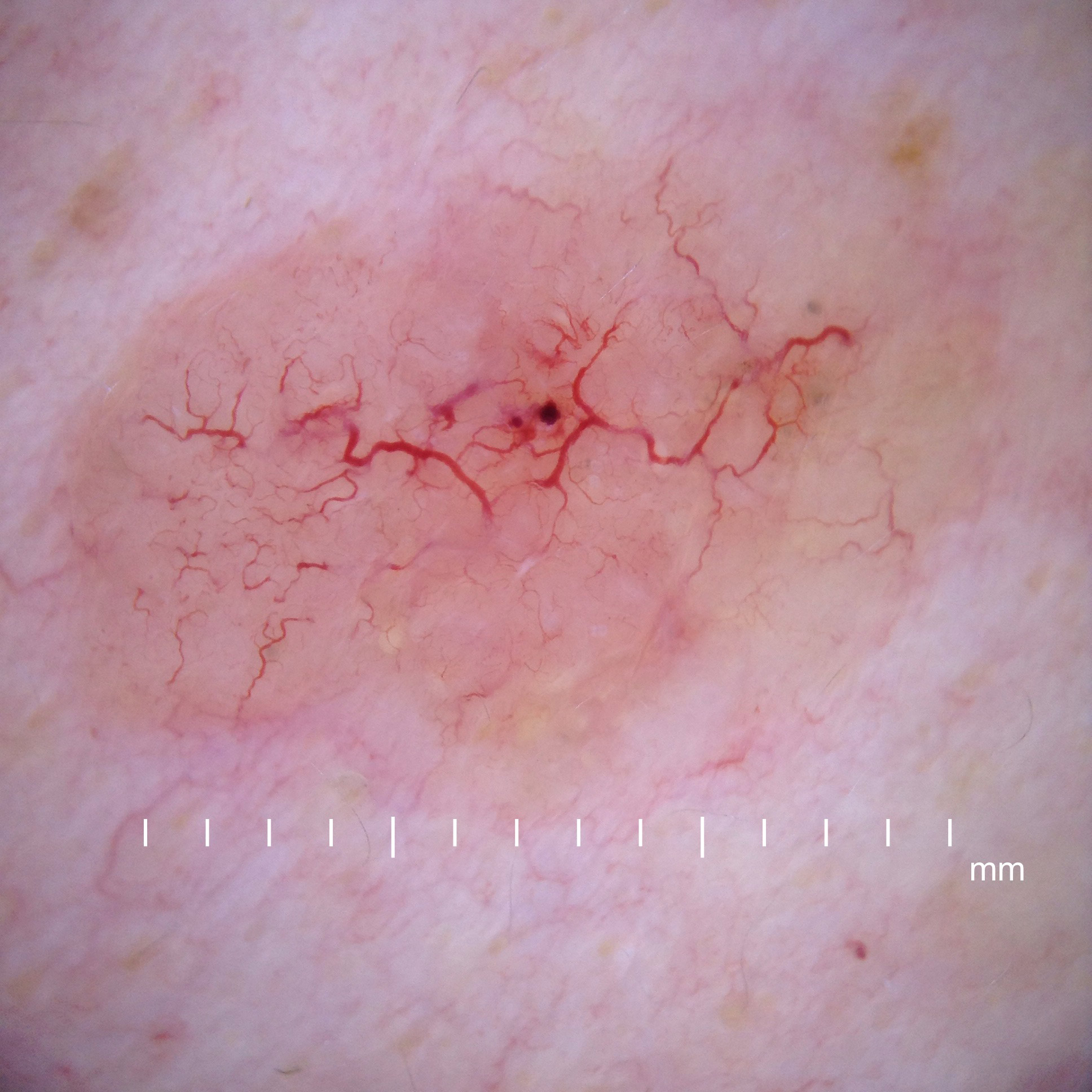
Telangiectasias (from tel- 'end' angi- 'blood vessel' and ectasia 'the expansion of a hollow or tubular organ'), also known as spider veins, are small dilated blood vessels that can occur near the surface of the skin or mucous membranes, measuring between 0.5 and 1 millimeter in diameter. These dilated blood vessels can develop anywhere on the body, but are commonly seen on the face around the nose, cheeks and chin. Dilated blood vessels can also develop on the legs, although when they occur on the legs, they often have underlying venous reflux or "hidden varicose veins" (see Venous hypertension section below). When found on the legs, they are found specifically on the upper thigh, below the knee joint and around the ankles.
Many patients with spider veins seek the assistance of physicians who specialize in vein care or peripheral vascular disease. These physicians are called vascular surgeons or phlebologists. More recently, interventional radiologists have started treating venous problems.
Some telangiectasias are due to developmental abnormalities that can closely mimic the behaviour of benign vascular neoplasms. They may be composed of abnormal aggregations of arterioles, capillaries or venules. Because telangiectasias are vascular lesions, they blanch when tested with diascopy.
Telangiectasias, aside from presenting in many other conditions, are one of the features of the acronymically named CREST syndrome, a form of systemic scleroderma. The syndrome recognises the significantly co-presenting symptoms of calcinosis, Raynaud's phenomenon, esophageal dysmotility, sclerodactyly and telangiectasia.
The causes of telangiectasia can be divided into congenital and acquired factors.
Goldman states that "numerous inherited or congenital conditions display cutaneous telangiectasia". These include:
In the past, it was believed that leg varicose veins or telangiectasia were caused by high venous pressure or "venous hypertension". However it is now understood that venous reflux disease is usually the cause of these problems.[full citation needed]
Telangiectasia in the legs is often related to the presence of venous reflux within underlying varicose veins. Flow abnormalities in smaller veins known as reticular veins or feeder veins under the skin can also cause spider veins to form, thereby making a recurrence of spider veins in the treated area less likely.
Hub AI
Telangiectasia AI simulator
(@Telangiectasia_simulator)
Telangiectasia
Telangiectasias (from tel- 'end' angi- 'blood vessel' and ectasia 'the expansion of a hollow or tubular organ'), also known as spider veins, are small dilated blood vessels that can occur near the surface of the skin or mucous membranes, measuring between 0.5 and 1 millimeter in diameter. These dilated blood vessels can develop anywhere on the body, but are commonly seen on the face around the nose, cheeks and chin. Dilated blood vessels can also develop on the legs, although when they occur on the legs, they often have underlying venous reflux or "hidden varicose veins" (see Venous hypertension section below). When found on the legs, they are found specifically on the upper thigh, below the knee joint and around the ankles.
Many patients with spider veins seek the assistance of physicians who specialize in vein care or peripheral vascular disease. These physicians are called vascular surgeons or phlebologists. More recently, interventional radiologists have started treating venous problems.
Some telangiectasias are due to developmental abnormalities that can closely mimic the behaviour of benign vascular neoplasms. They may be composed of abnormal aggregations of arterioles, capillaries or venules. Because telangiectasias are vascular lesions, they blanch when tested with diascopy.
Telangiectasias, aside from presenting in many other conditions, are one of the features of the acronymically named CREST syndrome, a form of systemic scleroderma. The syndrome recognises the significantly co-presenting symptoms of calcinosis, Raynaud's phenomenon, esophageal dysmotility, sclerodactyly and telangiectasia.
The causes of telangiectasia can be divided into congenital and acquired factors.
Goldman states that "numerous inherited or congenital conditions display cutaneous telangiectasia". These include:
In the past, it was believed that leg varicose veins or telangiectasia were caused by high venous pressure or "venous hypertension". However it is now understood that venous reflux disease is usually the cause of these problems.[full citation needed]
Telangiectasia in the legs is often related to the presence of venous reflux within underlying varicose veins. Flow abnormalities in smaller veins known as reticular veins or feeder veins under the skin can also cause spider veins to form, thereby making a recurrence of spider veins in the treated area less likely.
Recent media