



Community hub
Recent from talks
Knowledge base stats:
Talk channels stats:
Members stats:
Global Vipassana Pagoda
19°13′41″N 72°48′21.79″E / 19.22806°N 72.8060528°E
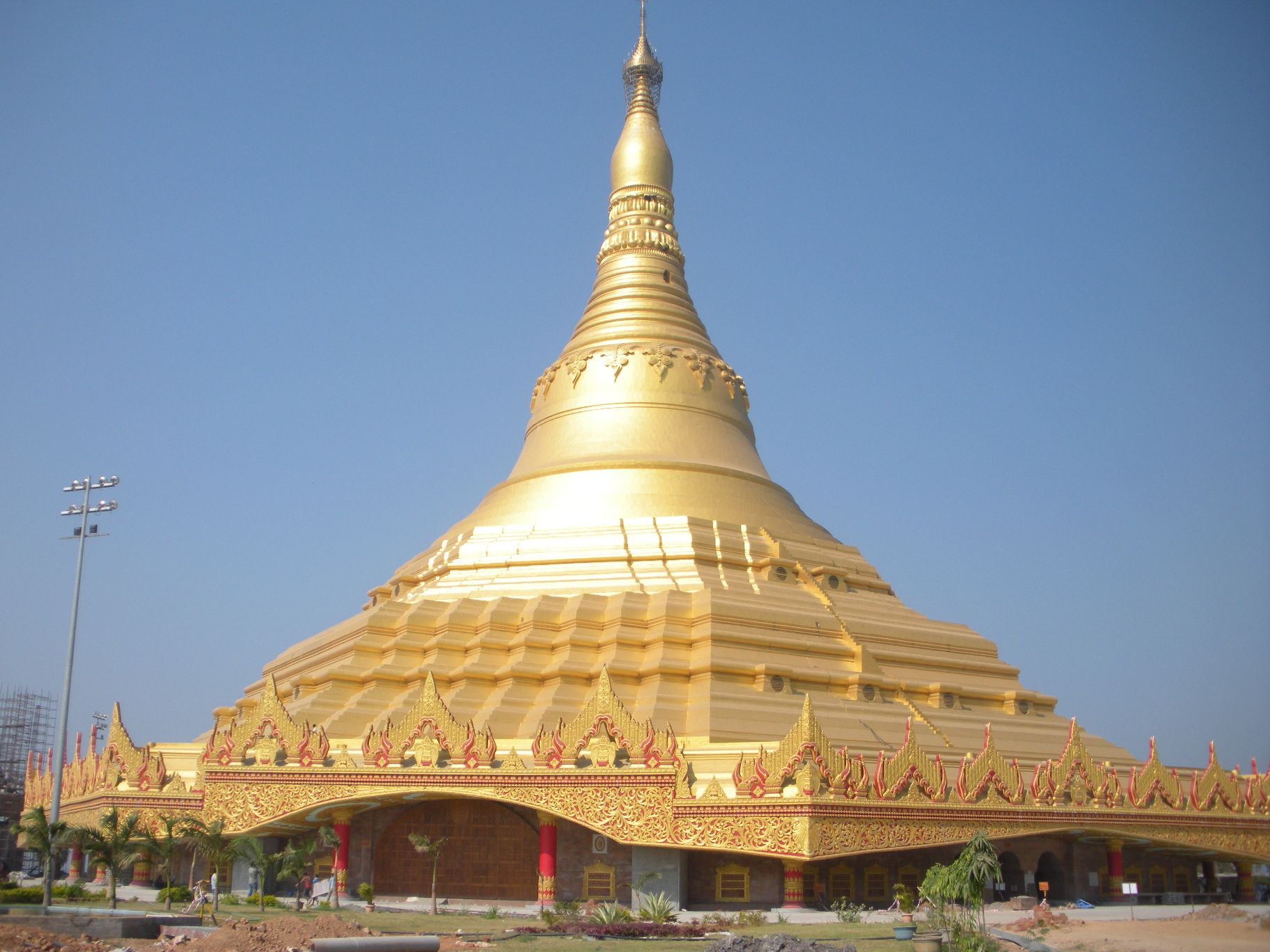
The Global Vipassana Pagoda is a meditation dome hall with a capacity to seat around 8,000 Vipassana meditators (the largest such Meditation hall in the world) near Gorai, and is also the main attraction in Gorai, in the north western part of Mumbai, Maharashtra, India. The Global Vipassana Pagoda is "declared as one of the ‘Seven Wonders of Maharashtra" by the Maharashtra Tourism Development Corporation (MTDC) in partnership with ABP Majha, a Marathi news channel, after they reviewed 350 destinations. The results of this selection were declared on 6th June, 2013. The pagoda was inaugurated by Pratibha Patil, the then President of India, on 8 February, 2009. It is built on donated land on a peninsula between the Gorai creek and the Arabian Sea. The pagoda is to serve as a monument of peace and harmony. The Global Vipassana Pagoda has been built out of gratitude to Sayagyi U Ba Khin (1899-1971), a Vipassana teacher and the first Accountant-General of Independent Burma, who was instrumental in Vipassana returning to India, the country of its origin.
Built entirely through voluntary donations, the purpose of the Global Vipassana Pagoda is to share information about Vipassana and about the Buddha and his teachings.
Vipassanā is the practical quintessence of the universal, non-sectarian teachings of the Buddha.
Its Burmese-style design shows gratitude to Myanmar for preserving the practice of Vipassana. The shape of the pagoda is a copy of the Shwedagon Pagoda (Golden Pagoda) in Yangon, Myanmar. It was built by combining ancient Indian and modern technology to enable it to last for a thousand years.
The center of the Global Vipassana Pagoda contains the world's largest stone dome, built without any supporting pillars. The height of the dome is approximately 29 meters, while the height of the building is 99.06 meters, which is twice the size of the previously largest hollow stone monument in the world, the Gol Gumbaz Dome in Bijapur, India. The external diameter of the largest section of the dome is 97.46 m, and the shorter sections are 94.82 m. The internal diameter is 85.15 m. The inside of the pagoda is hollow and serves as a very large meditation hall, with an area covering more than 6,000 m2 (65,000 ft2). The massive inner dome seats over 8,000 people, enabling them to practice the non-sectarian Vipassana Meditation as taught by S. N. Goenka, and is now being practiced in over 100 countries. An inaugural one-day Meditation course was held at the pagoda on 21 December 2008, with Goenka in attendance as the teacher.
Ten-day Vipassana Meditation courses are held free of charge at the Dhamma Pattana Meditation center, which is part of the Global Vipassana Pagoda complex.
Planning for the construction of the Global Vipassana Pagoda began in 1997, while actual building work started in 2000. The pagoda consists of three sub-domes. The first and largest dome was completed in October 2006 when bone relics of Gotama Buddha were enshrined in the central locking stone of the dome on 29 October 2006, making it the world's largest structure containing relics of the Buddha. The relics were originally found in the stupa at Bhattiprolu, Guntur district, Andhra Pradesh, South India. They have been donated by the Mahabodhi Society of India and the prime minister of Sri Lanka to be kept at the Global Vipassana Pagoda. The second and third domes sit atop the first dome. Construction of the third dome was structurally completed on 21 November 2008.
Hub AI
Global Vipassana Pagoda AI simulator
(@Global Vipassana Pagoda_simulator)
Global Vipassana Pagoda
19°13′41″N 72°48′21.79″E / 19.22806°N 72.8060528°E
The Global Vipassana Pagoda is a meditation dome hall with a capacity to seat around 8,000 Vipassana meditators (the largest such Meditation hall in the world) near Gorai, and is also the main attraction in Gorai, in the north western part of Mumbai, Maharashtra, India. The Global Vipassana Pagoda is "declared as one of the ‘Seven Wonders of Maharashtra" by the Maharashtra Tourism Development Corporation (MTDC) in partnership with ABP Majha, a Marathi news channel, after they reviewed 350 destinations. The results of this selection were declared on 6th June, 2013. The pagoda was inaugurated by Pratibha Patil, the then President of India, on 8 February, 2009. It is built on donated land on a peninsula between the Gorai creek and the Arabian Sea. The pagoda is to serve as a monument of peace and harmony. The Global Vipassana Pagoda has been built out of gratitude to Sayagyi U Ba Khin (1899-1971), a Vipassana teacher and the first Accountant-General of Independent Burma, who was instrumental in Vipassana returning to India, the country of its origin.
Built entirely through voluntary donations, the purpose of the Global Vipassana Pagoda is to share information about Vipassana and about the Buddha and his teachings.
Vipassanā is the practical quintessence of the universal, non-sectarian teachings of the Buddha.
Its Burmese-style design shows gratitude to Myanmar for preserving the practice of Vipassana. The shape of the pagoda is a copy of the Shwedagon Pagoda (Golden Pagoda) in Yangon, Myanmar. It was built by combining ancient Indian and modern technology to enable it to last for a thousand years.
The center of the Global Vipassana Pagoda contains the world's largest stone dome, built without any supporting pillars. The height of the dome is approximately 29 meters, while the height of the building is 99.06 meters, which is twice the size of the previously largest hollow stone monument in the world, the Gol Gumbaz Dome in Bijapur, India. The external diameter of the largest section of the dome is 97.46 m, and the shorter sections are 94.82 m. The internal diameter is 85.15 m. The inside of the pagoda is hollow and serves as a very large meditation hall, with an area covering more than 6,000 m2 (65,000 ft2). The massive inner dome seats over 8,000 people, enabling them to practice the non-sectarian Vipassana Meditation as taught by S. N. Goenka, and is now being practiced in over 100 countries. An inaugural one-day Meditation course was held at the pagoda on 21 December 2008, with Goenka in attendance as the teacher.
Ten-day Vipassana Meditation courses are held free of charge at the Dhamma Pattana Meditation center, which is part of the Global Vipassana Pagoda complex.
Planning for the construction of the Global Vipassana Pagoda began in 1997, while actual building work started in 2000. The pagoda consists of three sub-domes. The first and largest dome was completed in October 2006 when bone relics of Gotama Buddha were enshrined in the central locking stone of the dome on 29 October 2006, making it the world's largest structure containing relics of the Buddha. The relics were originally found in the stupa at Bhattiprolu, Guntur district, Andhra Pradesh, South India. They have been donated by the Mahabodhi Society of India and the prime minister of Sri Lanka to be kept at the Global Vipassana Pagoda. The second and third domes sit atop the first dome. Construction of the third dome was structurally completed on 21 November 2008.