
Recent from talks
Global brain
Knowledge base stats:
Talk channels stats:
Members stats:
Global brain
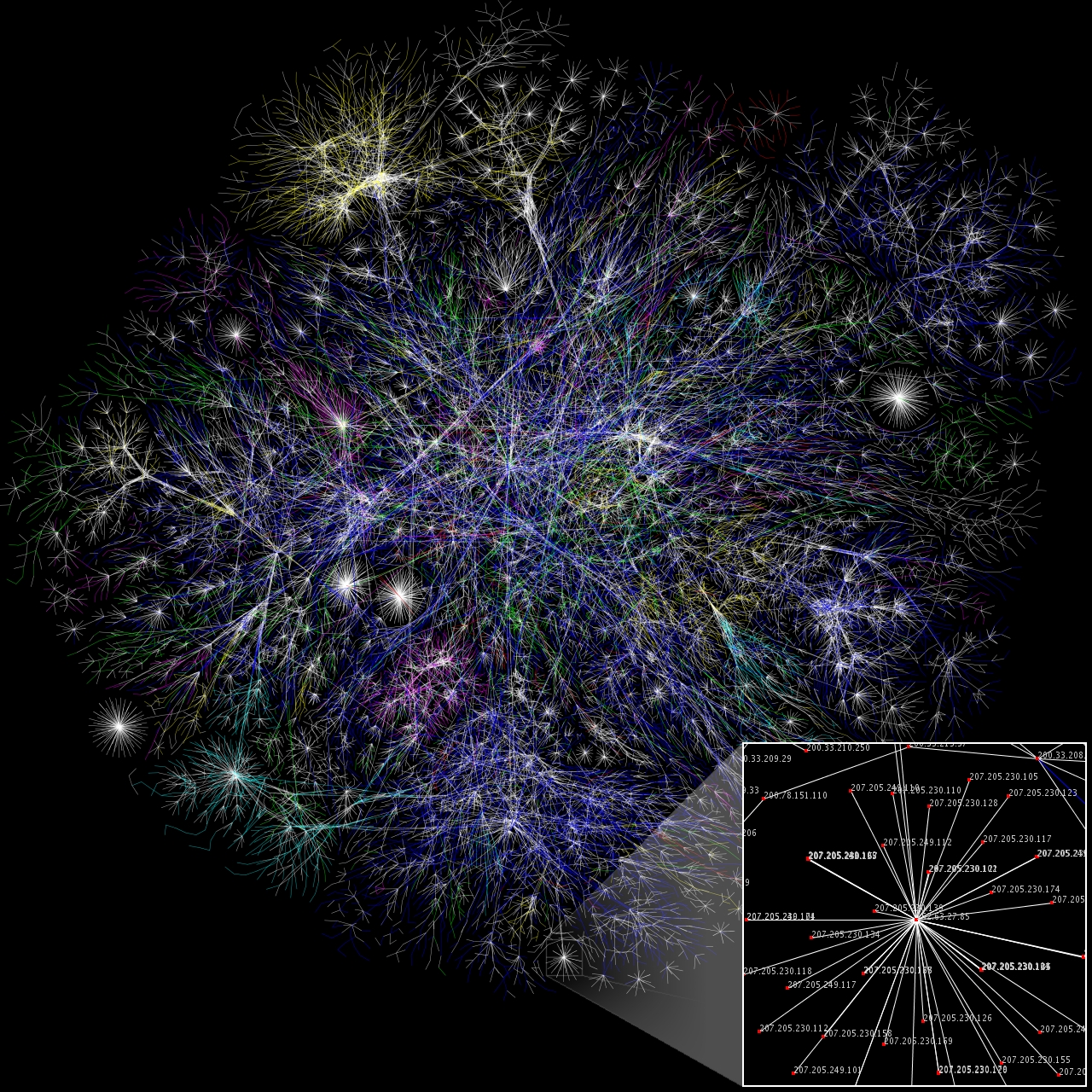
The global brain is a neuroscience-inspired and futurological vision of the planetary information and communications technology network that interconnects all humans and their technological artifacts. As this network stores ever more information, takes over ever more functions of coordination and communication from traditional organizations, and becomes increasingly intelligent, it increasingly plays the role of a brain for the planet Earth. In the philosophy of mind, global brain finds an analog in Averroes's theory of the unity of the intellect.
Proponents of the global brain hypothesis claim that the Internet increasingly ties its users together into a single information processing system that functions as part of the collective nervous system of the planet. The intelligence of this network is collective or distributed: it is not centralized or localized in any particular individual, organization or computer system. Therefore, no one can command or control it. Rather, it self-organizes or emerges from the dynamic networks of interactions between its components. This is a property typical of complex adaptive systems.
The World Wide Web in particular resembles the organization of a brain with its web pages (playing a role similar to neurons) connected by hyperlinks (playing a role similar to synapses), together forming an associative network along which information propagates. This analogy becomes stronger with the rise of social media, such as Facebook, where links between personal pages represent relationships in a social network along which information propagates from person to person. Such propagation is similar to the spreading activation that neural networks in the brain use to process information in a parallel, distributed manner.
Although some of the underlying ideas were already expressed by Nikola Tesla in the late 19th century and were written about by many others before him, the term "global brain" was coined in 1982 by Peter Russell in his book The Global Brain. How the Internet might be developed to achieve this was set out in 1986. The first peer-reviewed article on the subject was published by Gottfried Mayer-Kress in 1995, while the first algorithms that could turn the world-wide web into a collectively intelligent network were proposed by Francis Heylighen and Johan Bollen in 1996.
Reviewing the strands of intellectual history that contributed to the global brain hypothesis, Francis Heylighen distinguishes four perspectives: organicism, encyclopedism, emergentism and evolutionary cybernetics. He asserts that these developed in relative independence but now are converging in his own scientific re-formulation.
In the 19th century, the sociologist Herbert Spencer saw society as a social organism and reflected about its need for a nervous system. Entomologist William Wheeler developed the concept of the ant colony as a spatially extended organism, and in the 1930s he coined the term superorganism to describe such an entity. This concept was later adopted by thinkers such as Joël de Rosnay in the book Le Cerveau Planétaire (1986) and Gregory Stock in the book Metaman (1993) to describe planetary society as a superorganism.
The mental aspects of such an organic system at the planetary level were perhaps first broadly elaborated by palaeontologist and Jesuit priest Pierre Teilhard de Chardin. In 1945, he described a coming "planetisation" of humanity, which he saw as the next phase of accelerating human "socialisation". Teilhard described both socialization and planetization as irreversible, irresistible processes of macrobiological development culminating in the emergence of a noosphere, or global mind (see Emergentism below).
The more recent living systems theory describes both organisms and social systems in terms of the "critical subsystems" ("organs") they need to contain in order to survive, such as an internal transport system, a resource reserve, and a decision-making system. This theory has inspired several thinkers, including Peter Russell and Francis Heylighen to define the global brain as the network of information processing subsystems for the planetary social system.
Hub AI
Global brain AI simulator
(@Global brain_simulator)
Global brain
The global brain is a neuroscience-inspired and futurological vision of the planetary information and communications technology network that interconnects all humans and their technological artifacts. As this network stores ever more information, takes over ever more functions of coordination and communication from traditional organizations, and becomes increasingly intelligent, it increasingly plays the role of a brain for the planet Earth. In the philosophy of mind, global brain finds an analog in Averroes's theory of the unity of the intellect.
Proponents of the global brain hypothesis claim that the Internet increasingly ties its users together into a single information processing system that functions as part of the collective nervous system of the planet. The intelligence of this network is collective or distributed: it is not centralized or localized in any particular individual, organization or computer system. Therefore, no one can command or control it. Rather, it self-organizes or emerges from the dynamic networks of interactions between its components. This is a property typical of complex adaptive systems.
The World Wide Web in particular resembles the organization of a brain with its web pages (playing a role similar to neurons) connected by hyperlinks (playing a role similar to synapses), together forming an associative network along which information propagates. This analogy becomes stronger with the rise of social media, such as Facebook, where links between personal pages represent relationships in a social network along which information propagates from person to person. Such propagation is similar to the spreading activation that neural networks in the brain use to process information in a parallel, distributed manner.
Although some of the underlying ideas were already expressed by Nikola Tesla in the late 19th century and were written about by many others before him, the term "global brain" was coined in 1982 by Peter Russell in his book The Global Brain. How the Internet might be developed to achieve this was set out in 1986. The first peer-reviewed article on the subject was published by Gottfried Mayer-Kress in 1995, while the first algorithms that could turn the world-wide web into a collectively intelligent network were proposed by Francis Heylighen and Johan Bollen in 1996.
Reviewing the strands of intellectual history that contributed to the global brain hypothesis, Francis Heylighen distinguishes four perspectives: organicism, encyclopedism, emergentism and evolutionary cybernetics. He asserts that these developed in relative independence but now are converging in his own scientific re-formulation.
In the 19th century, the sociologist Herbert Spencer saw society as a social organism and reflected about its need for a nervous system. Entomologist William Wheeler developed the concept of the ant colony as a spatially extended organism, and in the 1930s he coined the term superorganism to describe such an entity. This concept was later adopted by thinkers such as Joël de Rosnay in the book Le Cerveau Planétaire (1986) and Gregory Stock in the book Metaman (1993) to describe planetary society as a superorganism.
The mental aspects of such an organic system at the planetary level were perhaps first broadly elaborated by palaeontologist and Jesuit priest Pierre Teilhard de Chardin. In 1945, he described a coming "planetisation" of humanity, which he saw as the next phase of accelerating human "socialisation". Teilhard described both socialization and planetization as irreversible, irresistible processes of macrobiological development culminating in the emergence of a noosphere, or global mind (see Emergentism below).
The more recent living systems theory describes both organisms and social systems in terms of the "critical subsystems" ("organs") they need to contain in order to survive, such as an internal transport system, a resource reserve, and a decision-making system. This theory has inspired several thinkers, including Peter Russell and Francis Heylighen to define the global brain as the network of information processing subsystems for the planetary social system.
Recent media