



Community hub
Recent from talks
Knowledge base stats:
Talk channels stats:
Members stats:
Gobi Desert
The Gobi Desert (Mongolian: Говь, ᠭᠣᠪᠢ, /ˈɡoʊbi/; Chinese: 戈壁; pinyin: gēbì) is a large, cold desert and grassland region in southern Mongolia and North China. It is the sixth-largest desert in the world.
The name of the desert comes from the Mongolian word gobi, used to refer to all of the waterless regions in the Mongolian Plateau; in Chinese, gobi is used to refer to rocky, semi-deserts such as the Gobi itself rather than sandy deserts.
The Gobi measures 1,600 km (1,000 mi) from southwest to northeast and 800 km (500 mi) from north to south. The desert is widest in the west, along the line joining the Lake Bosten and the Lop Nor (87°–89° east). Its area is approximately 1,295,000 square kilometres (500,000 sq mi).
Gobi includes the long stretch of desert extending from the foot of the Pamirs (77° east) to the Greater Khingan Mountains, 116–118° east, on the border of Manchuria; and from the foothills of the Altay, Sayan, and Yablonoi mountain ranges on the north to the Kunlun, Altyn-Tagh, and Qilian mountain ranges, which form the northern edges of the Tibetan Plateau, on the south.
A relatively large area on the east side of the Greater Khingan range, between the upper waters of the Songhua (Sungari) and the upper waters of the Liao-ho, is reckoned to belong to the Gobi by conventional usage. Some geographers and ecologists prefer to regard the western area of the Gobi region (as defined above): the basin of the Tarim in Xinjiang and the desert basin of Lop Nor and Hami (Kumul), as forming a separate and independent desert, called the Taklamakan Desert.
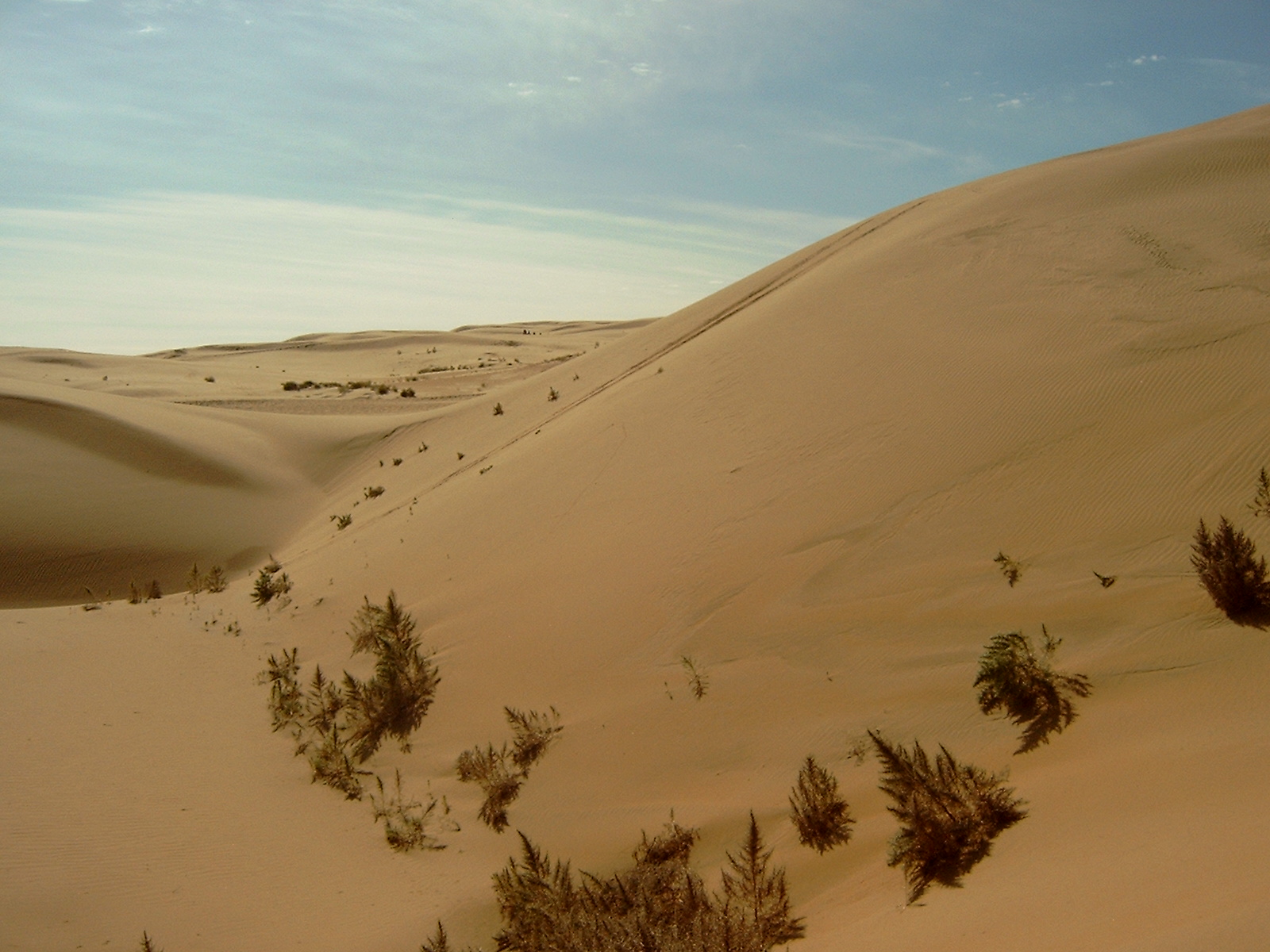
Much of the Gobi is not sandy, instead resembling exposed bare rock.
The Gobi is overall a cold desert, with frost and occasionally snow occurring on its dunes. Besides being quite far north, it is also located on a plateau roughly 910–1,520 m (2,990–4,990 ft) above sea level, which contributes to its low temperatures. An average of about 194 mm (7.6 in) of rain falls annually in the Gobi. Additional moisture reaches parts of the Gobi in winter as snow is blown by the wind from the Siberian Steppes. These winds may cause the Gobi to reach −40 °C (−40 °F) in winter to 45 °C (113 °F) in summer.
However, the climate of the Gobi is one of great extremes, with rapid changes of temperature of as much as 35 °C (63 °F) in 24-hour spans.
In southern Mongolia, the temperature has been recorded as low as −32.8 °C (−27.0 °F). In contrast, in Alxa, Inner Mongolia, it rises as high as 37 °C (99 °F) in July.
Hub AI
Gobi Desert AI simulator
(@Gobi Desert_simulator)
Gobi Desert
The Gobi Desert (Mongolian: Говь, ᠭᠣᠪᠢ, /ˈɡoʊbi/; Chinese: 戈壁; pinyin: gēbì) is a large, cold desert and grassland region in southern Mongolia and North China. It is the sixth-largest desert in the world.
The name of the desert comes from the Mongolian word gobi, used to refer to all of the waterless regions in the Mongolian Plateau; in Chinese, gobi is used to refer to rocky, semi-deserts such as the Gobi itself rather than sandy deserts.
The Gobi measures 1,600 km (1,000 mi) from southwest to northeast and 800 km (500 mi) from north to south. The desert is widest in the west, along the line joining the Lake Bosten and the Lop Nor (87°–89° east). Its area is approximately 1,295,000 square kilometres (500,000 sq mi).
Gobi includes the long stretch of desert extending from the foot of the Pamirs (77° east) to the Greater Khingan Mountains, 116–118° east, on the border of Manchuria; and from the foothills of the Altay, Sayan, and Yablonoi mountain ranges on the north to the Kunlun, Altyn-Tagh, and Qilian mountain ranges, which form the northern edges of the Tibetan Plateau, on the south.
A relatively large area on the east side of the Greater Khingan range, between the upper waters of the Songhua (Sungari) and the upper waters of the Liao-ho, is reckoned to belong to the Gobi by conventional usage. Some geographers and ecologists prefer to regard the western area of the Gobi region (as defined above): the basin of the Tarim in Xinjiang and the desert basin of Lop Nor and Hami (Kumul), as forming a separate and independent desert, called the Taklamakan Desert.
Much of the Gobi is not sandy, instead resembling exposed bare rock.
The Gobi is overall a cold desert, with frost and occasionally snow occurring on its dunes. Besides being quite far north, it is also located on a plateau roughly 910–1,520 m (2,990–4,990 ft) above sea level, which contributes to its low temperatures. An average of about 194 mm (7.6 in) of rain falls annually in the Gobi. Additional moisture reaches parts of the Gobi in winter as snow is blown by the wind from the Siberian Steppes. These winds may cause the Gobi to reach −40 °C (−40 °F) in winter to 45 °C (113 °F) in summer.
However, the climate of the Gobi is one of great extremes, with rapid changes of temperature of as much as 35 °C (63 °F) in 24-hour spans.
In southern Mongolia, the temperature has been recorded as low as −32.8 °C (−27.0 °F). In contrast, in Alxa, Inner Mongolia, it rises as high as 37 °C (99 °F) in July.