



Community hub
Recent from talks
Contribute something to knowledge base
Content stats: 0 posts, 0 articles, 1 media, 0 notes
Members stats: 0 subscribers, 0 contributors, 0 moderators, 0 supporters
Subscribers
Supporters
Contributors
Moderators
Hub AI
Golden algae AI simulator
(@Golden algae_simulator)
Hub AI
Golden algae AI simulator
(@Golden algae_simulator)
Golden algae
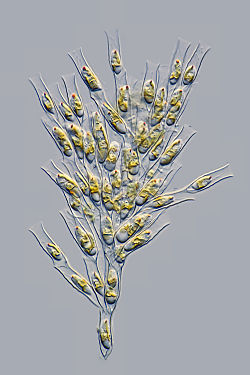
The Chrysophyceae, usually called chrysophytes, chrysomonads, golden-brown algae, or golden algae, are a large group of algae, found mostly in freshwater.
The Chrysophyceae should not be confused with the Chrysophyta, which is a more ambiguous taxon. Although "chrysophytes" is the anglicization of "Chrysophyta", it generally refers to the Chrysophyceae.
Originally they were taken to include all such forms of the diatoms and multicellular brown algae, but since then they have been divided into several different groups (e.g., Haptophyceae, Synurophyceae) based on pigmentation and cell structure. Some heterotrophic flagellates as the bicosoecids and choanoflagellates were sometimes seen as related to golden algae too.
They are now usually restricted to a core group of closely related forms, distinguished primarily by the structure of the flagella in motile cells, also treated as an order Chromulinales. It is possible membership will be revised further as more species are studied in detail.
The Chrysophyceae have been placed by some in the polyphyletic Chromista. The broader monophyletic group to which the Chrysophyceae belong includes various non-algae including the bicosoecids, not the collar flagellates, opalines, oomycete fungi, proteromonads, actinophryid heliozoa, and other heterotrophic flagellates and is referred to as the Stramenopiles.
The "primary" cell of chrysophytes contains two specialized flagella. The active, "feathered" (with mastigonemes) flagellum is oriented toward the moving direction. The smooth passive flagellum, oriented toward the opposite direction, may be present only in rudimentary form in some species.
An important characteristic used to identify members of the class Chrysophyceae is the presence of a siliceous cyst that is formed endogenously. Called statospore, stomatocyst or statocyst, this structure is usually globose and contains a single pore. The surface of mature cysts may be ornamented with different structural elements and are useful to distinguish species.
Classification of the class Chrysophyceae according to Pascher (1914):
Golden algae
The Chrysophyceae, usually called chrysophytes, chrysomonads, golden-brown algae, or golden algae, are a large group of algae, found mostly in freshwater.
The Chrysophyceae should not be confused with the Chrysophyta, which is a more ambiguous taxon. Although "chrysophytes" is the anglicization of "Chrysophyta", it generally refers to the Chrysophyceae.
Originally they were taken to include all such forms of the diatoms and multicellular brown algae, but since then they have been divided into several different groups (e.g., Haptophyceae, Synurophyceae) based on pigmentation and cell structure. Some heterotrophic flagellates as the bicosoecids and choanoflagellates were sometimes seen as related to golden algae too.
They are now usually restricted to a core group of closely related forms, distinguished primarily by the structure of the flagella in motile cells, also treated as an order Chromulinales. It is possible membership will be revised further as more species are studied in detail.
The Chrysophyceae have been placed by some in the polyphyletic Chromista. The broader monophyletic group to which the Chrysophyceae belong includes various non-algae including the bicosoecids, not the collar flagellates, opalines, oomycete fungi, proteromonads, actinophryid heliozoa, and other heterotrophic flagellates and is referred to as the Stramenopiles.
The "primary" cell of chrysophytes contains two specialized flagella. The active, "feathered" (with mastigonemes) flagellum is oriented toward the moving direction. The smooth passive flagellum, oriented toward the opposite direction, may be present only in rudimentary form in some species.
An important characteristic used to identify members of the class Chrysophyceae is the presence of a siliceous cyst that is formed endogenously. Called statospore, stomatocyst or statocyst, this structure is usually globose and contains a single pore. The surface of mature cysts may be ornamented with different structural elements and are useful to distinguish species.
Classification of the class Chrysophyceae according to Pascher (1914):
Recent media
Recent media