Hubbry Logo
Golden tigerGolden tigerMain
Open search
Golden tiger
Community hub
Golden tiger
logo
8 pages, 0 posts
0 subscribers
Be the first to start a discussion here.
Golden tiger
Golden tiger
from Wikipedia

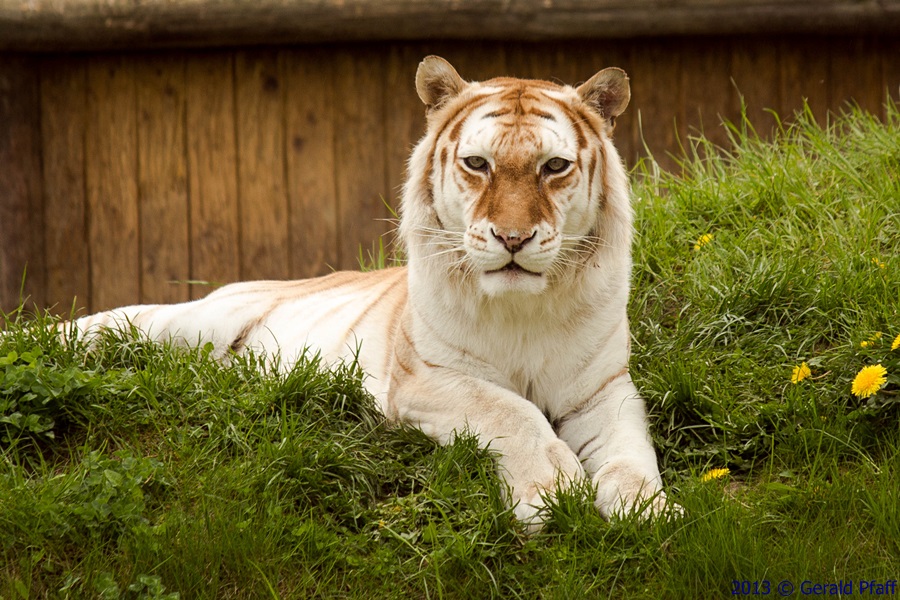
The golden tiger's coat is lighter than that of a normal tiger

A golden tiger, sometimes called a golden tabby tiger, is a Bengal tiger with a colour variation caused by a recessive gene. Like white tigers and black tigers, it is a morph, and not a separate subspecies. Known for its blonde or pale-golden color and red-brown (not black) stripes, the golden tiger colouring comes from a recessive trait referred to as "wideband" which affects the production of black during the hair growth cycle.[1] Tiger colorations that vary from the typical orange-with-black-stripe do occur in nature, but in a very small percentage.[2]

Captive breeding lines

[edit]
Golden tiger in Buffalo Zoo

All golden tabby tigers in captivity seem traceable to a white tiger called Bhim,[3] a white son of a part-white Amur tiger named Tony. Tony is considered to be a common ancestor of all white tigers in North America. Bhim was a carrier of the wide band gene and transmitted this to some of his offspring. Bhim was bred to his sister Sumita (also a carrier of the wide band gene), giving rise to stripeless white tigers (i.e. having two copies of the wide band gene). Bhim was also bred to a normal orange tigress called Kimanthi, and then to his own orange daughter Indira from that mating. The mating of Bhim and Indira resulted in striped white, stripeless white, normal orange, and golden tabby offspring indicating that both Bhim and his daughter carried the wide band gene.[4] When the golden tabby male offspring was mated to the normal orange female offspring, both golden tabby tigers and white tigers resulted.

Litters of different coloured cubs are not unusual because the white and golden tabby colours are caused by combinations of hidden recessive genes carried by the parents. White tigers, such as Dreamworld's Mohan (named after the white tiger captured in India in the 1950s), are highly inbred. Inbreeding reduces genetic variability and may cause hidden genes to manifest as there is a greater probability that two recessive genes will meet up.

Analysis of golden tiger family trees shows that golden tigers are genetically normal orange coloured tigers with the addition of a recessive modifying gene, probably the wide band gene. This same wide band gene also gives rise to stripeless white tigers. A white tiger that inherits two copies of the recessive wide band gene will be a stripeless white. A normal orange tiger that inherits two copies of the recessive wide band gene will be a golden tabby. The wide band gene is carried independently of the white gene.

References

[edit]
[edit]
Revisions and contributorsEdit on WikipediaRead on Wikipedia
from Grokipedia
The golden tiger, also known as the golden tabby tiger or strawberry tiger, is a rare color variant of the ( tigris tigris) featuring a pale golden or blonde coat with reddish-brown stripes, reduced black pigmentation, and lighter, elongated pheomelanin bands in its hairs, contrasting the typical vivid orange fur and bold black stripes of wild-type Bengal tigers. This morph arises from an autosomal recessive mutation in the CORIN gene (specifically, p.H587Y, c.1759C>T), which impairs the regulation of (ASIP), leading to wider agouti bands and diminished eumelanin production in the fur. Reported in the wild in since the early , golden tigers are exceptionally uncommon in due to the recessive of the trait, which requires both parents to carry the for expression in offspring. They are rare in the wild but have been reported in recent years, such as in as of 2025, occurring primarily in captivity, where —often linked to efforts to produce white s—has perpetuated the variant through , resulting in small populations in zoos and private facilities worldwide. Recent sightings in the wild raise concerns about in isolated populations. Such breeding practices frequently yield golden tigers as unintended outcomes or "throwaways" alongside white tigers, but they also contribute to genetic bottlenecks and health complications, including weakened immune systems, skeletal deformities, and reduced fertility. Unlike the variant (caused by a in SLC45A2), which can combine with the golden trait to produce "" tigers, the golden morph does not inherently impair vision but shares the broader risks of associated with captive tiger populations. Conservation efforts prioritize wild populations over color variants like the golden tiger, as the latter hold limited value for preserving in the species, which faces severe threats from loss and across its native range in South and .

Description and characteristics

Physical appearance

The golden tiger exhibits a distinctive light fawn or straw-colored coat, featuring pale yellow tones and significantly reduced black pigmentation compared to typical variants. Its fur displays faint, cinnamon-colored stripes that are narrower and less defined, often resembling tabby markings rather than the prominent, solid lines seen in standard specimens. This coloration results in a softer, more blended appearance overall, with the stripes sometimes fading into subtle spots or broader bands. In contrast to normal Bengal tigers, which have bold black stripes on a vibrant orange background that fully encircle the body for optimal pattern disruption, golden tigers possess broader, lighter red-brown stripes that do not completely close, producing a characteristic "" or "tabby" effect. The underbelly and facial regions are typically cream-colored with minimal markings, enhancing the overall paler aesthetic and making the animal stand out more distinctly in varied lighting conditions. These visual traits are evident in both captive and rare wild observations, such as the strawberry-blonde striped individual documented in India's . Shades of the golden morph can vary from pale gold to slightly deeper hues, potentially influenced by factors like age and environmental , though individual examples consistently show the reduced striping intensity. Regarding size and build, golden tigers are structurally identical to their counterparts, with adult males reaching up to 220 kg (480 lbs) and females up to 130 kg (286 lbs), maintaining the same powerful, muscular frame adapted for predation.

Genetic basis

The golden tiger coloration arises from an autosomal recessive in the CORIN gene, specifically a missense variant (c.1759C>T, p.H587Y), which impairs the protein's function in degrading (ASIP). This leads to prolonged pheomelanin production and wider agouti bands in the hair shafts, resulting in a lighter golden base coat and diluted, reddish-brown stripes instead of the typical black pigmentation. The mutation follows a standard autosomal recessive pattern, requiring homozygosity (wb/wb) for expression; heterozygous carriers (Wb/wb) appear as normal orange tigers. For to exhibit the golden phenotype, both parents must carry at least one copy of the recessive . In matings between two heterozygous parents (Wb/wb × Wb/wb), the probability of producing a golden tiger is 25%, as illustrated by the following :
Wbwb
WbWb/Wb (orange)Wb/wb (orange)
wbWb/wb (orange)wb/wb (golden)
This pattern ensures the trait remains rare without selective breeding. The wideband mutation interacts compatibly with the white tiger gene (a recessive variant in SLC45A2, p.A477V), producing "snow golden" or snow white tigers when both are homozygous (w/w; wb/wb), which exhibit nearly complete pigment loss and faint, cream-colored stripes. However, it is distinct from pseudo-melanism, a different morph involving altered stripe patterns, and does not confer any subspecies-level variation. The mutation's origin is likely rooted in Bengal tiger (Panthera tigris tigris) populations, though captive lines often show admixture with Amur (P. t. altaica) ancestry. Genomic analyses of captive tigers, including those with golden morphs, reveal admixed ancestry across multiple subspecies, predominantly Bengal and Amur, with no evidence of unique genetic markers elevating the golden form to subspecies status; it remains classified as a color morph of the Bengal tiger. A 2024 study of 138 privately owned captive tigers found genetic diversity comparable to wild populations but highlighted that selective breeding for rare morphs like golden does not add novel variation and may limit overall lineage diversity.

History

Discovery in captivity

The first known captive births of golden tigers occurred in the 1980s in the . While an unverified birth was reported in 1983 from two standard tigers at the Adriatic Animal Attractions in , the first confirmed litter was in 1987 from Josip Marcan's breeding program, including a female cub named born to the orange tigress Abra. This unexpected coloration appeared in litters from tigers carrying recessive traits, often linked to breeding lines. In the , documentation of golden tigers expanded through photographs and records at facilities in and , where the variant recurred in white tiger pairs. Breeders adopted the term "golden tabby" to describe the dilute pigmentation and wide, blurred stripes. Key sites included Josip Marcan's operations in the , which supplied circuses and zoos, and international facilities like Dreamworld in , where a mixed litter including golden tabbies Rama and was born in 1998. By the late , captive numbers were in the single digits due to the rarity of the recessive gene. Photographic evidence appeared publicly in wildlife magazines around this period, featuring young golden tigers and sparking interest in rare morphs. The cream base with cinnamon stripes was often likened to a "strawberry" pattern. As breeding continued, the global captive population grew modestly, reaching approximately 30 individuals by 2010, mostly descended from early US lines.

Origins of the gene

The wideband gene responsible for the phenotype is a rare recessive trait that occurs naturally in wild (Panthera tigris tigris) populations in , particularly in the region. Historical records confirm its presence in the wild, though it is extremely rare; for example, a golden tiger was shot in in 1929. Genomic analyses indicate that the gene exists as a polymorphism within populations, with no evidence of or records to trace its deeper evolutionary history. A recent photographic confirmation in in 2024 further demonstrates its occasional expression in the wild. The genetic basis of the wideband trait is a non-synonymous point mutation (c.1759C>T) in the CORIN gene, resulting in an amino acid substitution (p.H587Y). This mutation disrupts the Corin protein's ability to suppress agouti signaling protein (ASIP), thereby extending the pheomelanin (yellow-red pigment) bands in individual hairs and producing the characteristic golden coat with reduced stripe contrast. The mutation site is evolutionarily conserved across vertebrates, suggesting it alters a functionally critical residue, and the wideband phenotype itself has arisen independently multiple times in mammals. While the gene is tied to the Bengal subspecies, captive propagation occurred through white tiger breeding lines descended from wild-caught Bengals captured in during the mid-20th century. The core origins of the gene remain in wild Bengal tigers.

Captive populations

Breeding programs

Breeding programs for golden tigers primarily involve selective pairing of carriers of the recessive gene, which alters the to produce wider pheomelanin bands and reduced eumelanin pigmentation in homozygous individuals. This gene is most commonly found in captive lineages derived from the original white tiger Mohan (captured in 1951), where has concentrated both the white () and alleles, though the two are genetically independent. Breeders typically mate heterozygous carriers—often normal-striped or s—to express the golden tabby phenotype, yielding litters of 2-4 cubs on average, with a 25% probability of golden expression per cub under assuming no linkage with other traits. Key facilities maintaining golden tiger lines include Turpentine Creek Wildlife Refuge in Eureka Springs, Arkansas, USA, which houses rescued individuals like the male golden tabby Tigger (born August 2017) and emphasizes non-breeding sanctuary care to prevent further genetic bottlenecks. In Asia, programs at zoos such as those in Huzhou, China, and Chiang Mai Night Safari, Thailand, have documented successful reproductions, including a litter of four golden tiger cubs born in October 2020 at the Huzhou Zoo to raise public interest in rare variants, and notable individuals like siblings Ava and Luna (born 2021) at Chiang Mai Night Safari, which gained viral attention in 2024-2025. Pedigrees are tracked via broader Bengal tiger international studbooks coordinated by bodies like the Central Zoo Authority of India, with systematic records enhancing since the early 2000s to monitor variant subpopulations despite the absence of a dedicated golden tiger registry..pdf) The global captive population stands at an estimated 20-30 individuals as of 2025, confined to a handful of sanctuaries and zoos across , , and , reflecting limited breeding due to ethical concerns over . Management strategies focus on mitigating through occasional outcrossing with non-carrier Bengal tigers to introduce diversity, alongside cryopreservation of semen from diverse lines in general tiger , though application to golden-specific efforts remains sporadic. Zoos incorporate golden tigers into educational initiatives, showcasing them for public viewing to highlight in tigers while promoting wild conservation; for instance, the 2020 Huzhou litter was displayed post-weaning to engage visitors on captive breeding's role in variant preservation. These programs prioritize controlled reproductions over expansion, integrating births into outreach to foster awareness without encouraging commercial exploitation.

Health and welfare concerns

Breeding golden tigers, a color morph resulting from recessive genetic traits often amplified through selective mating, frequently involves close familial pairings that elevate levels. In some captive lines, the reaches up to 0.25, contributing to characterized by diminished genetic diversity. This manifests in reduced fertility, with litter sizes hampered by high rates of stillbirths (up to 37% in studied populations) and early cub mortality, as well as weakened immune systems prone to infections like . Consequently, affected individuals may exhibit shorter lifespans due to , potentially averaging less than typical captive s (15-20 years), though specific data for golden tigers is limited. Specific health complications arise from interactions between the golden tabby gene and related recessive alleles, such as those linked to lineages. Vision impairments, including or crossed eyes, occur in many golden tigers due to these genetic overlaps, impairing and hunting instincts even in controlled environments. Spinal deformities, such as kinked tails and vertebral malformations, are documented in veterinary assessments, potentially causing and mobility issues; for instance, case studies from the early 2000s reported such anomalies in inbred variants leading to secondary infections. Organ weaknesses, including and congenital heart defects, further compromise vitality, with reports of enlarged heads and cleft palates in rescued individuals underscoring the severity. These issues, observed in facilities like those in , highlight the long-term toll of prioritizing aesthetics over genetic health. Behavioral impacts on golden tigers stem from the physiological strain of unnatural selection and confined settings, exacerbating stress responses. Individuals often display abnormal toward conspecifics or handlers, linked to heightened levels from genetic frailties, alongside and indicative of chronic discomfort. In captive observations, these tigers exhibit reduced exploratory activity and increased stereotypic behaviors, such as pacing, which deviate from typical solitary ranging patterns and signal welfare deficits. Welfare standards in golden tiger breeding facilities draw sharp critiques for inadequate provisions that compound health risks. Organizations like the Wildlife Friends Foundation (WFFT) have documented substandard enclosures—often cramped concrete pens lacking natural substrates or climbing structures—in Thai operations, leading to and psychological distress. Insufficient enrichment, such as minimal scent marking opportunities or varied diets, fails to mitigate unnatural selection pressures, resulting in higher incidences of and poor overall condition; WFFT reports emphasize the need for species-appropriate habitats to address these systemic shortcomings.

Wild occurrences

Reported sightings

Historical reports of golden tigers in the wild date back to the early , primarily from anecdotal accounts by hunters in northeastern . In 1929, two light-colored red tigers—described as having a pale golden coat with faint stripes—were shot in the Duars region of ; the tigress and her cub's skins were preserved by taxidermists Van Ingen & Van Ingen and documented with a submitted to the Journal of the . These specimens represent the earliest verified evidence of the golden tabby in the wild, though no genetic analysis was possible at the time. Subsequent anecdotal descriptions from hunters in the 1930s and 1950s, particularly around , mentioned "tabby" tigers with unusually pale fur and narrow, tawny stripes, but these lacked photographic or physical proof and were often secondhand reports shared in hunting logs or local wildlife journals. The first photographic documentation of a golden tiger in the wild occurred in 2014 during an all-India tiger monitoring exercise in , , where a female individual designated Kazi 106F was camera-trapped, revealing her distinctive golden coat and reduced striping. This sighting confirmed the persistence of the recessive and tabby gene mutations in natural populations. In 2020, wildlife photographer Mayuresh Hendre captured clear images of the same tigress in Kaziranga, sparking widespread attention after being shared by Indian Forest Service officer Parveen Kaswan; the photos showed her lighter yellowish tone and narrower black stripes compared to typical tigers. Additional sightings of Kazi 106F and possibly related individuals followed in 2022, 2024, and 2025, all within Kaziranga, including a 2024 photograph by Gaurav Ramnarayanan during a , an adult male sighted in April 2025, a possible golden cub with a tigress in January 2025, and multiple observations in November 2025. Reported sightings remain extremely rare, with fewer than 10 credible accounts since 1900, all concentrated in northeastern —primarily Assam's and adjacent areas in —suggesting a localized higher frequency of the responsible genes in populations there. No DNA-confirmed wild specimens exist, as genetic sampling has focused on captive populations. Verification challenges include distinguishing golden tigers from normal variants affected by lighting, mud, or juvenile in low-quality images; early 20th-century reports relied on subjective hunter descriptions without follow-up investigations, while modern unverified claims (e.g., pale tigers in other regions like ) have been debunked as environmental artifacts rather than genetic traits.

Potential in the wild

The golden tiger morph, resulting from the recessive wideband gene, faces significant survival challenges in natural environments primarily due to impaired . In dense habitats typical of Bengal tigers, the pale golden coat with lighter stripes offers poor blending against the dappled light and shadowy undergrowth, hindering effective stalking of prey and increasing detection by competitors or humans. This vulnerability is exacerbated in regions with high pressure, where the rarity and distinctive appearance make golden individuals prime targets for illegal trade. The expression rate of the wideband gene in wild populations is extremely low due to the recessive nature of the trait, rendering the formation of a viable self-sustaining improbable without extensive . Such low frequency stems from the recessive nature of the trait, which typically remains masked in heterozygous carriers, but habitat isolation can elevate homozygosity risks, though at the cost of overall genetic health. Habitat suitability for golden tigers appears marginally better in open grasslands of , such as those in , where the lighter coloration may facilitate visibility for hunting herbivores in less occluded terrain, supported by abundant prey like deer and water buffalo. However, these areas are under severe threat from and , which fragment grasslands and reduce available space. Modeling studies project declines in suitable habitats in Assam and surrounding regions by mid-century due to land-use changes and climate shifts, potentially leading to of rare morphs like the golden variant. Gene flow dynamics further limit the persistence of the golden in the wild, as natural with standard morphs could theoretically maintain its frequency, but widespread in disrupts dispersal corridors and promotes isolated subpopulations. This isolation fosters , occasionally expressing the wideband trait but resulting in reduced fitness and no documented evidence of isolated golden tiger populations capable of long-term survival. Ongoing monitoring efforts, including camera traps and non-invasive genetic sampling in Indian tiger reserves since , have generally yielded no confirmed golden tigers through DNA analysis, indicating near-absence despite occasional visual sightings. These methods, deployed across key areas like , focus on population estimates and but highlight the morph's rarity, with genetic scat samples showing standard profiles without wideband markers in broad surveys.

Conservation and ethics

Relation to tiger conservation

Breeding programs for golden tigers, a rare color morph of the Bengal tiger () caused by a recessive , offer no direct benefits to the conservation of wild populations. With the global wild tiger population estimated at approximately 5,500 individuals as of 2025, conservation efforts prioritize habitat protection, measures, and reintroduction programs over the maintenance of captive color variants, as resources allocated to morph breeding divert funding and attention from these critical initiatives. While the wideband gene contributing to golden coloration represents a natural element of intraspecific variability in tigers, captive breeding for this trait often involves intense inbreeding, which erodes overall genetic health and diversity in managed populations. Experts recommend focusing on banking from wild sources, such as repositories, to preserve broader tiger genomic diversity without the risks associated with morph-specific captive lines. Under the Convention on International Trade in Endangered Species of Wild Fauna and Flora (), all tigers receive uniform Appendix I protection prohibiting commercial trade, with no additional safeguards for rare morphs like golden tigers, emphasizing species-level rather than variant-specific conservation. In , home to over 70% of wild tigers, the has approved breeding programs for white tigers in zoos, including a dedicated centre in as of February 2025, while the refused reintroduction of white tigers to in 2013, citing no conservation value and emphasizing efforts toward wild population recovery. Golden tigers have seen limited application in public awareness campaigns to highlight needs, but such uses are widely criticized for promoting exploitative attractions that undermine messaging and ethical priorities.

Controversies in breeding

Animal rights organizations have strongly criticized the breeding of golden tigers, arguing that it involves deliberate to produce rare color variants for commercial exploitation rather than conservation. Groups such as People for the Ethical Treatment of Animals (PETA) have highlighted that golden tigers, like white tigers, are inherently the product of inbreeding for recessive traits, leading to inherent vulnerabilities and offering no value to wild tiger populations. The Wildlife Friends Foundation Thailand (WFFT), in its 2025 campaign, has decried the practice as unethical, noting that golden tigers are bred in unregulated facilities across for profit-driven attractions, including private menageries and traveling circuses, where animals endure poor living conditions and forced interactions with . PETA's investigations into exhibitors further link such breeding to roadside zoos and performance acts, where selective propagation of morphs like golden tigers prioritizes exotic appeal over , resulting in widespread suffering. Media sensationalism surrounding golden tigers has amplified public fascination while obscuring the underlying ethical issues, often portraying them as mystical rarities to drive tourism and social media engagement. Viral photographs from the 2010s and early 2020s, such as those of a golden tiger in India's Kaziranga National Park, sparked widespread hype but prompted conservationists to warn that such visibility masks the inbreeding risks in isolated populations or captive programs. This hype boosts visitor numbers at exploitative venues but ignores the animals' compromised quality of life, as evidenced by campaigns from organizations like WFFT that contrast the "exotic" allure with the reality of health deformities and confinement. In response, European policies have tightened restrictions on displaying inbred tiger morphs; since 2020, the European Association of Zoos and Aquaria (EAZA) has prohibited breeding of white tigers—a policy extending to similar variants like golden tigers in accredited facilities—to prioritize ethical standards over novelty. The EU's 2023 guidance further enhances controls on captive tiger trade, effectively limiting the exhibition of such morphs in member state zoos to curb commercial incentives. Legal frameworks governing golden tiger breeding vary by jurisdiction but generally permit it under welfare oversight while imposing trade restrictions. In the United States, the Animal Welfare Act (AWA) regulates exhibitors and breeders of big cats, including golden tigers, requiring compliance with minimum standards for housing, veterinary care, and handling, though it does not explicitly ban color-variant breeding; however, advocates like PETA have petitioned for stricter rules to address health disclosures and prohibit exploitative practices. In India, the Wildlife Protection Act of 1972, as amended in 2022, prohibits the export of tigers and their derivatives, including captive-bred cubs like golden variants, to prevent illegal trade and reinforce protections for endangered species under Schedules I and II. These amendments expand enforcement powers and regulate international trade, effectively curbing the movement of golden tiger cubs beyond borders. Advocacy efforts increasingly call for phasing out golden tiger breeding programs, redirecting resources toward wild tiger conservation initiatives. The World Wildlife Fund (WWF), in its 2024 roadmap, urges governments to close facilities focused on commercial breeding of color variants, such as those producing golden tigers through recessive gene selection, and instead allocate funds to corridors and efforts in tiger range countries. This aligns with IUCN guidelines on ex situ management, which emphasize that captive programs should support, not undermine, by avoiding non-viable morphs. Examples of transitions include European sanctuaries that have ceased breeding inbred tigers, relocating animals to naturalized enclosures or phasing them out humanely, thereby modeling a shift from spectacle to ethical stewardship.

References

Add your contribution
Related Hubs
User Avatar
No comments yet.