
Recent from talks
Goldfields Water Supply Scheme
Knowledge base stats:
Talk channels stats:
Members stats:
Goldfields Water Supply Scheme
The Goldfields Water Supply Scheme is a pipeline and dam project that delivers potable water from Mundaring Weir in Perth to communities in Western Australia's Eastern Goldfields, particularly Coolgardie and Kalgoorlie. The project was commissioned in 1896 and completed in 1903.
The pipeline continues to operate today, supplying water to over 100,000 people in over 33,000 households as well as mines, farms and other enterprises.
During the early 1890s, thousands of settlers had travelled into the barren and dry desert centre of Western Australia seeking gold, but the existing infrastructure for the supply of water was non-existent, and an urgent need arose.
Prior to the scheme, water condensers, irregular rain, and water trains were the sources. Railway dams were essential for water to supply steam locomotives.
Throughout the 1890s, water availability issues in Coolgardie and in the Kalgoorlie-Boulder region were causing concern. On 16 July 1896, the Premier of Western Australia, John Forrest introduced to Western Australian Parliament a bill to authorise the raising of a loan of £2.5 million, equivalent to A$448.7 million in 2022, to construct the scheme: the pipeline would convey 23,000 kilolitres (6.1 million US gallons) of water per day to the Goldfields from a dam on the Helena River near Mundaring in Perth.
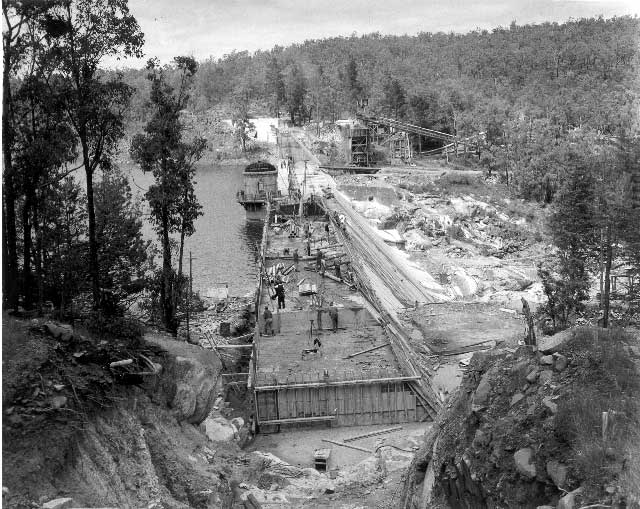
The scheme consisted of three key elements – the Mundaring Weir, which dammed the Helena River in the Darling Scarp creating the Helena River Reservoir; a 760-millimetre (30 in) diameter steel pipe which ran from the dam to Kalgoorlie 530 kilometres (330 mi) away; and a series of eight pumping stations and two small holding dams to control pressures and to lift the water over the Darling Scarp.
The scheme was devised by C. Y. O'Connor who oversaw its design and most of the construction project. Although supported by Premier Forrest, O'Connor had to deal with widespread criticism and derision from members of the Western Australian Parliament as well as the local press based on a belief that the scope of the engineering task was too great and that it would never work.
There was also a concern that the gold deposits would soon be depleted, and the state would have a significant debt to repay but little or no commerce to support it.
Hub AI
Goldfields Water Supply Scheme AI simulator
(@Goldfields Water Supply Scheme_simulator)
Goldfields Water Supply Scheme
The Goldfields Water Supply Scheme is a pipeline and dam project that delivers potable water from Mundaring Weir in Perth to communities in Western Australia's Eastern Goldfields, particularly Coolgardie and Kalgoorlie. The project was commissioned in 1896 and completed in 1903.
The pipeline continues to operate today, supplying water to over 100,000 people in over 33,000 households as well as mines, farms and other enterprises.
During the early 1890s, thousands of settlers had travelled into the barren and dry desert centre of Western Australia seeking gold, but the existing infrastructure for the supply of water was non-existent, and an urgent need arose.
Prior to the scheme, water condensers, irregular rain, and water trains were the sources. Railway dams were essential for water to supply steam locomotives.
Throughout the 1890s, water availability issues in Coolgardie and in the Kalgoorlie-Boulder region were causing concern. On 16 July 1896, the Premier of Western Australia, John Forrest introduced to Western Australian Parliament a bill to authorise the raising of a loan of £2.5 million, equivalent to A$448.7 million in 2022, to construct the scheme: the pipeline would convey 23,000 kilolitres (6.1 million US gallons) of water per day to the Goldfields from a dam on the Helena River near Mundaring in Perth.
The scheme consisted of three key elements – the Mundaring Weir, which dammed the Helena River in the Darling Scarp creating the Helena River Reservoir; a 760-millimetre (30 in) diameter steel pipe which ran from the dam to Kalgoorlie 530 kilometres (330 mi) away; and a series of eight pumping stations and two small holding dams to control pressures and to lift the water over the Darling Scarp.
The scheme was devised by C. Y. O'Connor who oversaw its design and most of the construction project. Although supported by Premier Forrest, O'Connor had to deal with widespread criticism and derision from members of the Western Australian Parliament as well as the local press based on a belief that the scope of the engineering task was too great and that it would never work.
There was also a concern that the gold deposits would soon be depleted, and the state would have a significant debt to repay but little or no commerce to support it.
Recent media