


Community hub
Recent from talks
Contribute something to knowledge base
Content stats: 0 posts, 0 articles, 1 media, 0 notes
Members stats: 0 subscribers, 0 contributors, 0 moderators, 0 supporters
Subscribers
Supporters
Contributors
Moderators
Hub AI
Gong chime AI simulator
(@Gong chime_simulator)
Hub AI
Gong chime AI simulator
(@Gong chime_simulator)
Gong chime
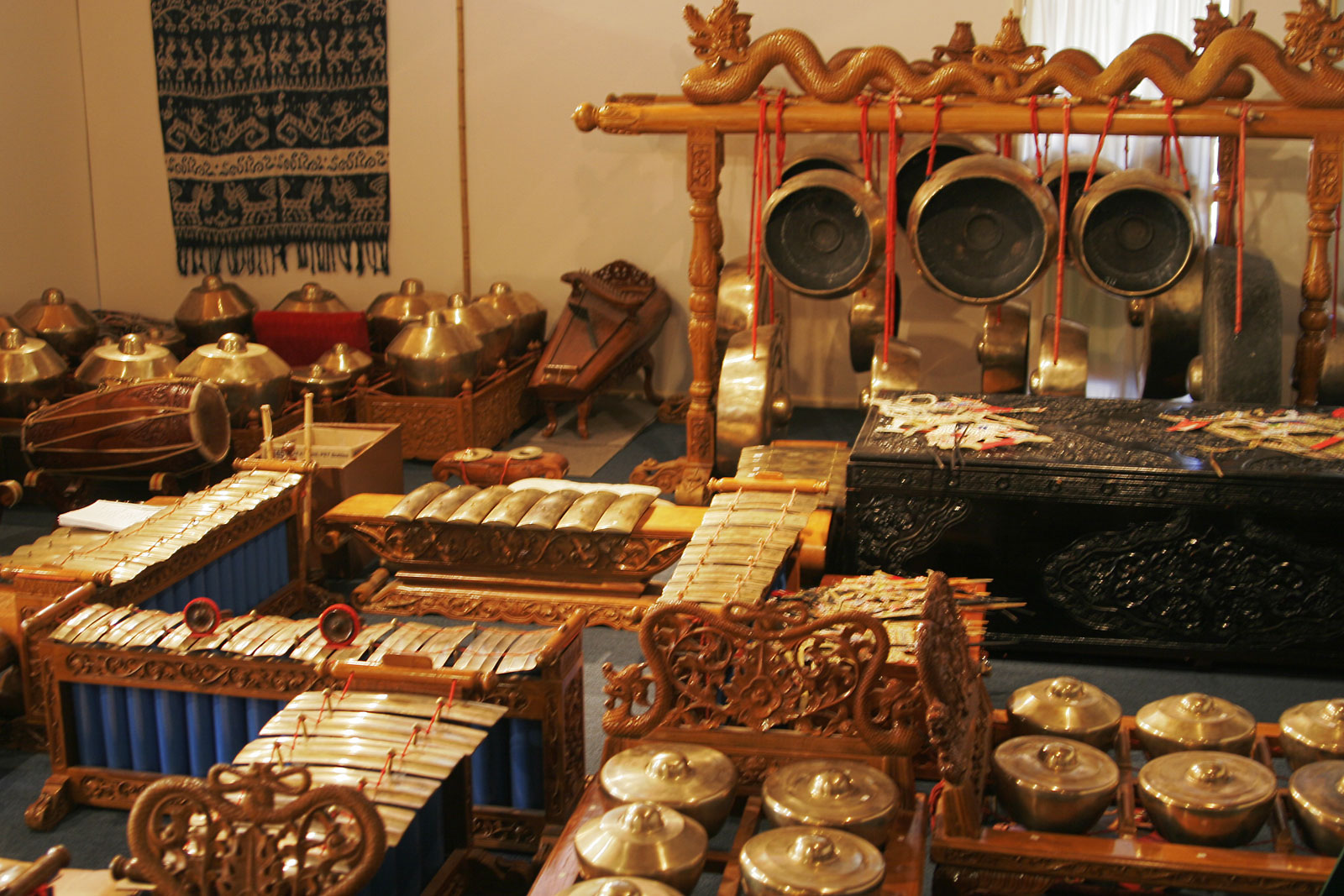
A gong chime is a generic term for a set of small, high-pitched bossed pot gongs. The gongs are ordinarily placed in order of pitch, with the boss upward on cords held in a low wooden frame. The frames can be rectangular or circular (the latter are sometimes called "gong circles"), and may have one or two rows of gongs. They are played by one to four musicians, each using two padded sticks to strike them. They are an important instrument in many Southeast Asian musical ensembles, such as Indonesian gamelan, kulintang, or Thai pi phat. For this reason, such ensembles are sometimes called "gong chime ensembles" or "gong chime orchestras," and the broad variety of music "gong chime music."
Gong chimes typically are played either in a soloistic style, providing a virtuosic embellishing role, or providing a rhythmic role, for example, in a colotomic structure.
The term may also be used to refer to hand-held tuned gongs played in high rhythmic density, such as the older Indonesian-Balinese reyong, and gangsa, and also some ensembles of minorities within the mountainous interior of Vietnam.
Gong chime
A gong chime is a generic term for a set of small, high-pitched bossed pot gongs. The gongs are ordinarily placed in order of pitch, with the boss upward on cords held in a low wooden frame. The frames can be rectangular or circular (the latter are sometimes called "gong circles"), and may have one or two rows of gongs. They are played by one to four musicians, each using two padded sticks to strike them. They are an important instrument in many Southeast Asian musical ensembles, such as Indonesian gamelan, kulintang, or Thai pi phat. For this reason, such ensembles are sometimes called "gong chime ensembles" or "gong chime orchestras," and the broad variety of music "gong chime music."
Gong chimes typically are played either in a soloistic style, providing a virtuosic embellishing role, or providing a rhythmic role, for example, in a colotomic structure.
The term may also be used to refer to hand-held tuned gongs played in high rhythmic density, such as the older Indonesian-Balinese reyong, and gangsa, and also some ensembles of minorities within the mountainous interior of Vietnam.
Recent media
Recent media