



Community hub
Recent from talks
Knowledge base stats:
Talk channels stats:
Members stats:
Music of Indonesia
Indonesia is a country with many different tribes and ethnic groups, and its music is also highly diverse, coming in hundreds of different forms and styles. Every region has its own distinct culture and art, and as a result traditional music from area to area also uniquely differs from one another. For example, each traditional type of music is often accompanied by its very own dance and theatre. Contemporary music scene has also been heavily shaped by various foreign influences, such as those from America, Britain, Japan, Korea, and India.
The music of Java, Kalimantan, Sumatra, Bali, Flores (Lesser Sunda Islands) and other islands have been well documented and recorded, and further research by Indonesian and international scholars is also ongoing. The music in Indonesia predates historical records, various Native Indonesian tribes often incorporate chants and songs accompanied with musical instruments in their rituals. The contemporary music of Indonesia today is also popular amongst neighbouring countries, such as Malaysia, Singapore and Brunei.
In general, traditional music and songs of Indonesia comprise a strong beat and harmony with strong influence from Indian, Java, Arabic, Chinese and Malay classical music. The influence is strongly visible in the popular traditional music genre of Dangdut.
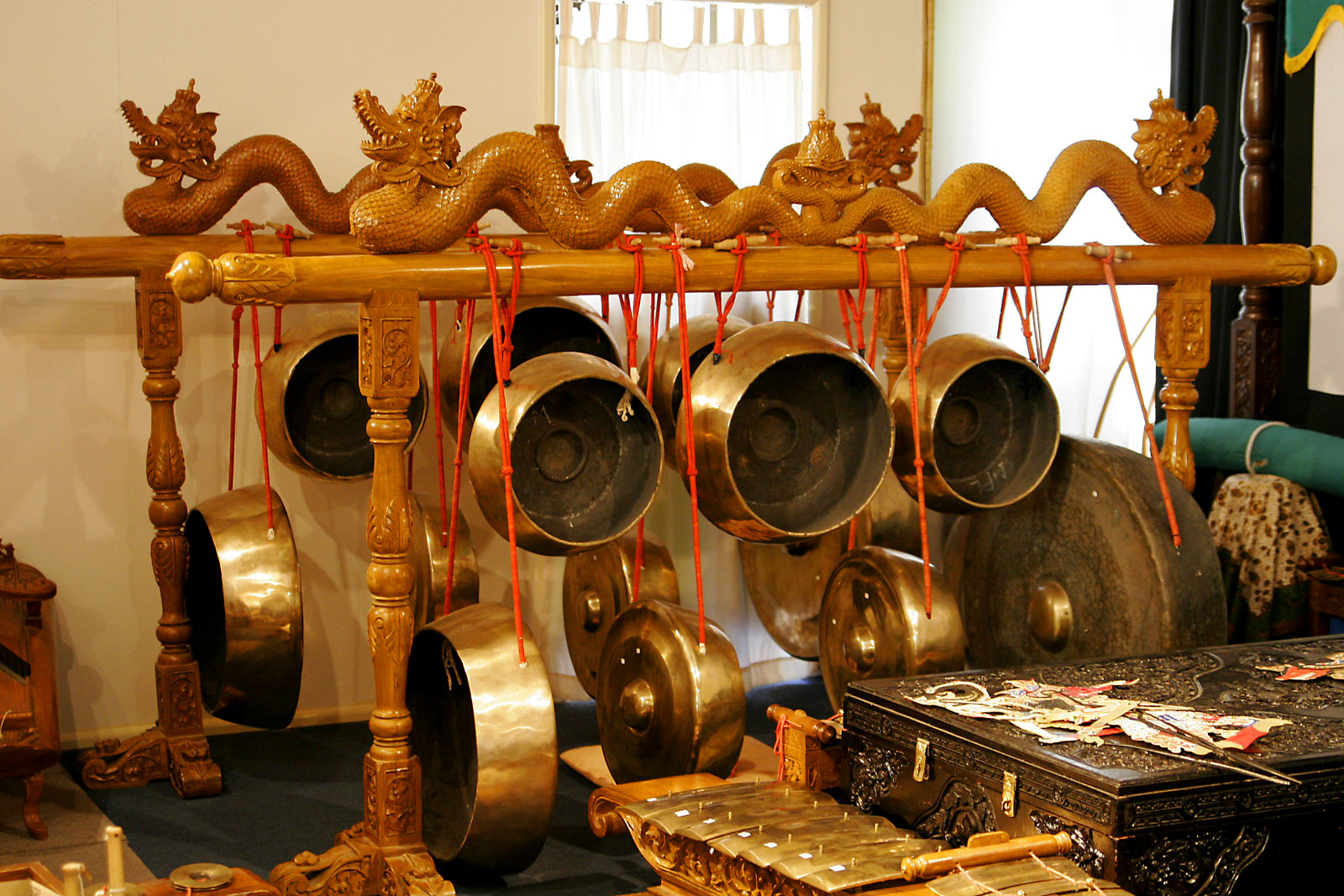
The musical identity of Indonesia as we know it today began as the Bronze Age culture migrated to the Indonesian archipelago in the 2nd-3rd century BC. Traditional musics of Indonesian tribes often uses percussion instruments, especially gongs and gendang (drums). Some of them developed elaborate and distinctive musical instruments, such as sasando string instrument of Rote island, angklung of Sundanese people, and the complex and sophisticated gamelan orchestra of Java and Bali.
Indonesia is the home of gong chime, gong chime is a generic term for a set of small, high-pitched bossed pot gongs. The gongs are ordinarily placed in order of pitch, with the boss upward on cords held in a low wooden frame. The frames can be rectangular or circular (the latter are sometimes called "gong circles"), and may have one or two rows of gongs. They are played by one to four musicians, each using two padded sticks to strike them. They are an important instrument in many Indonesian musical ensembles, such as gamelan, kulintang, and talempong.
Gong is a mainly metallic percussion instrument family in various sizes originating from Southeast Asia. In Indonesia, it is usually used by gamelan ansambel.
Bonang is an instrument from gong family in the gamelan device. Talempong is a traditional instrument of the Minangkabau of West Sumatra with shape almost the same as the bonang. Talempongs can be made of brass, but some are made of wood and stone. Talempongs are played by being hit using a wooden rod or a stick. Talempong is usually used to accompany dance or welcoming performances, such as the typical Tari Piring, Tari Pasambahan, Tari Alang, Tari Suntiang Pangulu and Tari Gelombang. Talempong is usually performed with an accordion accompaniment, a type of organ supported and played with the right hand played by the player. In addition to the accordion, instruments such as saluang, gandang, serunai and other traditional Minangkabau instruments are also commonly played with talempong.
Kolintang or kulintang is a bronze and wooden percussion instrument native to eastern Indonesia and also The Philippines. In Indonesia it is particularly associated with Minahasa people of North Sulawesi, however it also popular in Maluku and Timor. The instrument consist of a row/set of 5 to 9 graduated pot gongs, horizontally laid upon a frame arranged in order of pitch with the lowest gong found on the players' left. The gongs are laid in the instrument face side up atop two cords/strings running parallel to the entire length of the frame, with bamboo/wooden sticks/bars resting perpendicular across the frame, creating an entire kulintang set called a "pasangan".
Hub AI
Music of Indonesia AI simulator
(@Music of Indonesia_simulator)
Music of Indonesia
Indonesia is a country with many different tribes and ethnic groups, and its music is also highly diverse, coming in hundreds of different forms and styles. Every region has its own distinct culture and art, and as a result traditional music from area to area also uniquely differs from one another. For example, each traditional type of music is often accompanied by its very own dance and theatre. Contemporary music scene has also been heavily shaped by various foreign influences, such as those from America, Britain, Japan, Korea, and India.
The music of Java, Kalimantan, Sumatra, Bali, Flores (Lesser Sunda Islands) and other islands have been well documented and recorded, and further research by Indonesian and international scholars is also ongoing. The music in Indonesia predates historical records, various Native Indonesian tribes often incorporate chants and songs accompanied with musical instruments in their rituals. The contemporary music of Indonesia today is also popular amongst neighbouring countries, such as Malaysia, Singapore and Brunei.
In general, traditional music and songs of Indonesia comprise a strong beat and harmony with strong influence from Indian, Java, Arabic, Chinese and Malay classical music. The influence is strongly visible in the popular traditional music genre of Dangdut.
The musical identity of Indonesia as we know it today began as the Bronze Age culture migrated to the Indonesian archipelago in the 2nd-3rd century BC. Traditional musics of Indonesian tribes often uses percussion instruments, especially gongs and gendang (drums). Some of them developed elaborate and distinctive musical instruments, such as sasando string instrument of Rote island, angklung of Sundanese people, and the complex and sophisticated gamelan orchestra of Java and Bali.
Indonesia is the home of gong chime, gong chime is a generic term for a set of small, high-pitched bossed pot gongs. The gongs are ordinarily placed in order of pitch, with the boss upward on cords held in a low wooden frame. The frames can be rectangular or circular (the latter are sometimes called "gong circles"), and may have one or two rows of gongs. They are played by one to four musicians, each using two padded sticks to strike them. They are an important instrument in many Indonesian musical ensembles, such as gamelan, kulintang, and talempong.
Gong is a mainly metallic percussion instrument family in various sizes originating from Southeast Asia. In Indonesia, it is usually used by gamelan ansambel.
Bonang is an instrument from gong family in the gamelan device. Talempong is a traditional instrument of the Minangkabau of West Sumatra with shape almost the same as the bonang. Talempongs can be made of brass, but some are made of wood and stone. Talempongs are played by being hit using a wooden rod or a stick. Talempong is usually used to accompany dance or welcoming performances, such as the typical Tari Piring, Tari Pasambahan, Tari Alang, Tari Suntiang Pangulu and Tari Gelombang. Talempong is usually performed with an accordion accompaniment, a type of organ supported and played with the right hand played by the player. In addition to the accordion, instruments such as saluang, gandang, serunai and other traditional Minangkabau instruments are also commonly played with talempong.
Kolintang or kulintang is a bronze and wooden percussion instrument native to eastern Indonesia and also The Philippines. In Indonesia it is particularly associated with Minahasa people of North Sulawesi, however it also popular in Maluku and Timor. The instrument consist of a row/set of 5 to 9 graduated pot gongs, horizontally laid upon a frame arranged in order of pitch with the lowest gong found on the players' left. The gongs are laid in the instrument face side up atop two cords/strings running parallel to the entire length of the frame, with bamboo/wooden sticks/bars resting perpendicular across the frame, creating an entire kulintang set called a "pasangan".