
Recent from talks
Goose Creek Oil Field
Knowledge base stats:
Talk channels stats:
Members stats:
Goose Creek Oil Field
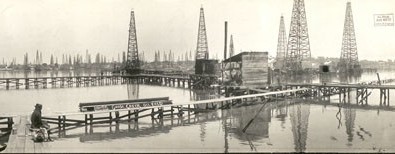
The Goose Creek Oil Field is a large oil field in Baytown, Texas, on Galveston Bay. Discovered in 1903, and reaching maximum production in 1918 after a series of spectacular gushers, it was one of the fields that contributed to the Texas Oil Boom of the early 20th century. The field was also the location of the first offshore wells in Texas, and the second group of offshore wells in the United States. Consequences of the development of the Goose Creek field included an economic boom and associated influx of workers, the founding and fast growth of Baytown, and the building of the adjacent Baytown Refinery, which is now the 2nd largest oil refinery in the United States with a capacity of 584,000 barrels per day. The field remains active, having produced over 150 million barrels (24,000,000 m3) of oil in its 100-year history.
The Goose Creek field is also the first place where subsidence of overlying terrain was attributed to the removal of oil from underneath. On the Goose Creek field, subsidence has damaged houses, roads, and businesses, and much of the oil field that was on land in the early years of its development is now submerged in Tabbs Bay. Subsidence-induced motion along faults on the field also caused the only earthquake of local origin ever felt in the Houston area.
The Goose Creek field is located along the northern shoreline of Tabbs Bay, an arm of Galveston Bay, at the point where Goose Creek exits to the sea. It is directly south of the city of Baytown, and about 25 miles (40 km) east of downtown Houston. Elevations on the field range from approximately 30 feet (9.1 m) at the highest well locations next to developed parts of Baytown, on the north side of the field, to submerged and partially submerged areas within Tabbs Bay itself. Much of the field is close to sea level. The total productive area of the field, including the submerged portion, is approximately 3,470 acres (14.0 km2).
Alexander Drive, a spur of Texas State Highway 146, runs through the field. West of Goose Creek it rejoins Highway 146 to go over Tabbs Bay on the Fred Hartman Bridge.
The oil field is an accumulation of petroleum in sediment overlying a deep salt dome, one of several such fields in the Gulf of Mexico region. It was the first oil field to be found in a deep rather than a shallow salt dome, and its discovery led to the search for others like it; the finds that resulted were some of the largest oil fields in the United States. The sedimentary layers over the dome are themselves arched into a shape conforming to the underlying dome, so the structure forms a perfect trap for hydrocarbons which would otherwise migrate to the surface. The field contains 30 separate pools or producing horizons, ranging in depth from 800 to 4,500 feet (1,400 m). The oil-bearing strata under the salt dome consist of porous sands with some interspersed clay.
The Goose Creek field is the first place where subsidence of the land over the oil field was definitively attributed to the extraction of petroleum. Subsidence over the Goose Creek field is well documented and particularly dramatic; parts of the field which were once above-water are now wholly or partially submerged, and the area of subsidence almost exactly conforms to the boundary of the productive region. The connection between extraction and subsidence was first recognized by geologists Wallace Everette Pratt and D.W. Johnson, who published their findings in a 1926 paper. By this year, after about ten years of active pumping, most of the productive area of the field had subsided three feet, and the submerging of the facilities had already become obvious to field operators.
Along with the subsidence, surface faulting has been observed, and motion along these faults – although minimal compared to motion along faults in areas in which the seismic activity is due to tectonic forces – has been sufficient to damage buildings and be felt in the local area. One of the faults in the Goose Creek area, first observed in 1925, shows a vertical displacement of 0.4 meter, along a length of over 700 meters.
Subsidence of land due to either oil or groundwater extraction is now widely recognized, and the Gulf Coast is one of many places in the world in which it has become a serious problem. In the present day, oil fields underneath sensitive areas, such as cities, are usually re-pressurized with water or gas to prevent the land above them from collapsing into the vacated space.
Hub AI
Goose Creek Oil Field AI simulator
(@Goose Creek Oil Field_simulator)
Goose Creek Oil Field
The Goose Creek Oil Field is a large oil field in Baytown, Texas, on Galveston Bay. Discovered in 1903, and reaching maximum production in 1918 after a series of spectacular gushers, it was one of the fields that contributed to the Texas Oil Boom of the early 20th century. The field was also the location of the first offshore wells in Texas, and the second group of offshore wells in the United States. Consequences of the development of the Goose Creek field included an economic boom and associated influx of workers, the founding and fast growth of Baytown, and the building of the adjacent Baytown Refinery, which is now the 2nd largest oil refinery in the United States with a capacity of 584,000 barrels per day. The field remains active, having produced over 150 million barrels (24,000,000 m3) of oil in its 100-year history.
The Goose Creek field is also the first place where subsidence of overlying terrain was attributed to the removal of oil from underneath. On the Goose Creek field, subsidence has damaged houses, roads, and businesses, and much of the oil field that was on land in the early years of its development is now submerged in Tabbs Bay. Subsidence-induced motion along faults on the field also caused the only earthquake of local origin ever felt in the Houston area.
The Goose Creek field is located along the northern shoreline of Tabbs Bay, an arm of Galveston Bay, at the point where Goose Creek exits to the sea. It is directly south of the city of Baytown, and about 25 miles (40 km) east of downtown Houston. Elevations on the field range from approximately 30 feet (9.1 m) at the highest well locations next to developed parts of Baytown, on the north side of the field, to submerged and partially submerged areas within Tabbs Bay itself. Much of the field is close to sea level. The total productive area of the field, including the submerged portion, is approximately 3,470 acres (14.0 km2).
Alexander Drive, a spur of Texas State Highway 146, runs through the field. West of Goose Creek it rejoins Highway 146 to go over Tabbs Bay on the Fred Hartman Bridge.
The oil field is an accumulation of petroleum in sediment overlying a deep salt dome, one of several such fields in the Gulf of Mexico region. It was the first oil field to be found in a deep rather than a shallow salt dome, and its discovery led to the search for others like it; the finds that resulted were some of the largest oil fields in the United States. The sedimentary layers over the dome are themselves arched into a shape conforming to the underlying dome, so the structure forms a perfect trap for hydrocarbons which would otherwise migrate to the surface. The field contains 30 separate pools or producing horizons, ranging in depth from 800 to 4,500 feet (1,400 m). The oil-bearing strata under the salt dome consist of porous sands with some interspersed clay.
The Goose Creek field is the first place where subsidence of the land over the oil field was definitively attributed to the extraction of petroleum. Subsidence over the Goose Creek field is well documented and particularly dramatic; parts of the field which were once above-water are now wholly or partially submerged, and the area of subsidence almost exactly conforms to the boundary of the productive region. The connection between extraction and subsidence was first recognized by geologists Wallace Everette Pratt and D.W. Johnson, who published their findings in a 1926 paper. By this year, after about ten years of active pumping, most of the productive area of the field had subsided three feet, and the submerging of the facilities had already become obvious to field operators.
Along with the subsidence, surface faulting has been observed, and motion along these faults – although minimal compared to motion along faults in areas in which the seismic activity is due to tectonic forces – has been sufficient to damage buildings and be felt in the local area. One of the faults in the Goose Creek area, first observed in 1925, shows a vertical displacement of 0.4 meter, along a length of over 700 meters.
Subsidence of land due to either oil or groundwater extraction is now widely recognized, and the Gulf Coast is one of many places in the world in which it has become a serious problem. In the present day, oil fields underneath sensitive areas, such as cities, are usually re-pressurized with water or gas to prevent the land above them from collapsing into the vacated space.
Recent media