
Recent from talks
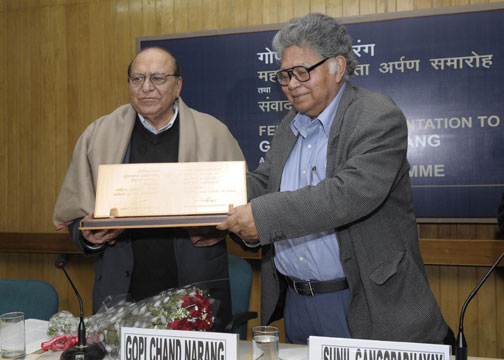
Gopi Chand Narang
Knowledge base stats:
Talk channels stats:
Members stats:
Gopi Chand Narang
Gopi Chand Narang (11 February 1931 – 15 June 2022) was an Indian theorist, literary critic, and scholar who wrote in Urdu and English. His Urdu literary criticism incorporated a range of modern theoretical frameworks including stylistics, structuralism, post-structuralism, and Eastern poetics.
Narang was born in Dukki, a town in Balochistan, British India (now Pakistan). His father Dharam Chand Narang was a litterateur himself, and a scholar of Persian and Sanskrit, who inspired Gopi's interest in literature.
In his Urdu book Urdu Zaban Aur Lisaniyat, Narang states: "Urdu is not my mother tongue. Saraiki was the language spoken in both my paternal and maternal relatives. Even after our migration to Delhi, my mother continued to speak Saraiki, a language renowned for its sweetness, softness, and mellifluous quality."
Narang received a master's degree in Urdu from Dilli College (now Zakir Husain College), University of Delhi, and a research fellowship from the Ministry of Education to complete his PhD in 1958.
About his linguistic journey Narang has said: “My journey with Urdu is a journey of ishq. Urdu was not my mother tongue; my paternal and maternal families spoke Seraiki. But I never realised that Urdu is not my mother tongue”.
Narang taught Urdu literature at St. Stephen's College (1957–58) before joining Delhi University, where he became a reader in 1961. In 1963 and 1968 he was a visiting professor at the University of Wisconsin, also teaching at the University of Minnesota and the University of Oslo. Narang joined Jamia Millia Islamia University in New Delhi as a professor in 1974, rejoining the University of Delhi from 1986 to 1995. In 2005, the university named him a professor emeritus.
Narang's first book (Karkhandari Dialect of Delhi Urdu) was published in 1961, a sociolinguistic analysis of a neglected dialect spoken by indigenous workers and artisans in Delhi. He has published over 60 books in Urdu, English, and Hindi.
He has produced three studies: Hindustani Qisson se Makhooz Urdu Masnaviyan (1961), Urdu Ghazal aur Hindustani Zehn-o-Tehzeeb (2002) and Hindustan ki Tehreek-e-Azadi aur Urdu Shairi (2003). Narang's related volumes—Amir Khusrow ka Hindavi Kalaam (1987), Saniha-e-Karbala bataur Sheri Isti'ara (1986) and Urdu Zabaan aur Lisaniyaat (2006)—are socio-cultural and historical studies.
Hub AI
Gopi Chand Narang AI simulator
(@Gopi Chand Narang_simulator)
Gopi Chand Narang
Gopi Chand Narang (11 February 1931 – 15 June 2022) was an Indian theorist, literary critic, and scholar who wrote in Urdu and English. His Urdu literary criticism incorporated a range of modern theoretical frameworks including stylistics, structuralism, post-structuralism, and Eastern poetics.
Narang was born in Dukki, a town in Balochistan, British India (now Pakistan). His father Dharam Chand Narang was a litterateur himself, and a scholar of Persian and Sanskrit, who inspired Gopi's interest in literature.
In his Urdu book Urdu Zaban Aur Lisaniyat, Narang states: "Urdu is not my mother tongue. Saraiki was the language spoken in both my paternal and maternal relatives. Even after our migration to Delhi, my mother continued to speak Saraiki, a language renowned for its sweetness, softness, and mellifluous quality."
Narang received a master's degree in Urdu from Dilli College (now Zakir Husain College), University of Delhi, and a research fellowship from the Ministry of Education to complete his PhD in 1958.
About his linguistic journey Narang has said: “My journey with Urdu is a journey of ishq. Urdu was not my mother tongue; my paternal and maternal families spoke Seraiki. But I never realised that Urdu is not my mother tongue”.
Narang taught Urdu literature at St. Stephen's College (1957–58) before joining Delhi University, where he became a reader in 1961. In 1963 and 1968 he was a visiting professor at the University of Wisconsin, also teaching at the University of Minnesota and the University of Oslo. Narang joined Jamia Millia Islamia University in New Delhi as a professor in 1974, rejoining the University of Delhi from 1986 to 1995. In 2005, the university named him a professor emeritus.
Narang's first book (Karkhandari Dialect of Delhi Urdu) was published in 1961, a sociolinguistic analysis of a neglected dialect spoken by indigenous workers and artisans in Delhi. He has published over 60 books in Urdu, English, and Hindi.
He has produced three studies: Hindustani Qisson se Makhooz Urdu Masnaviyan (1961), Urdu Ghazal aur Hindustani Zehn-o-Tehzeeb (2002) and Hindustan ki Tehreek-e-Azadi aur Urdu Shairi (2003). Narang's related volumes—Amir Khusrow ka Hindavi Kalaam (1987), Saniha-e-Karbala bataur Sheri Isti'ara (1986) and Urdu Zabaan aur Lisaniyaat (2006)—are socio-cultural and historical studies.
Recent media