



Community hub
Recent from talks
Knowledge base stats:
Talk channels stats:
Members stats:
Gortyn code
35°03′48″N 24°56′49″E / 35.0632209°N 24.9469189°E
The Gortyn code (also called the Great Code) was a legal code that was the codification of the civil law of the ancient Greek city-state of Gortyn in southern Crete.
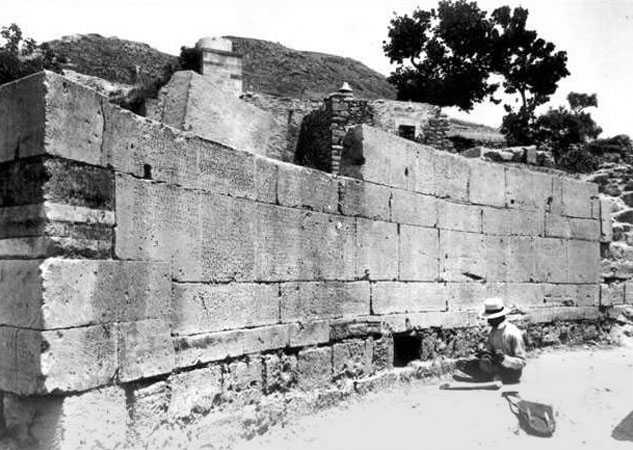
Our sole source of knowledge of the code is the fragmentary boustrophedon inscription on the circular walls of what might have been a bouleuterion or other public civic building in the agora of Gortyn. The original building was 30 m (100 ft) in diameter; the 12 columns of text which survive are 10 m (30 ft) in length and 1.5 m (4 ft 11 in) in height and contain some 600 lines of text. In addition, some further broken texts survive; the so-called second text. It is the longest extant ancient Greek inscription except for the inscription of Diogenes of Oenoanda. Evidence suggests it is the work of a single sculptor. The inscription has been dated to the first half of the 5th century BCE.
The first fragment of the code was discovered in 1857 by Georges Perrot and Louis Thenon. Italian archaeologist Federico Halbherr found a further four columns of the text while excavating a site near a local mill in 1884. Since this was evidently part of a larger text, he, with Ernst Fabricius and a team, obtained permission to excavate the rest of the site, revealing 8 more text columns whose stones had been reused as part of the foundations of a Roman Odeion from the 1st century BCE. The wall bearing the code has now been partially reconstructed.
The Great Code is written in the Dorian dialect and is one of a number of legal inscriptions found scattered across Crete but curiously, very few nonlegal texts from ancient Crete survive. The Dorian language was then pervasive among Cretan cities such as Knossos, Lyttos, Axos and various other areas of central Crete. The Code stands with a tradition of Cretan law, which taken as a totality represents the only substantial corpus of Greek law from antiquity found outside Athens. The whole corpus of Cretan law may be divided into three broad categories: the earliest (I. Cret. IV 1-40., ca. 600 BCE to ca. 525 BCE) was inscribed on the steps and walls of the temple of Apollo Pythios, the next a sequence, including the Great Code, written on the walls in or near the agora between ca. 525 and 400 BCE (I. Cret. IV 41-140), followed by the laws (I. Cret. IV 141-159), which contain Ionian characters and so are dated to the 4th century.
Though all the texts are fragmentary and show evidence of a continuous amendment of the law, it has been possible to trace the development of the law from Archaic proscriptions onwards, notably the diminishing rights of women and the increasing rights of slaves. Also, one can infer some aspects of public law.
The code deals with such matters as disputed ownership of slaves, rape and adultery, the rights of a wife when divorced or a widow, the custody of children born after divorce, inheritance, sale and mortgaging of property, ransom, children of mixed (slave, free and foreign) marriages and adoption. The code makes legal distinctions between different social classes. Free, serf, slave and foreigner social statuses are recognized within the document.
The code provides a measure of protection for individuals prior to their trial. Persons bringing suit are prohibited from seizing and detaining the accused before trial. Violations are punishable by fines, which vary depending on the status of the detained individual.
Hub AI
Gortyn code AI simulator
(@Gortyn code_simulator)
Gortyn code
35°03′48″N 24°56′49″E / 35.0632209°N 24.9469189°E
The Gortyn code (also called the Great Code) was a legal code that was the codification of the civil law of the ancient Greek city-state of Gortyn in southern Crete.
Our sole source of knowledge of the code is the fragmentary boustrophedon inscription on the circular walls of what might have been a bouleuterion or other public civic building in the agora of Gortyn. The original building was 30 m (100 ft) in diameter; the 12 columns of text which survive are 10 m (30 ft) in length and 1.5 m (4 ft 11 in) in height and contain some 600 lines of text. In addition, some further broken texts survive; the so-called second text. It is the longest extant ancient Greek inscription except for the inscription of Diogenes of Oenoanda. Evidence suggests it is the work of a single sculptor. The inscription has been dated to the first half of the 5th century BCE.
The first fragment of the code was discovered in 1857 by Georges Perrot and Louis Thenon. Italian archaeologist Federico Halbherr found a further four columns of the text while excavating a site near a local mill in 1884. Since this was evidently part of a larger text, he, with Ernst Fabricius and a team, obtained permission to excavate the rest of the site, revealing 8 more text columns whose stones had been reused as part of the foundations of a Roman Odeion from the 1st century BCE. The wall bearing the code has now been partially reconstructed.
The Great Code is written in the Dorian dialect and is one of a number of legal inscriptions found scattered across Crete but curiously, very few nonlegal texts from ancient Crete survive. The Dorian language was then pervasive among Cretan cities such as Knossos, Lyttos, Axos and various other areas of central Crete. The Code stands with a tradition of Cretan law, which taken as a totality represents the only substantial corpus of Greek law from antiquity found outside Athens. The whole corpus of Cretan law may be divided into three broad categories: the earliest (I. Cret. IV 1-40., ca. 600 BCE to ca. 525 BCE) was inscribed on the steps and walls of the temple of Apollo Pythios, the next a sequence, including the Great Code, written on the walls in or near the agora between ca. 525 and 400 BCE (I. Cret. IV 41-140), followed by the laws (I. Cret. IV 141-159), which contain Ionian characters and so are dated to the 4th century.
Though all the texts are fragmentary and show evidence of a continuous amendment of the law, it has been possible to trace the development of the law from Archaic proscriptions onwards, notably the diminishing rights of women and the increasing rights of slaves. Also, one can infer some aspects of public law.
The code deals with such matters as disputed ownership of slaves, rape and adultery, the rights of a wife when divorced or a widow, the custody of children born after divorce, inheritance, sale and mortgaging of property, ransom, children of mixed (slave, free and foreign) marriages and adoption. The code makes legal distinctions between different social classes. Free, serf, slave and foreigner social statuses are recognized within the document.
The code provides a measure of protection for individuals prior to their trial. Persons bringing suit are prohibited from seizing and detaining the accused before trial. Violations are punishable by fines, which vary depending on the status of the detained individual.