
Recent from talks
Gotthard railway
Knowledge base stats:
Talk channels stats:
Members stats:
Gotthard railway
The Gotthard railway (German: Gotthardbahn; Italian: Ferrovia del Gottardo) is the Swiss trans-alpine railway line from northern Switzerland to the canton of Ticino. It is named for the Saint-Gotthard Massif, through which it passes. The line forms a major part of an important international railway link between northern and southern Europe, especially on the Rotterdam-Basel-Genoa corridor. Construction was financed by the Gotthard Railway Company (German: Gotthardbahn-Gesellschaft at Lucerne).
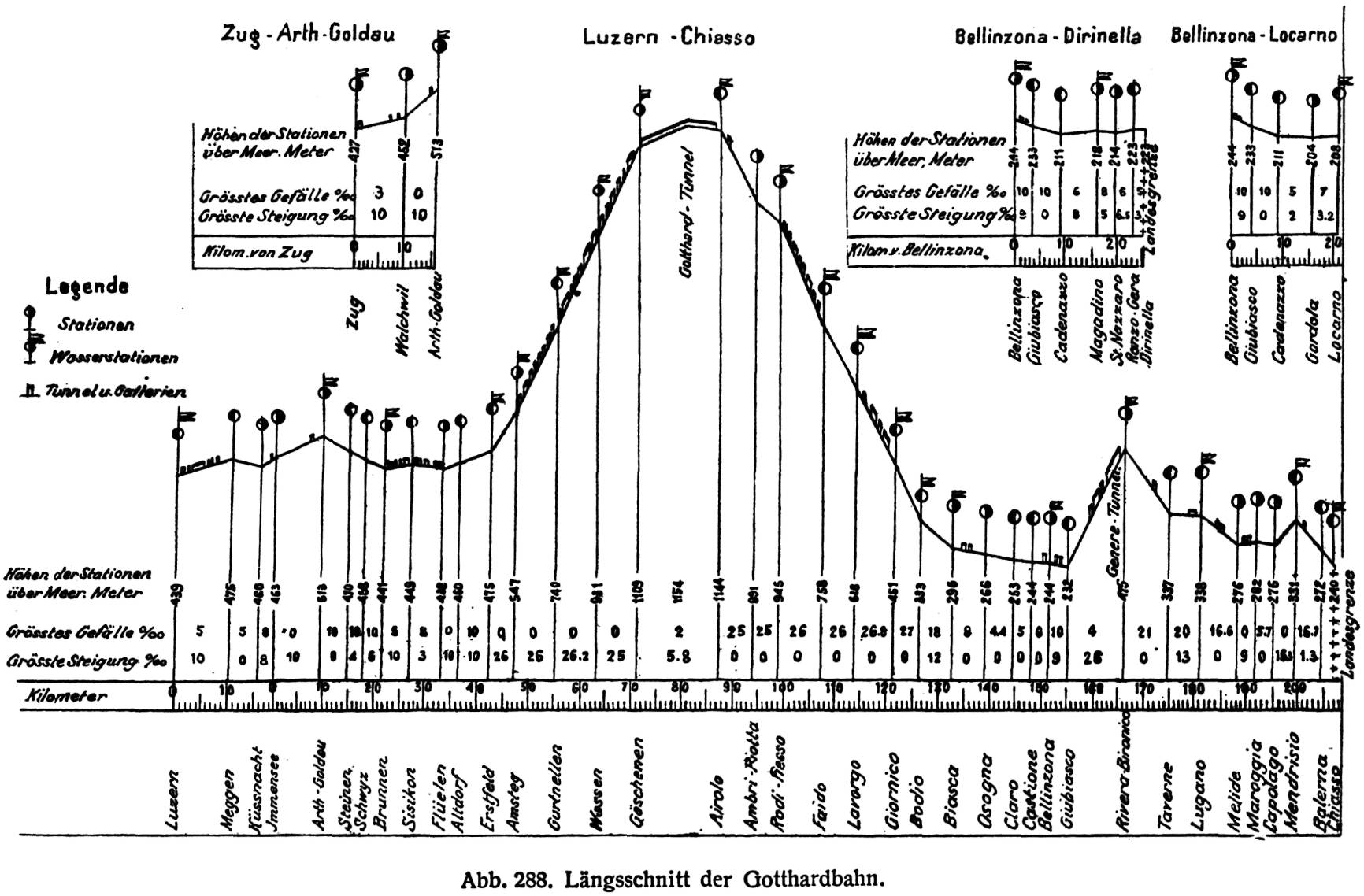
The railway comprises an international main line through Switzerland from Basel or Zürich to Immensee to Chiasso, together with branches, from Immensee to Lucerne and Rotkreuz, from Arth-Goldau to Zug or Pfäffikon SZ, and from Bellinzona to Chiasso via Locarno and Luino. At Chiasso, the line connects to the Milan–Chiasso railway, which runs across the Swiss–Italian border. The main line, the second-highest standard railway in Switzerland, penetrates the Alps using the Gotthard Tunnel at 1,151 metres (3,776 ft) above sea level. The line then descends as far as Bellinzona, at 241 metres (791 ft) above sea level, before climbing again to the pass of Monte Ceneri, on the way to Lugano and Chiasso. The extreme differences in altitude necessitate the use of long ramped approaches on each side, together with seven spirals.
Construction of the line started in 1872, with some lowland sections opening by 1875. The full line opened in 1882, following the completion of the Gotthard Tunnel. The line was incorporated into the Swiss Federal Railways in 1909 and electrified in 1922. The line has 36 tunnels totaling 31,216 meters.[citation needed]
The approaches to the existing tunnel continue to restrict speed and capacity on this important international route, and in 1992 it was decided to build a new lower level route on the Gotthard axis as part of the NRLA project. This route involved the construction of the new Gotthard Base Tunnel and Ceneri Base Tunnel. The Gotthard Base Tunnel was completed and integrated into the existing route in 2016, while the Ceneri Base Tunnel opened in 2020.
By the early 1870s, northern Switzerland had a significant network of railways, with links to the adjoining railways of Germany and France. To the west, a line had reached Brig, in the upper Rhone valley, from Lausanne. In the central north, lines linked Olten, Lucerne, Zug and Zürich. However, no line had yet reached through the Alps to southern Switzerland or the border with Italy. All north-to-south rail traffic had to pass either to the west or east of Switzerland through the Mont-Cenis, Semmering or Brenner railways.
A north-south route through Switzerland had been discussed as far back as 1848. An international conference in Bern in 1869 had decided that the best route would be via the valleys of the rivers Reuss and Ticino, linked by a tunnel under the Gotthard Pass. The selected route was an ancient one that pilgrims and traders had used since at least the 13th century.
Treaties for the construction of the line were signed with the Kingdom of Italy, in 1869, and the German Empire, in 1871. The Gotthard Railway Company was incorporated in Lucerne in 1871. To the overall costs of CHF 238 million (in 1869/71) the Italian government eventually contributed CHF 58 million (£2.25 million), with Germany contributing CHF 30 million (£1.25 million).
Construction of the Gotthard railway started in 1872, and the first lowland sections from Biasca to Locarno and Lugano to Chiasso were opened by 1874.
Hub AI
Gotthard railway AI simulator
(@Gotthard railway_simulator)
Gotthard railway
The Gotthard railway (German: Gotthardbahn; Italian: Ferrovia del Gottardo) is the Swiss trans-alpine railway line from northern Switzerland to the canton of Ticino. It is named for the Saint-Gotthard Massif, through which it passes. The line forms a major part of an important international railway link between northern and southern Europe, especially on the Rotterdam-Basel-Genoa corridor. Construction was financed by the Gotthard Railway Company (German: Gotthardbahn-Gesellschaft at Lucerne).
The railway comprises an international main line through Switzerland from Basel or Zürich to Immensee to Chiasso, together with branches, from Immensee to Lucerne and Rotkreuz, from Arth-Goldau to Zug or Pfäffikon SZ, and from Bellinzona to Chiasso via Locarno and Luino. At Chiasso, the line connects to the Milan–Chiasso railway, which runs across the Swiss–Italian border. The main line, the second-highest standard railway in Switzerland, penetrates the Alps using the Gotthard Tunnel at 1,151 metres (3,776 ft) above sea level. The line then descends as far as Bellinzona, at 241 metres (791 ft) above sea level, before climbing again to the pass of Monte Ceneri, on the way to Lugano and Chiasso. The extreme differences in altitude necessitate the use of long ramped approaches on each side, together with seven spirals.
Construction of the line started in 1872, with some lowland sections opening by 1875. The full line opened in 1882, following the completion of the Gotthard Tunnel. The line was incorporated into the Swiss Federal Railways in 1909 and electrified in 1922. The line has 36 tunnels totaling 31,216 meters.[citation needed]
The approaches to the existing tunnel continue to restrict speed and capacity on this important international route, and in 1992 it was decided to build a new lower level route on the Gotthard axis as part of the NRLA project. This route involved the construction of the new Gotthard Base Tunnel and Ceneri Base Tunnel. The Gotthard Base Tunnel was completed and integrated into the existing route in 2016, while the Ceneri Base Tunnel opened in 2020.
By the early 1870s, northern Switzerland had a significant network of railways, with links to the adjoining railways of Germany and France. To the west, a line had reached Brig, in the upper Rhone valley, from Lausanne. In the central north, lines linked Olten, Lucerne, Zug and Zürich. However, no line had yet reached through the Alps to southern Switzerland or the border with Italy. All north-to-south rail traffic had to pass either to the west or east of Switzerland through the Mont-Cenis, Semmering or Brenner railways.
A north-south route through Switzerland had been discussed as far back as 1848. An international conference in Bern in 1869 had decided that the best route would be via the valleys of the rivers Reuss and Ticino, linked by a tunnel under the Gotthard Pass. The selected route was an ancient one that pilgrims and traders had used since at least the 13th century.
Treaties for the construction of the line were signed with the Kingdom of Italy, in 1869, and the German Empire, in 1871. The Gotthard Railway Company was incorporated in Lucerne in 1871. To the overall costs of CHF 238 million (in 1869/71) the Italian government eventually contributed CHF 58 million (£2.25 million), with Germany contributing CHF 30 million (£1.25 million).
Construction of the Gotthard railway started in 1872, and the first lowland sections from Biasca to Locarno and Lugano to Chiasso were opened by 1874.
Recent media