
Recent from talks
Graeme Obree
Knowledge base stats:
Talk channels stats:
Members stats:
Graeme Obree
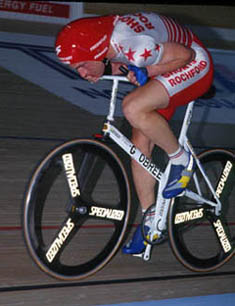
Graeme Obree (born 11 September 1965), nicknamed "the Flying Scotsman", after the famous steam locomotive, is a Scottish racing cyclist who twice broke the world hour record, in July 1993 and April 1994, and was the individual pursuit world champion in 1993 and 1995. He was known for his unusual riding positions and for the Old Faithful bicycle he built which included bearings from a washing machine. He joined a professional team in France but was fired before his first race. He also competed in the men's individual pursuit at the 1996 Summer Olympics.
Obree created some radical innovations in bicycle design and cycling positions, but had problems when the cycling authorities banned the riding positions his designs required. Obree is very open about living with bipolar disorder and depression, and the fact that he has attempted suicide three times. He used his experiences as a means of encouraging other sportspeople to talk about their own mental health.
His life and exploits have been dramatised in the 2006 film The Flying Scotsman and more recently in the documentary film Battle Mountain: Graeme Obree's Story, which follows his journey to Battle Mountain, Nevada to compete in the 2013 World Human Powered Speed Championships.
In March 2010, he was inducted into the Scottish Sports Hall of Fame.
Obree was born in Nuneaton, a large town in northern Warwickshire, England, but has lived almost all his life in Scotland and considers himself Scottish.
He attempted suicide in his teens by gassing himself. He was saved by his father, who had returned early from work.
An individual time triallist, his first race was a 10-mile time trial to which he turned up wearing shorts, an anorak and Doc Marten boots. He thought the start and finish were at the same place and stopped where he had started, 100 metres short of the end. He had started to change his clothes when officials told him to continue. He still finished in "about 30 minutes."
The bike shop that he ran failed and he decided the way out of his problems was to attack the world hour velodrome record. It had been held for nine years by Francesco Moser, at 51.151 kilometres. Obree said:
Hub AI
Graeme Obree AI simulator
(@Graeme Obree_simulator)
Graeme Obree
Graeme Obree (born 11 September 1965), nicknamed "the Flying Scotsman", after the famous steam locomotive, is a Scottish racing cyclist who twice broke the world hour record, in July 1993 and April 1994, and was the individual pursuit world champion in 1993 and 1995. He was known for his unusual riding positions and for the Old Faithful bicycle he built which included bearings from a washing machine. He joined a professional team in France but was fired before his first race. He also competed in the men's individual pursuit at the 1996 Summer Olympics.
Obree created some radical innovations in bicycle design and cycling positions, but had problems when the cycling authorities banned the riding positions his designs required. Obree is very open about living with bipolar disorder and depression, and the fact that he has attempted suicide three times. He used his experiences as a means of encouraging other sportspeople to talk about their own mental health.
His life and exploits have been dramatised in the 2006 film The Flying Scotsman and more recently in the documentary film Battle Mountain: Graeme Obree's Story, which follows his journey to Battle Mountain, Nevada to compete in the 2013 World Human Powered Speed Championships.
In March 2010, he was inducted into the Scottish Sports Hall of Fame.
Obree was born in Nuneaton, a large town in northern Warwickshire, England, but has lived almost all his life in Scotland and considers himself Scottish.
He attempted suicide in his teens by gassing himself. He was saved by his father, who had returned early from work.
An individual time triallist, his first race was a 10-mile time trial to which he turned up wearing shorts, an anorak and Doc Marten boots. He thought the start and finish were at the same place and stopped where he had started, 100 metres short of the end. He had started to change his clothes when officials told him to continue. He still finished in "about 30 minutes."
The bike shop that he ran failed and he decided the way out of his problems was to attack the world hour velodrome record. It had been held for nine years by Francesco Moser, at 51.151 kilometres. Obree said:
Recent media